For most retail investors, asset allocation means a simple split between equity and debt. For India’s high-net-worth individuals, that formula falls apart quickly. Asset allocation for HNI portfolios needs to account for higher tax brackets, concentrated business or real estate holdings, multi-generational goals and access to instruments most investors never encounter.
Once investable assets cross a meaningful threshold, the standard 60/40 approach simply isn’t enough. Every allocation decision now carries tax implications, liquidity trade-offs and legacy considerations that a smaller portfolio never has to weigh. This guide explains why HNI asset allocation looks different, how to structure a portfolio by purpose, and how allocation should evolve across life stages.
Why Asset Allocation Works Differently for HNIs
Retail investors typically optimize for one thing: returns. HNIs, on the other hand, must balance returns against tax efficiency, liquidity needs, capital protection and wealth transfer – often simultaneously. These goals frequently pull in different directions, which is why a structured, documented allocation framework matters far more than ad hoc decisions.
A few challenges unique to higher wealth levels:
- Higher effective tax rates – HNIs in top tax brackets with applicable surcharge can face significantly higher effective taxation than smaller investors, making every investment decision a tax decision too
- Concentration risk – Many HNIs hold the majority of their net worth in a single business or property, creating a structurally fragile position
- Liquidity complexity – Wealth spread across real estate, PMS and AIFs requires deliberate planning to meet near-term personal or business needs
- Succession pressure – Wealth must not only grow, but it must also transfer efficiently across generations without disputes or unnecessary tax leakage
Because of this, asset allocation for HNI portfolios needs a written policy rather than a loose collection of investments picked opportunistically.
A Purpose-Built Framework: Three Portfolio Buckets
One of the clearest ways to structure asset allocation for HNI wealth is to organize holdings into three purpose-driven buckets, each with a distinct role and time horizon.
Bucket 1: Growth
Purpose: Build wealth meaningfully above inflation. Horizon: 7+ years.
- Diversified equity mutual funds across market caps
- Portfolio Management Services (PMS) for larger equity allocations with customized stock selection
- Direct equity for investors with sector conviction and market experience
- Private equity or growth-stage AIFs for qualified investors
Bucket 2: Stability and Income
Purpose: Generate reliable income while protecting capital. Horizon: 3–7 years.
- High-quality debt mutual funds and bond funds
- REITs for exposure to commercial real estate income without direct ownership
- Gold, via ETFs or sovereign gold bonds, as an inflation hedge
- Government securities and top-rated corporate bonds for safety
Bucket 3: Alternatives and Hedging
Purpose: Capture non-correlated returns and add portfolio resilience. Horizon: Flexible, often longer lock-ins.
- International funds for currency diversification and developed-market exposure
- Private credit AIFs offering steady income with lower equity correlation
- Category III AIFs for sophisticated investors seeking hedge or arbitrage strategies
- Structured products designed for specific risk-return profiles
This bucket approach gives every holding a defined job, rather than treating the portfolio as a loose pile of products accumulated over time.
What a Balanced HNI Allocation Might Look Like
There is no universal formula, but a reasonable starting framework often looks roughly like this for a moderately risk-tolerant investor:
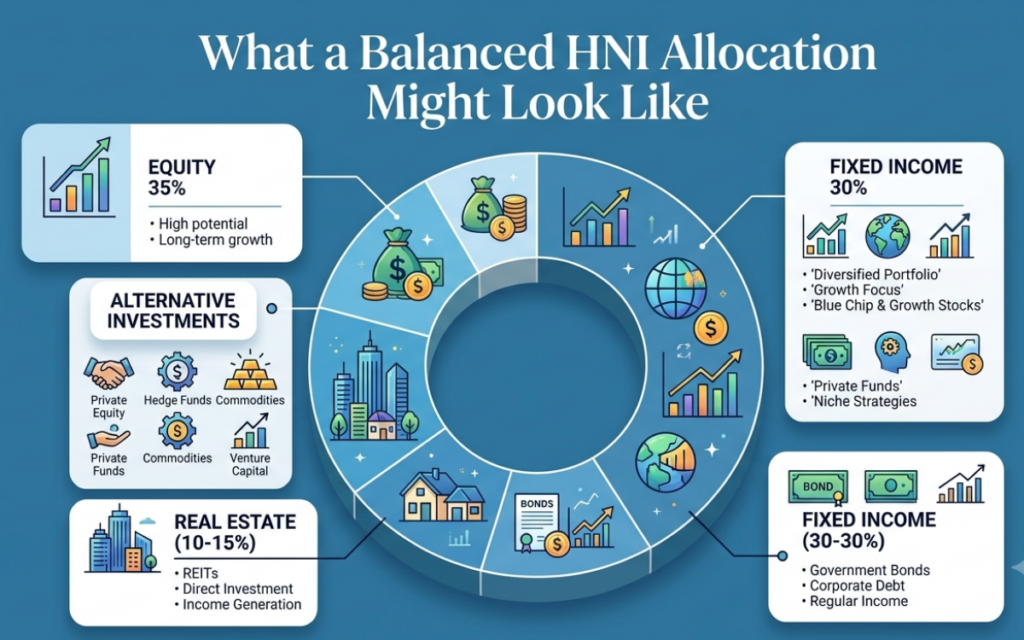
- Equity (funds, PMS, direct stocks): roughly 45–55% of the portfolio
- Debt and fixed income: roughly 20–25%
- Real estate and REITs: roughly 12–18%
- Gold: roughly 5–8%
- Alternatives (AIFs, private credit, private equity): roughly 7–12%
Conservative investors typically shift weight toward debt and gold, while aggressive investors lean further into equity and alternatives. The right mix always depends on income stability, existing concentration and personal risk tolerance, so these ranges should be treated as a starting reference rather than a fixed rule.
Asset Allocation for HNI Investors Across Life Stages
Allocation isn’t static. It should shift meaningfully as an investor moves through different phases of their financial life.
In peak earning years (typically 40s): Risk capacity is highest, and compounding has the most time to work. This is usually the window to build meaningful equity, PMS and AIF exposure while income supports aggressive contributions.
In the consolidation phase (typically 50s): Focus shifts toward balancing growth with stability. Many investors begin adding REITs, increasing debt exposure, and starting formal estate-planning conversations, often with estate-planning law firms to formalise succession structures.
In the preservation phase (typically 60s and beyond): Capital protection and income generation take priority. Systematic withdrawal strategies from debt instruments and REIT distributions often replace the growth-heavy approach used decades earlier.
Rebalancing Without Triggering Unnecessary Tax
Rebalancing keeps HNI portfolio allocations aligned with goals rather than wherever the market has drifted. Without it, a strong equity rally can silently push allocations from a moderate 50% equity weight toward 70%, creating concentration risk the investor never intended.
A few practices help rebalance efficiently:
- Review at least annually, or sooner if any asset class drifts more than 8–10% from its target
- Direct new inflows toward underweight asset classes first, rather than selling existing winners and triggering capital gains
- Use tax-loss harvesting during rebalancing to offset gains elsewhere in the portfolio
- Account for AIF lock-ins when planning liquidity, since these holdings can’t be rebalanced on demand like listed securities
Working with an accounting and tax advisory practice during rebalancing helps ensure capital gains and tax-loss harvesting decisions are optimized correctly each financial year.
Common Asset Allocation Mistakes HNIs Make
- Over-concentration in real estate or a single business, leaving the portfolio illiquid and tax-inefficient
- No written allocation policy, leading to reactive, sentiment-driven decisions instead of a documented strategy
- Ignoring alternatives altogether, missing diversification and return potential available at higher wealth levels
- Mixing insurance with investment through traditional endowment or ULIP products, which typically underperform as both
- Letting the portfolio go unreviewed for years, even as tax laws, market cycles and personal circumstances change significantly
Avoiding these mistakes requires discipline, not complexity. A written allocation policy, reviewed on a fixed schedule, prevents most of them entirely.
Practical Checklist for Building HNI Asset Allocation
- Document target allocations across equity, debt, real estate, gold and alternatives
- Match each holding’s time horizon to an actual financial goal
- Review and rebalance at least once a year, more often for complex portfolios
- Direct new capital toward underweight assets before selling existing holdings
- Coordinate tax planning and rebalancing timing with a qualified advisor
- Revisit allocation whenever a major life event or tax law change occurs
How SurgeAIO can help in terms of SEO
Just as asset allocation for HNI investors depends on structured, purpose-driven diversification, a wealth management firm’s digital presence depends on a deliberate mix of channels and content, rather than relying on a single traffic source.
SurgeAIO helps fintech and wealth management firms build organic visibility strategies suited to sophisticated, high-intent audiences. For firms operating in competitive B2B financial services, understanding top SEO platforms built for B2B audiences can help prioritize the right tools before scaling a strategy.
Every strong SEO strategy starts with a thorough competitive analysis of keywords to identify where prospective HNI clients are actually searching, followed by organic traffic strategies built to compound over time rather than deliver short-lived spikes. As search behavior shifts toward AI-driven discovery, understanding how to rank in AI Overviews has become just as important as traditional rankings.
Once live, ongoing success depends on tracking content performance and monitoring AI visibility metrics – the same disciplined, review-driven approach that keeps a well-diversified investment portfolio on track.
Final Thoughts
Asset allocation for HNI investors is not about picking the best-performing fund of the year. It’s about building a documented, purpose-driven structure that balances growth, income, protection and legacy transfer. By organizing holdings into clear buckets, rebalancing with tax efficiency in mind, and reviewing the strategy consistently as life stages change, high-net-worth investors can build portfolios resilient enough to support decades of financial goals.
Frequently Asked Questions
1. What is the ideal asset allocation for HNI investors in India?
There is no single ideal split. A balanced investor in their 40s might hold roughly 50% equity, 20–25% debt, 12–18% real estate or REITs, and the remainder in gold and alternatives. The right mix depends on age, income stability, risk tolerance and goals.
2. How much should HNIs allocate to alternative investments?
Many advisors suggest starting around 7–12% of the portfolio in alternatives such as AIFs and private credit, with this share potentially expanding as investable assets grow and liquidity needs are well understood.
3. How often should asset allocation be reviewed?
At minimum, once a year. Investors with complex holdings across PMS, AIFs and real estate often benefit from a mid-year check-in as well as a year-end rebalancing review.
4. Is PMS better than mutual funds for HNI asset allocation?
For larger equity allocations, PMS offers greater customization and direct stock ownership, while mutual funds remain useful for smaller allocations and asset classes where PMS doesn’t typically operate, such as international funds or gold ETFs.
5. What is the biggest asset allocation mistake HNIs make?
Over-concentration, most commonly in real estate or a single business, is one of the most frequent and damaging mistakes, since it limits liquidity and diversification even when overall net worth appears strong.
