
Wealth doesn’t grow by accident. It grows through deliberate structure, and nowhere is that more true than in portfolio diversification for HNI investors. For India’s high-net-worth individuals, spreading money across a few mutual funds is no longer enough. True diversification today spans asset classes, sectors, geographies and even strategies that were once reserved for institutions.
In India, an HNI is generally defined as someone holding significant investable assets – excluding a primary residence – that qualify them for specialized wealth management services. As this wealth grows, portfolio diversification for HNI investors becomes less about avoiding a single bad stock and more about engineering a resilient, multi-layered structure that can absorb shocks from any direction.
This guide explains why diversification looks different at the HNI level, which asset classes matter most, and how to build a portfolio that protects wealth while still capturing growth.
Why Diversification Looks Different for HNIs
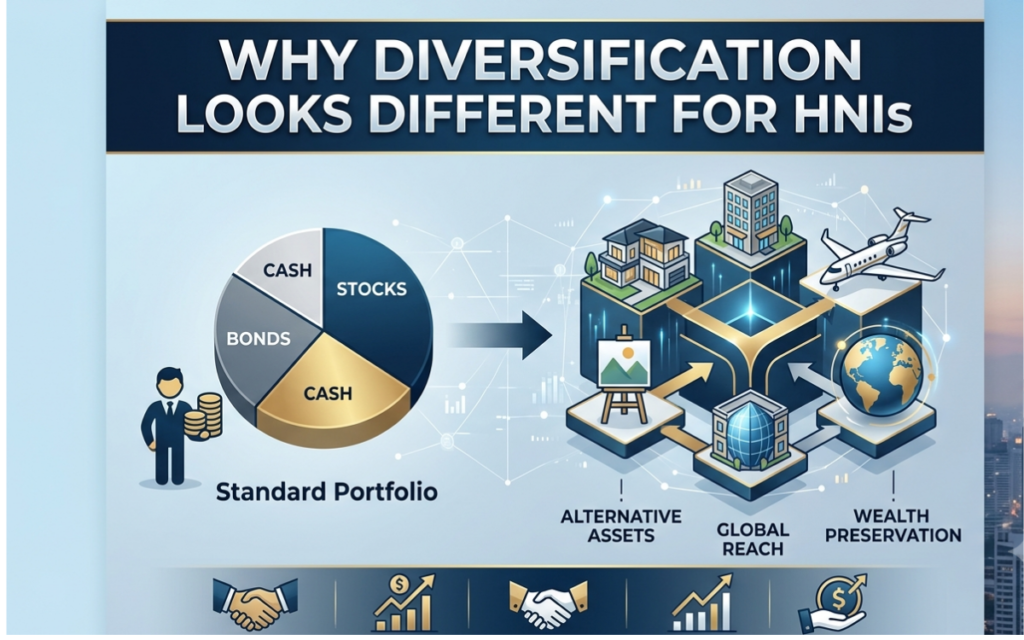
Most retail investors understand diversification as simple risk-spreading: a few equity funds, some gold, a fixed deposit. That logic works reasonably well at smaller wealth levels.
However, for HNIs managing significant capital, diversification becomes more deliberate and layered. It goes well beyond spreading money across a handful of standard products. Instead, portfolio diversification for HNI investors is purpose-driven – each allocation is chosen to play a specific role rather than simply adding another line item to the portfolio.
India’s wealthy population is also expanding quickly, which means competition for skilled portfolio managers and quality alternative investments is intensifying. This makes disciplined, purpose-built diversification more important than ever.
The Five-Part Framework Behind Modern HNI Portfolios
A typical affluent Indian portfolio today spreads capital across five broad components, each serving a distinct function:
- Equities – Long-term capital growth through direct stocks or professionally managed PMS strategies
- Debt instruments – Stability and predictable income
- Real estate – Inflation-linked growth, increasingly accessed through structured vehicles like REITs rather than direct ownership alone
- Gold – A stabiliser against currency volatility and macro uncertainty
- Alternative investments – Private equity, venture capital, AIFs and private credit for return profiles unavailable in public markets
This five-part structure has replaced the older two-pillar approach of equities and real estate alone. Each sleeve compounds capital, generates income, preserves purchasing power or captures private-market opportunity – rarely all four at once.
Why Alternative Investments Are Reshaping HNI Diversification
The most significant shift in portfolio diversification for HNI investors over the past decade has been the sharp rise in alternative investments. Alternative Investment Funds (AIFs) registered with SEBI have grown dramatically in number, and domestic HNIs and family offices now contribute the majority of capital flowing into these structures – a clear move away from historically offshore-dominated funding.
Within this space, private credit has emerged as a favoured addition to the income sleeve of HNI portfolios, offering floating-rate structures and regular cash flows that traditional fixed income cannot always match. Meanwhile, private equity and venture capital allocations give investors access to growth stories years before they reach public markets.
That said, alternatives come with trade-offs: longer lock-ins, limited liquidity and more complex valuation. Therefore, they should complement – not replace – a portfolio’s core holdings.
How Portfolio Management Services (PMS) Support Diversification
Unlike mutual funds, where portfolios are standardized and resources pooled across investors, PMS offers a highly personalized structure curated around an individual’s specific goals, risk appetite and time horizon. This flexibility allows PMS providers to build portfolios spanning niche markets, alternative assets and even global instruments.
PMS supports portfolio diversification for HNI clients across three dimensions:
- Multi-asset diversification – Spreading capital across equities, bonds, commodities and alternatives so no single asset class dominates
- Sectoral and geographic diversification – Allocating across industries like technology, pharmaceuticals and FMCG, and increasingly into global or emerging markets
- Niche and alternative diversification – Adding assets with low correlation to traditional stock market performance
Active portfolio managers also apply tactical asset allocation, shifting exposure toward stable instruments like bonds during volatile periods and rebalancing continuously rather than waiting for scheduled reviews. This is very different from the static nature of many standardized products.
Risk Management: The Other Half of Diversification
Diversification and risk management go hand in hand. For HNIs, protecting large amounts of capital matters just as much as growing it. A few techniques that support this:
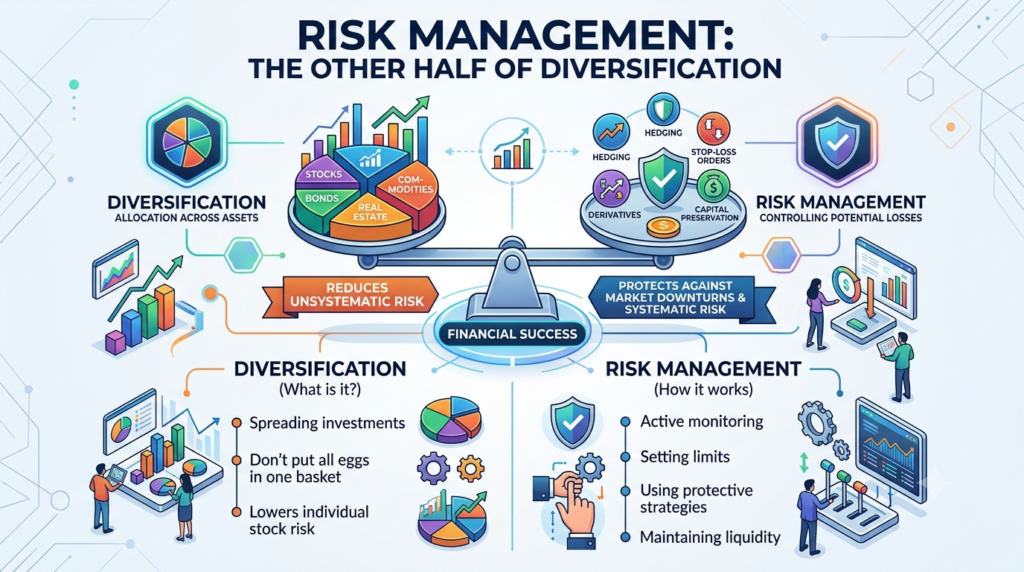
- Active rebalancing – Adjusting allocations as market conditions or economic indicators shift
- Downside hedging – Using derivatives, futures or options to insulate portfolios during market corrections
- Customized risk profiling – Building a portfolio around the investor’s specific comfort with volatility, rather than a generic model
- Tactical shifts – Increasing exposure to defensive assets temporarily during periods of heightened uncertainty
Ultimately, the goal isn’t to eliminate risk. It’s to avoid dependence on any single source of returns, so that one weak asset class doesn’t derail the entire portfolio.
Common Mistakes HNIs Make With Diversification
Even sophisticated investors misstep when building diversified portfolios. Common errors include:
- Treating alternative investments as a status symbol rather than a genuine portfolio need
- Over-concentrating in real estate or a single family business
- Assuming diversification alone eliminates risk without checking correlation between assets
- Ignoring liquidity needs when locking capital into long-tenure AIFs or private credit
- Reviewing the portfolio only during downturns instead of on a consistent schedule
Avoiding these mistakes requires consolidated visibility across every holding. As portfolios grow more complex – spanning listed securities, PMS strategies, mutual funds, AIFs, private credit, and real estate – a single, real-time view of the full picture becomes essential to knowing whether the mix still matches long-term goals.
Building a Diversified HNI Portfolio: A Practical Checklist
- Define what each portfolio sleeve is meant to achieve – growth, income, stability or private-market access
- Set target allocations across equity, debt, real estate, gold and alternatives
- Evaluate liquidity needs before committing to long lock-in alternative investments
- Choose PMS or fund managers with a track record across full market cycles, not just recent gains
- Rebalance periodically rather than only during market stress
- Maintain a consolidated view of all holdings to track overall risk exposure
How SurgeAIO can help in terms of SEO
Just as portfolio diversification for HNI investors depends on spreading exposure across the right asset classes, a wealth management or PMS firm’s digital presence depends on spreading visibility across the right search terms and channels.
SurgeAIO helps fintech and wealth management firms build a diversified, sustainable organic growth strategy rather than relying on a single traffic source. Firms offering allied services, such as accounting and tax advisory practices alongside investment planning, can strengthen their combined visibility across related search intent.
Building this kind of strategy starts with a thorough competitive analysis of keywords to identify where prospective HNI clients are actually searching. From there, organic traffic strategies built for complex, considered-purchase industries help sustain long-term growth rather than short-lived spikes. As AI-driven search reshapes discovery, understanding how to rank in AI Overviews is becoming just as important as traditional rankings.
Once a strategy is live, ongoing success depends on tracking content performance, monitoring AI visibility metrics, and understanding how many backlinks are actually needed to build authority – the same disciplined, data-driven approach that underpins a well-diversified investment portfolio. Firms working closely with mortgage and lending advisors as part of a client’s broader financial ecosystem often find cross-topical SEO strategy particularly effective too.
Final Thoughts
Portfolio diversification for HNI investors has evolved far beyond the traditional equity-debt-gold mix. Today’s most resilient portfolios combine public markets, private markets, real assets and active risk management into one coherent, purpose-built structure. By understanding each asset class’s role and reviewing allocations consistently, high-net-worth investors can build portfolios strong enough to weather volatility while still capturing long-term growth.
Frequently Asked Questions
1. What makes portfolio diversification for HNI investors different from regular diversification?
HNI diversification is more layered, spanning private markets, structured credit and global instruments, not just standard equity and debt mixes. It is purpose-driven, with each allocation serving a specific role rather than simply spreading risk.
2. How much should an HNI allocate to alternative investments?
There is no fixed percentage. It depends on liquidity needs, existing exposures, risk tolerance and time horizon. Some investors treat alternatives as a smaller satellite allocation; others with longer horizons allocate more meaningfully.
3. Is real estate still important for HNI portfolio diversification?
Yes, but the format is evolving. Many HNIs are shifting toward structured vehicles like REITs and real estate AIFs alongside, or instead of, direct property ownership for better liquidity and transparency.
4. How often should a diversified HNI portfolio be reviewed?
At least annually, with more frequent reviews during periods of significant market movement, tax law changes or major life events.
5. Does diversification guarantee protection from losses?
No. Diversification reduces dependence on any single asset or market, but it does not eliminate risk. Proper risk management techniques, such as hedging and tactical rebalancing, work alongside diversification for full protection.
