I am the Growth Head at SurgeAIo, where I oversee performance and conversion strategies for the brands we partner with. My role focuses on driving measurable results, optimizing campaigns, and ensuring sustainable growth. I work closely with teams to align marketing efforts with business objectives, leveraging data-driven insights to maximize ROI and client success.
Search engine optimization (SEO) is evolving fast, and artificial intelligence (AI) is at the heart of this transformation.
From Google’s Search Generative Experience (SGE) to AI-powered assistants reshaping how people ask questions, SEO strategies must now adapt to an AI-first search landscape.
But what really matters for SEO in the age of AI? Let’s break down the foundational elements you need to understand and implement if you want your content to stay visible and competitive.
Understanding Search Intent in the Age of AI
Why Intent Matters More Than Ever
In traditional SEO, keywords were the main driver of visibility. But AI has shifted the focus from keywords to intent.
Search engines are getting better at understanding the why behind a query, whether a user is looking to buy, learn, compare, or solve a specific problem.
For example, a search for “best DSLR cameras” signals comparison intent, while “buy Canon EOS R10” clearly shows transactional intent.
AI-powered algorithms can detect this nuance better than ever before, and they tailor the results (and even generate summaries) to meet that intent directly.
If your content doesn’t match the user’s purpose, it simply won’t surface, even if you’ve nailed the keywords.
Aligning Content with AI-Powered Search Behaviors
To succeed in AI-driven search, start with user journey mapping. Ask:
What stage of the buying or learning process is the user in?
What questions might they ask before and after this one?
How might they phrase that query in natural language?
Searchers today are using longer, more conversational queries. Thanks to AI tools and voice assistants, people are searching like they speak: “What’s the best camera for travel photography under $1000?” rather than “best travel camera.”
Align your content with this behavior. Instead of stuffing in keywords, create helpful content that naturally addresses the full scope of the user’s intent.
Quality Content That Serves the User
AI has increased competition for attention, and mediocre content won’t cut it. In fact, Google’s Helpful Content Updates (and similar AI-powered ranking systems) are explicitly built to filter out low-value content.
Here’s how to make yours stand out:
Natural Language & Conversational Keywords
AI understands context better than ever, so the days of awkward keyword stuffing are over. Instead, aim for natural, conversational writing that mirrors how people talk and search.
Example:
Keyword-stuffed: “Our travel cameras for travel photography are the best travel cameras for travel.”
Natural language: “If you’re looking for a camera that’s light, powerful, and ideal for travel photography, here are some great options under $1000.”
Use tools like Google’s “People Also Ask,” Reddit, Quora, and AI-powered keyword research platforms to find real user questions and phrasing. Then, mirror that tone in your content.
Answering Questions Directly (Featured Snippets, AI Summaries)
AI-generated answers and featured snippets pull content directly from well-structured pages. If your content isn’t concise, clear, and question-focused, it’s less likely to be used in these high-visibility areas.
Tips to get featured or summarized:
Use H2s and H3s to phrase common questions.
Provide concise, direct answers immediately below those headings.
Use bullet points, tables, and short paragraphs for clarity.
Example:
What’s the best camera for beginners under $500? Many beginner photographers prefer the Canon EOS Rebel T7. It offers a simple interface, solid image quality, and a price under $500.
Google may pull this answer for a snippet, or an AI summary, because it’s clear, useful, and structured.
Structured Content: Headings, Lists, and Summaries
AI favors content that’s easy to parse and understand. That means structure is more important than ever.
Best practices:
Use clear headings (H1, H2, H3) to signal hierarchy and context.
Break up content into digestible sections using lists, bullets, and bolded key phrases.
Include a summary or TL;DR at the top or bottom of the page.
Search engines often scan for these formatting cues to better understand and extract content. A clean structure not only helps SEO, it keeps readers engaged.
Technical SEO + AI Enhancements
While content and intent are crucial, the technical foundation of your site is what allows AI-powered search engines to access, understand, and rank your pages effectively.
Schema Markup and Structured Data
Structured data (like schema markup) helps search engines make sense of your content, and it’s even more important in the AI era. Schema provides context: is this a product? A recipe? An FAQ? AI needs this clarity to generate relevant summaries and display rich results.
Common schemas that boost visibility:
FAQ Page – Increases chance of featured snippets
Product – Enables rich product information in results
HowTo – Shows step-by-step guides directly in SERPs
Article – Helps Google News and AI summaries pull key info
Tools like Google’s Rich Results Test can confirm if your schema is implemented correctly.
AI systems prioritize performance. If your site is slow or hard to navigate, your content may never reach the top, regardless of quality.
Key areas to optimize:
Mobile-first design: Google indexes mobile versions by default.
Core Web Vitals: Improve loading speed, interactivity, and visual stability.
Crawlability: Use a clean URL structure, sitemap, and robots.txt to ensure AI can easily explore your site.
Google’s PageSpeed Insights and Search Console are your best friends here.
Optimized Meta Tags for AI Snippets
AI uses title tags, meta descriptions, and OG tags to understand and summarize content quickly.
Best practices:
Keep title tags under 60 characters and relevant to search intent.
Use meta descriptions (150–160 characters) to concisely describe what the page offers.
Include a conversational tone and key questions/answers AI might pull into summaries.
Think of your meta tags as your “elevator pitch” to both users and machines.
Strategic Use of Links
Links still play a powerful role in SEO, but in the AI age, it’s not just about quantity. Context and quality are more important than ever.
Internal Linking for Context and Crawlability
A smart internal linking strategy helps AI understand site structure and content relationships.
Link related articles to build topic clusters.
Use descriptive anchor text that reflects the linked page’s intent.
Create pillar pages that organize content around a central topic.
This not only improves crawlability but also builds semantic relationships between pages, helping AI systems interpret your site’s expertise.
Ethical Backlink Building with AI Insights
AI tools can now analyze backlink profiles for quality, not just volume. Spamming backlinks from low-authority sites? That’s a red flag.
Instead:
Use AI SEO platforms (like Clearscope or Surfer) to identify which types of links your competitors earn.
Create high-value, shareable content like research, infographics, or tools that naturally attract backlinks.
Reach out to industry blogs or media with personalized pitches informed by AI insights (e.g., relevance scores, topic fit).
Maintaining a Strong Domain Authority
AI-powered search engines may not use Moz’s “Domain Authority” directly, but they do evaluate credibility and trustworthiness.
To maintain a strong domain:
Avoid spammy link schemes
Keep your site’s technical health in check
Regularly update outdated content
Earn mentions from reputable sources (PR + guest posts help)
Over time, this builds a strong reputation that AI and users both recognize.
Leveraging AI Tools for Smarter SEO
AI isn’t just changing search, it’s also giving SEOs powerful tools to make smarter, faster decisions. Leveraging these tools can give you a strategic edge.
AI Keyword Clustering & Content Gaps
Old-school keyword research focused on search volume. AI-driven research focuses on intent clusters.
Use tools like MarketMuse, Surfer, or ChatGPT to:
Group keywords by topic and user journey stage
Identify content gaps where your competitors are ranking and you aren’t
Plan content based on semantically related terms, not just single phrases
This ensures your site covers full topics comprehensively, something AI values highly.
Predictive Performance Analytics
AI analytics tools (like Google’s Performance Max or predictive GA4 dashboards) can now forecast:
Which content will perform based on trends
Which pages are likely to drop in rankings soon
Where user engagement is lagging
By analyzing historical patterns and real-time data, these tools allow you to optimize before rankings dip or before competitors catch up.
Real-Time SEO Adjustments Based on AI Trends
AI doesn’t just help you analyze, it can help you act.
Some SEO tools now offer real-time optimization suggestions based on search trends and algorithm shifts. Examples:
Adjusting content length or keyword density based on real-time competitor analysis
Modifying meta descriptions based on new SERP layouts
Surfacing new “People Also Ask” questions to target
Staying agile is key. SEO in 2025 isn’t about set-and-forget, it’s about monitoring, iterating, and responding quickly with the help of AI.
Best Practices for Human + AI SEO Strategy
As AI becomes more deeply integrated into content creation and optimization, striking the right balance between automation and authenticity is essential. AI can dramatically improve SEO scalability, but only if it’s guided with intention, oversight, and a strong ethical foundation.
Keep AI Outputs Aligned with Brand Voice
AI can help speed up content production, generate outlines, and even draft entire articles. But one major risk is losing your unique brand voice in the process.
Best practices:
Train your AI tools (or prompt them effectively) to match your tone, whether it’s formal, conversational, witty, or technical.
Create brand voice guidelines for your team and any AI tools you use.
Avoid generic, overly templated AI content that “feels” robotic. Audiences and search engines both recognize it.
Your brand voice is a key differentiator. AI should amplify it, not replace it.
Prioritize Editorial Oversight
AI can generate content fast, but quality, accuracy, and nuance still need a human touch.
Maintain editorial review processes to:
Fact-check AI-generated information
Ensure ethical and inclusive language
Refine clarity, flow, and alignment with user intent
This step is non-negotiable if you want to maintain credibility, rank well, and avoid penalties from search engines that are cracking down on low-effort AI content.
Monitor Compliance with Search Engine Guidelines
Search engines like Google are transparent: AI content is fine, as long as it’s helpful, accurate, and not manipulative. But blindly publishing AI content without review can put your SEO at risk.
Keep your strategy compliant by:
Staying up to date with Google’s guidelines on AI-generated content
Avoiding auto-generated spam, doorway pages, or deceptive practices
Using tools like Google Search Console and third-party SEO audits to monitor site health
Treat AI as a tool, not a loophole, and you’ll stay on the right side of both search engines and your audience.
Conclusion
AI is not a shortcut to SEO success, but it’s an incredible accelerator when used responsibly.
The future of SEO lies in blending human creativity with AI efficiency to create content that is insightful, structured, and aligned with user needs.
I am the Growth Head at SurgeAIo, where I oversee performance and conversion strategies for the brands we partner with. My role focuses on driving measurable results, optimizing campaigns, and ensuring sustainable growth. I work closely with teams to align marketing efforts with business objectives, leveraging data-driven insights to maximize ROI and client success.
Remember when getting someone to click on your website was the ultimate victory? Well, plot twist: zero-click searches now dominate the search landscape with 58.5% of Google searches in the US ending without a click, reaching 65% globally in 2024 and projected to exceed 70% by 2025. Welcome to the age of Answer Engine Optimization (AEO), where your content needs to be so good that AI systems want to quote it directly.
What exactly is Answer Engine Optimization? Think of AEO as SEO’s highly intelligent cousin who went to graduate school and learned multiple languages. While traditional SEO focuses on getting your content to rank high in search results, AEO optimizes your content to appear directly in AI-generated answers across platforms like:
• ChatGPT (with live browsing capabilities)
• Google AI Overviews (powered by Gemini)
• Microsoft Copilot • Perplexity
• Claude
• Meta AI
The shift is profound and immediate. As one industry expert recently noted, “We’re not just competing for clicks anymore—we’re competing to become the authoritative source that AI systems trust enough to cite.” This isn’t hyperbole; it’s the new reality of digital marketing.
Why does AEO matter right now? The numbers tell a compelling story. About 80% of consumers now rely on “zero-click” results in at least 40% of their searches, reducing organic web traffic by an estimated 15% to 25%. But here’s the kicker—this isn’t necessarily bad news. It’s evolution, and those who adapt first will thrive.
The platforms driving this change aren’t just search engines anymore; they’re answer engines. Users ask questions in natural language and expect comprehensive, accurate responses without having to hunt through multiple websites. It’s convenience culture meets artificial intelligence, and the result is a fundamental shift in how information is discovered and consumed.
What makes this shift different from previous SEO changes? Unlike past algorithm updates that tweaked ranking factors, AEO represents a complete paradigm shift. We’re moving from a click-based economy to a citation-based one, where being quoted accurately by AI systems can be more valuable than traditional traffic metrics.
Why AEO Is Essential in 2025: The Numbers Don’t Lie
Let’s cut straight to the data, because in digital marketing, numbers are the ultimate truth-tellers. The statistics around zero-click searches and AI adoption paint a picture that’s impossible to ignore.
The Zero-Click Revolution
The most striking trend? 40.3% of U.S. Google searchers clicked on an organic result in March, which was down from 44.2% the prior year. 43.5% of EU/UK Google searchers clicked on an organic result in March 2025 versus 47.10% in March 2024. That’s not just a dip—that’s a fundamental behavioral shift happening in real-time.
But wait, there’s more (as they say in those late-night infomercials, except this data is actually useful). A study from SparkTaro found that zero-click searches accounted for nearly 60% of Google searches ending without a click in 2024. If current trends continue, we’re looking at a future where the majority of search interactions never leave the search results page.
Platform
Zero-Click Rate (2024)
Projected 2025
Traffic Impact
Google US
58.5%
70%+
-15% to -25% organic traffic
Google EU/UK
65%
72%+
-20% to -30% organic traffic
AI Chat Tools
85%+
90%+
Entirely new traffic source
Industry Case Studies: The Good, The Bad, and The Adaptive
Here’s where it gets interesting (and where smart marketers start taking notes). Of the top 100 search keywords driving traffic to People’s site, 40 triggered AI Overviews in May 2025. That number was 32 for the Daily Mail, 21 for The Washington Post and 20 for the New York Post.
The Plot Twist: Companies that have optimized for AEO aren’t just surviving this shift—they’re thriving. Early adopters report:
• Brand Authority Boost: Being cited by AI systems positions brands as trusted sources
• Quality Traffic Increase: Users who do click through from AI references show higher engagement
• Competitive Advantage: Less competition in AEO space compared to traditional SEO
• Future-Proofing: Building relationships with AI systems before competitors catch on
Distinguishing AEO from Its Digital Marketing Cousins
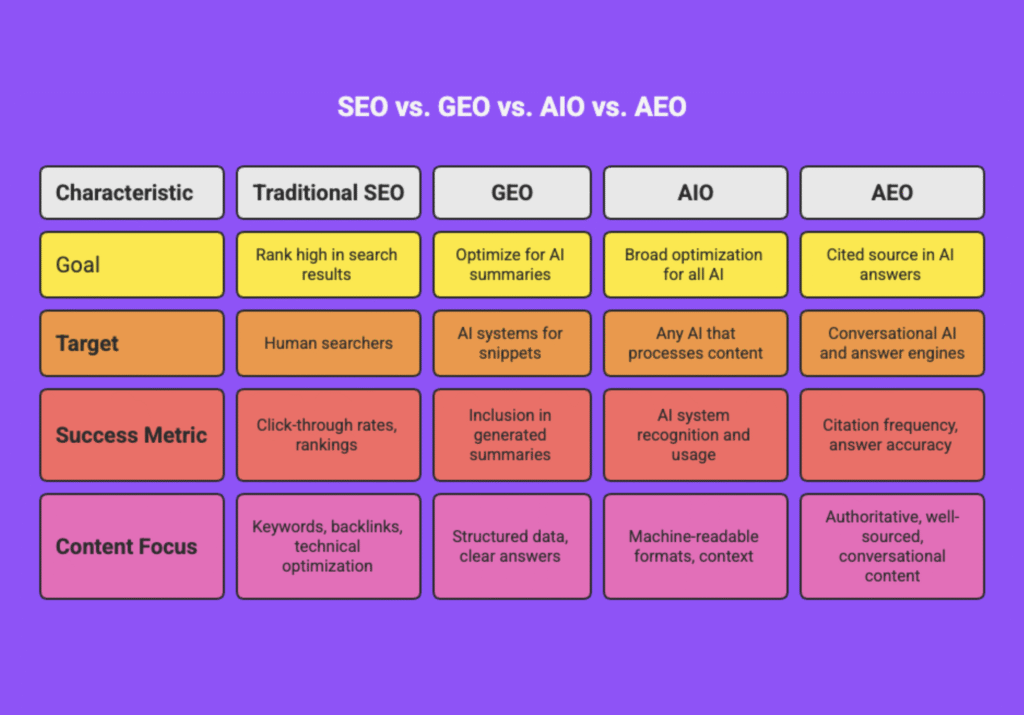
Let’s clear up the alphabet soup of modern search optimization. Here’s how AEO differs from its relatives:
Think of it this way: SEO is like optimizing your résumé for HR managers, while AEO is like optimizing it for an AI recruiter who needs to explain to humans why you’re the perfect candidate. The AI doesn’t just need to find you—it needs to confidently recommend you.
The Bottom Line Question: Are you ready to shift from fighting for clicks to earning citations? Because ready or not, the answer engine era is here, and the early adopters are already building their competitive moats.
How AI Answer Engines Work: Behind the Digital Curtain
Ever wondered how AI systems decide which sources to trust when answering your questions? It’s not magic (though it might seem like it)—it’s a sophisticated process called Retrieval-Augmented Generation, or RAG for those who love acronyms as much as marketers do.
The RAG Revolution: Why AI Systems Need External Sources
Here’s the thing about large language models: they’re brilliant at understanding patterns and generating human-like text, but they’re trained on fixed datasets. It’s like having a very smart friend who went to an excellent university but graduated in 2021 and hasn’t read the news since. RAG redirects the LLM to retrieve relevant information from authoritative, pre-determined knowledge sources. Organizations have greater control over the generated text output, and users gain insights into how the LLM generates the response.
The RAG Process in Simple Terms:
User asks a question (“What’s the latest trend in digital marketing?”)
Retrieval system searches external sources for relevant information
AI system combines its training with retrieved information
Generated answer includes both AI knowledge and current data
Citations provided so users can verify information
Retrieval-augmented generation gives models sources they can cite, like footnotes in a research paper, so users can check any claims. That builds trust. And trust, as we all know, is the currency of the internet age.
How Different Answer Engines Select Content
Not all AI systems are created equal, and understanding their unique approaches is crucial for AEO success. Let’s break down the major players:
ChatGPT (Live Web Browsing)
Selection Criteria:
• Recency: Prioritizes fresh, up-to-date information
• Authority: Favors established domains and expert sources
• Relevance: Matches query intent with high precision
• Featured Snippet History: Content that previously appeared in snippets
• User Behavior: Pages with high engagement and low bounce rates
• Structured Data: Proper schema markup and organization
Industry Insight: Between January and March 2025, zero-click behavior among these queries actually declined slightly—challenging the assumption that AI Overviews always reduce clicks. This suggests Google is still fine-tuning the balance between information and traffic.
Microsoft Copilot
Selection Criteria:
• Microsoft Ecosystem: Integration with Office, LinkedIn, and Bing data
• Professional Sources: Emphasis on business and professional content
• Multi-modal Content: Images, videos, and interactive elements
• Real-time Data: Live information from news and financial sources
Perplexity
Selection Criteria:
• Academic Sources: Strong preference for research papers and journals
• Fact-checking: Cross-references multiple sources for accuracy
• Context Preservation: Maintains conversation flow and relevance
• Safety First: Avoids controversial or potentially harmful sources
Meta AI
Selection Criteria:
• Social Signals: Content with high social media engagement
• Visual Elements: Images and multimedia content
• Trending Topics: Current conversations and viral content
• User Preferences: Personalized based on social graph data
The Technical Magic: How RAG Actually Works
RAG takes an input and retrieves a set of relevant/supporting documents given a source (e.g., Wikipedia). The documents are concatenated as context with the original input prompt and fed to the text generator which produces the final output.
Think of it like this: if traditional AI is like a knowledgeable professor giving a lecture from memory, RAG is like that same professor with access to a library, research assistants, and real-time data feeds. The professor (AI) is still brilliant, but now they can provide citations and current information.
The AEO Implications: • Authority Matters More: AI systems prefer established, credible sources • Structure Wins: Well-organized content is easier for AI to parse and cite • Freshness Counts: Recent content often gets priority for time-sensitive queries • Context is King: Content that provides comprehensive context performs better
Questions to Ponder:
How might your content strategy change if you knew AI systems valued depth over breadth?
What would happen if you optimized for AI comprehension rather than human scanning?
Could the future of content be less about attracting humans and more about teaching machines?
The answer engine revolution isn’t just changing how we search—it’s fundamentally altering how we create, structure, and distribute information. And the companies that understand this shift first? They’re the ones who’ll be quoted, cited, and trusted in the age of AI-mediated information discovery.
Core Principles of AEO: The Four Pillars of Answer Engine Success
Think of AEO as building a house for AI systems to live in comfortably. You wouldn’t put furniture in random rooms and expect guests to feel at home, would you? The same logic applies to content optimization—AI answer engines need structure, clarity, and trust signals to confidently cite your content.
Conversational Q&A Format: Speaking AI’s Language
Why do natural-language questions matter so much in AEO? Simple: AI systems are trained on conversational data. When your content mirrors how people actually ask questions, you’re essentially speaking their native language.
Traditional SEO content might target “best CRM software 2025,” but AEO-optimized content addresses “What is the best CRM software for small businesses in 2025?” The difference isn’t just semantic—it’s strategic.
The AEO Q&A Formula:
• Question as H2 heading: Use the exact phrasing people search with
• Immediate answer paragraph: 30-60 words that directly answer the question
• Supporting depth: Bullet points, examples, and context that expand the answer
• Related questions: Address follow-up queries in the same section
Here’s what this looks like in practice:
Instead of: “2025 Email Marketing Trends” Use: “What are the most effective email marketing trends in 2025?”
Instead of: “Social Media ROI Calculation” Use: “How do you calculate ROI for social media marketing campaigns?”
The magic happens when AI systems can easily extract your direct answer while having access to comprehensive supporting information. It’s like providing a quick summary for busy executives while keeping detailed appendices for those who want to dig deeper.
Pro Tip: Place a 30-60-word direct answer immediately below each H2 question. Support it with bulleted detail, visuals and internal links. This structure makes it incredibly easy for AI systems to extract and cite your content confidently.
Structured Data & Semantic Markup: The AI GPS System
If conversational content is speaking AI’s language, structured data is providing the GPS coordinates. Schema markup is a form of structured data. You add it to your HTML. This improves how your page is represented in search results.
Essential Schema Types for AEO Success:
FAQ Schema (schema.org/FAQPage)
• Perfect for question-and-answer content
• Enables rich snippets in search results
• Helps AI systems understand content structure
• A FAQPage is a WebPage presenting one or more “Frequently asked questions”
Q&A Schema (schema.org/QAPage)
• Ideal for community-driven content
• Distinguishes between questions and accepted answers
• Supports multiple answer formats
HowTo Schema (schema.org/HowTo)
• Perfect for step-by-step guides
• Includes tools, materials, and time estimates
• Appears in voice search results frequently
Article Schema (schema.org/Article)
• Establishes content authority and freshness
• Includes author information and publication dates • Supports rich media elements
Schema Type
Best For
AEO Impact
Implementation Difficulty
FAQ
Q&A content
High
Easy
HowTo
Step-by-step guides
Very High
Medium
Article
Long-form content
Medium
Easy
Product
E-commerce
High
Hard
Review
Opinion content
Medium
Medium
The Technical Sweet Spot: The ultimate aim of this code integration is to enable search engines to crawl and understand your content better. But here’s the thing—you don’t need to be a coding wizard. Most modern CMS platforms offer plugins that handle the heavy lifting.
Quick Implementation Checklist: • Use JSON-LD format (Google’s preference) • Test markup with Google’s Rich Results Test • Include required properties for each schema type • Keep markup current with content updates • Monitor performance in Google Search Console
Trusted Content & Authority Signals: Building AI Confidence
AI systems are naturally cautious—they don’t want to cite information that could damage their credibility. That’s why authority signals are crucial for AEO success. Think of it as building a reputation that AI systems can stake their own reputation on.
The Authority Stack:
Expert Author Credentials
• Detailed author bios with relevant expertise
• Professional headshots and contact information
• Links to social profiles and professional credentials
• Track record of industry recognition
External Citations and Data
• Reference authoritative sources (universities, government agencies, industry leaders)
• Link to original research and studies
• Include publication dates and source credibility indicators
• Use diverse source types (academic, industry, news)
Trust Badges and Signals
• Professional associations and certifications
• Awards and industry recognition
• Client testimonials and case studies
• Media mentions and press coverage
First-Hand Experience Indicators
• Case studies from your own work
• Screenshots and behind-the-scenes content
• Personal insights and lessons learned
• Results and outcomes from real implementations
The E-E-A-T Formula for AEO:
Experience: Demonstrate hands-on knowledge
Expertise: Show deep subject matter understanding
Authoritativeness: Build industry recognition
Trustworthiness: Maintain accuracy and transparency
Real-World Example: A marketing agency writing about Facebook advertising should include their actual ad spend data, screenshots of successful campaigns, client case studies, and author credentials showing Facebook Blueprint certifications. AI systems love this level of verifiable authority.
Topical Depth + Related Question Clusters: The Authority Web
A topic in AEO is a cluster of many questions with a similar search intent. To target questions in AEO, you can create single pages that fulfill the intent of many similar questions.
This is where AEO diverges most dramatically from traditional SEO. Instead of targeting individual keywords, you’re building comprehensive topic maps that address entire question families.
• “What are the benefits of automated email campaigns?”
• “Which email automation tools are best for small businesses?”
• “How much does email marketing automation cost?”
• “What are common email automation mistakes to avoid?”
The Pillar + Cluster Model for AEO: This involves creating a central “pillar” page for a broad topic, supported by multiple “cluster” content pieces that delve into specific sub-topics, all interlinked.
Implementation Framework:
Identify Core Topic: Broad subject with high search interest
Map Question Variations: Use tools like AnswerThePublic, AlsoAsked
Create Pillar Content: Comprehensive guide addressing main topic
Develop Cluster Content: Detailed pages for specific sub-questions
Interlink Strategically: Connect related content with contextual links
Update Regularly: Keep content fresh and expand based on new questions
The Competitive Advantage: While competitors chase individual keywords, you’re building topical authority that AI systems recognize and reward. Topical authority is the focus keyphrase for sustainable SEO success, improving brand visibility and trust in 2025.
Questions to Consider:
How many related questions could you answer comprehensively on a single page?
What would happen if AI systems viewed your content as the definitive resource on a topic?
Could building question clusters give you a sustainable competitive advantage over keyword-focused competitors?
Tactical AEO Framework: Your Step-by-Step Battle Plan
Ready to stop theorizing and start optimizing? This tactical framework is designed for immediate implementation—no PhD in computer science required, just systematic execution and a willingness to think differently about content strategy.
Step 1: Identify and Cluster User Intent/Question Sets
The Foundation Question: What exactly are people asking AI systems about your industry, and how are those questions related?
AEO-focused topic research differs significantly from traditional approaches, emphasizing questions or prompts and conversational phrases over short keyword strings. This shift requires new tools and methodologies.
Your Question Mining Toolkit:
Primary Research Tools:
• AnswerThePublic: Visual question maps for any topic
• AlsoAsked: “People also ask” data expansion
• Quora/Reddit: Real user questions and pain points
• Your customer service logs: Actual questions people ask
• Site search data: What visitors search for on your site
Tools like AnswerThePublic, AlsoAsked, and Quora are critical for identifying trending questions and mapping user intent. These platforms extract commonly searched queries related to your topic and visually organize them based on prepositions, comparisons, and alphabetical keywords.
Advanced Intelligence Gathering:
• ChatGPT Prompt: “What are the 20 most common questions people ask about [your topic]?”
• Claude Analysis: “Analyze these questions and group them by user intent”
• Perplexity Research: “What questions do businesses typically have about [industry topic]?”
Question Clustering Matrix:
Intent Type
Question Examples
Content Format
Priority Level
Informational
“What is…?” “How does…?”
FAQ, Guides
High
Commercial
“Best…?” “Compare…?”
Reviews, Lists
Very High
Navigational
“Where to find…?”
Directory, Links
Medium
Transactional
“How to buy…?”
Product pages
High
The 3-Tier Clustering Approach:
Primary Clusters: Main topic areas (5-10 clusters)
Secondary Questions: Related sub-topics (10-20 per cluster)
Long-tail Variations: Specific scenarios (unlimited)
Step 2: Craft Micro-Answers (50-160 Characters)
This is where AEO gets surgical. Place a 30-60-word direct answer immediately below each H2 question. But for snippet optimization, you need even more precision.
The Micro-Answer Formula:
• 50-80 characters: For voice search optimization
• 80-120 characters: For featured snippets
• 120-160 characters: For AI overview inclusion
Example Transformations:
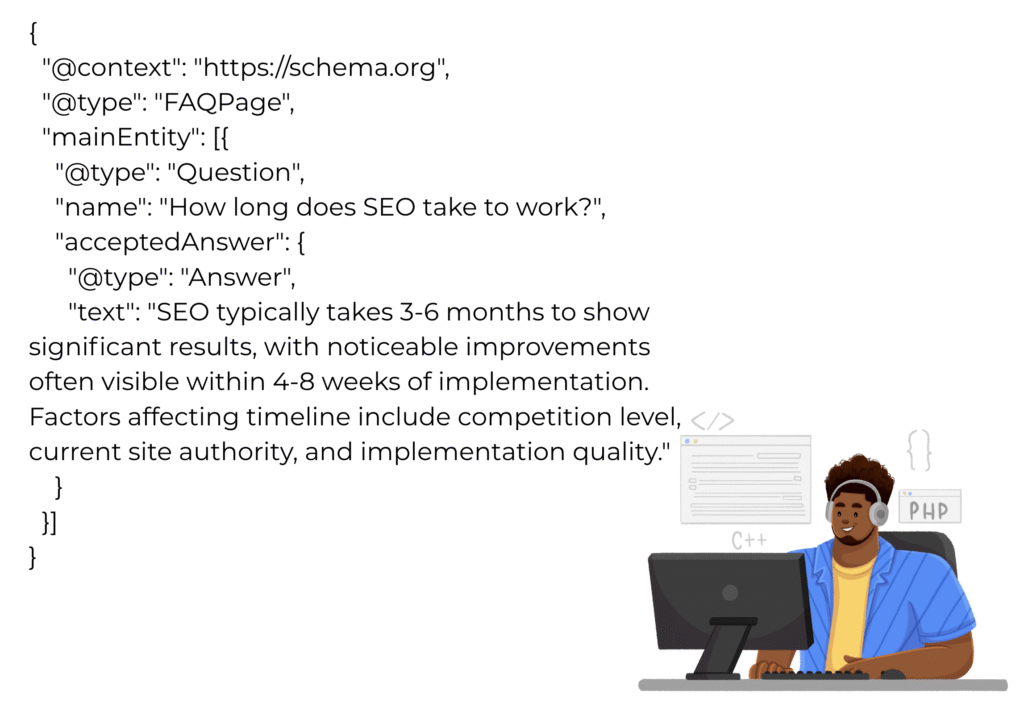
Question: “How long does SEO take to work?” Micro-Answer: “SEO typically takes 3-6 months to show significant results, with noticeable improvements often visible within 4-8 weeks of implementation.” Character Count: 156 characters
Question: “What is the best email marketing platform?” Micro-Answer: “Mailchimp leads for beginners, while ConvertKit serves creators best. Enterprise businesses prefer Salesforce or HubSpot for advanced features.” Character Count: 158 characters
The Science Behind Micro-Answers:
• Cognitive Load Theory: Humans process information better in chunks
• AI Processing: Shorter answers are easier for AI to extract and verify
• Voice Search: Concise responses work better for spoken results
• Mobile Optimization: Limited screen space requires brevity
Quality Control Checklist for Micro-Answers:
✓ Directly answers the question asked
✓ Includes specific, actionable information
✓ Uses natural, conversational language
✓ Contains no promotional language
✓ Can stand alone as a complete thought
Step 3: Organize Content into Q&A Blocks with Structured Markup
Think of this as creating a perfectly organized filing system that both humans and AI systems can navigate effortlessly.
The Q&A Block Structure:
## [Natural Language Question]
**Direct Answer (30-60 words)**
**Supporting Details:**
• Bullet point 1 with specific data
• Bullet point 2 with examples
• Bullet point 3 with actionable insights
**Related Information:**
– Link to detailed guide
– Reference to case study
– Connection to related question
Schema Implementation Example (JSON-LD):
Step 4: Bullet/Number Format with Short Paragraphs
Mobile-optimized pages are more likely to appear as rich answers, featured snippets, and voice responses. This means your content structure needs to work perfectly on every device and platform.
The Scannable Content Formula:
• Paragraph Length: 1-3 sentences maximum
• Bullet Points: 3-7 items per list
• Numbered Lists: Use for sequential processes
• White Space: Generous spacing between sections
• Headers: H2 for questions, H3 for sub-topics
Mobile-First Formatting Rules:
One idea per paragraph
Bullet points over dense paragraphs
Short sentences (under 20 words)
Visual breaks every 2-3 paragraphs
Scannable subheadings
Step 5: Include External Citations from Authoritative Sources
AI systems love companies that do their homework. External citations don’t just add credibility—they demonstrate the thorough research that AI systems value when deciding what to cite.
The Citation Hierarchy:
Academic Research: University studies, peer-reviewed papers
Government Data: Census, labor statistics, regulatory information
Industry Reports: Authoritative research from respected organizations
News Sources: Recent developments from credible media
Company Data: Original research and case studies
Citation Best Practices:
• Link to original sources, not aggregators
• Include publication dates
• Use diverse source types
• Update broken or outdated links
• Provide context for why the source is relevant
Step 6: Technical SEO Foundation
Don’t let technical issues sabotage your AEO efforts. The basics still matter—perhaps more than ever.
The Technical Checklist:
✓ Page Speed: Under 3 seconds load time
✓ Mobile Optimization: Responsive design, touch-friendly
✓ Crawlability: Clean XML sitemaps, proper robots.txt
✓ HTTPS: Secure connections required
✓ Core Web Vitals: Meet Google’s performance standards
AEO-Specific Technical Considerations:
• Structured Data Validation: Test with Google’s tools
• JSON-LD Implementation: Preferred over Microdata
• Canonical URLs: Avoid duplicate content issues
• International SEO: hreflang for multiple languages
Step 7: Promote Brand Mentions Across Sources
Here’s where AEO strategy extends beyond your website. AI systems consider source diversity and cross-platform mentions when evaluating authority.
Multi-Platform Authority Building:
• Industry Forums: Active participation in relevant discussions
• Social Media: Consistent, valuable content sharing
• Guest Publishing: Articles on authoritative industry sites
• Podcast Appearances: Audio content for voice search optimization
• Conference Speaking: Building industry recognition
The Authority Multiplication Effect: When AI systems see your brand mentioned across multiple authoritative sources, it creates a compound credibility effect. You’re not just another website—you’re a recognized industry voice.
Measurement and Iteration: • Track AI citation frequency across platforms • Monitor brand mention sentiment and context • Measure referral traffic from AI systems • Analyze question cluster performance • Test micro-answer variations
The Strategic Question: If you implemented this framework systematically over the next 90 days, how would your relationship with AI answer engines change? More importantly, how would that change your competitive position in your industry?
The framework is comprehensive, but implementation doesn’t have to be overwhelming. Start with your highest-value content, perfect the process, then scale systematically. The companies winning in AEO aren’t necessarily the ones with the biggest budgets—they’re the ones with the most systematic approach to earning AI trust.
Platform-Specific Optimization Strategies
Google AI Overviews (Gemini)
Front-load key information in the first 1-2 sentences
Implement structured data markup for better content understanding
Use clear heading hierarchy (H1, H2, H3) to organize information
Create FAQ sections that directly answer common questions
Microsoft Copilot
Emphasize authoritative sources through proper citations and references
Build comprehensive FAQ structures that address user intent
Focus on trustworthy, well-researched content with expert backing
Include data-driven insights and statistics
ChatGPT (Live Web Access)
Build domain authority through consistent, high-quality content
Ensure repeated mentions across multiple authoritative websites
Create linkable assets that other sites reference naturally
Develop thought leadership content in your industry
Perplexity & Claude
Adopt conversational writing style that mirrors natural speech patterns
Include personal insights and testimonials for authenticity
Generate user-generated content signals through reviews and discussions
Write with a distinctly human voice rather than corporate tone
Content Types That Drive Citations
Data-Rich FAQs
Structure answers to directly address “who,” “what,” “when,” “where,” and “how” questions. Include specific statistics, dates, and actionable information.
Structured Listicles
Create numbered or bulleted lists with detailed explanations for each point. Answer engines favor this format for comprehensive responses.
Interactive Tools
Calculators that solve user problems
Quizzes that provide personalized recommendations
Assessment tools that deliver valuable insights
Original Research & Charts
Conduct industry surveys, compile data studies, and create visual representations that other sites will reference and cite.
Personal Insights & Testimonials
Share unique experiences, case studies, and first-hand accounts that provide value unavailable elsewhere.
Measurement & Performance Tracking
Key Metrics to Monitor
Citation frequency across different AI platforms
Mention placement (primary vs. secondary source)
AI share of voice compared to competitors
Referral traffic from answer engines
Conversion rates from AI-driven traffic
Tracking Tools
Manual monitoring: Search target queries across platforms weekly
OmniSEO™: Automated tracking across multiple answer engines
Google Analytics 4: Set up custom channel groups for AI referral traffic
Custom spreadsheets: Log citations, mentions, and competitor analysis
Expected Timeline
Most brands see 40-60% improvement in AI citations within 3-6 months of implementing AEO strategies. Results typically appear faster for sites with existing SEO authority.
Implementation Best Practices
Content Optimization
Answer questions directly in the first paragraph
Use specific, actionable language rather than generic advice
Include relevant keywords naturally in conversational contexts
Structure content with clear subheadings for easy scanning
Add schema markup to help AI understand content context
Technical Requirements
Ensure fast page loading speeds (under 3 seconds)
Implement mobile-responsive design
Create XML sitemaps for better discoverability
Use clean, semantic HTML structure
Optimize images with descriptive alt text
Authority Building
Secure high-quality backlinks from industry publications
Claim and optimize local business listings
Maintain active, engaging social media presence
Encourage authentic customer reviews and testimonials
Guest post on authoritative industry websites
Critical Pitfalls to Avoid
Content Quality Issues
Don’t keyword-stuff: Focus on natural, helpful language
Avoid AI-generated content without human review and expertise
Don’t rely solely on SERP rankings: Answer engines use different algorithms
Avoid neglecting content updates: AI models evolve rapidly
Don’t ignore user intent: Focus on actually helping users, not just ranking
Never duplicate content across multiple pages or sites
Future Trends & Evolution
Emerging Opportunities
Multimodal content optimization will become critical as AI improves at interpreting images, video, and audio content. Brands should prepare for:
Voice assistant integration with platforms like Apple Intelligence
Social AI search through Meta AI and similar platforms
Visual search optimization for image and video content
Real-time content updates to maintain relevance
Strategic Adaptations
The rise of Generative Engine Optimization (GEO) represents the next evolution, combining traditional SEO principles with AI-specific optimization techniques. Successful brands will implement hybrid strategies that work across both traditional search engines and AI platforms.
Getting Started: Your 30-Day Action Plan
Week 1: Audit existing content and identify top-performing pages for AEO optimization
Week 2: Research target questions your audience asks AI platforms and map content gaps
Week 3: Optimize 3-5 key pages with AEO best practices and implement tracking
Week 4: Create new FAQ content targeting conversational queries and monitor initial performance
Conclusion
Answer engines are fundamentally changing how consumers find information online, making AEO essential for maintaining digital visibility. While the strategy requires new approaches and metrics, the fundamentals of creating helpful, authoritative content remain constant.
Success in AEO comes from understanding that AI platforms prioritize content that directly answers user questions with specificity and authority. By implementing platform-specific optimizations, creating citation-worthy content, and tracking performance consistently, brands can maintain visibility in this evolving search landscape.
The key is starting now—early adopters will gain significant advantages as these platforms continue growing in popularity and influence.
I am the Growth Head at SurgeAIo, where I oversee performance and conversion strategies for the brands we partner with. My role focuses on driving measurable results, optimizing campaigns, and ensuring sustainable growth. I work closely with teams to align marketing efforts with business objectives, leveraging data-driven insights to maximize ROI and client success.
The digital marketing landscape is experiencing its most significant shift since the dawn of Google. As artificial intelligence reshapes how people search for information, businesses across the United States are scrambling to understand a new acronym that’s becoming as important as traditional SEO: LLM SEO.
If you’ve noticed changes in your website traffic patterns or wondered why your competitors seem to be getting mentioned more often in AI-powered search results, you’re not alone. This comprehensive guide will walk you through everything you need to know about LLM SEO and how to position your business for success in the AI-driven search era.
What Is LLM SEO and Why Should US Businesses Care?
LLM SEO, or Large Language Model Search Engine Optimization, is the practice of optimizing your business and website not just for traditional search engines like Google, but for the AI-powered tools that more and more people are using to find local services, recommendations, and answers.
Think about how search behavior has evolved in your own daily life. Instead of typing fragmented keywords like “best pizza NYC,” you might now ask ChatGPT, “What’s the best pizza place in New York City for a first date?” or use Perplexity to research “small business accounting software with the best customer support.”
This shift represents more than just a new way to phrase questions. For businesses, these shifts translate to a 15 – 25% decrease in organic traffic. Companies like NerdWallet and HubSpot have seen these traffic decreases play out publicly, with NerdWallet reporting a 20% year-over-year traffic loss in 2024.
But here’s the opportunity: while some businesses are losing visibility, others are gaining unprecedented exposure by appearing as trusted sources in AI responses. The businesses that adapt first will capture the attention of the millions of Americans who are increasingly turning to AI for their research and decision-making.
The New Rules of the Game: How AI Search Works Differently
Understanding LLM SEO starts with recognizing that AI-powered search operates on fundamentally different principles than traditional search engines.
Traditional SEO vs. LLM SEO: A Side-by-Side Comparison
Traditional SEO focuses on:
Keyword density and placement
Backlink authority and quantity
Technical page optimization
Ranking for specific search terms
Getting users to click through to your website
LLM SEO prioritizes:
Becoming the answer. It means owning a concept with depth, structuring for retrieval, earning citations, and keeping it fresh and reliable.
Factual accuracy and authoritative information
Clear, conversational content structure
Being cited as a trusted source
Building brand recognition within AI responses
The fundamental difference? Instead, LLMs use natural language processing to interpret user intent and find content that best answers the underlying question. This allows SEO to become the ideal effort of optimizing for the user rather than what the user will type in a search engine.
The Current LLM Landscape: Where Americans Are Searching
To develop an effective LLM SEO strategy, you need to understand where your potential customers are actually searching. The AI search landscape includes several major platforms that American consumers are adopting rapidly:
ChatGPT and GPT-4: With over 100 million weekly active users, ChatGPT has become many Americans’ go-to for research, planning, and problem-solving.
Google AI Overviews: Google’s AI-powered summaries now appear for billions of searches, fundamentally changing how users interact with search results.
Perplexity: Growing rapidly as a research-focused AI search engine that provides sourced answers.
Claude: Anthropic’s AI assistant is gaining traction, especially among professionals and researchers.
Microsoft Copilot: Integrated across Microsoft’s ecosystem, reaching millions of business users daily.
Each platform has its own nuances in how it sources, processes, and presents information. A successful LLM SEO strategy must account for these differences.
Core LLM SEO Strategies That Drive Results
1. Master the Art of Being “Citation-Worthy”
In the world of LLM SEO, being mentioned is more valuable than being visited. AI systems don’t just find your content; they evaluate whether it’s trustworthy enough to cite or reference in their responses.
How to become citation-worthy:
Establish Topical Authority: Instead of covering hundreds of topics superficially, become the definitive source for a specific niche. If you’re a marketing agency in Austin, become THE authority on Texas small business marketing challenges.
Create Comprehensive, Original Research: AI systems love to cite original data, case studies, and research. Conduct surveys, analyze industry trends, or document unique methodologies.
Maintain Factual Accuracy: AI systems are increasingly sophisticated at fact-checking. Any inaccuracies in your content can disqualify you from being cited.
Use Clear Attribution: When you reference other sources, use proper attribution. AI systems note and reward this behavior.
2. Structure Content for AI Consumption
The structure of your content has never been more important. Here’s exactly how to format content for maximum visibility in AI search results: The Strategy: Structure content around specific questions and direct answers.
The Question-Answer Framework: Structure your content to directly answer specific questions your audience asks. Start sections with clear questions and provide immediate, comprehensive answers.
Use Hierarchical Information Architecture: Organize information from general to specific. Start with overview concepts, then dive into details.
Implement FAQ Sections: AI systems frequently pull from well-structured FAQ sections. Include questions your customers actually ask, not just keywords you want to rank for.
Create Scannable Content: Use bullet points, numbered lists, and clear subheadings. AI systems can more easily parse and extract relevant information from well-organized content.
3. Optimize for Conversational Queries
People interact with AI differently than they search on Google. They ask complete questions, request comparisons, and seek nuanced advice.
Examples of conversational optimization:
Instead of targeting “plumber Chicago,” create content that answers “How do I find a reliable plumber in Chicago?” or “What should I expect to pay for emergency plumbing services in Chicago?”
Instead of “social media marketing tips,” address “How can a small business create a social media strategy with limited budget and time?”
4. Build Authority Through Consistent Expertise
While Google optimization focuses on keywords, backlinks, and technical SEO, AI platforms like ChatGPT and Claude prioritize factual accuracy, clear structure, and comprehensive information.
Demonstrate Expertise Consistently: Every piece of content should demonstrate deep knowledge of your subject matter. Avoid thin content that only scratches the surface.
Show Your Work: Explain your reasoning, provide examples, and walk through processes step-by-step. AI systems value content that shows how conclusions are reached.
Stay Current: AI systems favor fresh, up-to-date information. Regularly update your content to reflect current trends, data, and best practices.
Technical Implementation: Making Your Content AI-Friendly
Schema Markup for AI
While traditional schema markup remains important, LLM optimization requires additional considerations:
FAQ Schema: Essential for question-answer content that AI systems frequently reference.
Organization Schema: Helps AI systems understand your business context and authority.
Article Schema: Provides AI systems with publication dates, author information, and content categorization.
Content Structure Optimization
Use Semantic HTML: Proper heading hierarchy (H1, H2, H3) helps AI systems understand content organization.
Implement Clean URLs: Descriptive URLs that reflect content topics aid AI understanding.
Optimize Loading Speed: Ensure fast-loading, mobile-friendly pages with clean, semantic HTML to facilitate easy crawling and indexing.
Industry-Specific LLM SEO Strategies
For Local Businesses
Local businesses have unique opportunities in LLM SEO because AI users often ask location-specific questions.
Create Location-Specific Content: Write about local challenges, regulations, or preferences. A Denver HVAC company might create content about “Heating Challenges in High-Altitude Colorado Homes.”
Build Local Authority: Become the go-to source for industry information in your geographic area.
Optimize for “Near Me” Conversational Queries: Instead of optimizing for “restaurant near me,” create content that answers “What’s the best family restaurant in [your city] for picky eaters?”
For SaaS and Tech Companies
Technology companies can leverage LLM SEO by becoming educational resources.
Create Comparison Content: AI users frequently ask for software comparisons. Create comprehensive, unbiased comparisons that include your product.
Develop Use Case Libraries: Document specific scenarios where your product solves problems. AI systems love concrete examples.
Publish Industry Research: Original research positions you as a thought leader and creates citation-worthy content.
For Professional Services
Law firms, consultants, and other professional services can build authority through educational content.
Answer Real Client Questions: Transform common client questions into comprehensive content pieces.
Create Process Explanations: Walk through complex procedures step-by-step.
Address Common Misconceptions: AI users often have incomplete or incorrect information. Authoritative content that corrects misconceptions gets cited.
Measuring LLM SEO Success: New Metrics for a New Era
Traditional SEO metrics like keyword rankings and organic traffic don’t tell the complete story for LLM SEO. You need new ways to measure success.
Key LLM SEO Metrics to Track
Citation Frequency: How often your brand or content gets mentioned in AI responses.
Source Attribution: When AI systems cite sources, how often do they reference your content?
Brand Mention Context: Are you mentioned positively, as an authority, or in comparison to competitors?
Topic Association: Which topics or queries consistently result in your brand being mentioned?
Competitive Mention Share: How often are you mentioned versus competitors for relevant queries?
The Challenge of LLM Analytics
You are probably already getting traffic from LLMs! It’s just a little more tricky to see as there is not yet a “Default channel grouping” for LLMs.
Traditional analytics tools weren’t designed for AI-driven traffic. Many LLM visits appear as direct traffic or unattributed referrals, making it difficult to measure the true impact of your LLM SEO efforts.
Introducing SurgeAI: Your Partner in LLM Success
Recognizing the challenges businesses face in tracking and optimizing their LLM performance, we recently launched SurgeAI – a comprehensive platform designed specifically to help US businesses succeed in the AI search era.
Why We Built SurgeAI
After working with hundreds of businesses struggling to understand their AI visibility, we realized there was a critical gap in the market. LLM tracking tools allow businesses to monitor AI-generated references to their brand, track visibility in search results, and optimize content for AI-driven search engines.
However, most existing tools were either too technical for the average business owner or didn’t provide actionable insights for improvement.
What SurgeAI Does Differently
Real-Time LLM Monitoring: Track how your brand appears across major AI platforms including ChatGPT, Claude, Perplexity, and Google AI Overviews.
Competitive Intelligence: See how often competitors are mentioned and in what context, helping you identify content gaps and opportunities.
Content Optimization Recommendations: Get specific, actionable suggestions for improving your content’s AI visibility.
ROI Tracking: Connect LLM mentions to actual business outcomes, helping you prove the value of your AI optimization efforts.
User-Friendly Dashboard: Unlike technical SEO tools that require expertise to interpret, SurgeAI presents insights in clear, business-focused language.
Common LLM SEO Mistakes to Avoid
Mistake 1: Treating LLM SEO Like Traditional SEO
Many businesses try to apply traditional SEO tactics to LLM optimization. This approach fails because AI systems evaluate content differently than search engine algorithms.
Instead: Focus on becoming a comprehensive, authoritative source rather than optimizing for specific keywords.
Mistake 2: Neglecting Content Depth
Thin content that barely covers a topic won’t get cited by AI systems.
Instead: Create comprehensive resources that thoroughly address topics from multiple angles.
Mistake 3: Ignoring Fact-Checking
AI systems are increasingly sophisticated at identifying and avoiding potentially inaccurate information.
Instead: Implement rigorous fact-checking processes and cite authoritative sources for any claims.
Mistake 4: Focusing Only on Text Content
AI systems can process various content types, but many businesses only optimize text.
Instead: Optimize images with descriptive alt text, create video transcripts, and ensure all content types are accessible to AI systems.
The Future of LLM SEO: What’s Coming Next
The LLM SEO landscape continues evolving rapidly. Several trends will shape the future:
Increased Integration with Traditional Search
Google’s AI Overviews represent just the beginning. Expect deeper integration between traditional search results and AI-generated summaries.
Multi-Modal AI Search
Future AI systems will better integrate text, images, video, and audio. Businesses need to prepare for AI that can understand content across all formats.
Personalized AI Responses
AI systems will become better at tailoring responses to individual users, making local and niche optimization even more important.
Real-Time Information Integration
AI systems will improve at incorporating real-time information, making content freshness increasingly critical.
Getting Started: Your 30-Day LLM SEO Action Plan
Week 1: Assessment and Planning
Day 1-3: Audit your current content for AI-friendliness. Look for opportunities to add question-answer formats and improve content structure.
Day 4-5: Research the questions your target audience asks AI systems. Use tools like AnswerThePublic and social media listening to identify conversational queries.
Day 6-7: Analyze competitor content that might be getting cited by AI systems. Look for content gaps you can fill.
Week 2: Content Optimization
Day 8-10: Rewrite your most important pages using the question-answer framework.
Day 11-12: Create comprehensive FAQ sections for your key service or product pages.
Day 13-14: Develop topic cluster content that establishes your authority in specific niches.
Week 3: Technical Implementation
Day 15-17: Implement proper schema markup, focusing on FAQ and Organization schemas.
Day 18-19: Optimize your content structure with proper heading hierarchy and semantic HTML.
Day 20-21: Ensure fast loading speeds and mobile optimization.
Week 4: Monitoring and Refinement
Day 22-24: Set up monitoring systems to track your LLM visibility (consider tools like SurgeAI for comprehensive tracking).
Day 25-26: Create a content calendar focused on answering specific audience questions.
Day 27-30: Analyze initial results and plan your ongoing LLM SEO strategy.
Final Verdict
LLM SEO represents more than just another marketing channel – it’s a fundamental shift in how businesses connect with customers. Instead, businesses need to expand their thinking to how they’ll meet users in traditional and AI-powered experiences on ChatGPT, Google, and Perplexity.
The businesses that succeed in this new landscape won’t be those that try to game AI systems, but those that genuinely become the best, most authoritative sources of information in their fields. By focusing on creating genuinely helpful, accurate, and comprehensive content, you’re not just optimizing for AI – you’re building a stronger business foundation.
The AI search revolution is happening now, and early adopters have a significant advantage. The question isn’t whether your business should invest in LLM SEO, but how quickly you can start building your AI visibility.
Ready to take the next step? Consider how tools like SurgeAI can help you monitor, track, and optimize your performance across AI platforms. The future of search is here, and it’s time to make sure your business is part of it.
Want to see how your business currently performs in AI search results? Try SurgeAI's free LLM visibility audit and discover opportunities to improve your AI search presence today.
I am the Growth Head at SurgeAIo, where I oversee performance and conversion strategies for the brands we partner with. My role focuses on driving measurable results, optimizing campaigns, and ensuring sustainable growth. I work closely with teams to align marketing efforts with business objectives, leveraging data-driven insights to maximize ROI and client success.
Belekar Sir’s Academy is an educational platform focused on improving English grammar and writing skills, especially for Indian students. It offers structured lessons, practical examples, and grammar breakdowns on common language challenges such as confusing words (e.g., “waist vs waste”), sentence construction, parts of speech, and usage errors.
The content is simplified and tailored for learners preparing for competitive exams or aiming to enhance their written communication. The academy is led by an experienced English educator known for clarity, consistency, and easy to understand teaching style.
Spotting the Challenge
When Belekar Sir’s Academy launched its online presence, there was a stark gap between its strong teaching reputation and its digital discoverability. Despite valuable content, visibility was nearly nonexistent.
Three core challenges emerged:
No Organic Visibility: Students searching grammar help landed on generic blogs or competitors, not the academy.
Near Zero Website Traffic: Just 36 clicks in 3 months, with no search driven lead flow.
Offline Only Trust: A respected name in classrooms, but online growth was blocked by poor SEO fundamentals.
When We Started
BelekarSir’s Academy had strong offline brand recall in the regional grammar education space, but almost zero visibility online.
The site was live but indexed for <50 pages.
Content was inconsistent, largely undirected, and not aligned to search demand.
No presence across AI Overviews, ChatGPT, or any LLMs.
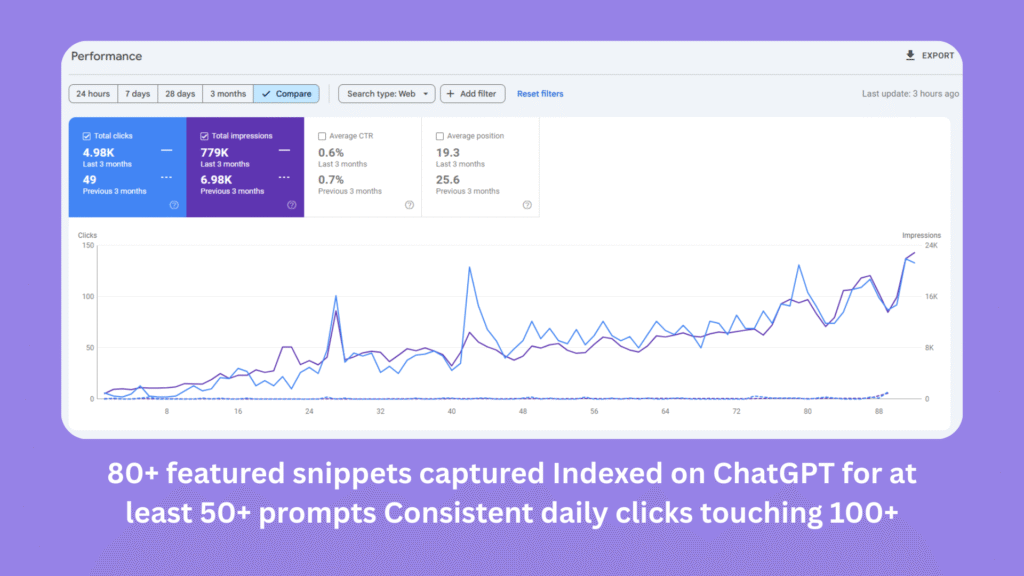
GSC showed just 36 organic clicks and 4.81K impressions over the prior 3 months.
CTR was below 1%, and average position hovered around 19.
The goal was simple: build topical authority at scale using AI-powered search signals.
What We Did with SurgeAIO
We didn’t touch the site’s codebase or publish any new content. Instead, we used SurgeAIO’s LLM optimization framework to reverse engineer how AI platforms were interpreting their content and why they weren’t recommending it.
Here’s what we focused on:
1. LLM Visibility Audit
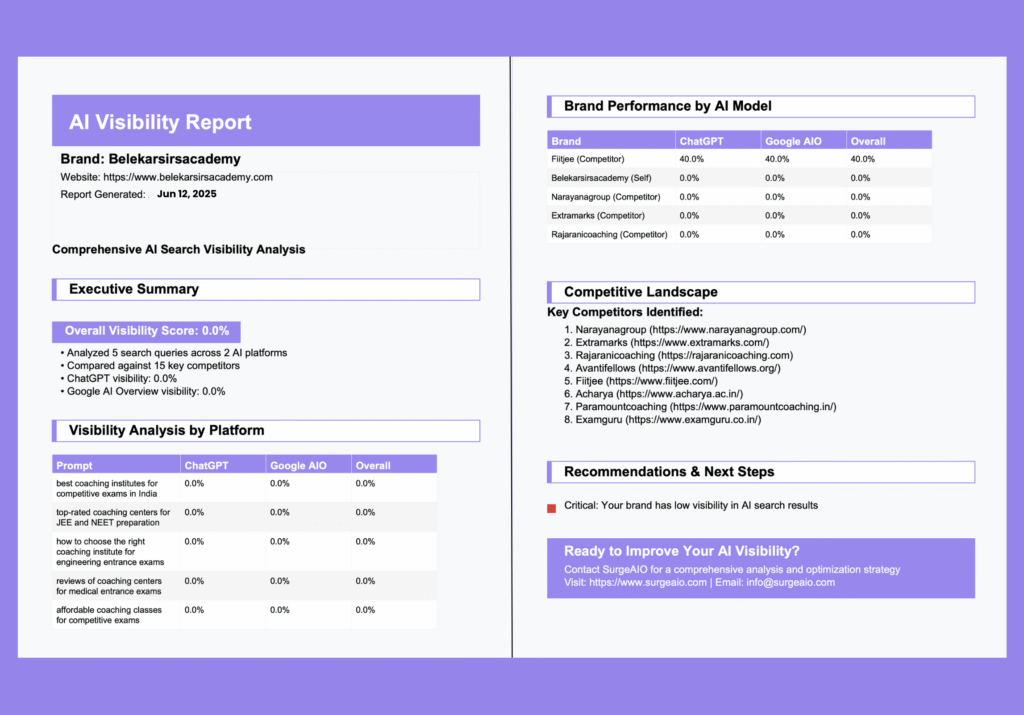
We started by scanning the site across Google’s AI Overview, ChatGPT browsing mode, and Gemini. Visibility: Zero.
SurgeAIO highlighted gaps in:
Entity recognition
Semantic structuring
Reverse prompt matchability
2. Reverse Prompt Discovery
We analyzed how queries like “words to describe your friends” were being answered by AI and structured our content accordingly. We aligned headers, content blocks, and answer first snippets to match prompt intent.
3. Semantic Reinforcement
We enriched key pages with:
Structured lists and examples
Schema markup optimized for generative search
Visual tables that could be repurposed by AI
4. Real-time LLM Monitoring
Every tweak was tracked using SurgeAIO’s AI SERP tracking engine, allowing us to see when the site entered AI Overviews and how its content was being interpreted.
The Outcome
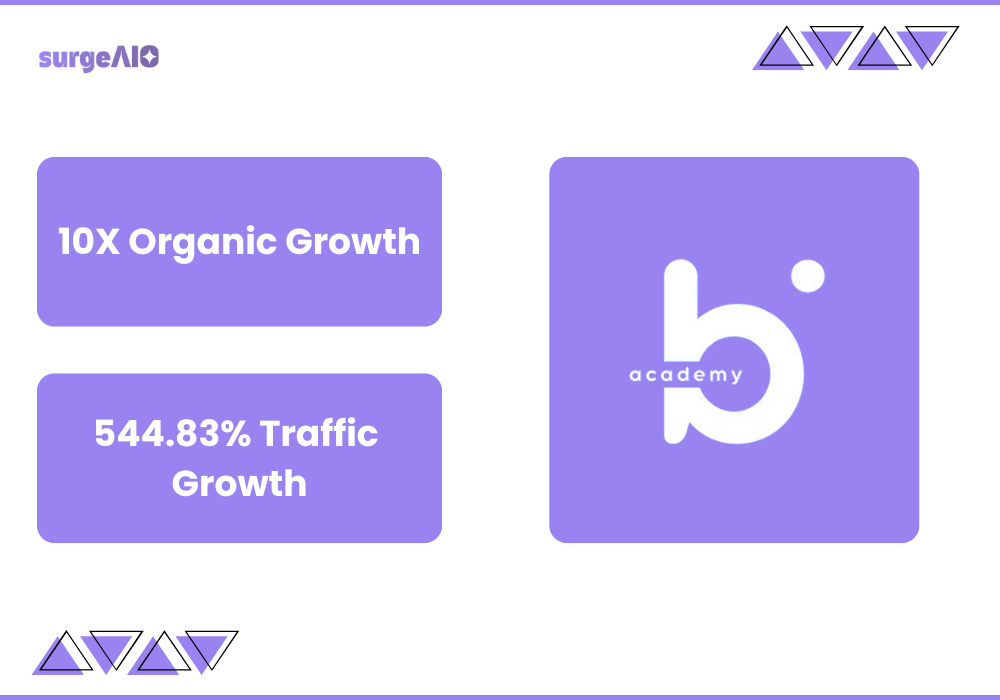
Belekarsirsacademy.com now ranks in 111 keywords inside Google’s AI Overview, all within 6 weeks of optimization.
Traffic is up. Visibility is real. Credibility is high.
A Few of the Keywords They Rank #1 for in AI Overview
Here’s a snapshot of some of the actual high intent keywords Google’s AI Overview now recommends the site for:
And 101 more just like these, all now visible in AI Overviews, not just blue links.
What Changed for the Brand
AI-first discovery: Students began referencing their site after seeing it in Google’s AI answer
Passive traffic: Gained traffic for long tail queries without additional backlinks or paid promotion
Credibility boost: Showing up in AI answers made the brand feel authoritative, even compared to older competitors
The Real Insight
“We didn’t just improve SEO. We made them LLM recommendable.”
Traditional SEO still stops at the 10 blue links. But AI first search is the new game, and it’s won by those who know how to talk to language models.
That’s what SurgeAIO does.
“ What Happened in 30 Days”
Within the first month of working with SurgeAIO:
Topical clustering began for grammar topics (vs/who/whom, sentence errors, parts of speech).
SurgeAIO’s LLM Ranking Intelligence identified key prompt based variants being surfaced on ChatGPT and Gemini.
We created 32 new pages optimized for LLM discoverability, with Schema enrichment and scroll depth based prioritization.
By day 30:
Total clicks grew from 36 → 820
Impressions crossed 65K
Average position started to stabilize across clusters (25 → 20)
Small Wins: Breaking Into Google’s AI Overviews
One of the most exciting developments in BelekarSir’s Academy’s growth story has been its consistent appearance in Google’s AI Overview results — the new front page of search for millions of users.
While the big numbers (111 AI Overview keywords, 544% traffic growth) tell the macro story, these micro victories reveal how deeply SurgeAIO’s LLM-first approach is paying off.
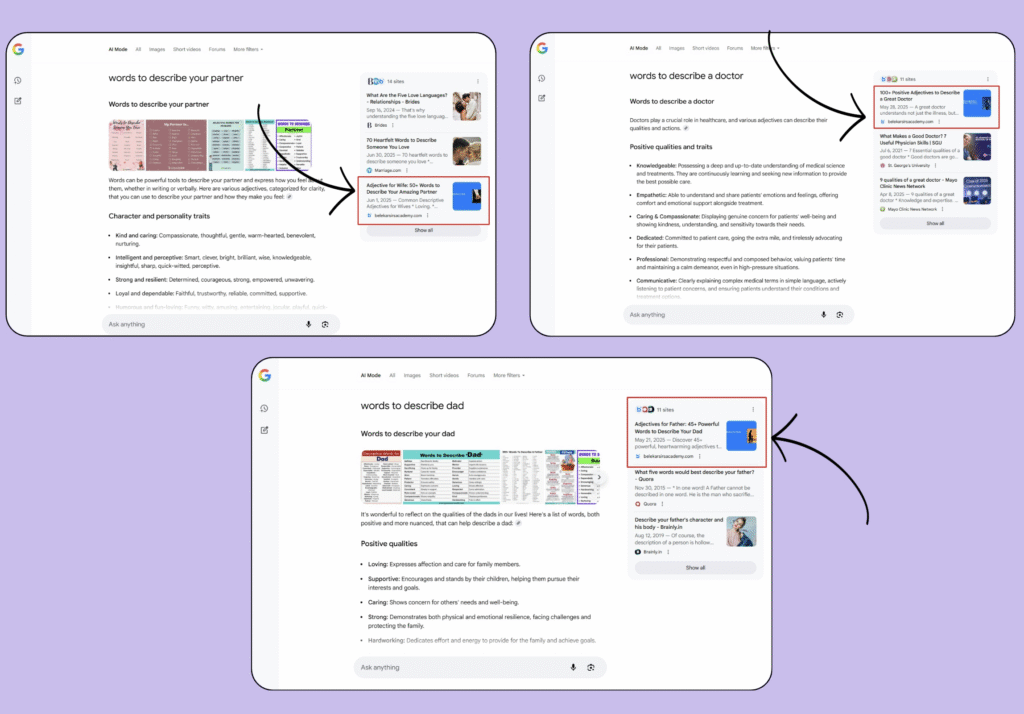
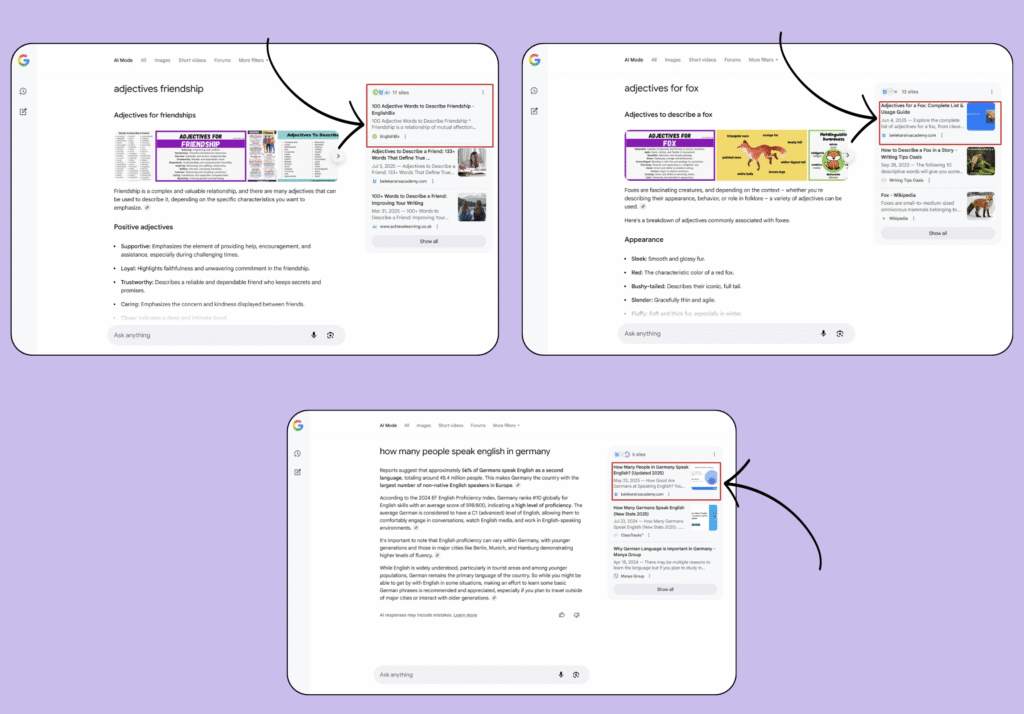
Over the last few weeks, the academy’s grammar and vocabulary content has been hand-picked by Google’s AI Overview for diverse, high-intent searches — not just competitive grammar matchups like “who vs whom,” but also lifestyle and descriptive queries such as:
Words to describe your dad – ranking alongside major lifestyle publishers
Adjectives for friendship – beating out generic listicles with richer, example-driven explanations
Words to describe your partner – appearing in AI responses for relationship-based queries
How many people speak English in Germany – cited for statistical clarity and structured presentation
Adjectives for a fox – even in niche animal-related searches, content formatting triggered AI inclusion
Words to describe a doctor – trusted for professional and character-based descriptors
These may seem like small placements, but in the AI Overview era, they function like high-visibility featured snippets on steroids — appearing before any traditional blue link and carrying the implicit endorsement of Google’s AI.
Each AI Overview appearance has two direct benefits:
Trust Transfer – When the AI Overview cites BelekarSir’s Academy, users immediately perceive the brand as credible, even if they’ve never heard of it before.
Passive Traffic Capture – Without additional backlinks, ads, or social pushes, these spots generate clicks purely from topical authority and content structuring.
What makes these wins even sweeter is that they’re cross-category. We’re not just winning in grammar keyword battles; we’re surfacing for lifestyle, education, statistics, and niche curiosity searches. That breadth is a direct outcome of SurgeAIO’s reverse prompt mapping, where we match our content blocks to the way AI engines parse and summarize information.
In a search world shifting away from page-by-page SEO toward prompt-based discoverability, these micro-rankings are early proof that BelekarSir’s Academy isn’t just riding the AI search wave — it’s shaping it.
We call them “small wins,” but in the context of AI-driven search, each one is a permanent foothold in a rapidly evolving SERP landscape. And as history shows in SEO, footholds compound.
What We Did Strategically
a. Reverse Engineered LLM Overviews Used SurgeAIO’s prompt mining tool to detect exactly how AI bots were surfacing grammar help especially for vs/waste, who/whom, etc.
b. Designed for Scroll Depth & Snippet Triggers We used heatmaps and AI SERP signals to optimize where answer boxes would appear in long form content. CTA elements were pushed above 60% scroll to match LLM crawl bias.
c. Built a Library of AI-First Assets Published ~120 grammar topic pages with:
Educational content built from actual student queries
Google and LLM style Q&A formats
Interlinking across concepts (subject verb, modifiers, etc.)
d. On-Page CTR Experimentation Adjusted meta titles using SurgeAIO’s CTR simulation engine. For example: “Who vs Whom – Stop Using Them Wrong!” converted 2.4× better than “Who and Whom Explained”.
Final Result
From a static educational site to an AI aware grammar hub, BelekarSir’s Academy now ranks across Google and LLMs for hundreds of terms students actively search and ask.
All in under 3 months, powered by SurgeAIO‘s AI SEO system.
AI OVERVIEW: How SurgeAIO Made Grammar Cool Again (To ChatGPT, Too)
Most content dies in silence. But not here.
Within weeks, SurgeAIO trained AI platforms like ChatGPT, Gemini, and Perplexity to cite Belekarsirsacademy.com as a trusted source for grammar clarity. It wasn’t about stuffing keywords it was about teaching AI what humans actually mean when they search for “who vs whom.”
Now, not only does the site show 131% growth in ranked keywords and a 544% spike in traffic it’s earning AI credibility too.
Want to See How AI Sees Your Website?
Get a real time visibility report across ChatGPT, Gemini, and Google’s AI Overview. We’ll show you where your site appears (or doesn’t), and how to fix it.
I am the Growth Head at SurgeAIo, where I oversee performance and conversion strategies for the brands we partner with. My role focuses on driving measurable results, optimizing campaigns, and ensuring sustainable growth. I work closely with teams to align marketing efforts with business objectives, leveraging data-driven insights to maximize ROI and client success.
Traditional SEO is no longer sufficient. As AI and large language models (LLMs) like ChatGPT, Google’s Gemini, and Perplexity become the dominant sources of information discovery, LLM SEO has rapidly emerged as a crucial strategy.
This new approach ensures brands are not only visible in search results, but actively cited in AI-generated answers.
In this article, you’ll discover:
What LLM SEO is, and how it differs from traditional SEO
Why it’s essential for modern brands
Strategies to align your content with both traditional search and generative AI
Steps to future-proof your content pipeline for AI‑driven visibility
What Is LLM SEO?
LLM SEO, also known as Large Language Model Optimization, Generative Engine Optimization (GEO), Answer Engine Optimization (AEO), or AI SEO, refers to optimizing web content so it can be understood, retrieved, and cited by generative AI models
Unlike traditional SEO that focuses on backlinks, keyword ranking, and link‑based discovery, LLM SEO centers on semantic relevance, topical authority, conversational clarity, and structured content that matches how AI systems interpret queries
The AI Search Revolution: Why It Matters Now
a) Shake‑Up of Traditional Search Traffic
Recent studies show that up to 80% of consumers resolve 40% of searches without clicking links, thanks to AI summaries on search engines and generative LLM tools. As a result, many brands are experiencing traffic declines even though their content remains relevant to users.
In response, companies like Mailchimp have adapted by optimizing their technical stack and page structure to serve AI crawlers better, emphasizing fast load speeds, accessible metadata, and “LLMs.txt” files to signal AI readiness.
b) AI Traffic Is Exploding
While still smaller than Google search volume, LLM‑driven traffic is growing fast. ChatGPT reportedly processes about 1 billion searches per week, up from nearly zero just a year ago, and usage increases by the month.
Projections suggest AI‑powered discovery may surpass traditional organic search traffic by as early as 2027–2028.
c) Zero‑Click, Citation‑Based Visibility
LLM SEO teaches that rank and click‑through aren’t the only metrics anymore. Becoming the answer, even without clicks, builds brand awareness, trust, and eventually branded searches.
Core Principles of Effective LLM SEO
a) Structure Content for Retrieval
AI models favor well-structured information, clear headings, Q&A formats, data tables, lists, and FAQ sections. These formats make content easy for models to parse, retrieve, and cite.
Creating comparison articles, “best of” lists, and transparent decision criteria increases the likelihood of being included in AI answers, even if you don’t rank on page one of Google
b) Write Conversationally and Contextually
LLMs process intent and semantics, not just keywords. A conversational tone that answers probable user questions naturally improves relevance in generative summaries.
Use plain language, answer real questions up front, and avoid keyword stuffing.
c) Build Topical Authority (Depth Over Brevity)
Deep, well-reasoned content that covers multiple angles of a topic is preferred by LLMs. Truly owning a concept, with context, definitions, case studies, and reasoning, enhances your chances of being pulled into generated responses.
Vercel’s engineering blog puts it well: “LLM SEO is the art of becoming the answer”
d) Maintain Technical Friendliness
Just like SEO, technical factors still matter. Ensure clean code, fast page load, structured data, crawlable content, and optionally an llms.txt file to guide AI indexing.
e) Seed Your Content Strategically (LLM Seeding)
Publish content that is likely to get scraped and cited, on your own site and external platforms (guest posts, industry sites, forums), with structured formats and authoritative tone. This method, called LLM seeding, builds AI citations organically
AEO, GEO, AIO, Understanding the Terminology
These terms overlap, but each has its nuance:
AEO (Answer Engine Optimization): Focused on shaping how AI chatbots reply to user queries with concise, authoritative content
GEO (Generative Engine Optimization): Aims to increase the likelihood that your content is cited in generative AI outputs by optimizing for AI-friendly formats and metadata.
AIO (Artificial Intelligence Optimization): A broader category dealing with embedding, indexing, and prompt-compatibility to support AI retrieval mechanisms inside LLMs.
Why Brands That Ignore LLM SEO Risk Falling Behind?
a) Losing Visibility in AI‑Mediated Answers
If your content isn’t optimized for AI retrieval, you won’t appear in chatbot-driven summaries. That means losing authority, mindshare, and the chance to convert users who rely on AI answers directly
b) Declining Organic Traffic Without Compensation
Even with great traditional SEO, traffic may fall as users get answers via AI tools and never click through. Brands that don’t adapt will see declining web visits, yet gain no benefit from AI-generated brand exposure
c) Losing Competitive Edge
AI‑driven discovery favors brands that supply clear, structured, and context-rich content. From Semrush studies, lesser-known brands can get cited if they provide better AI‑ready content, often surfacing ahead of traditional ranking leaders
Ethan Smith and other experts note: traditional SEO veterans are often unprepared for this shift, and must rethink visibility metrics entirely
6. Practical Steps to Implement LLM SEO on SurgeAIO
Step 1: Identify Core Topics & User Questions
Use chat logs, forum snippets, Reddit threads, and user support questions to derive real conversational queries users ask LLMs.
Focus on emerging topics where you can establish thought leadership early.
Use headings like “What is…?”, “How to…?”, “Why does it matter?”
Include FAQ sections, bullet lists, comparison tables, and case studies.
Explain data clearly and transparently, AI citation likelihood improves when reasoning steps and criteria are evident.
Step 3: Technical Optimization
Ensure fast page load, clean HTML, structured data markup (JSON‑LD or Schema), and optionally llms.txt to control access by AI systems
Use metadata, clear canonicalization, and internal linking to build contextual authority.
Step 4: Distribute & Seed Content in AI‑Friendly Contexts
Publish on industry sites with structured formats, allow LLMs to crawl and cite.
Use guest posts, knowledge bases, blog platforms, or forums with high AI crawlability.
Ensure content is formatted in an LLM‑digestible way (headings, short paragraphs, clear reasoning)
Step 5: Monitor AI Mentions & Brand Citations
Use tools now tracking mentions in ChatGPT, Gemini, and Perplexity.
Track trending prompts and queries where your brand appears, that visibility can lead to branded search and direct traffic even without link clicks
Best Practices & Tips for Ongoing Success
Update regularly. AI models value freshness, periodic content refresh signals that your information remains current and authoritative.
Be semantically rich. Use synonyms, context clues, examples, and related topics to reinforce embeddings that match AI retrieval.
Write with natural conversations in mind. Imagine real prompts users might type. Frame your content to directly answer those queries.
Track performance beyond links. Monitor changes in branded search volume, AI mentions, and referral traffic rather than relying solely on click-through metrics.
Balance SEO and LLM readiness. Implement a coordinated strategy combining keyword targeting with conversational and structured AI‑friendly formats
What Early Adopters Are Doing?
Back Market, an e‑commerce brand, adopted more conversational product copy and optimized product pages to align with LLM preferences. It began capturing AI citations even before achieving top page‑one rankings on Google.
Mailchimp enhanced its site structure and metadata to better serve the AI systems that crawl content for generative summaries.
A wave of startups offering AEO/GEO/AIO platforms have emerged in 2025, supporting analytics, prompt‑tracking, and LLM visibility for brands adapting to the shift.
The Future Outlook: How LLM SEO Will Evolve
Greater AI model integration: LLMs with live web access, real‑time retrieval, and multimodal capabilities (text + visuals) will dominate discovery channels.
AI commerce and shopping: As tools like ChatGPT roll out integrated shopping buttons, being cited in AI responses can directly drive conversions without traditional search click paths.
Dominance of answer‑first interfaces: If AI platforms become primary entry points to content, brands that invest in LLM SEO will win visibility even if they don’t rank highly on traditional SERPs.
Conclusion
LLM SEO isn’t just the next iteration of SEO, it’s a fundamental shift. The goal is no longer to climb to the top of rankings or drive clicks, but to own the answer. By optimizing content around semantic clarity, structured formats, topical depth, and AI‑seeding strategies, brands like yours can remain discoverable and authoritative in both conventional search and AI‑mediated discovery channels.
If you want help mapping LLM‑ready content, refining your structure, or tracking AI mentions for SurgeAIO, I’d be glad to assist. Let’s make sure your brand stays the answer in the era of AI search.
I am the Growth Head at SurgeAIo, where I oversee performance and conversion strategies for the brands we partner with. My role focuses on driving measurable results, optimizing campaigns, and ensuring sustainable growth. I work closely with teams to align marketing efforts with business objectives, leveraging data-driven insights to maximize ROI and client success.
Search engine optimization (SEO) has always been a moving target. What worked yesterday may not work today and what will work tomorrow is already evolving. In 2024 and beyond, AI SEO is no longer a buzzword it’s the cornerstone of competitive digital strategy.
If your brand isn’t leveraging AI to understand search intent, automate optimizations, and track visibility across both search engines and AI platforms (like ChatGPT or Perplexity), you’re leaving massive organic growth on the table.
This blog dives deep into what AI SEO really is, how it’s different from traditional SEO, and how to use it to grow traffic, conversions, and brand visibility.
What is AI SEO?
AI SEO is the application of artificial intelligence technologies to improve your website’s ranking, visibility, and performance on search engines and emerging AI powered platforms. It combines:
Machine learning algorithms
Natural language processing (NLP)
Predictive analytics
Automation tools
to make data driven SEO decisions faster and more effectively than traditional methods.
But AI SEO is more than just using tools. It’s about shifting your approach from static, rule based optimization to dynamic, intent focused strategies that adapt in real time.
Why Traditional SEO is No Longer Enough?
Until recently, SEO was largely about:
Targeting keywords with high search volume
Optimizing meta tags and headings
Earning backlinks from other websites
Publishing blog posts regularly
These tactics still matter but they don’t work in isolation anymore.
Why?
Because search engines and search behavior have changed.
Google now uses machine learning (like BERT and RankBrain) to understand user intent.
Generative AI (e.g., ChatGPT, Gemini, Claude) is answering queries directly often without sending traffic to the source site.
AI Overviews (on Google) and AI assistants (like Perplexity) are choosing which sites to show, based on visibility, relevance, and semantic depth not just keywords.
In short: ranking on page 1 of Google is not enough anymore.
You need to rank on AI Overviews, ChatGPT, Perplexity, Bing Copilot, and more.
Core Components of AI SEO:
1. AI Powered Keyword and Topic Research
Traditional keyword tools focus on search volume and competition. AI SEO tools go a step further.
For example, tools like SurferSEO, MarketMuse, Frase, and SurgeAIO use machine learning to suggest not just keywords, but the topical clusters you need to cover to become an authority in your niche.
2. Search + AI Assistant Visibility Tracking
This is where most people fall short. It’s not just about Google anymore.
A good AI SEO strategy tracks:
Where your site appears in Google AI Overviews
Which of your content is being pulled into ChatGPT responses
How your brand shows up on Perplexity, Bing Copilot, and Claude
Which URLs are gaining traction over time across AI interfaces
Visibility score is the new metric.
Instead of just checking your Google rank for “best CRM for startups,” you’ll now want to know:
Is your site referenced by ChatGPT when users ask that?
Which pages are most quoted by Perplexity?
Are you showing up when people ask AI tools for recommendations in your category?
3. Content Optimization with NLP
AI SEO tools can now analyze your content using Natural Language Processing, just like Google does.
That means they can:
Compare your article to the semantic structure of top ranking pages
Suggest improvements in tone, reading level, and depth
Recommend missing topics and questions
Identify internal linking opportunities
Tools like Clearscope, Surfer, Jasper, and Koala can help here but the real value comes from combining these insights with human storytelling.
AI gives you the structure. Your brand gives it voice.
4. AI Generated & Human Edited Content
Let’s be honest: everyone’s generating content with AI.
But Google (and users) are smarter than that.
Pure AI content ≠ rankable content.
You need AI assisted content, not AI only.
Here’s a proven workflow:
Use AI to generate a first draft using tools like ChatGPT, Claude, or Koala.
Human edit the output to improve:
Originality
Examples
Brand tone
Thought leadership
Run it through AI SEO tools to ensure you’re covering all the important angles semantically.
The result? Fast, high quality content that ranks and converts.
5. Automation + Real Time Adaptation
AI SEO isn’t just about research and content. It’s about scalability and adaptability.
With the right stack, you can:
Automate internal linking based on topic clusters
Detect and fix thin content or outdated pages
Redirect decaying content to updated URLs
Monitor changes in AI Overviews or ChatGPT visibility
This is what separates smart SEO teams from outdated ones.
Instead of quarterly audits, AI SEO enables continuous optimization.
AI SEO vs Traditional SEO: A Quick Comparison
Feature
Traditional SEO
AI SEO
Keyword Targeting
Based on volume
Based on intent & semantics
Search Engines
Google & Bing
Google + ChatGPT + Perplexity + Bing Copilot
Content Creation
Manual
AI assisted + Human edited
Ranking Signals
Links, keywords
Entity relevance, content depth, visibility
Reporting
Google Search Console
Multiplatform visibility (AI + search)
Speed
Manual updates
Real time monitoring & optimization
How to Implement AI SEO: Step by Step
Here’s a simplified roadmap to get started:
Step 1: Audit Your Current Visibility
Use tools like SurgeAIO to check where your site appears across search engines and AI tools.
Identify which pages are already ranking and which are invisible.
Step 2: Identify High Intent Topics
Use AI powered research to find topic clusters your audience is searching for.
Don’t just chase keywords look for conversational queries AI tools will answer.
Step 3: Create Authority Driven Content
Use AI to generate outlines and ideas
Add real world examples, unique insights, and brand voice
Optimize semantically using NLP suggestions
Step 4: Track AI + Search Rankings Together
Install trackers that monitor visibility on:
Google AI Overviews
ChatGPT results
Perplexity citations
Monitor changes weekly, not monthly.
Step 5: Iterate Fast
Use AI suggestions to update old content
Fill topical gaps
Add schema, links, and multimedia
Scale without sacrificing quality
Common Misconceptions About AI SEO
❌ “AI generated content is spammy.”
Not if it’s edited and enriched with human expertise.
❌ “Google punishes AI written content.”
False. Google ranks helpful content regardless of how it was created.
❌ “You can just publish and pray.”
AI SEO requires constant iteration, monitoring, and optimization.
Best AI SEO Tools in 2025
Here’s a shortlist of tools making AI SEO work in the real world:
SurgeAIO – Tracks search + AI visibility, monitors rankings across ChatGPT, Perplexity, Google AI Overviews.
Frase – Helps build content briefs and optimize semantic coverage.
SurferSEO – Offers real time content scoring + NLP suggestions.
Koala – One click AI content generation with built in SEO logic.
Jasper – Brand aware long form content generator.
MarketMuse – Deep topical authority planner with predictive content scoring.
Future Trends in AI SEO
Personalized search results based on user profiles (AI assistants are learning your preferences).
Voice first SEO as AI voice agents become more common.
AI driven backlink discovery based on citation patterns in large language models.
Searchless discovery – content that ranks without being searched (e.g., showing up in AI conversations directly).
Conclusion: AI SEO is the New Competitive Edge
If SEO is a game, then AI just changed the rules.
You’re no longer just optimizing for Google you’re optimizing for machines that talk, think, and recommend.
That means you need:
Smarter research
Faster content workflows
Wider visibility tracking
And a mindset that’s always testing, always learning.
Whether you’re a solo creator, agency, or enterprise now is the time to build your AI SEO stack, track your true visibility, and grow with intent.
Need help implementing AI SEO?
Whether you’re just starting out or want to track your brand’s presence across ChatGPT, Google, and Perplexity we can help. Let’s build your AI visibility stack together.
Frequently Asked Questions:
What is AI SEO?
AI SEO refers to the use of artificial intelligence technologies such as machine learning, natural language processing (NLP), and predictive analytics to improve website visibility, ranking, and performance on search engines and AI platforms (like ChatGPT, Perplexity, and Bing Copilot). It automates tasks, analyzes user intent, and optimizes content at scale.
How is AI SEO different from traditional SEO?
Traditional SEO relies on manual keyword targeting, backlink building, and static audits. AI SEO, on the other hand: Understands intent using NLP
Automates research and optimization
Tracks rankings on AI tools (ChatGPT, Gemini, etc.)
Offers continuous insights and real time updates
It’s smarter, faster, and built for a multi platform future.
Can I rank on ChatGPT or Perplexity like I do on Google?
Not exactly you don’t “rank” in the same way. But you can optimize your content to be cited or referenced by ChatGPT, Perplexity, Claude, or Bing. This involves: Covering topics comprehensively
Including clear, factual data
Using structured content (like Q&A, lists, headings)
Tracking visibility with the right tools
Is AI generated content safe to use for SEO?
Yes, as long as it’s human edited and adds value. Google’s guidelines focus on helpful, original, and people first content regardless of how it’s created. That said, avoid: Copy paste AI articles without editing
Low quality, duplicate outputs
Content without unique insights or examples
Best practice: Use AI for drafting → Human for polishing
What tools should I use for AI SEO?
Some of the most effective AI SEO tools include: SurgeAIO – Tracks visibility across search + AI tools
Frase / Jasper / Koala – For AI assisted content creation
SurferSEO / MarketMuse – For content optimization
Clearscope – For NLP based scoring
Choose your stack based on content volume, team size, and your need to track AI visibility.
How do I know if my content is showing up in AI Overviews or ChatGPT?
You can use tools like SurgeAIO that track: Which of your URLs are being cited in ChatGPT
Whether your brand appears in Perplexity answers
Google AI Overview snapshots and triggers Manual methods include:
Searching your brand or keywords in AI tools
Asking ChatGPT or Perplexity questions your audience would
But tracking manually is time consuming use automation.
I am the Growth Head at SurgeAIo, where I oversee performance and conversion strategies for the brands we partner with. My role focuses on driving measurable results, optimizing campaigns, and ensuring sustainable growth. I work closely with teams to align marketing efforts with business objectives, leveraging data-driven insights to maximize ROI and client success.