If you have recently invested in medical SEO, you are probably refreshing your Google Analytics dashboard every other day. You are watching for ranking changes, waiting for the phone to ring more, and wondering – how long does it take for medical SEO to work?
It is one of the most common questions from doctors, clinic managers, and healthcare marketers. And the honest answer is: it varies. However, most practices start seeing early signals within 60 to 90 days and meaningful, revenue-generating results within 6 to 12 months.
This guide breaks down a realistic medical SEO timeline, the factors that control your speed, and what you can do right now to accelerate results.
Why Medical SEO Is Different from Regular SEO
Before diving into timelines, it is important to understand why medical SEO takes longer than SEO for, say, an e-commerce store or a local restaurant.
Google categorises healthcare websites under its YMYL (Your Money or Your Life) framework. This means medical content can directly impact a person’s health decisions. Therefore, Google holds these sites to a significantly higher standard before rewarding them with top rankings.
Your website must demonstrate E-E-A-T – Experience, Expertise, Authoritativeness, and Trustworthiness. This means having verified physician credentials, citing credible medical sources, earning genuine patient reviews, and publishing content that reflects real clinical knowledge.
Moreover, SEO for functional medicine doctors or any healthcare speciality cannot rely on generic content strategies. Every page must be precise, accurate, and patient-focused. Building that level of trust takes time – and Google rewards it consistently once you do.
The Medical SEO Timeline: Month by Month
Here is what a well-executed medical SEO campaign typically looks like across its first year.
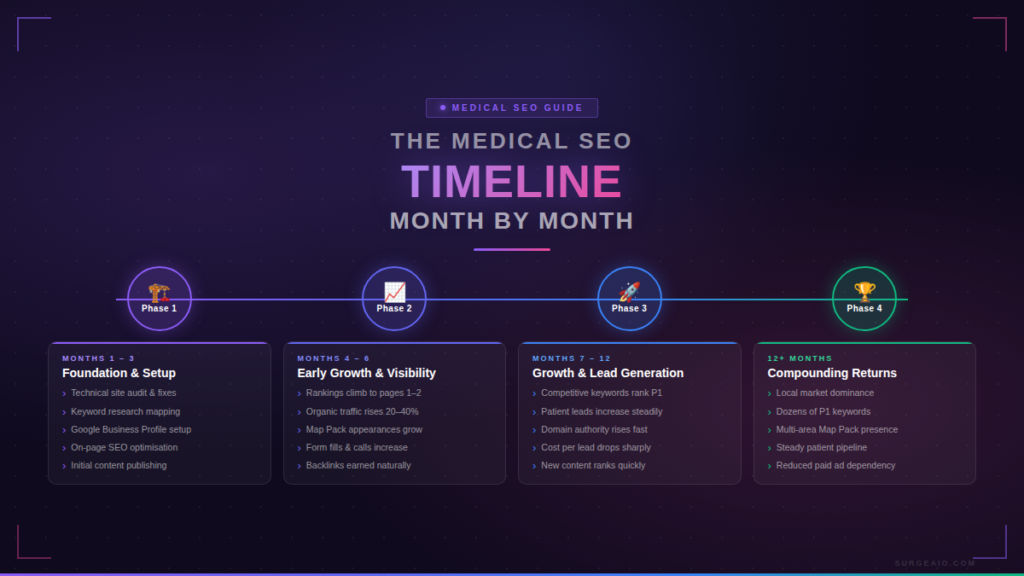
Months 1-3: Building the Foundation
The first three months are about infrastructure, not rankings. Your SEO team is laying the groundwork that everything else will be built upon. During this phase, expect your team to focus on:
- Full technical audit of your website – fixing crawl errors, broken links, and page speed issues
- Keyword research aligned with your speciality and patient search behaviour
- On-page optimisation – updating title tags, meta descriptions, header structure, and internal linking
- Schema markup implementation for medical practices
- Google Business Profile setup and optimisation
- Publishing the first wave of high-quality, intent-driven content
You may notice some early wins during this period. Impressions start rising in Google Search Console. A handful of long-tail keywords begin appearing in positions 15 to 30. Your Google Business Profile starts showing in more local searches.
However, do not expect patient leads yet. This phase is about signalling to Google that your website is credible, well-structured, and worthy of trust.
A well-planned competitive keyword analysis during this phase ensures you are targeting terms that can deliver real patient traffic – not just vanity metrics.
Months 4-6: Early Growth and Visibility
This is where things start getting interesting. The work done in months one through three begins to pay off. Google has crawled and indexed your updated pages, your content is gaining traction, and ranking improvements become visible.
During this phase, most medical practices experience:
- Mid-competition keywords are climbing to pages one and two of Google
- Organic traffic is increasing by 20-40% compared to the baseline
- Google Business Profile calls and direction requests are increasing noticeably
- Contact form submissions starting to grow
- Local map pack appearances are becoming more consistent
In addition, content published in the first three months starts earning backlinks naturally as other websites and directories reference it. This compounds your authority and accelerates rankings further.
This is also the phase where geo-targeting SEO strategies become especially powerful. Optimising for specific suburbs, neighbourhoods, or service areas can push your practice into the Google Map Pack well before you dominate broad competitive terms.
Months 7-12: Significant Growth and Lead Generation
This is the phase every healthcare practice is waiting for. By month seven, a well-executed medical SEO strategy starts delivering consistent, measurable ROI.
Competitive keywords – the ones that drive real patient volume – begin ranking on page one. Organic traffic may have doubled or even tripled from the starting baseline. Patient enquiries through the website increase substantially, and the cost per lead from SEO begins to drop well below what paid advertising delivers.
Furthermore, if you have actively worked on building backlinks and domain authority throughout the campaign, your domain rating is now strong enough that new content ranks faster – sometimes within days of publication rather than weeks.
Practices that reach this phase consistently describe it as a turning point. SEO stops feeling like an expense and starts feeling like an asset.
Beyond 12 Months: Compounding Returns
Medical SEO is one of the few marketing channels that genuinely compounds. The authority, backlinks, and content you build in year one continue generating traffic and leads in year two and beyond – without proportionally increasing costs.
Practices that sustain their SEO investment beyond 12 months often dominate their local market. They rank for dozens of high-value keywords, appear in the Google Map Pack for multiple service areas, and attract a steady stream of new patients without relying on paid ads.
Ultimately, the practices that treat SEO as a long-term asset – not a short-term campaign – see the strongest returns.
Key Factors That Control How Long Medical SEO Takes
The timeline above assumes consistent effort and good execution. However, several variables can speed up or slow down your results significantly.
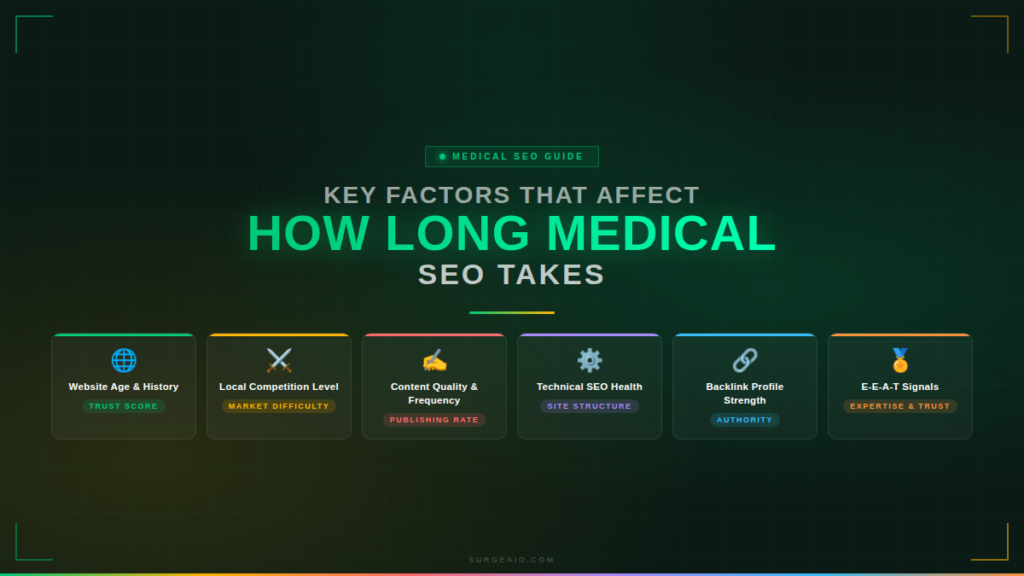
1. Your Website’s Age and History
Google places more trust in established websites than new ones. A medical practice that has maintained a website for five or more years with regular content updates and a clean backlink profile will see faster ranking improvements than a brand-new domain starting from scratch.
New websites typically spend their first six months in what is informally called the Google sandbox – a period where Google holds back rankings while evaluating credibility. This is even more pronounced for healthcare websites, where the YMYL standards apply strictly.
2. The Level of Local Competition
The market you operate in has an enormous influence on your timeline. A paediatric dentist in a rural town with two competitors can rank on page one within three to four months. A cardiologist in central London competing against major hospital networks may need 12 to 18 months to reach the same position.
In addition, AI local SEO tools are increasingly helping practices identify hyper-local keyword opportunities – specific suburbs, postcodes, or service-area terms – where competition is lower and early wins are achievable much faster.
3. Content Quality and Publishing Consistency
Google rewards practices that publish genuinely helpful, accurate, and regularly updated content. Thin, generic pages that could apply to any practice in any city perform poorly. Content that directly answers the specific questions your patients are typing into Google performs significantly better.
Practices that publish two to four high-quality blog posts or service pages per month consistently outpace those that publish sporadically. Using the right content optimisation tools ensures every piece of content is built around real search intent and has the structure needed to rank.
4. Technical SEO Health
No amount of great content overcomes a technically broken website. Core Web Vitals, mobile-friendliness, HTTPS security, clean URL structures, and fast page load speeds are all baseline requirements for competitive medical SEO.
Moreover, proper schema markup – specifically medical schema for conditions, treatments, and physician profiles – helps Google understand your content more accurately and can improve how your pages appear in search results.
5. Backlink Profile Strength
Backlinks remain one of the strongest ranking signals in Google’s algorithm. For medical websites, links from authoritative sources – medical directories, health publications, local news sites, and university health pages – carry significant weight.
Practices that invest in consistent, ethical link building throughout their SEO campaign rank faster and hold their positions more durably than those that focus only on on-page content.
6. E-E-A-T Implementation
For medical SEO specifically, E-E-A-T signals can be the difference between ranking on page one and being permanently stuck on page two. This means having detailed, verified author bios for every physician, citing peer-reviewed sources in medical content, displaying credentials and affiliations prominently, and actively managing patient reviews on Google and healthcare directories.
Tracking content performance data helps you identify which pages are earning trust signals and which need further E-E-A-T improvements.
Early Signs Your Medical SEO Strategy Is Working
Many practices make the mistake of abandoning their SEO investment too early because they do not know what good early progress looks like. Here are the signals to watch before patient leads start flowing:
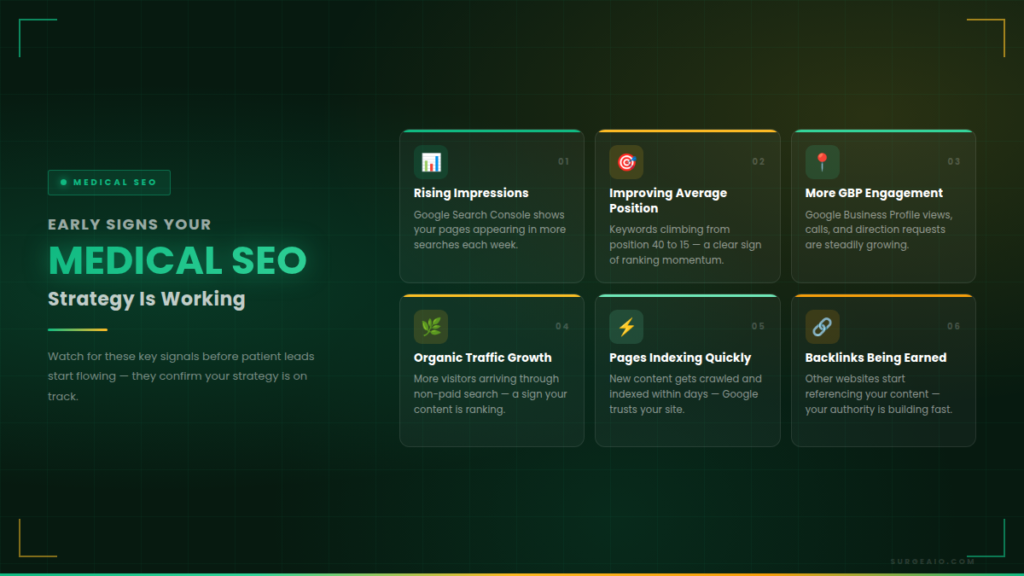
- Rising impressions in Google Search Console – your pages are appearing in more searches
- Improving average position – keywords are moving from position 40 to position 15 to position 8
- Growing Google Business Profile engagement – more views, calls, and direction requests
- Organic traffic trending upward – more visitors arriving through non-paid search
- New pages indexing quickly – Google is regularly crawling and indexing your content
- Decreasing bounce rate – visitors are finding your content relevant and staying longer
- Increasing backlinks – other websites are beginning to reference your content
These early signals confirm that your strategy is working. They precede patient leads by four to eight weeks in most cases.
How to Speed Up Your Medical SEO Results
While there are no genuine shortcuts in SEO, there are smart strategies that accelerate progress without cutting corners.
- Start with low-competition, long-tail keywords – ranking for “paediatric physiotherapist in [suburb]” builds momentum faster than targeting “physiotherapist”
- Fix all technical issues in the first 30 days – a clean, fast, well-structured site gets indexed faster
- Optimise your Google Business Profile immediately – Map Pack visibility can improve within 30 to 60 days with a fully optimised profile
- Publish content consistently from day one – frequency and quality compound over time
- Build backlinks actively – do not wait for links to come naturally in a competitive market
- Implement schema markup early – helps Google understand and rank your content faster
- Monitor and adjust monthly – SEO is not a set-and-forget strategy
Understanding what elements are foundational for SEO with AI is also increasingly important as Google’s algorithms incorporate AI-driven ranking signals that reward structured, authoritative content.
How SurgeAIO Can Help in Terms of SEO
SurgeAIO is designed to take the guesswork out of medical SEO. Whether you are a solo GP, a specialist clinic, or a multi-location healthcare group, SurgeAIO provides the tools and intelligence to build, execute, and measure an SEO strategy that delivers real patient results.
Here is what SurgeAIO brings to your medical SEO campaign:
- AI-powered keyword research that identifies high-value, low-competition terms your patients are actively searching for
- Automated content briefs built around search intent and E-E-A-T standards specific to healthcare
- Competitor gap analysis that reveals ranking opportunities your competitors are missing
- Backlink tracking and domain authority monitoring, so you always know where your authority stands
- Local SEO tools for Google Business Profile optimisation and Map Pack domination
- Real-time ranking dashboards that track keyword positions, traffic trends, and lead signals in one place
SurgeAIO also helps you track SEO performance for organic traffic growth so you can see exactly which pages and keywords are driving patient enquiries – and double down on what is working.
Moreover, SurgeAIO’s platform integrates AI-driven insights with proven SEO frameworks. You are not guessing. You are executing a data-backed strategy with a clear timeline and measurable milestones.
Ultimately, medical SEO is a long game. SurgeAIO helps you play it with precision, speed, and confidence.
Final Thoughts
So – how long does it take for medical SEO to work? Early signals arrive in 1 to 3 months. Meaningful traffic and lead growth build from months 4 to 6. Strong, consistent ROI typically arrives by months 9 to 12. And the results compound every month after that.
The timeline depends on your market, your starting point, and the quality of your strategy. However, one truth applies universally: the practices that commit early and stay consistent always outperform those that expect fast results and give up too soon.
Ready to build a medical SEO strategy that actually delivers? Explore how SurgeAIO’s SEO platform can help your practice rank higher, attract more patients, and grow sustainably – month after month.
Frequently Asked Questions
Q1: How long does it take for medical SEO to work for a brand-new practice?
A brand-new medical website typically takes 6 to 12 months to generate consistent patient leads through SEO. Early signals – rising impressions and keyword rankings – often appear within 60 to 90 days. The ramp-up period is longer for new domains because Google needs time to establish trust and authority before rewarding rankings.
Q2: Can a medical practice see SEO results in 3 months?
Some early results are visible within 3 months – particularly for long-tail keywords, local map pack visibility, and technical improvements on established websites. However, meaningful patient lead generation from SEO typically begins between months 4 and 6, with the strongest results arriving after month 9.
Q3: Is medical SEO harder than SEO for other industries?
Yes. Google applies stricter standards to healthcare websites through its YMYL and E-E-A-T guidelines. Medical content must demonstrate genuine expertise, cite credible sources, and be written or reviewed by qualified healthcare professionals. This makes the process more demanding but also means high-quality medical SEO creates a more durable competitive advantage.
Q4: What is the single biggest factor in how fast medical SEO works?
Local competition level has the largest impact on the timeline. In low-competition markets, strong results can arrive in 3 to 5 months. In highly competitive cities, the same quality of work may take 12 to 18 months to produce top-page rankings for high-volume keywords.
Q5: Do I need backlinks to rank in medical SEO?
Yes. Backlinks are a critical ranking signal for all websites, and especially for medical sites competing in YMYL categories. High-authority backlinks from medical directories, health publications, and local sources accelerate domain authority growth and directly improve your ability to rank for competitive keywords.
Q6: What happens to my rankings if I pause my medical SEO?
Rankings typically hold in the short term – weeks to a couple of months – before gradually declining. Competitors continue optimising, Google’s algorithms update, and fresh content signals weaken over time. Medical SEO is most effective as a continuous, compounding strategy rather than a campaign with a defined end date.
Q7: How does Google Business Profile affect medical SEO timelines?
Optimising your Google Business Profile can produce one of the fastest visible results in medical SEO – often within 30 to 60 days. Appearing in the Google Map Pack can drive significant patient calls and visits even before your organic website rankings reach page one.
