
If you run a local business, you have likely asked this question at least once. Does responding to Google reviews help SEO – or is it simply good customer service? Most business owners treat review responses as an afterthought. That is a costly mistake.
The truth is, responding to Google reviews sends real signals to Google. It influences where your business ranks in local search, how trustworthy your profile looks, and how often potential customers choose you over a competitor. In this guide, we break down exactly how review responses impact SEO, what the data proves, and how to respond strategically for maximum results.
Why Google Reviews Matter for Local SEO
Before diving into responses, it helps to understand why reviews carry weight in the first place. Google ranks local businesses using three core factors: relevance, distance, and prominence. Reviews – and how actively you engage with them – directly shape your prominence score.
Prominence measures how well-known and trusted your business appears online. It draws from reviews, backlinks, citations, and active engagement signals. A business that consistently gathers and responds to reviews tells Google it is legitimate, active, and customer-focused.
This is why SEO for home service leads almost always includes reputation management as a core pillar. Reviews and responses work together – you cannot fully separate one from the other.
Does Responding to Google Reviews Help SEO? What the Data Shows
Yes – and the evidence is compelling. A study analyzing 5,000 local businesses across 47 industries over 12 months found a clear pattern. Businesses responding to 75% or more of their reviews ranked 2.3 positions higher in local pack results on average. That gap is the difference between page one and page two. It is the difference between getting the call and watching a competitor get it.
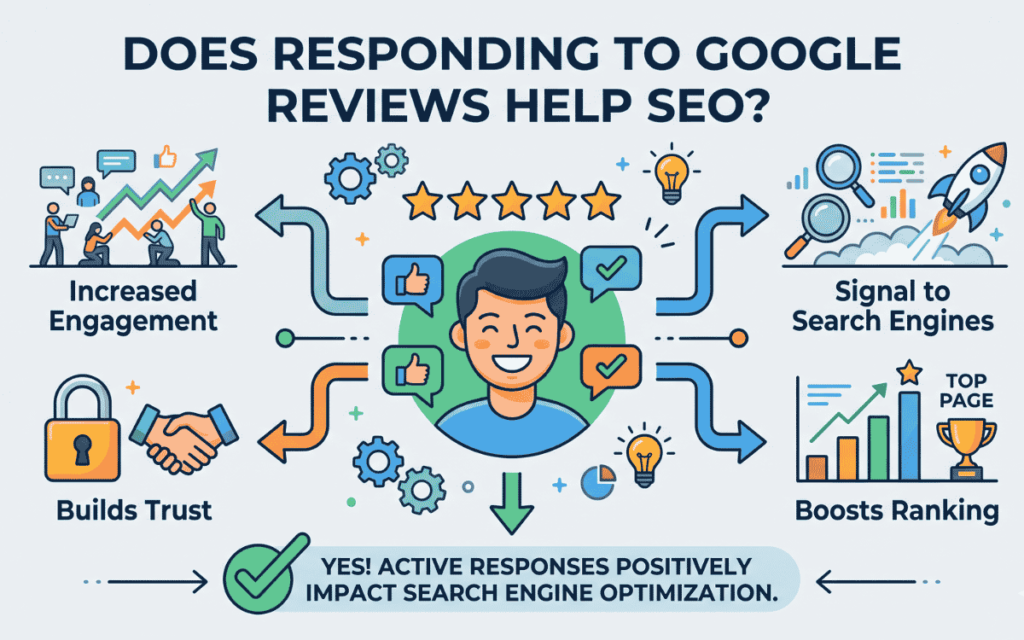
Furthermore, response speed matters significantly. Businesses that replied within 24 hours ranked 1.6 positions higher than those that took a week or longer. Here is how the numbers broke down:
| Response Rate | Avg. Local Pack Position |
| 0-25% | 4.7 |
| 26-50% | 4.1 |
| 51-75% | 3.4 |
| 76-100% | 2.4 |
The pattern is clear. More responses – and faster responses – equal stronger local rankings. Moreover, most competitors are not doing this. The average response rate across industries sits below 50%. Simply responding consistently puts you ahead of the majority.
How Review Responses Directly Impact SEO
Let us look at the specific mechanisms through which responding to Google reviews helps your search performance.
1. Fresh Content on Your Business Profile
Google treats your review responses as indexable content. Every reply adds new, relevant text to your Google Business Profile. That text carries freshness signals, keyword context, and semantic relevance – all things Google weighs when ranking local listings.
A profile where your last response was six months ago tells Google your business may be inactive. A profile with weekly replies signals that your business is running and paying attention. Tracking how this engagement compounds over time is exactly what content performance data strategies are built around – active profiles generate stronger authority signals month after month.
2. Engagement Signals That Google Tracks
Google monitors engagement across all its platforms. When you respond to reviews, you confirm that a real, active business operates behind the listing. This distinguishes legitimate businesses from spam or abandoned profiles – something Google weighs heavily when populating local search results.
3. Natural Keyword Integration
Customers naturally use valuable local search terms in their reviews. Phrases like “best dentist in downtown Chicago” or “affordable plumber near me” appear organically in feedback. When you respond thoughtfully, you can mirror those terms naturally.
For example, if a customer writes “Great roofing service in Atlanta,” a reply like “Thank you for trusting us with your roofing needs in Atlanta!” adds keyword context without manipulation. However, avoid stuffing keywords artificially – Google and customers both notice, and it damages credibility. Understanding keywords important for SEO helps you identify exactly which terms are worth reinforcing in your responses.
4. E-E-A-T Trust Signals
Google’s algorithm increasingly weighs E-E-A-T: Experience, Expertise, Authoritativeness, and Trustworthiness. Review responses demonstrate all four. They show that you actively run the business, address customer concerns knowledgeably, and engage honestly with feedback – all qualities Google values in local search results.
5. Improved Click-Through Rates
A Google Business Profile with active, professional responses looks far more trustworthy to users scrolling through results. Businesses that respond consistently see higher click-through rates. Higher CTRs send a positive relevance signal back to Google. One industry estimate suggests a 5–10% improvement in CTR for businesses that maintain active review engagement.
The Impact of Responding to Negative Reviews
Many business owners focus on positive reviews and quietly hope negative ones disappear. That approach backfires. Ignoring negative feedback does more damage than the review itself.
Responding professionally to negative reviews shows both Google and potential customers that your business takes accountability seriously. The same 5,000-business study found that companies responding to negative reviews saw a 12% improvement in overall rating over 12 months. Those who ignored negative reviews saw only a 4% improvement.
Why does this happen? A thoughtful response can prompt the customer to update their review. It also reassures future visitors who see the exchange. They trust a business that handles problems openly far more than one that goes silent. This is also a principle behind what is SEO lead generation – trust drives conversions, and trust is built through every customer touchpoint.
How to Respond to Google Reviews for Maximum SEO Benefit
The right approach combines authenticity with strategic thinking. Here is how to do it well.
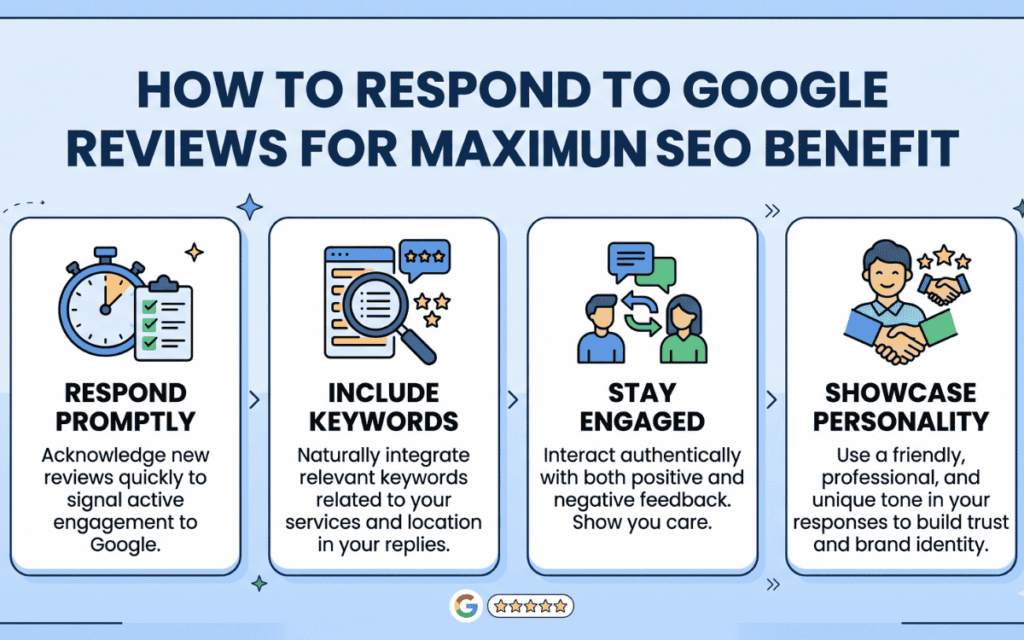
Respond to Every Review – Positive and Negative
Make it a policy to respond to all reviews, not just the ones that feel comfortable. Even a brief, personalised response to a five-star review adds fresh content to your profile and signals engagement to Google.
Respond Within 24 Hours
Speed matters more than most people realise. Set up notifications in your Google Business Profile so you know immediately when a new review arrives. A prompt response demonstrates that your business is active and customer-focused – both of which matter for local rankings.
Personalise Every Response
Generic, copy-pasted responses hurt more than they help. Google can recognise duplicate content, and customers can spot a template instantly. Reference specific details from each review – the service mentioned, the experience described, or the outcome achieved.
For example:
- Weak: “Thank you for your feedback. We appreciate your support!”
- Strong: “Thank you, Sarah! We are so glad the deep tissue massage helped with your back pain. Our team specialises in therapeutic relief – we look forward to seeing you again.”
The second response is personal, specific, and naturally contains relevant service keywords. That is exactly the standard to aim for.
Naturally Include Location and Service Context
When it fits naturally, weave in your location or service category. This reinforces geographic relevance and helps Google connect your profile to specific local searches. Do not force it into every reply – use it where it flows conversationally. Businesses investing in geo-targeting SEO understand that location signals across every touchpoint – including review responses – compound into stronger local authority.
Keep Responses Substantive
Data shows that responses of 50 or more words correlate with better rankings than very short replies. Quality matters more than length, but a thoughtful response that genuinely addresses the reviewer will naturally reach that threshold without padding.
Avoid These Common Mistakes
- Stuffing responses with repetitive keyword phrases
- Using an identical template language across multiple reviews
- Responding defensively or emotionally to criticism
- Ignoring negative reviews entirely
- Responding only to five-star reviews and skipping everything else
The Compound Effect: Reviews, Responses, and Rankings
Review responses do not work in isolation. They are part of a broader content and engagement ecosystem. When you respond well, your ranking improves. Better rankings bring more visibility. More visibility drives more customers. More customers leave more reviews. More reviews give you more opportunities to respond and generate fresh content.
This flywheel builds compounding SEO momentum over time. It connects directly to your organic traffic strategies – the stronger your reputation signals, the more Google trusts your profile, and the more consistently you appear for high-intent local searches.
Additionally, review responses work best alongside a fully optimised Google Business Profile. That means complete business information, regular posts, high-quality photos, and consistent NAP data across all platforms. If you are unsure whether to handle this yourself or bring in help, understanding whether you need to hire an SEO company often comes down to how consistently you can dedicate time to each of these moving parts.
Industry Benchmarks: How Does Your Response Rate Compare?
Here is how response rates look across industries, based on the 5,000-business study:
| Industry | Avg. Response Rate | Top Performers |
| Restaurants | 34% | 85%+ |
| Healthcare | 52% | 95%+ |
| Home Services | 28% | 75%+ |
| Professional Services | 61% | 90%+ |
| Retail | 22% | 70%+ |
| Hospitality | 67% | 95%+ |
Most industries show a significant gap between the average response rate and what top performers achieve. That gap is your competitive opportunity. If your competitors in home services respond to 28% of reviews on average and you respond to 90%, you hold a consistent SEO advantage. This principle applies across every vertical – whether you are running SEO for wedding planners or managing a multi-location service brand.
How SurgeAIO Can Help in Terms of SEO
Managing review responses is just one piece of a complete local SEO strategy. However, it is a piece that compounds quickly – and SurgeAIO gives you the infrastructure to execute it alongside every other SEO priority.
Here is how SurgeAIO supports your local SEO performance:
- Local Rank Tracking – Monitor your Google Business Profile rankings in real time. See the direct impact of your review engagement on local pack positions as it happens.
- Keyword Research and Gap Analysis – Identify the exact terms customers use to find businesses like yours. Naturally incorporate them into review responses and profile content. A solid competitive analysis of keywords reveals exactly which search terms your competitors are winning – and where you have room to take ground.
- Content Optimisation Tools – Build profile posts, landing pages, and business descriptions that reinforce local keyword signals alongside your review strategy.
- AI Visibility Monitoring – Track how your brand appears across AI-powered search results, not just traditional rankings. Understanding AI visibility metrics is increasingly important as Google integrates generative AI into local search.
- Competitor Intelligence – See what your top local competitors are doing with their profiles and reviews. Find the gaps you can exploit before they do.
Whether you handle your own SEO or manage multiple client accounts, SurgeAIO gives you the data and tools to turn review management into a measurable ranking advantage.
Final Thoughts
Does responding to Google reviews help SEO? The data, Google’s own guidelines, and the experience of thousands of local businesses all point to the same conclusion – yes, significantly.
Review responses add fresh content to your profile, signal active engagement, reinforce local keyword relevance, and build the kind of trust that both Google and customers reward. The businesses sitting at the top of local search results are not there by accident. They respond consistently, respond quickly, and respond thoughtfully.
Start today. Check your current response rate. Reply to any unanswered reviews, beginning with the most recent. Then commit to responding to every new review within 24 hours. That discipline – consistently applied – will put you ahead of most local competitors and build a reputation that drives both rankings and revenue.
Frequently Asked Questions
Q1. Does responding to Google reviews directly affect rankings?
Yes. Review responses influence local search rankings through content freshness, engagement signals, keyword reinforcement, and trust indicators. Studies consistently show that businesses with high response rates outrank those that ignore reviews.
Q2. How quickly should I respond to a Google review?
Within 24 hours is the benchmark for maximum SEO benefit. Businesses responding within that window rank an average of 1.6 positions higher than those who wait a week or more. Set up profile notifications so you never miss a new review.
Q3. Should I respond to negative reviews?
Absolutely. Responding professionally to negative reviews demonstrates credibility, can prompt customers to update their rating, and reassures potential customers who read the exchange. Ignoring negative reviews does more long-term damage than the review itself.
Q4. Can I include keywords in my review responses?
Yes – but naturally. Mention your location and service category when it flows conversationally. Never force keywords artificially, as it signals spam to both Google and customers and undermines your credibility.
Q5. How long should a review response be?
Aim for at least 50 words when possible. Longer, personalised responses correlate with stronger ranking signals than brief one-liners. Focus on quality and relevance first – appropriate length will follow naturally.
Q6. Does responding to reviews matter if I already have a high star rating?
Yes. A high rating with no responses signals a passive business. An active response pattern – even on four- and five-star reviews – tells Google your profile is managed, engaged, and relevant. That consistency drives sustained local rankings.
Q7. Can I use AI tools to help write review responses?
Yes, with the right approach. AI-drafted responses that are personalised, unique, and contextually relevant perform just as well as manually written ones. The key is ensuring each response addresses the specific review. Generic AI templates copied across multiple reviews will dilute the SEO benefit significantly.
