Search is no longer what it used to be. For years, marketers focused on one goal – ranking on Google’s first page. Today, a new discipline called GEO (Generative Engine Optimization) is changing the rules entirely. Understanding how does SEO differ from GEO is no longer optional. It is a strategic necessity for any brand that wants to stay visible online.
In this guide, we break down both strategies, highlight key differences, and show you how to use them together for maximum impact.
What Is SEO?
Search Engine Optimization (SEO) is the process of improving your website’s visibility in search engine results pages (SERPs). The goal is simple – rank higher so more people click on your link.
SEO relies on several core pillars:
- On-page optimization – keyword usage, meta tags, headings, and content quality
- Technical SEO – site speed, mobile-friendliness, crawlability
- Off-page SEO – backlinks, domain authority, brand signals
- Local SEO – optimizing for geographic search results
When done right, SEO drives consistent organic traffic to your website over time. It builds authority and generates long-term ROI without relying on paid ads.
What Is GEO?
Generative Engine Optimization (GEO) is a newer practice. It focuses on getting your brand mentioned inside AI-generated answers – not just ranked in a list of links.
AI tools like ChatGPT, Perplexity, Google AI Overviews, and Claude now answer user queries directly. They synthesize information from multiple sources and deliver one confident response. Your brand either gets mentioned in that response – or it doesn’t.
GEO is the process of optimizing your content so that AI models extract it, trust it, and cite it. Understanding what LLM in SEO means is an important starting point for grasping how generative engines work.
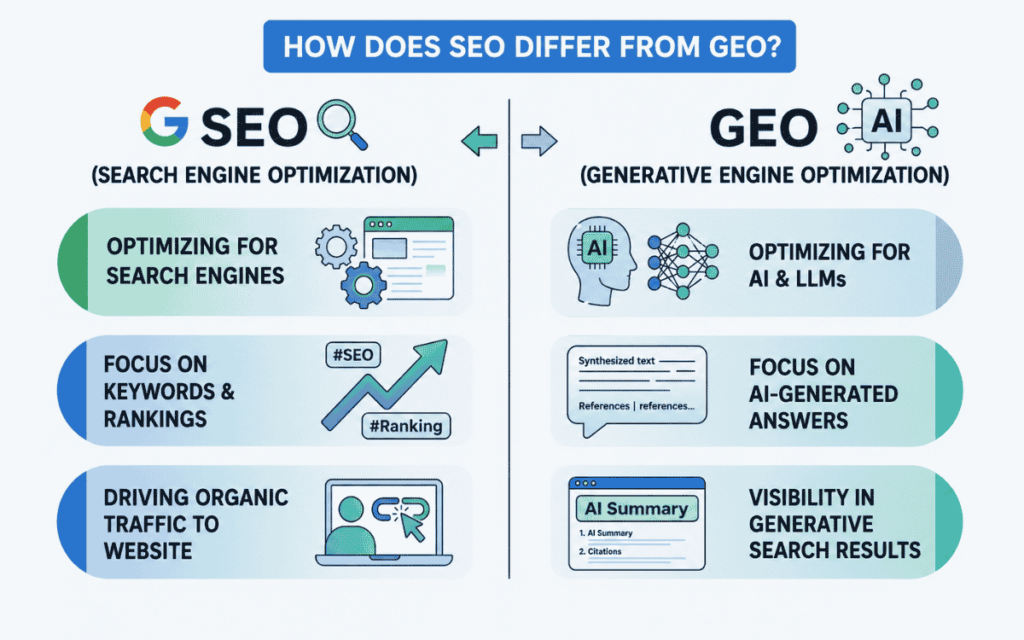
How Does SEO Differ from GEO? The Core Distinctions
Both SEO and GEO aim for visibility. However, they operate in fundamentally different environments. Here is how they compare across key dimensions.
1. The Target Platform
SEO targets traditional search engines – primarily Google and Bing. These engines crawl pages, index content, and return a ranked list of links.
GEO, on the other hand, targets AI-powered platforms. These systems don’t return lists. They generate synthesized, conversational answers. The competition shifts from “which link ranks first” to “which brand gets mentioned at all.”
This is why many marketers now explore what SEO and GEO mean together as part of a unified strategy.
2. Rankings vs. Mentions
In SEO, success is measured by position. If you rank #1, you win clicks.
In GEO, success is measured by mentions. If an AI tool includes your brand in its answer, you gain visibility – even if the user never visits your site.
This is a significant shift. You are no longer competing for a spot on a page. You are competing to be included in a single synthesized response. That response might not even contain a clickable link.
3. Keyword Strategy vs. Topical Authority
SEO uses keywords strategically. You research terms people search for and optimize pages around them. Keywords remain important for SEO, but their role is evolving.
GEO requires something deeper – topical authority. AI models favour sources that consistently provide accurate, well-structured, and authoritative information on a topic. A single well-optimized keyword page won’t cut it. You need a body of credible content that AI systems recognize as trustworthy.
4. Click-Through Rates vs. Answer Inclusion
Traditional SEO success metrics include:
- Organic click-through rate (CTR)
- Impressions in search results
- Time on page and bounce rate
GEO success metrics look very different:
- Brand mention rate in AI responses
- Position within AI-generated answers
- Frequency of recommendation by AI tools
- Sentiment of the mention (positive, neutral, negative)
Users who receive an AI-generated answer may never click through to any website. Therefore, optimizing purely for clicks no longer captures the full picture of digital visibility.
5. Content Structure
SEO content is built around headers, keywords, internal links, and readability. Search engines crawl and index these signals to decide where to rank your page.
GEO content must be structured for extraction. AI models pull specific facts, claims, and data points from your content to synthesize into answers. Clear attribution, structured data, and authoritative sourcing matter enormously. If your content is vague or disorganized, AI models will simply skip it and cite a competitor instead.
This is why AI visibility optimization techniques are rapidly becoming a core competency for content teams.
Where SEO and GEO Overlap
Despite their differences, SEO and GEO share several common foundations.
Quality content matters for both. Whether you want to rank on Google or get cited by ChatGPT, shallow content won’t work. Both strategies reward original, accurate, and well-structured writing.
Backlinks and authority still count. GEO platforms tend to cite sources that already have strong domain authority. Your SEO link-building efforts directly support your GEO performance.
Technical foundations are shared. Fast-loading, well-structured, crawlable websites perform better in both ecosystems.
Many businesses now pursue SEO and GEO for their website simultaneously, treating them as complementary disciplines rather than competing ones.
Why GEO Is Becoming Impossible to Ignore
The rise of AI Overviews in Google Search has changed how millions of users interact with search results. A large share of queries now get an AI-generated summary at the top of the page – before any organic results appear.
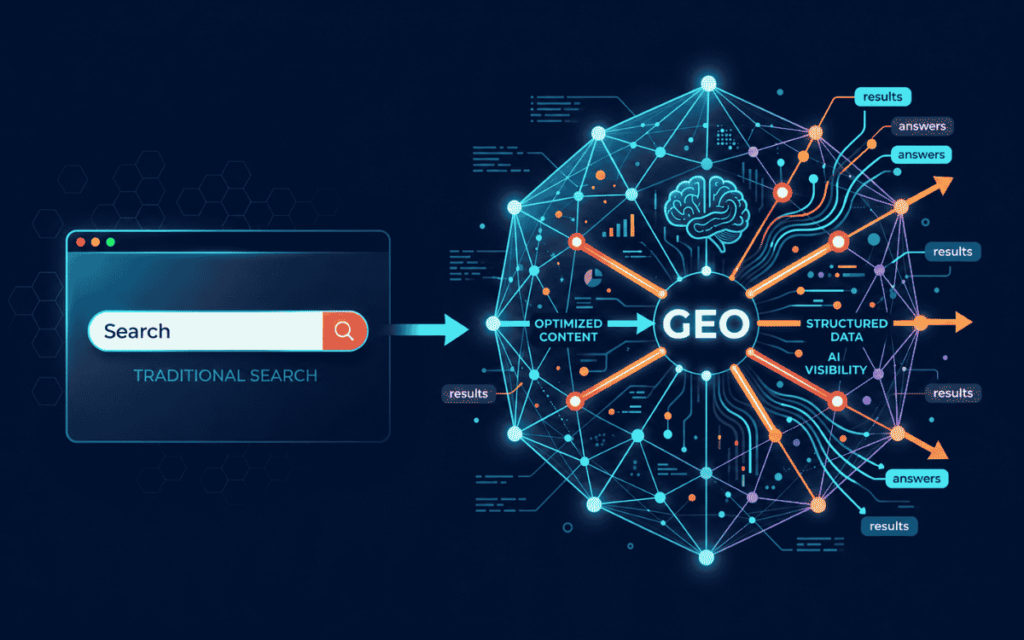
If your brand isn’t included in that summary, users may never scroll down to find you.
Understanding how AI Overviews will change SEO is critical for any business investing in organic growth. The traffic dynamics are shifting – and fast.
Moreover, standalone AI tools like ChatGPT and Perplexity are now primary research tools for a growing number of users. These platforms don’t show organic rankings. They show synthesized answers. Brands that ignore GEO risk are becoming invisible to an entirely new category of searcher.
How to Combine SEO and GEO Effectively
You don’t have to choose one over the other. The most effective approach is an integrated strategy.
Here’s how to build one:
Start with strong SEO fundamentals. Build a technically sound website, create high-quality content, and earn authoritative backlinks. These foundations support both traditional rankings and AI visibility.
Layer in GEO-specific content practices. Write content that AI models can easily extract. Use clear headings, concise definitions, structured data, and factual claims with proper attribution.
Track your AI visibility separately. Use tools designed to monitor brand mentions in AI responses. Standard SEO dashboards won’t capture this data.
Audit your content for topical depth. AI models favour comprehensive topic coverage. Thin content on a keyword won’t earn mentions. Build out full topic clusters that demonstrate genuine expertise.
Optimize for geo targeting in SEO where relevant. For local businesses, combining geographic optimization with AI visibility strategies creates a powerful dual advantage.
How SurgeAIO Can Help in Terms of SEO
SurgeAIO is built for the era where SEO and GEO must work together. It provides businesses with the tools to manage both traditional search optimization and AI visibility – from a single platform.
Here’s what SurgeAIO brings to the table:
AI Visibility Tracking – SurgeAIO monitors how and where your brand appears in AI-generated responses across major platforms. You can see your mention rate, position within responses, and how that changes over time.
Content Optimization Tools – The platform helps you create content structured for both Google rankings and AI extraction. It identifies gaps in your topical coverage and suggests improvements based on real performance data.
Keyword and GEO Analysis – SurgeAIO helps you find the right keywords while also mapping out how AI engines are likely to interpret your content. This dual-layer analysis gives you an edge over competitors still operating in SEO-only mode.
Competitor Intelligence – Understand how your competitors are performing in both traditional SERPs and AI-generated answers. Identify where they’re winning mentions and where you can outmanoeuvre them.
Technical SEO Foundation – SurgeAIO audits your site for the technical issues that affect both search rankings and AI crawlability. A clean, fast, well-structured site performs better across all channels.
Whether you’re a startup building your first SEO strategy or an established brand pivoting to include AI visibility, SurgeAIO gives you the data and tools to act confidently.
Final Thoughts
Understanding how does SEO differ from GEO is no longer a theoretical exercise. It is a practical requirement for any marketer serious about long-term visibility.
SEO gets you ranked in Google. GEO gets you mentioned in AI-generated answers. Both matter. Both require strategy. And both are best managed together.
The businesses that will thrive in the next phase of digital marketing are those that stop treating SEO and GEO as separate conversations – and start building strategies that address both, intelligently and simultaneously.
SurgeAIO is designed to help you do exactly that.
Frequently Asked Questions
Q1. Is GEO replacing SEO?
No. GEO is complementing SEO, not replacing it. Traditional search engines still drive significant traffic. However, ignoring GEO means missing a growing share of AI-driven visibility. Both strategies are now essential.
Q2. Do I need separate content for SEO and GEO?
Not necessarily. High-quality, well-structured content works for both. However, GEO requires additional attention to content clarity, factual attribution, and structured formatting that AI models can easily extract.
Q3. What platforms does GEO target?
GEO targets AI-powered tools and platforms, including ChatGPT, Google AI Overviews, Perplexity, Claude, Gemini, and similar tools that generate synthesized answers rather than ranked link lists.
Q4. How do I measure GEO performance?
Unlike SEO, GEO performance is measured by brand mention rate, position within AI responses, and recommendation frequency across AI platforms. Specialised tools are required to track these metrics accurately.
Q5. Does local SEO still matter with GEO?
Absolutely. Local businesses benefit from both local SEO and local GEO strategies. AI tools increasingly provide location-specific recommendations. Optimizing for both increases your chances of appearing in local AI-generated answers.
Q6. Is GEO relevant for small businesses?
Yes. AI tools don’t only favour large brands. Well-structured, authoritative content from any business size can earn AI mentions. Small businesses that adopt GEO early will have a significant competitive advantage.
