If you’ve researched search engine optimization even briefly, you’ve come across the term “backlink.” But what is a backlink in SEO, and why do so many strategies revolve around building them?
A backlink is a hyperlink from one website that points to a page on another website. Search engines like Google treat these links as votes of confidence. When a reputable site links to your content, it signals that your page offers something valuable, trustworthy, or worth referencing.
In this guide, we’ll define backlinks clearly, walk through real examples, and explain why they remain one of the most important ranking factors in modern SEO.
What Is a Backlink in SEO?
A backlink, also called an inbound link or incoming link, is created when one website links to a page on a different website. If Site A links to Site B, that link counts as a backlink for Site B.
Search engines use these connections to evaluate authority, relevance, and trustworthiness. Essentially, every backlink acts like a small endorsement. The more high-quality endorsements a page earns, the more likely search engines are to rank it favourably.
Backlinks differ from internal links, which connect pages within the same website. While internal links help with site structure and navigation, backlinks influence how external, independent sources perceive your credibility. Understanding this distinction matters when building your overall SEO strategy, especially when deciding which keywords are important for SEO alongside your link-building efforts.
What Is a Backlink in SEO With Example?
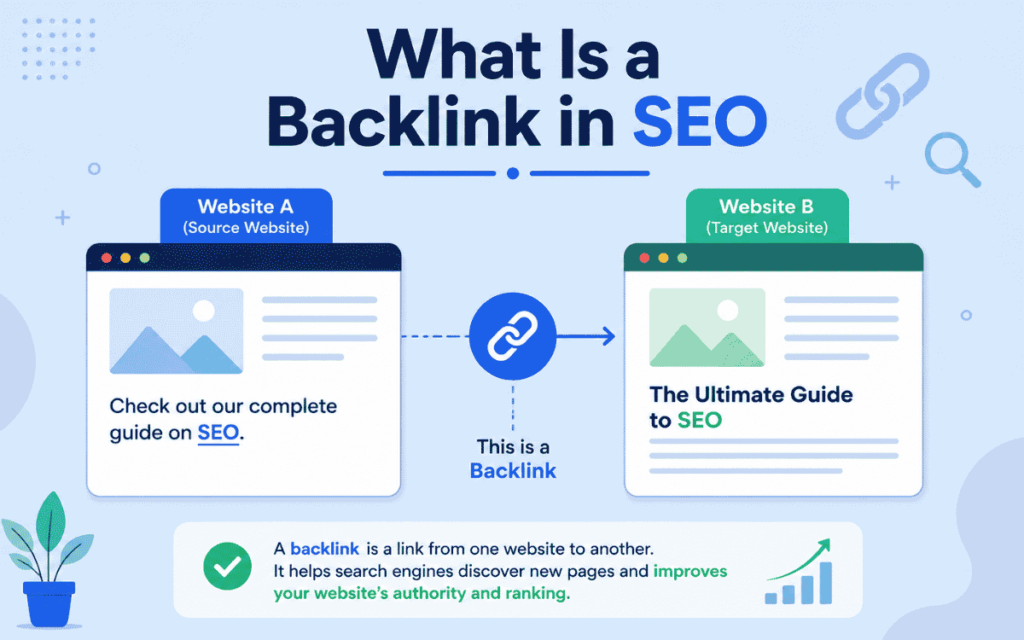
To make this concept concrete, let’s look at a simple example.
Imagine a nutrition blog publishes an article about protein intake. If a university’s health department website links to that article as a credible source, that link is a backlink pointing to the nutrition blog.
Here’s what that might look like in practice:
- Linking source: A university health department webpage
- Linked target: The nutrition blog’s protein intake article
- Anchor text: “recommended daily protein intake”
- Context: The link appears naturally within an educational paragraph
This example illustrates why backlinks from educational or government domains often carry extra weight. They’re seen as trustworthy, unbiased sources, so a link from one signals strong credibility to search engines.
Another common example involves guest posting. If a marketing consultant writes a guest article for an industry publication and includes a link back to their own service page, that link becomes a backlink – provided it’s placed naturally and adds value to readers.
Why Are Backlinks Important in SEO?
Backlinks influence far more than just rankings. They affect how search engines discover, evaluate, and trust your website as a whole.
Here’s why they matter so much:
- Ranking signals – Search algorithms use backlink quantity and quality to help determine how authoritative a page is.
- Referral traffic – Every backlink is a potential doorway for new visitors clicking through from another site.
- Crawling and indexing – Search engine bots follow links to discover new pages, making backlinks a pathway for content discovery.
- Brand credibility – Being linked to by respected sites builds recognition and trust within your industry.
- Competitive positioning – A stronger backlink profile often helps you outrank competitors targeting the same keywords.
Because backlinks influence so many outcomes at once, they remain a core focus for any serious SEO strategy. If you’re unsure how many you actually need, this guide on how many backlinks you need breaks down realistic benchmarks based on competition and industry.
Types of Backlinks You Should Know
Not all backlinks carry equal value. Understanding the different types helps you evaluate which links are worth pursuing.
1. Natural Backlinks
These links are earned organically when other sites find your content valuable enough to reference without being asked. Natural backlinks typically carry strong SEO value because they reflect genuine editorial trust.
2. Manually Built Backlinks
These come from deliberate outreach efforts, such as asking a partner site to link to a resource page or negotiating a placement within an article.
3. Editorial Backlinks
An editorial backlink happens when a website links to your content purely because it adds value, without any request from you. These are often considered the gold standard of link building.
4. Guest Post Backlinks
Acquired by contributing content to another website in exchange for a link back to your own site. When done thoughtfully, guest posting benefits both the publishing site and the linked page.
5. Nofollow vs. Dofollow Backlinks
- Dofollow links pass SEO value, known as “link equity,” to the linked page.
- Nofollow links include a tag telling search engines not to pass that value, though they can still drive referral traffic.
6. Contextual Backlinks
These links sit naturally within the body of relevant content, surrounded by related text. They’re generally viewed as more valuable than links placed in footers or sidebars.
What Makes a Backlink High Quality?
Not every link boosts your rankings equally. Search engines evaluate several factors to determine how much value a backlink actually passes along.
The strongest backlinks typically share these traits:
- They come from established, reputable websites within a relevant industry
- They use natural, relevant anchor text rather than forced keyword phrases
- They’re placed within genuinely useful content, not spammy directories
- They originate from diverse domains rather than a single repeated source
- They point to functional, high-quality pages rather than broken or thin content
Building this kind of link profile takes time and consistency. Many businesses choose to work with specialized partners to manage outreach efficiently, and reviewing backlink companies for SEO can help you understand what a credible partnership should look like.
How Are Backlinks Different From Internal Links?
It’s easy to confuse backlinks with regular internal links, but they serve very different purposes.
| Aspect | Backlink | Internal Link |
| Direction | Comes from an external website | Stays within your own website |
| Primary purpose | Builds authority and trust | Improves navigation and structure |
| SEO impact | Major ranking factor | Supports crawlability and user flow |
| Difficulty to acquire | Requires outreach or organic earning | Fully within your control |
Both link types matter, but backlinks specifically influence how external sources vouch for your site’s credibility.
How to Start Building Backlinks
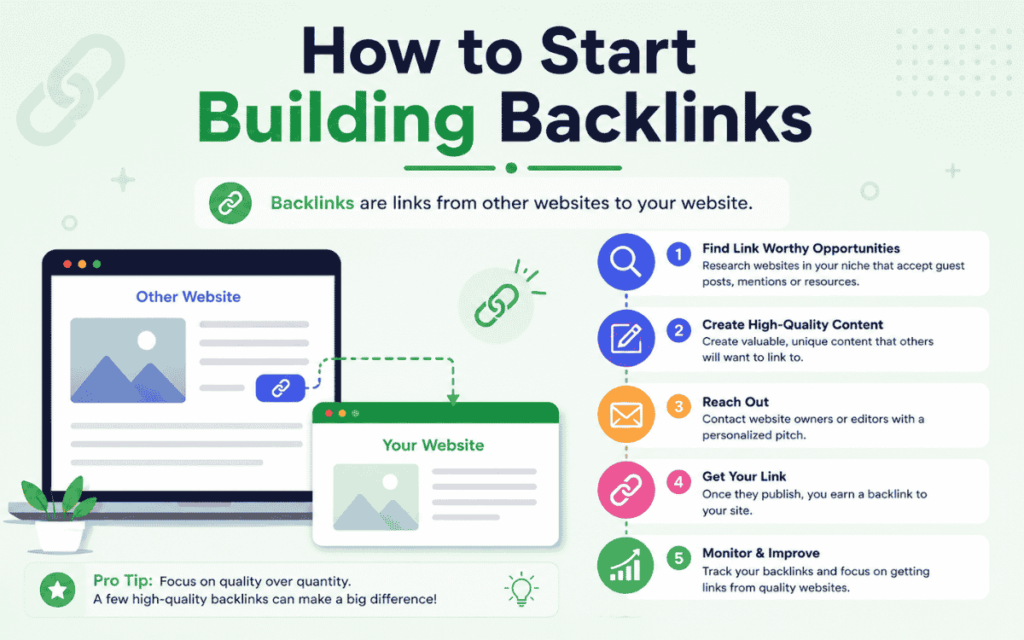
If you’re building a link strategy from scratch, start with approaches that prioritize quality over volume.
Consider these methods:
- Create genuinely useful content – Original research, in-depth guides, and helpful tools naturally attract links over time.
- Try broken link building – Find broken links on relevant sites and suggest your content as a replacement.
- Pursue guest posting – Contribute valuable articles to reputable publications within your niche.
- Reclaim unlinked mentions – Search for instances where your brand is mentioned without a link, then request one.
- Build relationships with journalists – Digital PR can earn high-authority backlinks from major publications.
Consistency matters more than speed here. Since SEO takes time to show measurable results, a steady, ethical link-building approach tends to outperform rushed tactics that risk penalties.
How to Check Your Backlinks
Monitoring your backlink profile helps you understand what’s working and catch potentially harmful links early.
Common ways to check backlinks include:
- Using backlink checker tools that show referring domains and anchor text
- Reviewing the “Links” report inside Google Search Console
- Inspecting page source code for anchor tags manually
- Using browser extensions built for SEO analysis
- Tracking link acquisition alongside broader content performance data to see which pages attract the most external interest
Regular monitoring also helps you spot low-quality or spammy links that could require disavowing to protect your site’s reputation.
Common Backlink Mistakes to Avoid
Even well-intentioned link-building efforts can backfire if certain mistakes go unnoticed.
Watch out for:
- Buying links in bulk – This violates search engine guidelines and risks penalties.
- Over-optimizing anchor text – Repeating exact-match keywords across every link looks unnatural to algorithms.
- Ignoring relevance – A backlink from an unrelated industry carries far less value than one from a topically relevant source.
- Focusing only on quantity – A handful of authoritative links often outperforms dozens of weak ones.
- Neglecting your own content quality – No outreach strategy compensates for content that isn’t genuinely worth linking to.
Since content quality directly determines whether links get earned naturally, it’s also worth understanding whether AI-generated content hurts SEO, especially if AI tools play a role in your content production process.
How SurgeAIO can help in terms of SEO
Building a strong, sustainable backlink profile takes strategy, patience, and the right relationships – and most businesses don’t have the time to manage outreach while also running daily operations. That’s where SurgeAIO comes in.
SurgeAIO helps identify link-building opportunities that align with your industry, content, and long-term ranking goals. Instead of chasing risky shortcuts, SurgeAIO focuses on earning backlinks that genuinely strengthen your site’s authority and visibility across both traditional search and AI-driven platforms. If you’re ready to build a backlink profile that actually moves rankings forward, SurgeAIO can help you get there efficiently.
Final Thoughts
Backlinks remain one of the clearest signals search engines use to judge a page’s authority and trustworthiness. Whether earned through original research, guest contributions, or genuine editorial mentions, quality backlinks consistently outperform shortcuts.
Ultimately, the businesses that treat link building as a long-term relationship-driven process – rather than a quick fix – are the ones that see lasting improvements in their search visibility.
FAQ
What is a backlink in SEO with a simple example?
A backlink is when another website links to your page. For example, a university site linking to your research article counts as a backlink.
Are all backlinks good for SEO?
No. Quality matters more than quantity. Links from reputable, relevant sites help far more than links from spammy or unrelated domains.
What’s the difference between dofollow and nofollow backlinks?
Dofollow links pass SEO value to the linked page, while nofollow links tell search engines not to pass that value, though they can still bring traffic.
How many backlinks do I need to rank well?
There’s no fixed number. It depends on your industry, competition, and the authority of the linking domains.
Can too many backlinks hurt my website?
Yes, if they’re low-quality, spammy, or acquired through manipulative tactics like buying links in bulk.
How long does it take to see results from backlinks?
Results vary, but building sustainable authority through backlinks typically takes several months of consistent effort.
