Every day, millions of people search for businesses near them. They type “plumber near me,” “best coffee shop in [city],” or “dentist open now” – and Google delivers a list of local results within seconds. The businesses that appear at the top of those results are not there by luck. They’ve invested in local SEO.
Understanding how local SEO helps attract local customers is one of the most valuable things a small or medium business owner can do in 2025. This guide breaks down exactly how it works, what strategies drive results, and how to build a local SEO presence that consistently brings customers through your door.
What Is Local SEO?
Local SEO is the process of optimising your online presence to attract customers from specific geographic areas. Unlike traditional SEO, which targets broad, national audiences, local SEO focuses on connecting your business with people who are physically nearby and actively searching for what you offer.
When someone searches for a product or service with local intent, Google surfaces three types of results:
- The Local Pack – a map-based section showing three nearby businesses with ratings, addresses, and contact details
- Google Maps results – an extended map view of local businesses
- Organic local results – standard search results that feature locally relevant pages
Appearing in the Local Pack alone can transform a business’s visibility. It sits above organic results and captures a significant share of clicks from high-intent local searchers.
Local SEO is particularly powerful for service-based businesses. Understanding SEO for home service leads demonstrates how plumbers, electricians, cleaners, and similar businesses generate consistent, qualified leads through local search optimisation.
Turn AI Visibility Into Real Revenue.
Automate Leads With SurgeAIO. Don’t Let AI Ignore Your Brand.
Why Local SEO Matters More Than Ever
Consumer behaviour has shifted dramatically toward local, mobile-first search. Consider these realities:
- A large majority of local searches on smartphones result in a visit to a business within 24 hours
- “Near me” searches have grown consistently year over year
- Most people who search locally with purchase intent visit or contact a business the same day
- Local search results receive significantly higher click-through rates than national results for location-based queries
Moreover, local SEO levels the playing field. A well-optimised local business can outrank a national competitor in its own geographic area. This is a unique advantage that smaller businesses can genuinely exploit – if they approach local SEO with the right strategy.
How Local SEO Helps Attract Local Customers: 8 Core Ways
1. Improved Visibility in Local Search Results
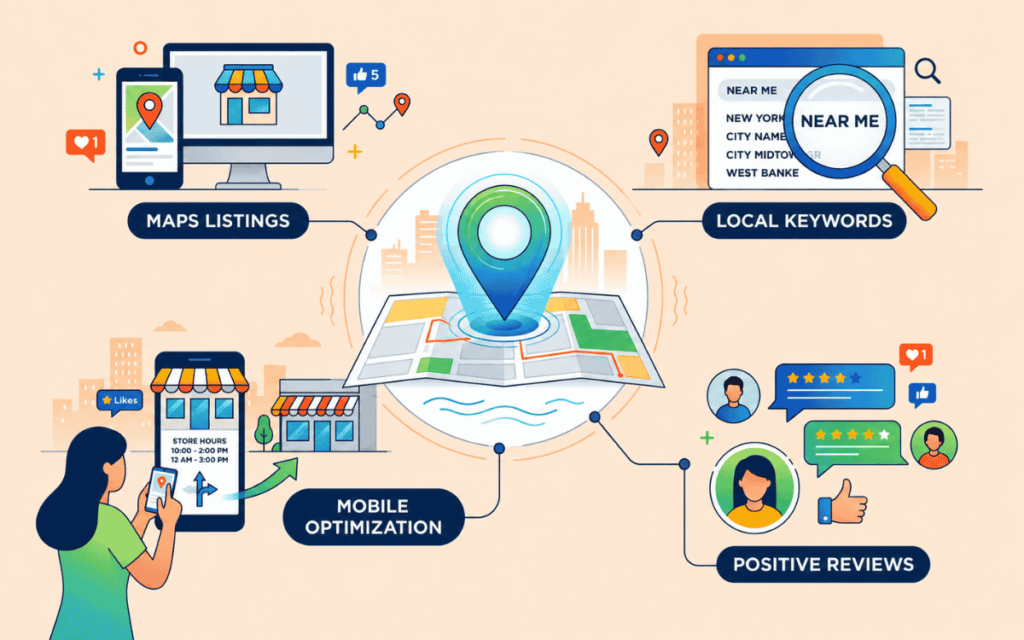
The most direct way local SEO helps attract local customers is by making your business visible when and where it matters most. When a nearby customer searches for your category of service, local SEO ensures your business appears prominently – in the Local Pack, on Google Maps, and in organic results.
Each of these placements drives traffic with strong local intent. Users searching locally are not browsing casually. They are looking for a business to contact, visit, or purchase from. Appearing in front of them at that precise moment is enormously valuable.
Location-specific keyword targeting is central to this. Optimising your pages and content for terms like “your service + city” or “your service + near me” signals to Google that your business is relevant to searches in that area.
2. Google Business Profile Optimisation
Your Google Business Profile (GBP) – formerly Google My Business – is the single most important local SEO asset for most businesses. It controls how your business appears in the Local Pack, Google Maps, and the knowledge panel in search results.
A fully optimised Google Business Profile includes:
- Accurate business name, address, and phone number (NAP)
- Correct business category and subcategories
- Comprehensive business description with relevant keywords
- Up-to-date opening hours, including holiday hours
- High-quality photos of your premises, products, or team
- Regular Google Posts sharing offers, news, and updates
- Responses to all customer reviews
An incomplete or unverified GBP listing weakens your local visibility. Conversely, a well-maintained profile increases your credibility and directly improves your chances of appearing in the Local Pack.
3. Targeting High-Intent Local Searchers
Local search traffic is some of the highest-quality traffic available to any business. People searching locally are typically close to a purchasing decision. They know what they want. They just need to find the right provider nearby.
This is fundamentally different from broad informational search traffic. A person searching “best accounting software” is researching. A person searching “accountant in Manchester” is ready to hire.
SEO services for accountants illustrate this perfectly – local keyword targeting converts at significantly higher rates than national keyword strategies for service professionals whose clients come from a defined geographic area.
Turn AI Visibility Into Real Revenue.
Automate Leads With SurgeAIO. Don’t Let AI Ignore Your Brand.
4. Building Trust Through Online Reviews
Online reviews are a powerful trust signal – both for potential customers and for search engines. Google considers review quantity, quality, and recency as ranking factors in local search.
A business with 200 positive reviews and a 4.7 star rating will consistently outperform a competitor with 20 reviews, even if the competitor’s service is equivalent.
Effective review strategies include:
- Actively asking satisfied customers to leave Google reviews
- Responding promptly to all reviews – positive and negative
- Addressing negative feedback professionally and constructively
- Using review content to identify and improve service gaps
Positive reviews build trust before a customer even visits your website. They signal social proof at the exact moment someone is deciding which local business to choose.
5. Mobile Search Dominance
The majority of local searches happen on mobile devices. Someone standing on a street corner, sitting in a waiting room, or driving past a neighbourhood will pull out their phone to find a nearby business.
Mobile optimisation is therefore inseparable from local SEO success. A slow, mobile-unfriendly website loses local customers at the point of discovery – even if it ranks well in search results.
Mobile-optimised local SEO ensures:
- Fast page load times on mobile connections
- Click-to-call buttons that connect searchers instantly
- Easy-to-read contact information and directions
- Maps integration that opens seamlessly on mobile devices
- Simple, conversion-focused page layouts on smaller screens
AI local SEO is also reshaping how mobile local searches deliver results – with AI-generated answer summaries increasingly featuring local business recommendations based on structured data, reviews, and location signals.
6. Local Landing Pages That Drive Conversions
For businesses serving multiple locations or a wide geographic area, local landing pages are one of the most effective tools in local SEO.
A local landing page is a dedicated page optimised for a specific city, neighbourhood, or region. It includes location-specific content, local keywords, relevant testimonials, and contact information tailored to that area.
These pages help you rank for location-specific searches without competing on a broad national level. They also improve user experience by presenting locally relevant information – rather than forcing a visitor in Birmingham to read about services in London.
Creating content for local landing pages for SEO is a proven strategy for expanding local reach across multiple service areas while maintaining relevance and specificity in each market.
7. Local Citations and NAP Consistency
A local citation is any online mention of your business’s name, address, and phone number (NAP). Citations appear on business directories, review platforms, social media profiles, and industry-specific listing sites.
Consistent, accurate citations across the web reinforce your business’s legitimacy and location signals to search engines. Inconsistencies – different phone numbers, misspelled addresses, or outdated information – confuse both search engines and customers.
Key citation sources for local SEO include:
- Google Business Profile
- Bing Places for Business
- Apple Maps
- Yelp
- Facebook Business Page
- Industry-specific directories relevant to your sector
- Local Chamber of Commerce listings
Building and maintaining clean, consistent citations is foundational local SEO work. It requires regular auditing to catch and correct any inconsistencies that emerge over time.
8. Local Link Building
Earning links from other locally relevant websites is one of the strongest local ranking signals available. Local links tell Google that your business is genuinely embedded in its community – not just geographically present, but actively part of the local ecosystem.
Turn AI Visibility Into Real Revenue.
Automate Leads With SurgeAIO. Don’t Let AI Ignore Your Brand.
Effective local link-building strategies include:
- Sponsoring local events or charities that publish sponsor lists online
- Getting featured in local news publications or community blogs
- Partnering with complementary local businesses for cross-promotions
- Joining local business associations that link to member websites
- Contributing expert commentary to local publications
Backlink companies for SEO can help accelerate link acquisition – but for local SEO, organic community-based link building often delivers the strongest and most durable results.
Local SEO Strategies by Business Type
Local SEO is not one-size-fits-all. Different business types require tailored approaches.
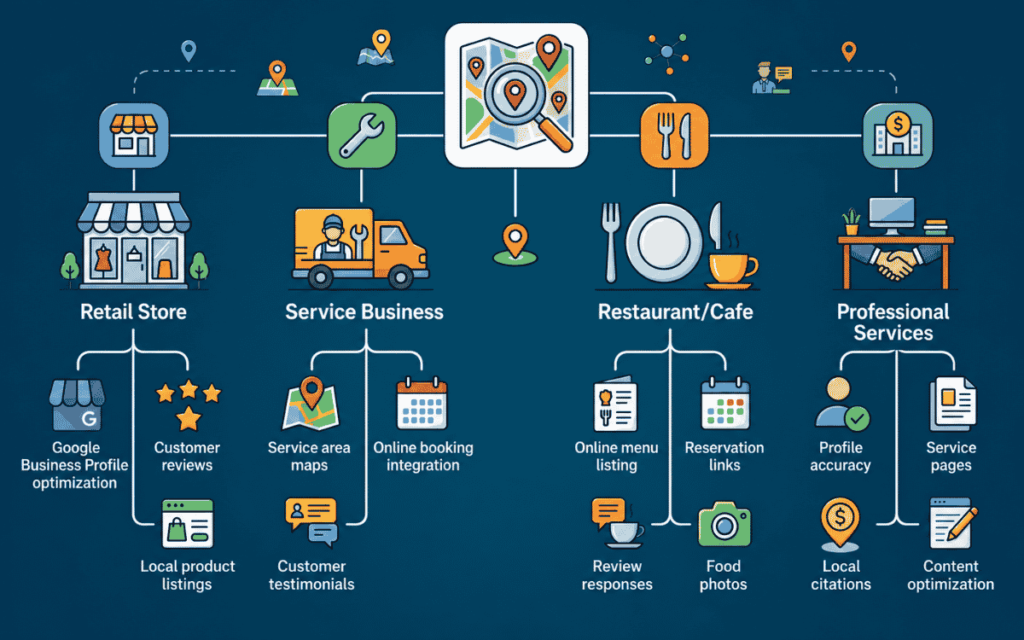
Service-Area Businesses (plumbers, electricians, cleaners) – Focus on city-specific landing pages, Google Business Profile service areas, and review generation. You may not have a physical storefront – your GBP should reflect a service area rather than a fixed address.
Brick-and-Mortar Retail – Prioritise Google Maps visibility, in-store visit tracking, and local inventory optimisation. Photos and opening hours are critical for this category.
Professional Services (lawyers, accountants, doctors) – Build trust through detailed local landing pages, professional credentials, and consistent review management. High-value clients research thoroughly before committing.
Restaurants and Hospitality – Menu optimisation, booking integrations, photo-rich GBP profiles, and active management of review platforms like TripAdvisor and Yelp are essential.
For medical and aesthetic services in particular, lead generation for aesthetic clinics shows how local SEO combined with targeted content strategies consistently fills appointment books with qualified local patients.
Measuring Local SEO Success
Tracking the right metrics ensures your local SEO investment is delivering tangible results.
Key local SEO metrics to monitor:
- Local Pack rankings – position in the map-based results for target keywords
- Google Business Profile insights – views, clicks, calls, and direction requests
- Organic traffic from local searches – tracked by geography in Google Analytics
- Phone call volume – attributed to organic local search via call tracking
- Review count and average rating – tracked over time across all platforms
- Local keyword rankings – position in organic results for location-specific terms
- Conversion rate from local landing pages – form submissions and calls per visit
Review these metrics monthly. Local SEO compounds over time – consistent optimisation produces accelerating results as authority and trust build.
How SurgeAIO Can Help in Terms of SEO
SurgeAIO provides businesses with the tools and intelligence to execute a powerful local SEO strategy – from initial setup through ongoing optimisation and reporting.
Here is how SurgeAIO supports local customer acquisition:
Local Keyword Research – SurgeAIO identifies the highest-value local search terms for your business category and geographic area. Find the queries your target customers are actually using – then build content and optimisation around them.
Local Ranking Tracking – Monitor your rankings for local keywords across specific cities and neighbourhoods. Track your Local Pack position alongside organic rankings to get a complete picture of your local visibility.
Google Business Profile Optimisation Guidance – SurgeAIO analyses your GBP setup and identifies specific improvements that will strengthen your Local Pack presence – from category selection to photo optimisation and post frequency.
Local Landing Page Strategy – The platform helps you plan and optimise location-specific landing pages across your service area – ensuring each page is properly structured, keyword-optimised, and internally linked.
Turn AI Visibility Into Real Revenue.
Automate Leads With SurgeAIO. Don’t Let AI Ignore Your Brand.
Technical SEO Auditing – Local SEO depends on a technically sound website. SurgeAIO audits for crawlability issues, mobile performance problems, and page speed bottlenecks that silently undermine local rankings.
AI Visibility for Local Search – As AI Overviews and AI-generated local recommendations become more prevalent, SurgeAIO tracks your brand’s presence in AI-generated local search results – a growing source of local customer discovery.
Competitor Intelligence – Understand which local competitors are winning in your market, which keywords they rank for, and where their local SEO strategy has gaps you can exploit.
Whether you’re a single-location business or managing SEO across multiple service areas, SurgeAIO gives you the data and tools to attract more local customers consistently.
Final Thoughts
How local SEO helps attract local customers is not a complicated story. It puts your business in front of people who are nearby, searching for exactly what you offer, and ready to act. That combination of proximity, intent, and timing is extraordinarily powerful.
The businesses winning in local search are not necessarily the largest or the best-funded. They’re the ones that have claimed and optimised their online presence, built trust through reviews, created locally relevant content, and earned local authority through consistent effort.
Start with your Google Business Profile. Build your local citations. Create location-specific content. And track your results consistently. Local SEO rewards patience and consistency – and the businesses that commit to it reap the rewards for years.
Frequently Asked Questions
Q1. How long does local SEO take to show results?
Most businesses see meaningful improvement in local rankings and traffic within 3 to 6 months of consistent local SEO effort. Google Business Profile optimisation often shows faster results – sometimes within weeks. More competitive markets may take longer to see significant movement.
Q2. Is local SEO only for small businesses?
No. Local SEO is valuable for any business that serves customers in a specific geographic area – regardless of size. National brands with local branches, franchises, and multi-location businesses all benefit significantly from local SEO investment.
Q3. Do I need a website for local SEO?
A website is highly recommended but not strictly required. You can appear in local search results through your Google Business Profile alone. However, a well-optimised website dramatically strengthens your local rankings and gives you far more control over your online presence.
Q4. How important are reviews for local SEO?
Reviews are extremely important. They influence both your local rankings and your click-through rate. Businesses with more positive reviews consistently attract more clicks and conversions. Actively managing your review profile is one of the highest-ROI local SEO activities available.
Q5. What is the difference between local SEO and regular SEO?
Regular SEO targets broad national or global audiences. Local SEO targets customers in a specific geographic area. Local SEO uses additional signals – Google Business Profile, NAP citations, local reviews, and location-specific content – that are not relevant to standard SEO campaigns.
Q6. Can local SEO work for service-area businesses without a physical address?
Yes. Service-area businesses – those that travel to customers rather than having a storefront – can configure their Google Business Profile to show a service area rather than a physical address. All other local SEO strategies apply equally.
Q7. How do online reviews affect local rankings?
Google uses review signals as a ranking factor in local search. The quantity, quality, recency, and diversity of reviews all contribute to your local ranking strength. Businesses that actively generate and respond to reviews consistently outperform those that ignore this element of local SEO.
