surgeaio.com

SurgeAIO — Navbar Mobile CTA

Why LLM SEO Matters: Staying Visible in the Age of AI‑Powered Search

why llm seo matter

Traditional SEO is no longer sufficient. As AI and large language models (LLMs) like ChatGPT, Google’s Gemini, and Perplexity become the dominant sources of information discovery, LLM SEO has rapidly emerged as a crucial strategy. 

This new approach ensures brands are not only visible in search results, but actively cited in AI-generated answers.


In this article, you’ll discover:

  • What LLM SEO is, and how it differs from traditional SEO
  • Why it’s essential for modern brands
  • Strategies to align your content with both traditional search and generative AI
  • Steps to future-proof your content pipeline for AI‑driven visibility

What Is LLM SEO?

LLM SEO, also known as Large Language Model Optimization, Generative Engine Optimization (GEO), Answer Engine Optimization (AEO), or AI SEO, refers to optimizing web content so it can be understood, retrieved, and cited by generative AI models 

Unlike traditional SEO that focuses on backlinks, keyword ranking, and link‑based discovery, LLM SEO centers on semantic relevance, topical authority, conversational clarity, and structured content that matches how AI systems interpret queries

The AI Search Revolution: Why It Matters Now

a) Shake‑Up of Traditional Search Traffic

Recent studies show that up to 80% of consumers resolve 40% of searches without clicking links, thanks to AI summaries on search engines and generative LLM tools. As a result, many brands are experiencing traffic declines even though their content remains relevant to users.

In response, companies like Mailchimp have adapted by optimizing their technical stack and page structure to serve AI crawlers better, emphasizing fast load speeds, accessible metadata, and “LLMs.txt” files to signal AI readiness.

b) AI Traffic Is Exploding

While still smaller than Google search volume, LLM‑driven traffic is growing fast. ChatGPT reportedly processes about 1 billion searches per week, up from nearly zero just a year ago, and usage increases by the month.

Projections suggest AI‑powered discovery may surpass traditional organic search traffic by as early as 2027–2028.

c) Zero‑Click, Citation‑Based Visibility

LLM SEO teaches that rank and click‑through aren’t the only metrics anymore. Becoming the answer, even without clicks, builds brand awareness, trust, and eventually branded searches.
Core Principles of Effective LLM SEO

a) Structure Content for Retrieval

AI models favor well-structured information, clear headings, Q&A formats, data tables, lists, and FAQ sections. These formats make content easy for models to parse, retrieve, and cite.

Creating comparison articles, “best of” lists, and transparent decision criteria increases the likelihood of being included in AI answers, even if you don’t rank on page one of Google 

b) Write Conversationally and Contextually

LLMs process intent and semantics, not just keywords. A conversational tone that answers probable user questions naturally improves relevance in generative summaries.

Use plain language, answer real questions up front, and avoid keyword stuffing.

c) Build Topical Authority (Depth Over Brevity)

Deep, well-reasoned content that covers multiple angles of a topic is preferred by LLMs. Truly owning a concept, with context, definitions, case studies, and reasoning, enhances your chances of being pulled into generated responses.

Vercel’s engineering blog puts it well: “LLM SEO is the art of becoming the answer”

d) Maintain Technical Friendliness

Just like SEO, technical factors still matter. Ensure clean code, fast page load, structured data, crawlable content, and optionally an llms.txt file to guide AI indexing.

e) Seed Your Content Strategically (LLM Seeding)

Publish content that is likely to get scraped and cited, on your own site and external platforms (guest posts, industry sites, forums), with structured formats and authoritative tone. This method, called LLM seeding, builds AI citations organically

AEO, GEO, AIO, Understanding the Terminology

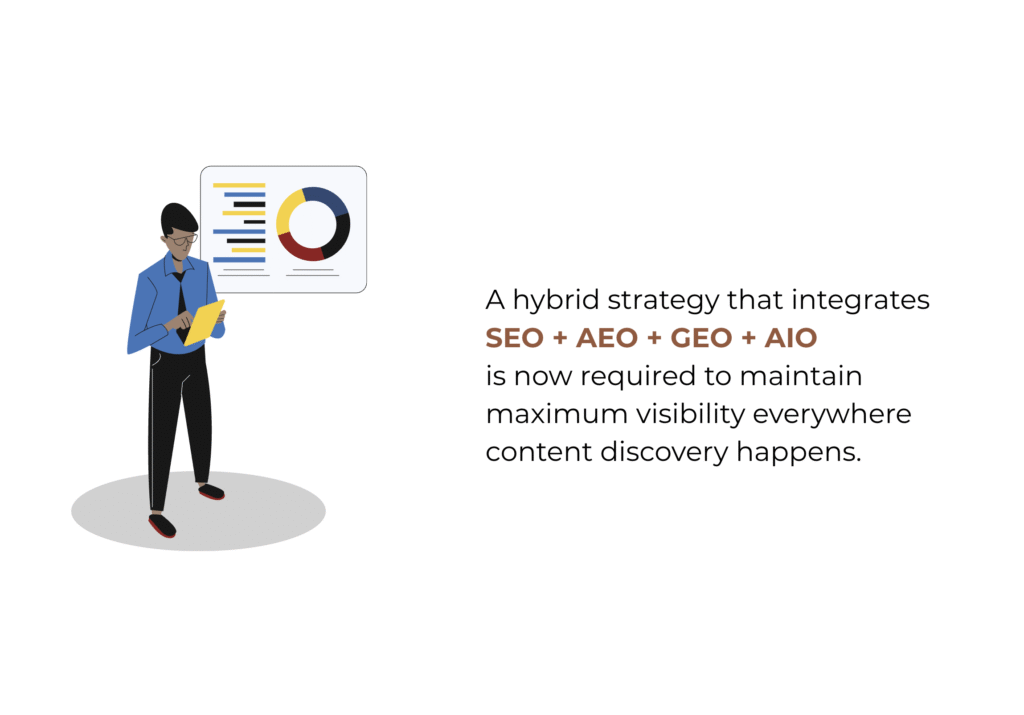
These terms overlap, but each has its nuance:

  • AEO (Answer Engine Optimization): Focused on shaping how AI chatbots reply to user queries with concise, authoritative content 
  • GEO (Generative Engine Optimization): Aims to increase the likelihood that your content is cited in generative AI outputs by optimizing for AI-friendly formats and metadata.
  • AIO (Artificial Intelligence Optimization): A broader category dealing with embedding, indexing, and prompt-compatibility to support AI retrieval mechanisms inside LLMs.
Why Brands That Ignore LLM SEO Risk Falling Behind?

a) Losing Visibility in AI‑Mediated Answers

If your content isn’t optimized for AI retrieval, you won’t appear in chatbot-driven summaries. That means losing authority, mindshare, and the chance to convert users who rely on AI answers directly

b) Declining Organic Traffic Without Compensation

Even with great traditional SEO, traffic may fall as users get answers via AI tools and never click through. Brands that don’t adapt will see declining web visits, yet gain no benefit from AI-generated brand exposure

c) Losing Competitive Edge

AI‑driven discovery favors brands that supply clear, structured, and context-rich content. From Semrush studies, lesser-known brands can get cited if they provide better AI‑ready content, often surfacing ahead of traditional ranking leaders

Ethan Smith and other experts note: traditional SEO veterans are often unprepared for this shift, and must rethink visibility metrics entirely

6. Practical Steps to Implement LLM SEO on SurgeAIO

Step 1: Identify Core Topics & User Questions

  • Use chat logs, forum snippets, Reddit threads, and user support questions to derive real conversational queries users ask LLMs.
  • Focus on emerging topics where you can establish thought leadership early.

Step 2: Craft Structured, Citation‑Friendly Content

  • Use headings like “What is…?”, “How to…?”, “Why does it matter?”
  • Include FAQ sections, bullet lists, comparison tables, and case studies.
  • Explain data clearly and transparently, AI citation likelihood improves when reasoning steps and criteria are evident.

Step 3: Technical Optimization

  • Ensure fast page load, clean HTML, structured data markup (JSON‑LD or Schema), and optionally llms.txt to control access by AI systems
  • Use metadata, clear canonicalization, and internal linking to build contextual authority.

Step 4: Distribute & Seed Content in AI‑Friendly Contexts

  • Publish on industry sites with structured formats, allow LLMs to crawl and cite.
  • Use guest posts, knowledge bases, blog platforms, or forums with high AI crawlability.
  • Ensure content is formatted in an LLM‑digestible way (headings, short paragraphs, clear reasoning)

Step 5: Monitor AI Mentions & Brand Citations

  • Use tools now tracking mentions in ChatGPT, Gemini, and Perplexity.
  • Track trending prompts and queries where your brand appears, that visibility can lead to branded search and direct traffic even without link clicks

Best Practices & Tips for Ongoing Success

  1. Update regularly. AI models value freshness, periodic content refresh signals that your information remains current and authoritative.
  2. Be semantically rich. Use synonyms, context clues, examples, and related topics to reinforce embeddings that match AI retrieval.
  3. Write with natural conversations in mind. Imagine real prompts users might type. Frame your content to directly answer those queries.
  4. Track performance beyond links. Monitor changes in branded search volume, AI mentions, and referral traffic rather than relying solely on click-through metrics.
  5. Balance SEO and LLM readiness. Implement a coordinated strategy combining keyword targeting with conversational and structured AI‑friendly formats

What Early Adopters Are Doing?

Back Market, an e‑commerce brand, adopted more conversational product copy and optimized product pages to align with LLM preferences. It began capturing AI citations even before achieving top page‑one rankings on Google.

Mailchimp enhanced its site structure and metadata to better serve the AI systems that crawl content for generative summaries.

A wave of startups offering AEO/GEO/AIO platforms have emerged in 2025, supporting analytics, prompt‑tracking, and LLM visibility for brands adapting to the shift.

The Future Outlook: How LLM SEO Will Evolve

  • Greater AI model integration: LLMs with live web access, real‑time retrieval, and multimodal capabilities (text + visuals) will dominate discovery channels.
  • AI commerce and shopping: As tools like ChatGPT roll out integrated shopping buttons, being cited in AI responses can directly drive conversions without traditional search click paths.
  • Dominance of answer‑first interfaces: If AI platforms become primary entry points to content, brands that invest in LLM SEO will win visibility even if they don’t rank highly on traditional SERPs.

Conclusion

LLM SEO isn’t just the next iteration of SEO, it’s a fundamental shift. The goal is no longer to climb to the top of rankings or drive clicks, but to own the answer. By optimizing content around semantic clarity, structured formats, topical depth, and AI‑seeding strategies, brands like yours can remain discoverable and authoritative in both conventional search and AI‑mediated discovery channels.

If you want help mapping LLM‑ready content, refining your structure, or tracking AI mentions for SurgeAIO, I’d be glad to assist. Let’s make sure your brand stays the answer in the era of AI search.
AI SEO: Future of Search Engine Optimization is Here

Search engine optimization (SEO) has always been a moving target. What worked yesterday may not work today and what will work tomorrow is already evolving. In 2024 and beyond, AI SEO is no longer a buzzword it’s the cornerstone of competitive digital strategy. 

If your brand isn’t leveraging AI to understand search intent, automate optimizations, and track visibility across both search engines and AI platforms (like ChatGPT or Perplexity), you’re leaving massive organic growth on the table.

This blog dives deep into what AI SEO really is, how it’s different from traditional SEO, and how to use it to grow traffic, conversions, and brand visibility.

What is AI SEO?

AI SEO is the application of artificial intelligence technologies to improve your website’s ranking, visibility, and performance on search engines and emerging AI powered platforms. It combines:

  • Machine learning algorithms
  • Natural language processing (NLP)
  • Predictive analytics
  • Automation tools

to make data driven SEO decisions faster and more effectively than traditional methods.

But AI SEO is more than just using tools. It’s about shifting your approach from static, rule based optimization to dynamic, intent focused strategies that adapt in real time.

Why Traditional SEO is No Longer Enough?

Until recently, SEO was largely about:

  • Targeting keywords with high search volume
  • Optimizing meta tags and headings
  • Earning backlinks from other websites
  • Publishing blog posts regularly

These tactics still matter but they don’t work in isolation anymore.

Why?

Because search engines and search behavior have changed.

  • Google now uses machine learning (like BERT and RankBrain) to understand user intent.
  • Generative AI (e.g., ChatGPT, Gemini, Claude) is answering queries directly often without sending traffic to the source site.
  • AI Overviews (on Google) and AI assistants (like Perplexity) are choosing which sites to show, based on visibility, relevance, and semantic depth not just keywords.

In short: ranking on page 1 of Google is not enough anymore.

You need to rank on AI Overviews, ChatGPT, Perplexity, Bing Copilot, and more.

Core Components of AI SEO:

1. AI Powered Keyword and Topic Research

Traditional keyword tools focus on search volume and competition. AI SEO tools go a step further.

They analyze:

  • Semantic relationships between queries
  • User intent behind each search
  • Trending topics before they spike
  • Entity level optimization (People, Places, Brands, Concepts)

For example, tools like SurferSEO, MarketMuse, Frase, and SurgeAIO use machine learning to suggest not just keywords, but the topical clusters you need to cover to become an authority in your niche.

2. Search + AI Assistant Visibility Tracking

This is where most people fall short. It’s not just about Google anymore.

A good AI SEO strategy tracks:

  • Where your site appears in Google AI Overviews
  • Which of your content is being pulled into ChatGPT responses
  • How your brand shows up on Perplexity, Bing Copilot, and Claude
  • Which URLs are gaining traction over time across AI interfaces

Visibility score is the new metric.

Instead of just checking your Google rank for “best CRM for startups,” you’ll now want to know:

  • Is your site referenced by ChatGPT when users ask that?
  • Which pages are most quoted by Perplexity?
  • Are you showing up when people ask AI tools for recommendations in your category?

3. Content Optimization with NLP

AI SEO tools can now analyze your content using Natural Language Processing, just like Google does.

That means they can:

  • Compare your article to the semantic structure of top ranking pages
  • Suggest improvements in tone, reading level, and depth
  • Recommend missing topics and questions
  • Identify internal linking opportunities

Tools like Clearscope, Surfer, Jasper, and Koala can help here but the real value comes from combining these insights with human storytelling.

AI gives you the structure. Your brand gives it voice.

4. AI Generated & Human Edited Content

Let’s be honest: everyone’s generating content with AI.

But Google (and users) are smarter than that.

Pure AI content ≠ rankable content.

You need AI assisted content, not AI only.

Here’s a proven workflow:

  1. Use AI to generate a first draft using tools like ChatGPT, Claude, or Koala.
  2. Human edit the output to improve:
    • Originality
    • Examples
    • Brand tone
    • Thought leadership
  3. Run it through AI SEO tools to ensure you’re covering all the important angles semantically.

The result? Fast, high quality content that ranks and converts.

5. Automation + Real Time Adaptation

AI SEO isn’t just about research and content. It’s about scalability and adaptability.

With the right stack, you can:

  • Automate internal linking based on topic clusters
  • Detect and fix thin content or outdated pages
  • Redirect decaying content to updated URLs
  • Monitor changes in AI Overviews or ChatGPT visibility

This is what separates smart SEO teams from outdated ones.

Instead of quarterly audits, AI SEO enables continuous optimization.

AI SEO vs Traditional SEO: A Quick Comparison

FeatureTraditional SEOAI SEO
Keyword TargetingBased on volumeBased on intent & semantics
Search EnginesGoogle & BingGoogle + ChatGPT + Perplexity + Bing Copilot
Content CreationManualAI assisted + Human edited
Ranking SignalsLinks, keywordsEntity relevance, content depth, visibility
ReportingGoogle Search ConsoleMultiplatform visibility (AI + search)
SpeedManual updatesReal time monitoring & optimization

How to Implement AI SEO: Step by Step

Here’s a simplified roadmap to get started:

Step 1: Audit Your Current Visibility

  • Use tools like SurgeAIO to check where your site appears across search engines and AI tools.
  • Identify which pages are already ranking and which are invisible.

Step 2: Identify High Intent Topics

  • Use AI powered research to find topic clusters your audience is searching for.
  • Don’t just chase keywords look for conversational queries AI tools will answer.

Step 3: Create Authority Driven Content

  • Use AI to generate outlines and ideas
  • Add real world examples, unique insights, and brand voice
  • Optimize semantically using NLP suggestions

Step 4: Track AI + Search Rankings Together

  • Install trackers that monitor visibility on:
    • Google AI Overviews
    • ChatGPT results
    • Perplexity citations
  • Monitor changes weekly, not monthly.

Step 5: Iterate Fast

  • Use AI suggestions to update old content
  • Fill topical gaps
  • Add schema, links, and multimedia
  • Scale without sacrificing quality

Common Misconceptions About AI SEO

❌ “AI generated content is spammy.”

Not if it’s edited and enriched with human expertise.

❌ “Google punishes AI written content.”

False. Google ranks helpful content regardless of how it was created.

❌ “You can just publish and pray.”

AI SEO requires constant iteration, monitoring, and optimization.

Best AI SEO Tools in 2025

Here’s a shortlist of tools making AI SEO work in the real world:

  • SurgeAIO – Tracks search + AI visibility, monitors rankings across ChatGPT, Perplexity, Google AI Overviews.
  • Frase – Helps build content briefs and optimize semantic coverage.
  • SurferSEO – Offers real time content scoring + NLP suggestions.
  • Koala – One click AI content generation with built in SEO logic.
  • Jasper – Brand aware long form content generator.
  • MarketMuse – Deep topical authority planner with predictive content scoring.

Future Trends in AI SEO

  • Personalized search results based on user profiles (AI assistants are learning your preferences).
  • Voice first SEO as AI voice agents become more common.
  • AI driven backlink discovery based on citation patterns in large language models.
  • Searchless discovery – content that ranks without being searched (e.g., showing up in AI conversations directly).

Conclusion: AI SEO is the New Competitive Edge

If SEO is a game, then AI just changed the rules.

You’re no longer just optimizing for Google you’re optimizing for machines that talk, think, and recommend.

That means you need:

  • Smarter research
  • Faster content workflows
  • Wider visibility tracking
  • And a mindset that’s always testing, always learning.

Whether you’re a solo creator, agency, or enterprise now is the time to build your AI SEO stack, track your true visibility, and grow with intent.

Need help implementing AI SEO?

Whether you’re just starting out or want to track your brand’s presence across ChatGPT, Google, and Perplexity we can help. Let’s build your AI visibility stack together.

Frequently Asked Questions:

What is AI SEO?

AI SEO refers to the use of artificial intelligence technologies such as machine learning, natural language processing (NLP), and predictive analytics to improve website visibility, ranking, and performance on search engines and AI platforms (like ChatGPT, Perplexity, and Bing Copilot). It automates tasks, analyzes user intent, and optimizes content at scale.

How is AI SEO different from traditional SEO?

Traditional SEO relies on manual keyword targeting, backlink building, and static audits. AI SEO, on the other hand:
Understands intent using NLP

Automates research and optimization

Tracks rankings on AI tools (ChatGPT, Gemini, etc.)

Offers continuous insights and real time updates

It’s smarter, faster, and built for a multi platform future.

Can I rank on ChatGPT or Perplexity like I do on Google?

Not exactly you don’t “rank” in the same way.
But you can optimize your content to be cited or referenced by ChatGPT, Perplexity, Claude, or Bing. This involves:
Covering topics comprehensively

Including clear, factual data

Using structured content (like Q&A, lists, headings)

Tracking visibility with the right tools

Is AI generated content safe to use for SEO?

Yes, as long as it’s human edited and adds value.
Google’s guidelines focus on helpful, original, and people first content regardless of how it’s created. That said, avoid:
Copy paste AI articles without editing

Low quality, duplicate outputs

Content without unique insights or examples

Best practice: Use AI for drafting → Human for polishing

What tools should I use for AI SEO?

Some of the most effective AI SEO tools include:
SurgeAIO – Tracks visibility across search + AI tools

Frase / Jasper / Koala – For AI assisted content creation

SurferSEO / MarketMuse – For content optimization

Clearscope – For NLP based scoring

Choose your stack based on content volume, team size, and your need to track AI visibility.

How do I know if my content is showing up in AI Overviews or ChatGPT?

You can use tools like SurgeAIO that track:
Which of your URLs are being cited in ChatGPT

Whether your brand appears in Perplexity answers

Google AI Overview snapshots and triggers
Manual methods include:

Searching your brand or keywords in AI tools

Asking ChatGPT or Perplexity questions your audience would

But tracking manually is time consuming use automation.

↗ BOOST TRAFFIC
Get Your FREE AI SEO Audit.

See Results In 30 Days.

✔ 100% Free Analysis Get A Free Demo →