
Most law firms that invest in SEO eventually ask the same uncomfortable question: “Is this actually working?”
The traffic numbers look decent in Google Analytics. Organic rankings have improved. But when it comes to knowing exactly which cases came from SEO versus paid ads versus a referral from a colleague, the picture gets blurry fast.
That gap between SEO activity and provable lead attribution is one of the most common pain points in legal marketing. Firms that cannot answer it end up making budget decisions on incomplete data – cutting investments that were working, or doubling down on channels that weren’t.
This guide walks through how to attribute leads to your SEO efforts accurately and systematically, so every marketing decision your firm makes is grounded in real performance data.
Why Lead Attribution Is a Unique Challenge for Law Firms
Lead attribution – identifying which marketing channel produced a specific enquiry or case – is complex for any business. For law firms, it carries additional layers.
First, legal decisions are high-consideration purchases. A person injured in a car accident might search for “personal injury lawyer near me,” read three blog posts from your firm over two weeks, revisit your practice area page, see a remarketing ad, and finally call. That conversion involved multiple touch points. A simple last-click model would credit the ad. The reality is that your SEO content initiated and nurtured the entire journey.
Second, phone calls are still the dominant conversion channel for law firms. Data from LawPay’s 2023 Benchmark Report identified Google as the single highest lead source for law firms – but a significant portion of those Google-sourced leads arrive as phone calls, not digital form submissions. Without call tracking, those conversions are invisible in web analytics.
Third, referral leads – from past clients, other attorneys, or community networks – often bypass digital touchpoints entirely. They arrive through a phone call with no URL history attached, making them easy to misclassify or lose in reporting.
These factors make attribution more important in legal marketing, not less. Understanding what SEO and GEO help frame why organic search and geographic visibility work together to generate leads – and why attributing those leads correctly matters for ongoing investment decisions.
Step 1: Define What a “Lead” Means for Your Firm

Before setting up any tracking infrastructure, your firm needs a clear, agreed-upon definition of what constitutes a lead. This sounds obvious – but in practice, many firms track different things at different points and end up with inconsistent data.
Common lead definitions for law firms:
- A completed contact form submission on the website
- A phone call of a minimum duration (typically two to three minutes, indicating a real conversation rather than a misdial.
- A scheduled consultation booking through an online intake tool
- A live chat message requesting more information
- An email enquiry from the contact page
Each of these should be tracked as a separate conversion event in your analytics setup, with the traffic source attached. Defining these upfront ensures the attribution data you collect is actually measuring the outcomes that matter to your firm – not just traffic volume or page views.
Step 2: Set Up the Technical Attribution Infrastructure
Accurate attribution requires the right tools installed and configured correctly before any meaningful data can be collected. Most law firms are underinvested in this area – they have Google Analytics running but no conversion goals configured, or they have form tracking but no call tracking.
Google Analytics 4 with Conversion Tracking
Google Analytics 4 (GA4) is the foundation of any digital attribution setup. Install it on every page of your website and configure conversion events for each lead type defined in Step 1 – form submissions, chat starts, and consultation bookings.
Use UTM parameters on all paid campaigns, email links, and any external sources you control. UTMs are short tags appended to URLs that tell GA4 exactly where a visit came from. Without them, paid traffic can appear as direct traffic or get mis-attributed to organic search.
GA4’s multi-channel funnel reports are particularly valuable for law firms. They show the full sequence of touchpoints a user took before converting – meaning you can see that someone first arrived via organic search, returned via a direct link three days later, and ultimately submitted a form after clicking a paid ad. Each channel’s contribution is visible, not just the final one.
Call Tracking
For most law firms, this is the single highest-impact attribution tool available. Call tracking assigns unique phone numbers to different marketing channels – one for organic search, one for paid ads, one for the Google Business Profile – and records which number was called. When a prospect calls the number displayed to organic search visitors, the lead is automatically attributed to SEO.
Tools like Call Rail, What Converts, and Call Tracking Metrics offer dynamic number insertion, meaning the phone number displayed on your website automatically changes based on how a visitor arrived. A visitor from a Google organic search sees your SEO-tracked number. A visitor from a paid ad sees a different one. The attribution happens automatically.
These tools also provide call recordings and keyword-level tracking – so you can see not just that the lead came from organic search, but which keyword they searched before calling. This data is invaluable for understanding which SEO content is producing real enquiries, not just traffic. Understanding AI visibility metrics adds a forward-looking dimension here – as AI-generated search answers increasingly influence which law firm a prospect contacts, tracking visibility across both traditional search and AI surfaces becomes part of the attribution picture.
CRM Integration
A CRM (Client Relationship Management) platform connects digital attribution data to the full client lifecycle. When a lead comes in through your website – whether via a form, a call, or a chat – the CRM captures the source channel, intake notes, case type, and eventual outcome (retained, not retained, referred out).
This connection between first touch and case outcome is where the real ROI picture for SEO becomes clear. You can see not just how many leads organic search generated, but what percentage converted to consultations, what percentage became retained clients, and what the average case value was for SEO-sourced matters compared to paid ad leads or referrals.
Good CRM platforms for law firms – Clio Grow, Lawmatics, My Case intake tools – allow customisation of intake forms to capture the channel source. At a minimum, include a “How did you hear about us?” field. This simple qualitative data supplements analytics tracking and captures leads that bypassed digital touchpoints entirely.
Step 3: Distinguish Between Organic, Paid, and Referral Leads
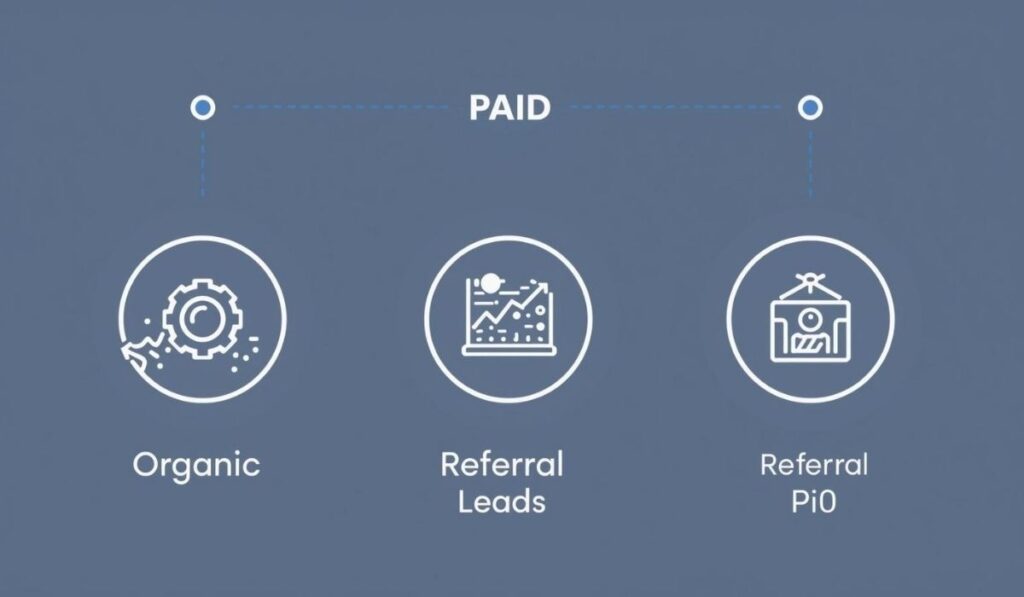
With the technical infrastructure in place, the next step is understanding the distinct characteristics of leads from each channel – and how to identify them accurately.
SEO-Driven (Organic) Leads
These leads originate from unpaid Google or Bing search results. In GA4, they appear under the “Organic Search” source/medium. They typically arrive on blog posts, practice area pages, or local landing pages – wherever your site ranks for relevant keywords.
Key characteristics of organic leads:
- Often arrive through informational or research-stage content (blog posts, FAQs, guides) before moving to service pages
- May involve multiple sessions before converting – the multi-touch nature means last-click models undercount their true influence
- Tend to be higher quality in legal contexts because the prospect has already researched their situation and is actively seeking representation
- Show up in Google Search Console as the search queries that drove clicks to your site before conversion
Connecting Google Search Console data to GA4 via the property linking feature gives you the fullest picture of which organic queries produce conversions – not just which pages receive traffic.
PPC/Paid Leads
Paid leads come from Google Ads, Local Service Ads, or paid social campaigns. They arrive tagged with gclid parameters (Google’s click identifier) or UTM tags you apply manually.
Paid leads often have higher initial intent – someone clicking “car accident lawyer near me” on a paid ad is typically ready to call – but the competition and cost per click in legal keywords is among the highest of any industry. Accurate attribution matters here, especially because wasted spend on non-converting paid campaigns is expensive.
Compare conversion rates and cost per retained client across paid and organic channels in your CRM. This comparison often reveals that organic search leads – while taking longer to arrive – convert at higher rates and produce lower cost per case.
Referral Leads
Referral leads from past clients, professional networks, or other attorneys typically arrive via a direct phone call or email with no preceding digital journey. They are commonly the hardest to attribute digitally because they by pass your website entirely or visit it only after the decision to contact your firm has already been made.
The most reliable way to capture referral attribution is through structured intake processes:
- A mandatory “How did you hear about us?” question in every intake call script
- A corresponding field in your CRM intake form
- Separate intake categories for client referral, attorney referral, and professional referral
This manual data entry, while imperfect, provides the clearest picture of referral volume over time and allows comparison against digital channel performance. Understanding geo-targeting SEO is relevant here too – local SEO efforts often blur the line between organic and referral leads, as a firm’s visibility in local search reinforces its reputation in the community and drives both digital and offline enquiries.
Step 4: Use Multi-Touch Attribution Models
Last-click attribution – the default in many analytics setups – assigns 100% of conversion credit to the final touchpoint before a lead submits a form or calls. In legal marketing, this systematically undercounts SEO’s contribution.
Consider a typical legal prospect journey:
- Searches “what to do after a slip and fall accident” → reads your blog post (organic)
- Searches your firm name directly three days later → visits your practice area page (direct)
- Sees a remarketing ad → returns and calls (paid)
Last-click gives all credit to paid. First-click gives all credit to organic. Neither is accurate.
Multi-touch attribution models distribute credit across the full journey. GA4’s data-driven attribution model uses machine learning to assign fractional credit to each touchpoint based on its actual influence on conversion, across your firm’s historical data. This is the most accurate model for firms with sufficient conversion volume.
For smaller firms, a linear model (equal credit to every touchpoint) or position-based model (40% to first and last touch, 20% split across middle touches) provides a more honest picture than last-click alone.
The practical benefit is significant. When multi-touch attribution reveals that 60% of cases involving an eventual paid ad click were first introduced to the firm through an organic search visit, the SEO investment looks very different from what it did under last-click. This data directly informs budget allocation decisions and helps justify continued investment in content and local SEO. Exploring best practices for AI visibility SEO adds another attribution layer to consider – as AI search summaries begin influencing which firms prospects research first, visibility in those AI-generated answers becomes a soft attribution touchpoint that precedes the first trackable website visit.
Step 5: Build a Lead Attribution Dashboard
Data collected across GA4, call tracking, and your CRM needs to come together in a single reporting view. Reviewing these platforms separately produces fragmented insights. A unified dashboard surfaces the metrics that actually drive decisions.
Key metrics to include in your law firm attribution dashboard:
- Organic leads generated per month (form submissions + tracked calls combined)
- Organic leads to consultation conversion rate
- Organic leads to a retained client conversion rate
- Cost per organic lead (SEO investment ÷ organic leads)
- Cost per retained organic client
- Comparison of the above metrics across paid, organic, and referral channels
- Top-converting organic landing pages and keywords
- Geographic performance of local SEO (which cities or service areas are producing leads)
Review this dashboard monthly. The goal is not to declare one channel the winner – it is to understand the genuine contribution of each channel to your firm’s caseload and revenue, so investment decisions are based on real performance data rather than assumptions. Using an AI SEO analyser helps identify which organic pages are under performing their ranking potential – meaning they attract traffic but fail to convert – allowing targeted improvements that directly improve attribution outcomes.
Step 6: Track SEO Leads Through the Full Case Lifecycle
Many law firms stop attribution at the lead stage. They know how many enquiries came from organic search. But they do not know whether those leads became retained clients, what practice areas they were involved in, or what revenue they eventually generated.
Closing this loop – connecting the first organic search touchpoint to an actual closed case – transforms SEO from a marketing expense into a quantifiable business investment.
To achieve this, the source channel captured at intake must carry through every stage of the CRM and case management workflow. When a case is marked as retained, closed, or referred out, the original lead source should remain attached. This allows reporting on:
- Total organic SEO cases retained in a given period
- Average case value for organic leads by practice area
- Organic SEO revenue as a percentage of total firm revenue
- Comparison of case quality metrics (average value, retention rate) across channels
This level of attribution data makes conversations about marketing budgets considerably more productive. When the firm can demonstrate that organic SEO generated X number of retained cases worth $Y in revenue during a given year, with a cost per retained client of $Z, the case for continued SEO investment is built on evidence, not faith.
Understanding why LLM SEO matters adds a longer-term perspective here: as AI language models increasingly shape how prospective clients discover and evaluate law firms, building traceable visibility across these platforms will become part of the attribution conversation within the next few years.
How SurgeAIO Can Help in Terms of SEO
Attributing leads to SEO accurately requires both the right tracking infrastructure and a clear picture of how your organic performance is driving that pipeline. SurgeAIO bridges both – giving law firms the tools to understand their SEO performance, identify where leads are coming from, and optimise the content and pages generating the highest-quality enquiries.
Here’s how SurgeAIO supports law firm SEO attribution and performance:
AI-Powered SEO Auditing – SurgeAIO’s AI SEO analyser gives your firm a complete technical and on-page health assessment. It identifies which practice area pages have optimisation gaps, which local landing pages are underperforming their keyword potential, and where technical issues are suppressing rankings – so you know exactly which organic assets need attention to convert more of the traffic you’re already attracting.
AI Visibility Tracking Across Search Surfaces – Beyond traditional keyword rankings, SurgeAIO tracks how your law firm brand and content appear in AI-generated answers across Google AI Overviews, ChatGPT, and Perplexity. This matters for attribution because AI-generated answers are increasingly the first touchpoint in a legal prospect’s research journey – before they ever visit your website. Tracking this layer closes a growing gap in standard attribution models.
Keyword and Content Performance Intelligence – SurgeAIO identifies which keyword clusters are driving organic traffic, which are generating genuine enquiries, and where content gaps exist in your practice area coverage. This turns your content strategy from speculative to data-driven – directly improving the quality and volume of organic leads entering your attribution pipeline.
Local SEO Performance Monitoring – SurgeAIO tracks your local search visibility across each service area your firm covers – identifying which geographic markets are generating organic enquiries and where local rankings need strengthening. For law firms where local intent is a primary driver of high-quality leads, this geographic-level intelligence is essential for allocating SEO investment accurately.
GEO Optimisation Guidance – As AI-powered search reshapes how prospective clients find legal professionals, SurgeAIO helps structure your firm’s content so that AI platforms recognise it as a credible, citation-worthy source. Understanding how to rank in AI overviews is increasingly part of the attribution story – and SurgeAIO ensures your firm is positioned to capture that emerging visibility channel before competitors do.
Whether your firm is trying to prove the ROI of an existing SEO investment or building an organic lead generation strategy from the ground up, SurgeAIO gives you the data, clarity, and direction to connect SEO activity to real case outcomes.
Final Thoughts
Attributing leads to SEO is not a one-time setup task. It is an ongoing discipline that connects marketing activity to business outcomes – and it is one of the most valuable operational improvements a law firm can make.
When you can see exactly which organic content generates consultations, which local SEO efforts produce phone calls, and which cases ultimately originated from a Google search three weeks before the client called, your entire approach to marketing investment becomes more confident and more accurate.
The firms that build this attribution infrastructure are the ones that stop guessing and start optimising. They allocate budget toward what actually produces retained clients, and they build a competitive advantage that is difficult to replicate.
Frequently Asked Questions
Why is lead attribution so difficult for law firms specifically?
Legal leads often involve multiple research touchpoints before a prospect contacts a firm, phone calls are the dominant conversion channel (making digital tracking harder), and referral leads frequently bypass the website entirely. These factors together mean that standard last-click web analytics dramatically undercounts what SEO and other channels actually contribute.
What is the most important tool for attributing law firm leads to SEO?
Call tracking is arguably the single highest-impact tool for most law firms, because phone calls are typically the highest-intent conversion event and the one most likely to be missed without dedicated tracking. Combined with GA4 conversion tracking and a CRM that captures lead source, call tracking closes the largest attribution gap most firms face.
Can small law firms or solo attorneys set up lead attribution without a large budget?
Yes. Google Analytics 4, Google Search Console, and a basic CRM with intake source fields are either free or very low-cost. Call Rail’s entry-level plan is affordable for solo practitioners. The combination of these tools provides meaningful attribution data without a large technology investment.
How do I attribute leads that came from my Google Business Profile?
Use a separate call tracking number on your Google Business Profile listing. When a prospect calls that number, it is automatically attributed to your GBP/local SEO channel rather than your main website. You can also add UTM parameters to the website URL in your GBP to tag clicks from the profile in GA4.
What is multi-touch attribution, and why does it matter for law firm SEO?
Multi-touch attribution distributes conversion credit across all the touchpoints in a prospect’s journey rather than assigning it all to the last interaction before contact. In legal marketing, where prospects typically research across multiple sessions before calling, multi-touch models reveal that SEO’s contribution is significantly higher than last-click models suggest – often making the difference in budget decisions.
How long should I track a lead before attributing it to SEO?
Most standard attribution windows in GA4 are set to 30 or 90 days. For law firms, where the research-to-contact cycle for complex cases (personal injury, family law, business disputes) can extend several weeks, a 90-day attribution window gives a more accurate picture than the default 30-day setting.
What should I do if my attribution data shows mixed or inconsistent results?
Audit your tracking setup first – GA4 configuration errors, missing UTM parameters on campaigns, and call tracking gaps are the most common causes of inconsistent data. Then, examine whether your intake process captures lead source reliably for non-digital leads. Attribution data is only as reliable as the tracking infrastructure behind it.
