Starting an SEO consulting business is one of the most accessible ways to build a profitable service-based company. Businesses of every size need help ranking on Google – and if you understand how search engines work, you can turn that knowledge into a thriving consultancy.
However, knowing where to begin can feel overwhelming. This guide walks you through every step clearly and practically.
What Is an SEO Consultant?
An SEO consultant helps businesses improve their visibility on search engines like Google. They analyze websites, develop strategies, fix technical issues, and create content plans to drive organic traffic.
Moreover, SEO consultants often serve as the bridge between a business’s goals and the technical actions needed to achieve them. You can work with clients independently or build a small team around you.
Why Start an SEO Consulting Business?
The demand for SEO services continues to grow rapidly. Here’s why this business model makes sense:
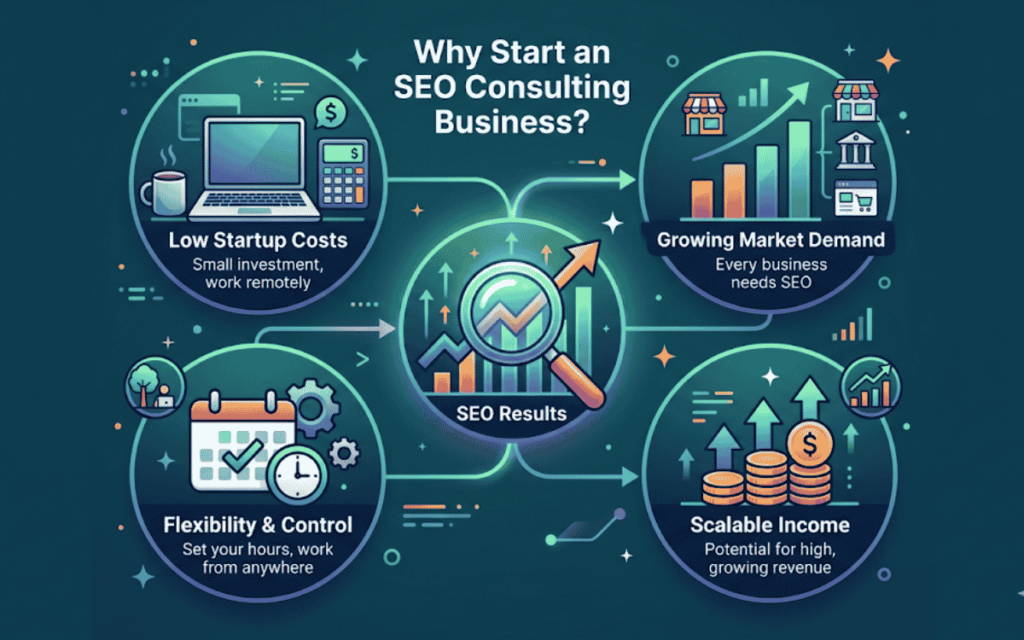
- Low startup costs – You mainly need a laptop, internet, and core tools
- High earning potential – Experienced consultants charge $75–$300+ per hour
- Remote-friendly – Work from anywhere with a client base across the globe
- Scalable – Start solo, then grow into a full agency over time
- Recurring revenue – Most clients pay monthly retainers
Therefore, it’s one of the few service businesses where your income scales with your expertise, not just your hours.
Step 1: Build Your SEO Skills First
Before pitching clients, you need a solid foundation. You don’t need a formal degree, but you do need real, working knowledge.
Focus on these core areas:
- On-page optimization (titles, meta tags, headings, content structure)
- Technical SEO (site speed, crawlability, indexing, Core Web Vitals)
- Link building and backlink analysis
- Keyword research and competitive analysis
- Local SEO strategies
- Analytics and reporting (Google Analytics, Search Console)
In addition, stay current with algorithm updates. Google changes its ranking systems frequently, and outdated advice can harm your clients.
If you’re newer to SEO, free resources from Google, Moz, Ahrefs, and Semrush offer excellent learning paths. Understanding what elements are foundational for SEO with AI is increasingly important as search evolves.
Step 2: Define Your Niche
Generalist consultants compete with thousands of others. Niche consultants win clients faster and charge more.
Ask yourself:
- Which industries do you understand best?
- Do you prefer local businesses, e-commerce, SaaS, or professional services?
- Do you want to focus on technical SEO, content, or full-service strategy?
For example, specializing in SEO for functional medicine doctors or SEO for wedding planners positions you as an expert – not just another generalist.
Moreover, niche positioning makes your marketing easier. You can speak directly to your target audience’s specific pain points, which builds trust faster.
Step 3: Set Up Your Business Legally
Before accepting money from clients, get your business structure in order.
Key steps include:
- Choose a business structure – Sole proprietorship, LLC, or limited company, depending on your location
- Register your business name – Check availability and register officially
- Get a business bank account – Keep personal and business finances separate
- Understand your tax obligations – Set aside income for quarterly taxes if applicable
- Create a simple contract template – Protect yourself and your clients from day one
Additionally, consider professional liability insurance if you’re advising on high-value SEO campaigns. It’s an affordable safety net.
Step 4: Build Your Online Presence
Your website is your most important marketing asset. It needs to rank – because if you can’t rank your own site, why would a client trust you to rank theirs?
Your website should include:
- A clear homepage explaining who you help and how
- A services page with specific offerings and pricing tiers (optional)
- A blog showing your SEO knowledge in action
- Case studies or portfolio examples
- A contact form or booking link
Furthermore, create profiles on LinkedIn, Google Business Profile, and industry directories. These signals help build credibility before you have a long client list.
Understanding whether SEO is earned or owned media helps you position your services more clearly to potential clients, too.
Step 5: Define Your Service Offerings
Clarity in your offerings makes sales conversations easier. Avoid vague packages – instead, define exactly what clients get.
Common SEO consulting services include:
- SEO Audit – A deep analysis of a website’s current SEO health
- Keyword Research & Strategy – Finding and prioritizing target keywords
- On-Page Optimization – Improving content, headings, internal links, and metadata
- Technical SEO Fixes – Resolving crawl issues, site speed, and indexing problems
- Content Strategy & Writing – Planning and producing SEO-optimized content
- Link Building – Earning high-quality backlinks to improve domain authority
- Monthly Retainer Management – Ongoing strategy, reporting, and execution
However, don’t try to offer everything at once. Start with two or three core services and expand as your team or capacity grows.
Step 6: Price Your Services Strategically
Pricing is one of the hardest parts when you’re starting. Many new consultants underprice heavily out of fear of rejection.
Common pricing models:
- Hourly rate – $75–$200/hour depending on experience and location
- Monthly retainer – $500–$5,000/month based on scope
- Project-based – Fixed price for audits, migrations, or one-time work
- Performance-based – Fees tied to ranking or traffic outcomes (use carefully)
Research how much SEO services cost in your target market so you can price competitively without undervaluing yourself.
In addition, always anchor higher than you think and offer scope adjustments rather than discounting your rate. Clients respect confident pricing.
Step 7: Get Your First Clients
Landing the first few clients is the biggest hurdle. Here’s how to approach it practically:
Start with your existing network:
- Tell former colleagues, friends, and family you’ve launched
- Offer a free or discounted audit to a local business in exchange for a testimonial
- Reach out to small business owners directly via LinkedIn
Use content marketing:
- Write blog posts targeting questions your ideal clients are searching for
- Answer questions on Reddit, Quora, and LinkedIn
- Build a small email list from your content audience
Leverage cold outreach:
- Identify businesses with clear SEO problems (slow sites, thin content, no rankings)
- Send personalized, value-first emails – not generic templates
Moreover, referrals become your most powerful growth channel once you deliver results. Focus on doing excellent work for early clients, and word-of-mouth will follow naturally.
Step 8: Deliver Results and Build Case Studies
Your ability to grow the business depends on proving results. Therefore, document everything from day one.

What to track for every client:
- Organic traffic (month over month)
- Keyword rankings for target terms
- Conversion rates from organic visits
- Backlink growth
- Core Web Vitals improvements
Use Google Search Console, Google Analytics 4, and a rank tracker to pull this data. Then compile it into a monthly report that your client can actually understand.
Additionally, when a client sees clear ROI, they renew their retainer and refer others. That’s how sustainable growth happens.
Understanding how long SEO takes to work helps you set realistic expectations with clients, which protects the relationship long-term.
Step 9: Scale Your Consulting Business
Once you have a steady stream of clients, you can scale in several directions:
Option 1: Raise your rates. Fewer clients at higher rates can generate more revenue with less stress.
Option 2: Hire contractors. Bring in writers, technical SEOs, or link builders to deliver more without burning out.
Option 3: Build productized services. Package-specific services (like audits or content sprints) at fixed prices to streamline delivery.
Option 4: Grow into an agency. Add team members, expand service lines, and pitch larger clients.
However, scaling too fast without systems in place is a common mistake. Build repeatable processes first – then grow.
Step 10: Use the Right Tools
Efficient tools let you serve more clients at a higher quality. Here are the categories you need covered:
| Category | Tools to Consider |
| Keyword Research | Ahrefs, Semrush, Google Keyword Planner |
| Technical Audits | Screaming Frog, Sitebulb, SurgeAIO |
| Rank Tracking | SurgeAIO, SERPWatcher, Ahrefs |
| Reporting | Google Looker Studio, AgencyAnalytics |
| Content Optimization | SurgeAIO, Clearscope, Surfer SEO |
| Backlink Analysis | Ahrefs, Majestic, Moz |
Furthermore, as AI search becomes more prominent, you’ll want tools that track AI visibility metrics – not just traditional rankings.
How SurgeAIO Can Help in Terms of SEO
Running an SEO consulting business means managing multiple clients, tracking dozens of keywords, auditing websites, and producing reports – all at the same time. That’s where SurgeAIO becomes a genuine game-changer.
SurgeAIO is an all-in-one SEO and AI visibility platform built for consultants and agencies who want to move fast without sacrificing quality.
Here’s how SurgeAIO supports your consulting business:
- Keyword tracking at scale: Monitor rankings for all your clients in one dashboard
- AI visibility monitoring: Track how your clients appear in AI Overviews, ChatGPT, and other LLM-based search surfaces
- Automated SEO audits: Identify technical issues quickly and present them in client-ready reports
- Competitor analysis: Understand where your clients stand versus their top competitors
- Content performance tracking: See which pages drive traffic and which need improvement
- GEO + SEO integration: Optimize for both traditional search and generative engine results simultaneously
Moreover, SurgeAIO helps you demonstrate value to clients clearly. When clients see their keyword improvements and AI visibility gains side by side, retention improves significantly.
For consultants looking to future-proof their service offerings, understanding what LLM SEO means and incorporating it into your strategy is no longer optional – it’s essential. SurgeAIO makes that transition smooth and measurable.
Ultimately, the right tools let you work smarter, serve more clients, and build a consulting business that grows sustainably.
Final Thoughts
Learning how to start an SEO consulting business takes planning, patience, and consistent execution. The opportunity is real – businesses everywhere need organic visibility, and skilled consultants who deliver results are always in demand.
Start by building genuine skills, pick a niche you understand, and focus obsessively on client results. Everything else – pricing, scaling, and tooling – follows from there.
Ultimately, tools like SurgeAIO give you the competitive edge to serve clients better, track modern SEO signals, and grow your consultancy with confidence.
Frequently Asked Questions
Q1: Do I need a degree to become an SEO consultant?
No formal degree is required. Most successful SEO consultants are self-taught through online courses, certifications, and hands-on practice. Results matter far more than credentials.
Q2: How much can an SEO consultant earn?
Earnings vary widely. Beginners may start at $1,000–$3,000/month. Experienced consultants with strong niches regularly earn $10,000–$30,000/month or more through retainers and project work.
Q3: How many clients can one SEO consultant handle?
Most solo consultants comfortably manage 3–8 clients on monthly retainers, depending on the scope of each engagement. Using automation tools helps increase that number.
Q4: How long does it take to land the first client?
With consistent outreach and a clear offer, most new consultants land their first client within 30–90 days. Starting with your existing network speeds, this ups.
Q5: Should I specialize in a niche from the start?
Yes, if possible. A niche makes your marketing clearer, speeds up client acquisition, and allows you to charge premium rates. You can always expand later.
Q6: What’s the difference between an SEO consultant and an SEO agency?
A consultant typically works independently, advising and sometimes executing a strategy. An agency has a team to execute across multiple service lines. Many consultants eventually grow into agencies.
Q7: Do I need to know coding to do SEO?
Basic HTML knowledge is helpful for on-page work. However, deep coding skills aren’t required. For technical issues, you can hire developers as needed.
