One of the first questions every business owner asks before investing in organic search is: ” How much does an SEO service cost? It is a fair question – and the answer varies far more than most people expect.
SEO pricing in 2026 ranges from $300 per month for basic automated local listings all the way to $10,000 or more per month for enterprise-level campaigns. Most small and medium businesses invest between $1,500 and $5,000 per month for quality, results-driven SEO. Understanding what drives those numbers – and what you actually get at each price point – is the key to making a smart investment.
This guide breaks it all down clearly, without the jargon.
The Quick Answer: SEO Service Cost at a Glance
Before diving into the details, here is a fast reference for the most common SEO pricing ranges in 2026:
- Automated local SEO: $300-$500/month
- Small-scale local SEO: $1,500-$2,500/month
- Comprehensive local SEO: $3,000-$5,000/month
- National or competitive SEO: $5,000-$10,000+/month
- Hourly consulting: $100-$300/hour
- Project-based work (audits, migrations): $5,000-$30,000 per project
According to Search Engine Journal’s State of SEO Agency Report, most businesses operate with SEO budgets between $500 and $10,000 per month. Nearly 48.9% of SEO professionals expect their clients’ budgets to increase within the next twelve months – a clear sign that businesses are recognising the long-term value of organic search investment.
The Three Main SEO Pricing Models
Understanding how agencies charge is the first step to evaluating what you are actually paying for. There are three primary models in the industry.
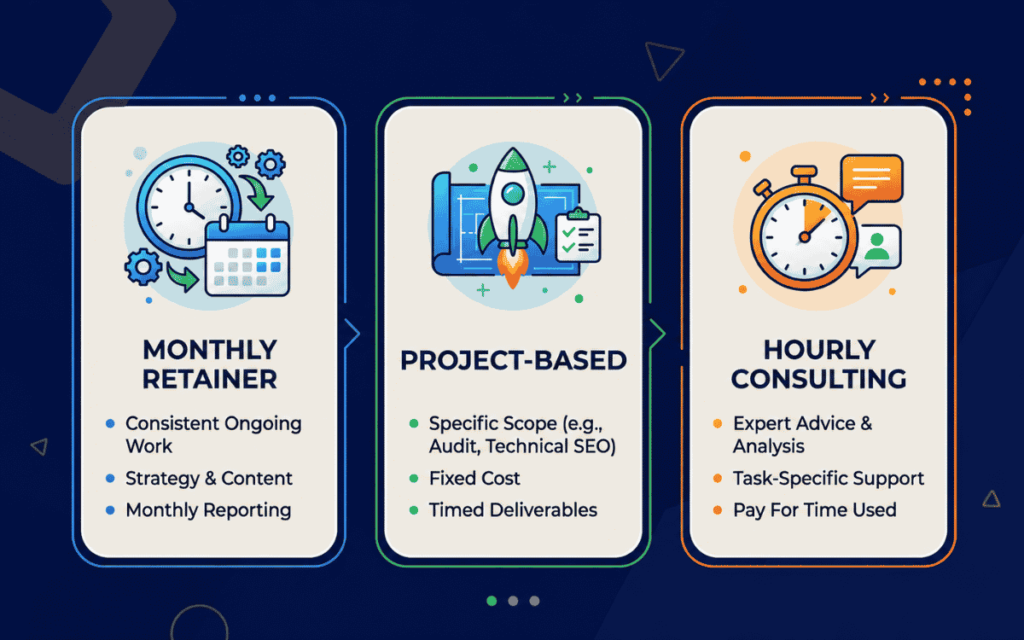
1. Monthly Retainer (Most Common)
You pay a fixed monthly fee for ongoing SEO services. This typically includes a defined scope of work – technical fixes, content creation, link building, reporting, and strategy adjustments each month.
Monthly retainers are the most common model because SEO is never a one-time project. Rankings require continuous maintenance, content needs regular updates, and competitors keep optimising. Paying month-to-month means you get consistent attention, accountability, and compounding results over time.
Best for: Businesses seeking steady, long-term organic growth.
This is also the model most closely tied to genuine SEO lead generation – where you build a pipeline of organic traffic that converts consistently rather than paying for each click.
2. Project-Based Pricing
You pay a one-time fee for a specific deliverable – a full site audit, a website migration, a penalty recovery, or a content overhaul. Costs typically range from $5,000 to $30,000, depending on scope and complexity.
Project-based pricing makes sense when you have a defined, one-time problem to solve. However, it rarely sustains results long-term because SEO requires ongoing work. Most businesses that start with a project engagement eventually move to a monthly retainer to maintain and build on the gains.
Best for: Specific technical fixes, site migrations, or initial audits before ongoing work begins.
Turn AI Visibility Into Real Revenue.
Automate Leads With SurgeAIO. Don’t Let AI Ignore Your Brand.
3. Hourly Consulting
You pay an experienced strategist or agency by the hour – typically between $100 and $300 per hour – for strategic guidance, audits, or direction while your in-house team handles implementation.
Hourly consulting works well for businesses with a capable internal marketing team that needs expert oversight without full agency management. However, hours can add up quickly, and the lack of accountability for results is a real downside.
Best for: Businesses with in-house teams that need strategic direction, not full execution.
What Affects How Much SEO Service Costs?
No two SEO campaigns are priced identically. Here are the primary factors that determine your actual investment:
Industry competition. Highly competitive industries like law, healthcare, finance, real estate, and home services require more aggressive and sustained strategies. Legal keywords, for example, can carry cost-per-click rates exceeding $1,000 on paid search, which reflects how fiercely businesses in those sectors compete for the same audience organically. Average industry SEO price ranges include Home Services ($1,500–$2,500/month), Healthcare ($3,000–$5,000/month), Law ($2,500–$5,000/month), and Software & IT ($3,000–$5,000/month).
Geographic target. Local SEO targeting one city is far less expensive than national or international campaigns. Multi-location businesses pay more because each location requires its own optimisation, content, and citation building. Understanding the role of geo-targeting in SEO helps businesses decide how broad their strategy should be from day one.
Website age and technical health. A newer website with no domain history, no backlinks, and technical issues costs more to build up than an established site that already has authority. Older sites with years of black-hat link building may require a cleanup phase before meaningful improvements can take hold.
Scope of services required. A comprehensive SEO campaign covering technical optimisation, content creation, link building, Google Business Profile management, reporting, and AI visibility costs significantly more than a basic on-page fix. The more complete the scope, the higher the monthly investment – but also the greater the return.
Business goals and timeline. Aggressive growth targets require more work, more content, and faster execution – all of which raise the monthly cost. Businesses willing to take a longer, more gradual approach can invest less each month, though results will take longer to appear.
Provider experience and reputation. An experienced, US-based agency with a proven track record charges more than a newer provider or offshore team. That premium reflects efficiency, strategic expertise, and the ability to avoid costly mistakes – factors that directly affect your ROI.
Breaking Down SEO Cost by Service Level
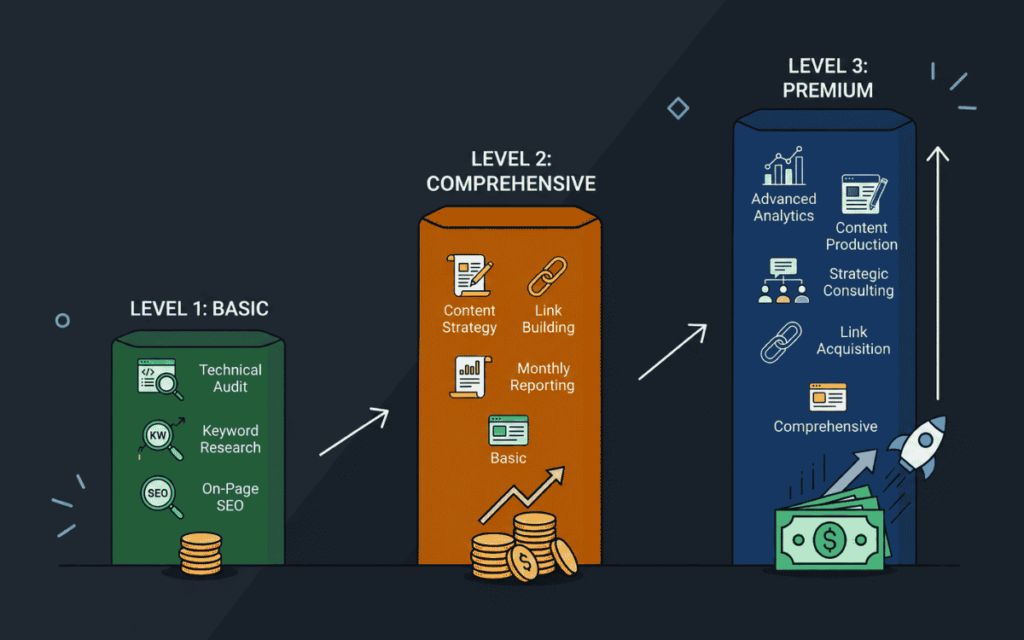
Automated Local SEO ($300–$500/month)
This is the most basic tier. It primarily covers ensuring your business information – name, address, phone number – is accurate and consistent across online directories like Yelp, Google, and Yellow Pages. It does not include content creation, link building, or active ranking work.
This tier is appropriate for very small, single-location businesses with minimal competition that simply need their basic online presence managed. It will not drive significant ranking improvements on its own.
Small-Scale Local SEO ($1,500-$2,500/month)
This level covers the fundamentals: targeted content creation, local search optimisation, Google Business Profile management, and some paid ad integration. It is designed for smaller businesses serving a limited geographic area and wanting to compete in local search results without aggressive investment.
At this tier, you can expect early ranking movement within three to four months and moderate lead growth within six months. It is a solid starting point for businesses new to organic search. Pairing this with a strong understanding of local landing page content creation gives small-scale campaigns a faster path to visibility.
Comprehensive Local SEO ($3,000-$5,000/month)
This is the tier at which most established businesses with growth goals operate at. A comprehensive campaign typically includes:
- Technical SEO auditing and fixes
- On-page and off-page optimisation
- Blog content creation and optimisation
- Link building and citation management
- Google Business Profile optimisation and management
- Competitor analysis
- Monthly reporting and strategy calls
- Paid search management (in some packages)
- Reputation and review management
At this investment level, businesses see meaningful ranking improvements within three to six months and consistent lead generation by months six to twelve. The reporting at this tier also tracks the metrics that matter – traffic growth, conversion rates, call tracking, and visibility – not just vanity rankings.
National or Enterprise SEO ($5,000-$10,000+/month)
Businesses competing nationally or in multiple large markets require significantly more investment. This level covers high-volume content production, aggressive link building, advanced technical work, and ongoing competitive strategy across dozens or hundreds of target keywords.
Enterprise campaigns also increasingly incorporate AI visibility optimisation – ensuring the brand appears in Google AI Overviews, ChatGPT responses, and other generative search results. This is where staying current with AI visibility optimization techniques becomes a core part of the monthly deliverables, not an afterthought.
Turn AI Visibility Into Real Revenue.
Automate Leads With SurgeAIO. Don’t Let AI Ignore Your Brand.
Is Cheap SEO Worth It?
The short answer is no. An average SEO specialist in the US earns upwards of $70,000 annually. If an agency is charging $150 to $500 per month for “full-service SEO,” the math does not work out. At $300 per month, a provider can only allocate two to four hours to your account. That is not enough time to move the needle on any meaningful SEO metric.
Agencies charging below market rates typically fall into one of three categories: they use automated tools that produce minimal results, they rely on offshore labour with little quality control, or they use tactics that violate Google’s guidelines – including spammy link schemes, keyword stuffing, and mass AI-generated content. Any of these approaches can result in a Google penalty that takes six to twelve months and a high cost to recover from.
The minimum viable investment for legitimate SEO services from a reputable provider is $1,500 per month. Below that threshold, expect slow or no meaningful progress. If your budget is currently under that level, focus on inexpensive SEO tools to handle the basics yourself while saving to invest properly.
Red Flags to Watch For When Hiring an SEO Agency
Not every agency that quotes you a number is worth hiring. Watch for these warning signs:
- Guaranteed rankings. No ethical, experienced agency can guarantee a specific position on Google. The algorithm has hundreds of ranking factors, many of which are outside anyone’s direct control. Any guarantee is either targeting irrelevant keywords or a red flag for black-hat tactics.
- Vague reporting. Good agencies show you specific keyword ranking changes, organic traffic trends, pages optimised, and links earned – with real data. If a monthly report shows only social media followers or general “improvements,” ask for specifics.
- No explanation of strategy. If an agency cannot clearly explain what they will do each month and why, do not hire them. Legitimate SEO strategies are not secrets.
- Prices too good to be true. As noted, quality SEO requires substantial time and expertise. Suspiciously low pricing almost always means corner-cutting.
- Lock-in contracts with no results clause. Reputable agencies are confident enough in their work to operate on shorter commitments, typically six-month initial sprints followed by month-to-month. Long lock-in contracts are a way to trap clients who are not getting results.
SEO vs. PPC: Understanding the Long-Term Value
Many businesses ask whether they should spend their budget on SEO or paid advertising. The honest answer depends on your timeline – but the long-term economics strongly favour SEO.
With PPC, you pay for every click. The moment you stop paying, your traffic disappears. Your cost per lead stays constant or increases over time as competition for ad space grows. With SEO, your cost per lead decreases over time as content compounds, authority builds, and rankings strengthen. At the twelve to eighteen-month mark, well-executed SEO typically delivers three to five times the ROI of a comparable paid search investment.
However, SEO takes longer to produce visible results. Most businesses begin seeing meaningful ranking improvements within three to six months, with significant traffic and lead growth between months six and twelve. This is not slow – it is simply the nature of building something that lasts. If you need leads next week, paid search is the faster lever. If you want to build a durable, low-cost lead source for the next three to five years, SEO is the smarter investment.
Understanding whether SEO is organic or paid and how both channels complement each other helps businesses allocate their marketing budget more effectively across the funnel.
How AI is Changing SEO Pricing in 2026
Search is evolving rapidly. Traditional Google rankings are no longer the only metric that matters. Google AI Overviews now appear in over half of tracked keywords. ChatGPT processes more than 5.3 billion visits per month. Traditional search engine volume is projected to drop 25% by 2026 due to the rise of AI assistants.
This shift means modern SEO must also include Generative Engine Optimisation (GEO) – the practice of ensuring your content gets cited by AI platforms, not just ranked on traditional search results pages. Businesses that appear in AI-generated answers gain significant visibility with users who never click a traditional search result.
When evaluating SEO agencies in 2026, ask specifically whether GEO is included in their services. Reputable agencies integrate this into standard monthly work – structured content, FAQ schema, E-E-A-T signals, and author authority building. Agencies charging separately for GEO as an expensive add-on are likely rebranding what should be standard modern practice. Tracking your AI visibility metrics alongside traditional rankings gives you the full picture of how your brand is performing across both search environments.
How SurgeAIO Can Help in Terms of SEO
Understanding how much SEO service costs is only the first step. Getting genuine value from that investment requires knowing exactly where your money should go, what is working, and where opportunities exist.
SurgeAIO helps businesses make smarter SEO decisions by providing a single platform to track keyword rankings, monitor AI visibility, identify content gaps, and benchmark performance against competitors. Instead of relying on monthly reports from an agency and hoping the numbers tell the right story, SurgeAIO gives you clear, real-time data to hold your strategy accountable.
For businesses managing their own SEO or working with an agency, SurgeAIO provides the transparency and intelligence needed to ensure every pound or dollar invested in SEO is generating measurable returns. It also tracks your presence in AI-generated search results – ensuring you are not invisible in the growing portion of searches that bypass traditional blue links entirely.
Turn AI Visibility Into Real Revenue.
Automate Leads With SurgeAIO. Don’t Let AI Ignore Your Brand.
Whether you are just starting to invest in organic search or scaling an established campaign, SurgeAIO gives you the visibility and direction to make every investment count.
Final Thoughts
How much does an SEO service cost? For most businesses, the realistic answer is $1,500 to $5,000 per month for quality, ongoing services – with the investment level determined by your competition, goals, geographic scope, and the level of service required.
The most important principle is to invest properly or not at all. Cheap SEO rarely produces results and can actively damage your rankings. Quality SEO, delivered consistently over six to twelve months, becomes one of the most cost-effective and durable marketing channels your business can build.
Understand what you are paying for. Ask hard questions. Demand transparent reporting. And choose a partner that treats your investment with the strategic seriousness it deserves.
Frequently Asked Questions
Q: How much does an SEO service cost for a small business?
Small businesses should budget $1,500-$3,500/month. Single-location businesses start at $1,500-$2,000/month. Competitive or multi-location businesses need $2,500-$3,500/month. Below $1,500/month rarely delivers meaningful results.
Q: Is SEO worth the cost for small businesses?
Yes. When done properly, SEO delivers a strong ROI over 18-24 months. Organic rankings compound over time, continuously lowering your cost per lead – making it one of the most cost-effective marketing channels available.
Q: How long before I see results from my SEO investment?
Most businesses see early improvements within 3-4 months and meaningful traffic growth by months 6-12. Months 1-2 are foundation work. Anyone promising results in 30 days is a red flag.
Q: What is included in a monthly SEO retainer?
A monthly retainer typically covers technical SEO, content creation, link building, Google Business Profile management, competitor analysis, and reporting. In 2026, quality agencies will also include AI visibility optimisation and GEO.
Q: Why do some agencies charge so much more than others?
Price reflects experience, expertise, and hours allocated. A $300/month agency gives you 2-3 hours per month. A $3,000/month agency delivers 20-30+ hours of coordinated specialist work – with dramatically different outcomes.
Q: Should I hire an agency or do SEO myself?
DIY works if you have 10-20 hours/month and the right tools. However, factoring in time, tool costs, and learning curve, hiring an agency is often more cost-effective for most business owners.
