
It is one of the most debated questions in digital marketing. Business owners, content creators, and SEO professionals all want to know: how many SEO keywords per page should you target to rank well on Google?
The standard answer you will hear is one primary keyword plus two to four supporting variations per page. However, that advice only tells half the story. If you follow it blindly – especially across a growing website – you will likely run into keyword cannibalization, thin content, and missed traffic opportunities.
This guide breaks down the full picture: the accepted best practice, why it works, where it falls short, and how a smarter approach can multiply your results without overcomplicating your strategy.
Why Keywords Still Matter in 2026
Before diving into numbers, it is worth understanding why keywords remain foundational to SEO. Search engines use keywords to understand what your page is about and match it to relevant user queries.
Without properly placed keywords, Google cannot confidently rank your page for the right searches. Keywords are how you communicate your topic to both search engines and real human readers.
However, keyword strategy has evolved significantly. Google no longer rewards pages that simply repeat a phrase dozens of times. Today, it rewards pages that comprehensively address a topic and genuinely satisfy the searcher’s intent. Understanding what elements are foundational for SEO with AI helps you see how keyword strategy fits into a much broader signals landscape.
The Standard Rule: 1 Primary + 2-4 Supporting Keywords
The widely accepted industry recommendation is to target one main keyword and two to three close variations per page. This formula has remained consistent across major SEO authorities for good reason – it works for most websites at most stages of growth.
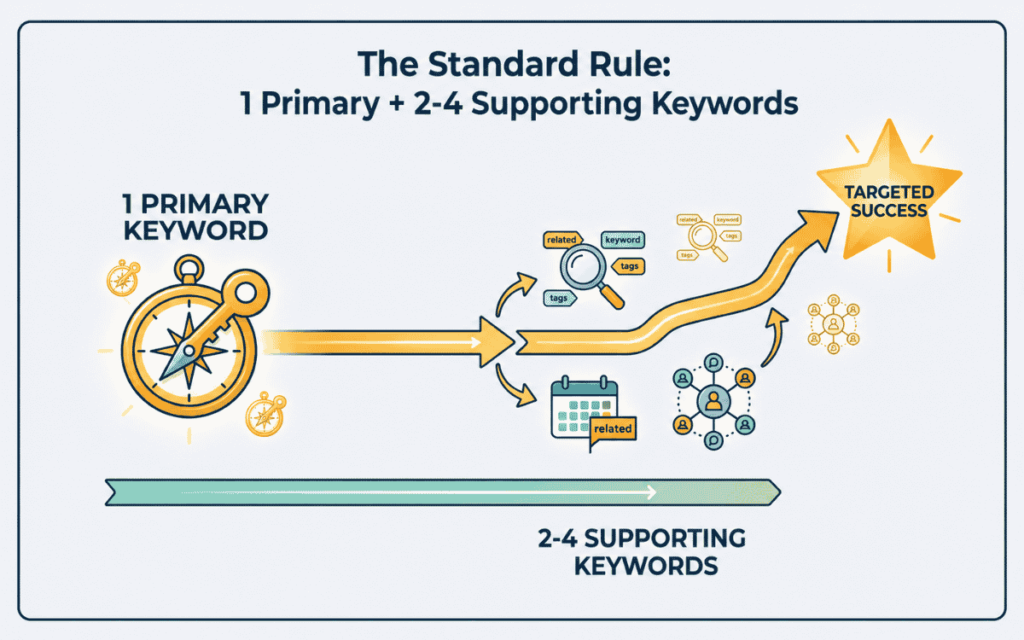
Here is how the components break down:
Primary keyword – Your core target. It should be the term with the highest search volume that best represents what the page is about. This appears in your title tag, H1 heading, meta description, and naturally throughout the body content.
Supporting keywords – Related terms, synonyms, or long-tail variations that provide context. For example, if your primary keyword is “content marketing strategy,” supporting keywords might include “content planning,” “editorial calendar,” and “blog content strategy.”
Keyword density – Most experts recommend keeping your primary keyword density between 1% and 2%. More importantly, keywords should appear naturally. Forcing them into awkward sentences hurts readability and signals keyword stuffing to Google.
Where you place your keywords matters just as much as how many you use. Standard best-practice placement includes:
- Title tag (primary keyword ideally near the beginning)
- H1 heading
- First 100 words of the content
- At least two to three subheadings (H2s and H3s)
- Meta description
- Image alt text where relevant
- Naturally, throughout the body paragraphs
Turn AI Visibility Into Real Revenue.
Automate Leads With SurgeAIO. Don’t Let AI Ignore Your Brand.
This formula gives search engines clear signals about your page’s focus while keeping content readable and user-friendly.
Why “Less Is More” When It Comes to Keywords Per Page
Targeting fewer, more focused keywords per page consistently outperforms trying to rank for too many at once. Here is why:
It keeps your content laser-focused. When you target one primary keyword, your entire page – from the headline to the conclusion – stays tightly aligned to a single topic. That clarity helps Google understand your page faster and rank it more confidently.
It prevents keyword dilution. Targeting two completely different main keywords on one page splits the page’s authority between them. Neither keyword gets the full weight of your optimization effort, which weakens your ranking potential for both.
It avoids keyword cannibalization. This is one of the most damaging SEO mistakes. Cannibalization happens when multiple pages on your site target the same or very similar keywords. Google has to pick one to rank and often picks poorly – leaving both pages weaker than a single, well-optimized page would be.
It enables precise on-page optimization. Writing a title tag, meta description, and header structure is far easier when you are focused on one keyword. Trying to serve multiple primary keywords in one page forces compromises that hurt both rankings and user experience.
How Many Keywords Can One Page Actually Rank For?
Here is the part that surprises most website owners: a single well-optimized page can realistically rank for dozens – sometimes hundreds – of related keywords. This happens naturally when you create comprehensive, high-quality content around one specific topic.
For example, an article targeting “how many SEO keywords per page” will naturally pick up rankings for variations like “number of keywords per page,” “keywords per blog post,” “optimal keyword count for SEO,” and many more. You did not intentionally optimize for those – Google recognized the relevance and ranked you for them anyway.
This phenomenon is sometimes called the “trickle-down effect.” When Google trusts that your page is the best resource for a topic, it extends that trust to related searches automatically.
This is why your goal should not be to stuff as many keywords into a page as possible. Instead, focus on creating the most thorough, useful content on the topic. The keyword variations will follow. Pairing this with a strong keyword gap strategy helps you identify which topics your competitors are capturing that you are missing entirely.
The Problem with Page-by-Page Keyword Thinking
The 1+2-4 formula works well for individual pages. However, as your content library grows, page-by-page keyword targeting creates serious problems.
Keyword cannibalization at scale. Imagine publishing three separate articles – one about “email marketing tips,” one about “email marketing strategies,” and one about “email marketing best practices.” Each targets slightly different wording, but all three serve the same search intent. Google now has to choose which one to rank. Instead of one strong page dominating, you have three weaker pages competing against each other.
Inconsistent coverage. Without a systematic approach, you end up with duplicate content in some areas and significant content gaps in others. You might have five articles on the same topic and zero articles on an adjacent high-traffic topic you simply missed.
Wasted research. Keyword research typically uncovers dozens of related terms. The traditional approach forces you to either ignore most of them or awkwardly create separate thin pages for each variation – both of which hurt your SEO in the long run.
This is where keyword clustering becomes a game-changer. Rather than thinking keyword by keyword and page by page, you group related keywords by shared search intent and assign one cluster per page. This eliminates cannibalization, captures more traffic per page, and creates a scalable content strategy. Combining this with competitive analyses of keywords tells you which clusters your competitors are already winning and which gaps remain open for you.
Keyword Density: What It Means and What to Ignore
Keyword density refers to how often your primary keyword appears as a percentage of the total word count. A 1,500-word article with your keyword appearing 15 times has a 1% keyword density.
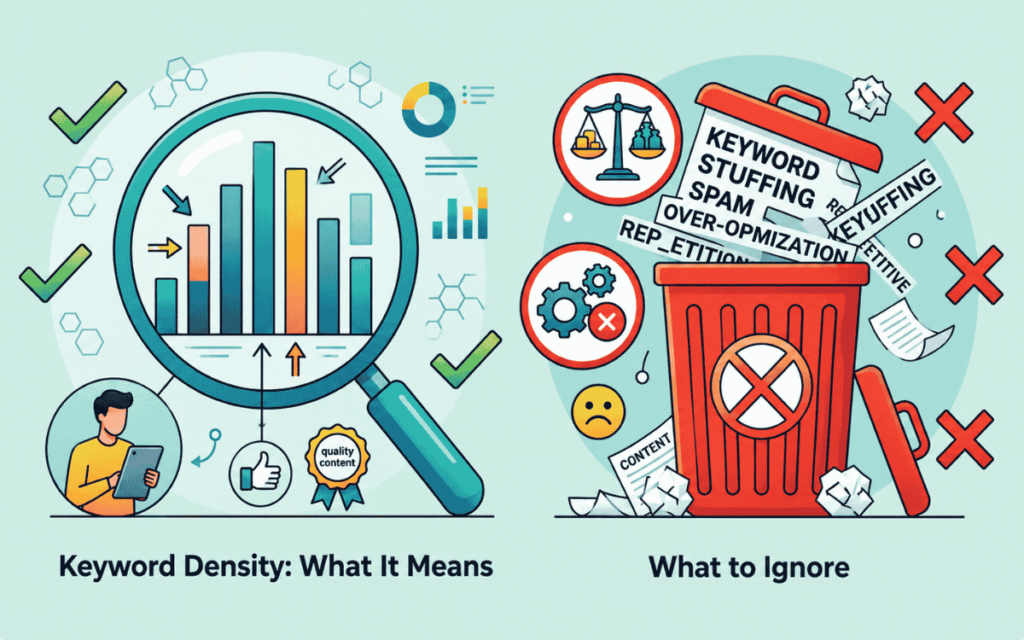
The recommended range is 1% to 1.5% for most pages. However, this metric is far less important than it used to be. Google’s algorithms have grown sophisticated enough to evaluate topical relevance without needing a specific keyword frequency.
What actually matters today:
- Does the content comprehensively address the topic?
- Are keywords placed in contextually meaningful locations (title, H1, early paragraphs)?
- Does the page use semantically related terms naturally throughout?
- Is the content readable and genuinely useful to the person searching?
Obsessing over hitting a precise keyword density often leads to unnatural writing. Write for your reader first. If your keyword appears naturally five to eight times in a 1,000-word article, that is entirely sufficient.
One critical mistake to avoid is keyword stuffing – repeating the same phrase excessively in an attempt to manipulate rankings. Google explicitly penalizes this practice. A page that reads unnaturally because of forced keyword repetition will not rank well and will drive readers away immediately. Understanding why keywords are important for SEO at a strategic level helps you avoid both under-optimization and over-optimization.
Turn AI Visibility Into Real Revenue.
Automate Leads With SurgeAIO. Don’t Let AI Ignore Your Brand.
How Many Keywords for Different Page Types?
Not every page on your website follows the same keyword rules. Here is how to approach different page types:
Blog posts and articles – Target one primary keyword with two to three supporting variations. Long-form content naturally covers more semantic ground, which helps you pick up additional rankings organically.
Service pages – Focus tightly on one primary keyword per service. If you offer ten services, create ten dedicated pages. Do not try to consolidate multiple service keywords onto one page, as it dilutes each service’s ranking potential and confuses searchers.
Product pages – Target one product-specific keyword. Use supporting keywords in product descriptions, bullet points, and technical specifications. Avoid duplicating the same description across multiple similar products.
Homepage – This is where many site owners go wrong. Your homepage should target your single most important brand or category keyword. Do not try to rank your homepage for every service or product you offer. Let individual service pages carry those keywords.
Location pages – Target one geo-specific keyword per location page. If you serve ten cities, create ten separate pages, each targeting the relevant location-specific search term. Creating content for local landing pages for SEO explains exactly how to structure these pages for maximum local visibility.
Common Keyword Mistakes That Hurt Your Rankings
Even experienced SEOs make these errors. Knowing them in advance saves you months of lost traction:
- Targeting too many unrelated keywords on one page – This confuses both Google and your readers. Each page needs a clear, singular focus.
- Ignoring long-tail keywords – Long-tail phrases are less competitive and convert better. Targeting “SEO services for small law firms” is far more achievable than “SEO services” and attracts a more qualified audience.
- Repeating keywords across multiple pages without differentiating intent – If two pages target the same keyword, Google will pick one and ignore the other. Audit your site regularly to catch cannibalization early.
- Keyword stuffing in titles and headings – Cramming your keyword into every H2 and H3 looks manipulative and reads poorly. Use supporting and semantic variations in subheadings instead.
- Ignoring search intent – A keyword’s volume is meaningless if your page does not match what the searcher actually wants to find. Informational, commercial, and transactional queries each need a different type of content.
Avoiding these mistakes keeps your strategy clean and gives each page its best chance to rank. If you are questioning whether certain SEO approaches are even worth pursuing, do you need SEO for your website is a useful starting point to ground your thinking.
How to Choose the Right Primary Keyword for Each Page
Selecting the right primary keyword is the most important decision in your keyword strategy. Here is a simple framework:
Step 1: Research volume and competition. Use keyword research tools to identify terms with meaningful search volume but manageable competition. For new websites, targeting lower-competition keywords first builds authority faster.
Step 2: Confirm search intent. Search your target keyword and look at the top-ranking pages. Are they blog posts, product pages, or service pages? Whatever format dominates the top 10 results is the format Google expects – match it.
Step 3: Check for cannibalization. Search your own site to confirm you do not already have a page targeting the same keyword. If you do, decide whether to consolidate the pages or differentiate their intent clearly.
Step 4: Align with business goals. High search volume means nothing if the keyword does not attract your target audience. Prioritize keywords that bring in the type of visitors most likely to convert. This is exactly what effective SEO lead generation is built on – matching keyword intent to business outcomes.
How SurgeAIO Can Help in Terms of SEO
Managing keywords across dozens or hundreds of pages manually is error-prone and time-consuming. SurgeAIO simplifies the entire process by giving you a centralized platform to research, track, and optimize your keyword strategy at scale.
With SurgeAIO, you can identify which keywords each page currently targets, spot cannibalization issues before they damage your rankings, and track how your keyword positions shift over time. The platform surfaces clear, data-backed recommendations – so you spend less time guessing and more time executing.
Moreover, SurgeAIO tracks your visibility in AI-powered search results, including Google AI Overviews and other generative search features. As AI visibility optimization techniques become increasingly critical alongside traditional keyword rankings, having a single platform that monitors both gives you a significant competitive edge.
Turn AI Visibility Into Real Revenue.
Automate Leads With SurgeAIO. Don’t Let AI Ignore Your Brand.
Whether you are optimizing your first ten pages or managing a content library of thousands, SurgeAIO scales with your needs and keeps your keyword strategy organized, effective, and ahead of algorithm changes.
Final Thoughts
The answer to how many SEO keywords per page is not as rigid as many guides suggest. The standard rule – one primary keyword plus two to three supporting variations – is a solid starting point. However, the real goal is always to match search intent, cover your topic comprehensively, and give Google a clear signal about what your page is about.
Focus on quality and clarity over keyword volume. Let one page own one topic. Audit regularly for cannibalization. And as your content library grows, think in terms of keyword clusters rather than individual terms – it is the approach that scales without creating chaos.
Apply these principles consistently, and your keyword strategy will build compounding authority over time rather than working against itself.
Frequently Asked Questions
Q: Can I use the same keyword on multiple pages?
Using the same primary keyword on multiple pages creates keyword cannibalization. Google must choose which page to rank, and typically ranks both pages poorly as a result. Each page should have a unique primary keyword that clearly differentiates its focus.
Q: Does keyword density still matter in 2026?
Keyword density matters less than it did five years ago. Focus on natural placement in key locations – title, H1, first paragraph, and a few subheadings – and let the rest of your content flow naturally. Aim for roughly 1% to 1.5% as a general guide, not a rigid rule.
Q: How many keywords should a 1,000-word article target?
A 1,000-word article should target one primary keyword and two to three supporting variations. At 1% to 1.5% density, your primary keyword should appear approximately 10 to 15 times naturally throughout the content.
Q: Should long-form content target more keywords?
Not necessarily more primary keywords – but longer content naturally ranks for more variations and long-tail terms. A 3,000-word article might rank for 50 or more related keywords without you intentionally targeting each one.
Q: Is it better to create separate pages for each keyword variation?
Only if those keyword variations represent meaningfully different search intents. If two variations serve the same intent – for example, u0022best running shoes for beginnersu0022 and u0022running shoes for new runnersu0022 – target them both on one page. If their intents differ significantly, separate pages make sense.
Q: What is the fastest way to find the right keywords for each page?
Start with a keyword research tool to find terms with the right volume and competition balance. Then, verify search intent by reviewing what already ranks. Finally, check your own site for existing coverage to avoid duplication before creating any new content.
