You’re paying for SEO services every month. But how do you actually know if it’s working? Many business owners feel uncertain – and that uncertainty is completely valid.
However, you don’t need to become an SEO expert to evaluate your agency’s performance. You just need to know what to look for, what questions to ask, and which numbers actually matter.
This guide breaks it all down clearly.
Why It’s Hard to Know If SEO Is Working
SEO is not like paid advertising. You don’t flip a switch and see immediate results. Therefore, many business owners struggle to connect their monthly payments to real business outcomes.
Moreover, some agencies take advantage of this confusion. They send reports full of vanity metrics – impressions, crawled pages, “SEO health scores” – without showing actual growth in traffic or revenue.
Understanding how long SEO takes to work helps set realistic expectations. Most campaigns take 3–6 months to show meaningful results. However, you should still see progress signals well before that.
The Difference Between Activity and Results
This is the most important distinction to understand.
Activity looks like:
- “We published 4 blog posts this month”
- “We fixed 12 technical errors on your site”
- “We submitted your sitemap to Google”
Results look like:
- “Your organic traffic increased by 18% this month”
- “Three of your target keywords moved from page 3 to page 1”
- “You received 22 leads from organic search last month”
A good SEO company does both – but they always connect activity to outcomes. Therefore, if your agency only reports on tasks completed and never on business impact, that’s a serious warning sign.
Key Metrics That Show SEO Is Actually Working
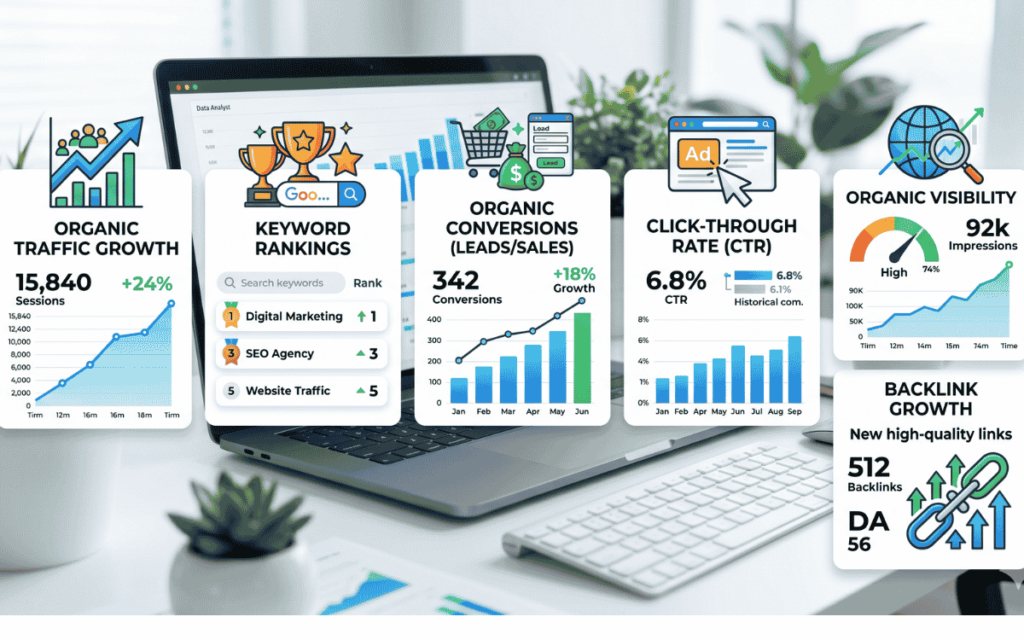
1. Organic Traffic Growth
This is the most direct signal. Open Google Analytics 4 and check your organic traffic month over month and year over year.
What to look for:
- A gradual upward trend over 3–6 months
- Growth in new users arriving from search engines
- Increases in sessions from target landing pages
However, don’t panic over small dips. Seasonal fluctuations and algorithm updates are normal. What matters is the overall trajectory over time.
2. Keyword Ranking Improvements
Your SEO company should track your target keywords and show movement over time. Rankings rarely jump from page 5 to position 1 overnight – but you should see consistent progress.
Healthy signs include:
- Keywords moving from positions 20–50 into the top 10
- New keywords appearing in rankings that weren’t there before
- Featured snippet appearances for informational queries
Ask your agency for a monthly ranking report showing position changes for your primary and secondary keywords. If they can’t provide one, that’s a red flag.
3. Click-Through Rate (CTR) From Search
More impressions mean nothing if people aren’t clicking. Google Search Console shows your average CTR by page and keyword.
A good SEO agency optimizes title tags and meta descriptions to maximize clicks – not just rankings. Therefore, watch for:
- Rising CTR on pages that recently had titles or descriptions rewritten
- Higher impressions combined with improving CTR
- Pages entering the top 10 with strong click performance
4. Leads and Conversions From Organic Traffic
Ultimately, rankings and traffic only matter if they produce business outcomes. Set up conversion tracking in Google Analytics to measure:
- Contact form submissions from organic visitors
- Phone calls triggered by organic landing pages
- Product purchases or sign-ups from organic search
If your traffic is growing but conversions aren’t, the issue might be with landing page quality or targeting – both of which your SEO agency should address. This is especially relevant when evaluating what is SEO lead generation and whether your agency understands the full funnel.
5. Backlink Growth
Links from other websites signal authority to Google. A working SEO company builds these consistently over time.
What healthy backlink growth looks like:
- New referring domains added monthly (not just more links from the same sites)
- Links from relevant, reputable websites in your industry
- No spike of low-quality or spammy links
You can check your backlink profile using Google Search Console, Ahrefs, or Semrush. Moreover, understanding how many backlinks you need helps you benchmark your agency’s link-building pace against realistic targets.
6. Technical SEO Health
Your website needs a clean technical foundation for Google to crawl and rank it effectively. A good SEO agency monitors and fixes:
- Crawl errors and broken links
- Page speed and Core Web Vitals
- Mobile usability issues
- Duplicate content problems
- Proper indexing of important pages
Ask your agency for a technical audit report at the start of the engagement – and periodic updates showing which issues were fixed and what impact followed.
7. Content Performance
If your agency produces content, that content should drive results. Ask them to show you:
- Which blog posts or landing pages rank for target keywords
- Which pages have grown in organic traffic month over month
- Which pieces of content generate leads or engagement
In addition, reviewing content performance data gives you a clear framework for evaluating whether your agency’s content work is actually moving the needle.
Green Flags: Signs Your SEO Company Is Doing Good Work
Here’s what a trustworthy, effective SEO partner looks like in practice:
They set realistic timelines – No promises of page 1 rankings in 30 days
They send clear monthly reports – With traffic, rankings, conversions, and explanations
They communicate proactively – They tell you when something changes, not just when things are good
They explain their strategy – You understand what they’re doing and why
They track the right metrics – Business outcomes, not just activity
They stay current – They understand AI search, algorithm changes, and modern SEO practices
They ask about your business goals – Not just rankings, but revenue targets and lead goals
They’re transparent about challenges – SEO is hard, and honest agencies say so
Red Flags: Signs Your SEO Company May Not Be Working
Unfortunately, not every agency delivers what they promise. Watch for these warning signs:
Guaranteed rankings – No one can guarantee specific Google rankings
Vague or confusing reports – Reports full of numbers that don’t connect to business outcomes
No access to your own analytics – You should always have access to your Google Analytics and Search Console accounts
Black-hat tactics – Buying links, keyword stuffing, or cloaking can get your site penalized
No strategy document – A real agency shows you a written plan with priorities and timelines
Radio silence – If you can’t reach your account manager easily, something is wrong
Traffic going up, but leads going down – Could signal they’re chasing irrelevant traffic
They own your website or analytics accounts – You should always own your digital assets
Therefore, if you’re seeing multiple red flags, it may be time to ask hard questions or consider switching providers. Understanding whether you need to hire an SEO company at all – versus building in-house capability – is a legitimate question at this point.
How to Evaluate Your SEO Company’s Reports

Most agencies send monthly reports. Here’s how to read them critically:
Step 1: Check the traffic trend
Open Google Analytics yourself. Don’t just trust a screenshot in a PDF. Look at organic sessions over the last 6–12 months.
Step 2: Cross-reference keyword rankings
Ask for a ranking report with historical data. If they use a tool like SurgeAIO, Ahrefs, or Semrush, they should be able to show ranking movement for every target keyword.
Step 3: Look at conversion data
Traffic without leads is not a success. Make sure your analytics tracks form submissions, calls, or purchases – and ask your agency to include this in every report.
Step 4: Review their deliverables
What did they actually do this month? Were pages optimized? Were blogs published? Were links built? And how did those actions impact your numbers?
Step 5: Ask “so what?”
For every metric they show you, ask what it means for your business. A good agency will have a clear answer every time.
What to Do If Your SEO Isn’t Working
If after 6 months you’re seeing no meaningful progress, here’s how to respond:
1. Request a strategy review meeting
Ask your agency to walk you through their plan and show you what’s working and what isn’t. Their response will tell you a lot.
2. Audit your own website
Use Google Search Console and a tool like SurgeAIO to identify technical issues, ranking opportunities, and content gaps yourself.
3. Compare your progress to competitors
Are your competitors outranking you on key terms? A competitive analysis of keywords shows you where the gap is and how your agency should be closing it.
4. Ask for a revised plan
If the current strategy isn’t working, ask what changes they’ll make and by when. Set clear benchmarks for the next 90 days.
5. Consider switching agencies
If you’ve given a fair timeline and still see no results – and the agency won’t take accountability – it’s reasonable to explore other options.
Questions to Ask Your SEO Company Right Now
If you want to evaluate your current agency immediately, ask these questions directly:
- What keywords are we currently ranking for, and how have they moved?
- How much organic traffic did we receive last month compared to 6 months ago?
- How many new backlinks did we earn this month, and from which domains?
- What content did you publish, and how is it performing?
- How are you adapting to AI-driven search changes?
- What are the top three priorities for next month?
- How do you measure success for our account specifically?
Moreover, pay attention to how confidently and specifically they answer. Vague answers to direct questions are a red flag in themselves.
How SurgeAIO Can Help in Terms of SEO
Whether you’re evaluating your current SEO agency or managing SEO yourself, SurgeAIO gives you the data you need to make informed decisions.
SurgeAIO is an all-in-one SEO and AI visibility platform that puts performance data directly in your hands – so you’re never dependent on an agency’s cherry-picked report.
Here’s what SurgeAIO offers:
- Keyword rank tracking – Monitor every target keyword daily across Google and AI search surfaces
- Organic traffic analysis – See real traffic trends without needing to dig through complex dashboards
- Technical SEO audits – Identify site issues your agency may have missed or ignored
- Backlink monitoring – Track new and lost links in real time
- AI visibility tracking – See how your brand appears in Google AI Overviews, ChatGPT, and other LLM-powered search tools
- Competitor benchmarking – Compare your SEO progress directly against your top competitors
- Content performance insights – Know exactly which pages are driving traffic and which need attention
Furthermore, SurgeAIO helps you have more productive conversations with your SEO agency. When you walk into a review meeting with your own data, the conversation shifts from vague updates to specific accountability.
In addition, as AI visibility optimization techniques become increasingly important to modern SEO, SurgeAIO tracks both traditional and AI-driven search performance – giving you a complete picture of how your brand is performing online.
Ultimately, the best way to know if your SEO company is working is to have your own source of truth. SurgeAIO is that source.
Final Thoughts
Knowing how to tell if your SEO company is working comes down to measuring the right things, asking the right questions, and holding your agency accountable to real business outcomes.
Don’t accept vague reports, empty promises, or confusion as a substitute for results. You’re investing real money – and you deserve clarity.
Therefore, use the metrics in this guide, ask direct questions, and use tools like SurgeAIO to verify your agency’s claims with your own data. Informed clients get better results – because they demand them.
Frequently Asked Questions
Q1: How long should I wait before judging my SEO company’s performance?
Give them at least 3–6 months before drawing firm conclusions. However, you should see early signals – keyword movement, technical fixes, and content published – within the first 60 days.
Q2: What’s the single most important metric to track?
Organic traffic with conversion tracking is the most meaningful combination. Rankings matter, but revenue from organic search is the real goal.
Q3: Should I have access to my own Google Analytics and Search Console?
Absolutely. You should always own and have full access to these accounts. If your agency controls them and won’t share access, that’s a serious red flag.
Q4: Can I check my SEO performance myself without technical knowledge?
Yes. Google Search Console is free and shows your rankings, impressions, and clicks clearly. Tools like SurgeAIO make it even simpler with automated dashboards.
Q5: What if my traffic grew, but leads didn’t?
This suggests your agency may be targeting the wrong keywords – high traffic, low intent. Ask them to refocus on keywords your buyers actually use at the bottom of the funnel.
Q6: How often should my SEO company send reports?
Monthly reports are standard, with a detailed strategy call each quarter. If you’re not receiving regular updates, ask for them explicitly.
Q7: Is it normal for rankings to drop sometimes?
Yes. Algorithm updates, competitor activity, and seasonal trends can cause temporary drops. What matters is how your agency responds – with explanation, diagnosis, and a plan.
