If your organic traffic numbers have dropped this year, you’re not imagining it, and you’re not necessarily doing anything wrong. Search results have changed dramatically, and understanding the right new marketing strategies declining organic traffic SEO 2026 businesses actually need starts with one important distinction: a traffic drop and a failing SEO strategy are not always the same thing.
AI Overviews, expanding ad placements, map packs and a more crowded search results page are reshaping how often people click through to a website at all. This guide breaks down what’s actually driving the decline, which pages are most affected, and the strategies businesses need to adopt to stay visible and keep generating leads in this new search environment.
Why Organic Traffic Is Dropping in 2026
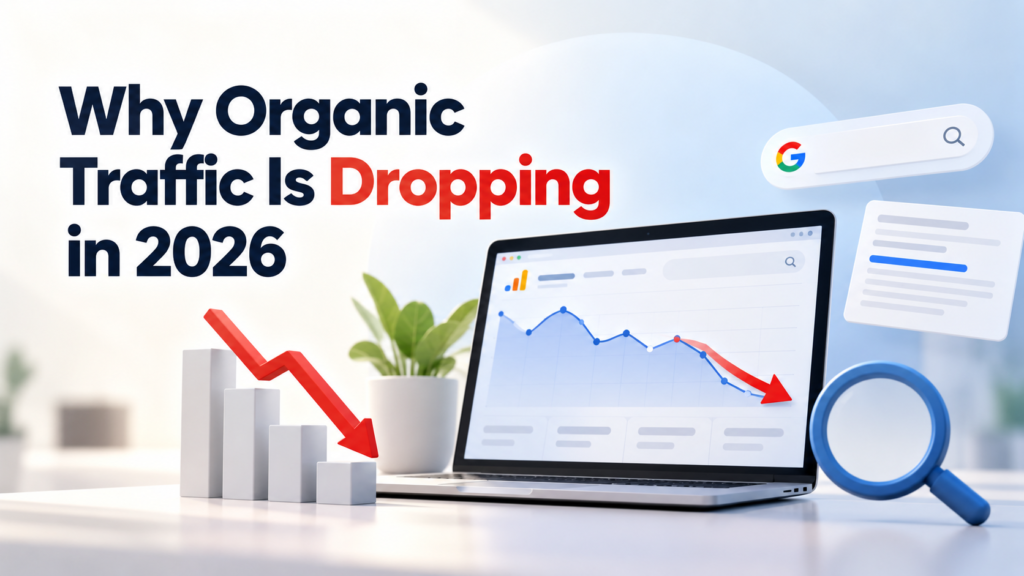
Google search results no longer look like a simple list of ten blue links. A single results page can now include AI-generated summaries, paid ads, shopping results, map packs, videos, and review snippets, all competing for the same click. Traditional organic listings still matter, but they’re sharing space with far more than before.
AI-generated summaries play a particularly large role in this shift. When a search engine can answer a question directly on the results page, many users never click through to a website at all. Research on this behavior has found that people are notably less likely to click a traditional search result when an AI summary appears above it, compared to when it doesn’t.
This doesn’t mean SEO has stopped working. It means the relationship between rankings and clicks has become less direct than it used to be.
A Traffic Drop Isn’t Always an SEO Failure
Before changing strategy, it’s worth diagnosing exactly what dropped. A decline in traffic to old, broad informational blog posts tells a very different story than a decline on service or product pages.
Ask these questions first:
- Did all organic traffic fall, or mainly older, top-of-funnel content?
- Are rankings and search impressions holding steady, even if clicks are down?
- Have leads, calls, bookings or form submissions also declined, or stayed flat?
- Has branded search demand changed at all?
If rankings and impressions remain stable while only broad informational traffic drops, the likely cause is a more crowded results page, not a weakening SEO strategy. If conversions are dropping faster than traffic overall, the issue may sit with the website experience rather than visibility.
Which Pages Are Most Vulnerable to AI Overviews
Not all content is affected equally by AI-generated summaries. Pages most at risk tend to answer short, broad, easily summarized questions:
- Basic “what is” or definition-style articles
- Simple how-to posts with a quick, single answer
- Short FAQ pages covering general topics
- Generic top-of-funnel educational content
These pages still have value – they build topical authority and support internal linking – but they’re the easiest for AI tools to summarize directly, reducing the need for a click.
Pages tied to genuine buying intent tend to hold up far better:
- Service and product pages
- Local landing pages
- Pricing and comparison pages
- Case studies and reviews
- Pages built around a specific problem and its solution
These pages survive the AI Overview shift because a user still needs more than a quick answer. They need to compare options, build trust and decide who to choose – something a summary alone can’t fully deliver.
New Marketing Strategies for 2026: What Actually Works
1. Shift Focus to High-Intent, Revenue-Close Pages
Rather than chasing total traffic volume, prioritize the pages closest to actual conversions. Make sure service pages, product pages and contact paths are specific, clear and genuinely useful. More visitors won’t fix a vague or thin page that fails to convert once someone arrives.
2. Rethink, Don’t Abandon, Content Strategy
Blog content still matters, but generic, broad-topic posts need to evolve. Content that answers real, specific customer questions, supports internal links, and adds a genuine point of view performs far better than content that reads like something available anywhere else online.
3. Build Visibility Beyond Traditional Rankings
Search visibility today extends well beyond the organic results list. It also includes AI Overview citations, local map pack rankings, video content, review-driven pages, partner backlinks and even branded search demand. Businesses need to understand what elements are now foundational for SEO with AI shaping discovery, rather than optimizing only for the classic list of blue links.
4. Track New Metrics, Not Just Traffic
Total sessions alone no longer tell the full story. A more accurate performance picture includes organic conversions, calls, bookings, branded search demand, high-intent keyword rankings, and search impressions alongside clicks. Using dedicated tools to monitor AI visibility metrics helps separate a genuine SEO problem from a simple shift in how search results are displayed.
5. Monitor AI Referral Traffic Early
Visits coming from AI tools like ChatGPT, Gemini, Copilot and Perplexity are still relatively small for most businesses, but tracking them now establishes a useful baseline. An AI SEO analyzer can help businesses understand how often their content is being surfaced by these tools, even before that traffic becomes a major channel.
6. Check Your Actual Position in AI Overviews
It’s no longer enough to check traditional rankings alone. Businesses need to know whether their content is being cited inside AI-generated summaries for their most important search terms. Using AI Overview checkers regularly shows exactly where a brand stands within these new, increasingly influential search features.
7. Strengthen Conversion, Not Just Visibility
When fewer, but more qualified, visitors reach a website, every visit carries more weight. Clear calls to action, simpler forms, stronger proof points and faster load times help convert a smaller volume of highly intentional traffic into real leads, rather than relying on volume alone to compensate.
8. Don’t Assume AI Content Will Fix This
Some businesses respond to traffic pressure by mass-producing AI-generated content, assuming more content automatically means more visibility. This often backfires. Understanding whether AI-generated content is actually good or bad for SEO matters more than ever, since thin, low-value content is unlikely to earn citations in AI Overviews or build the trust needed to convert visitors.
9. Invest in Dedicated AI Visibility Tools
As the gap between traditional SEO and AI-driven discovery widens, specialized software for AI visibility and generative engine optimization has become genuinely useful rather than optional. These tools help businesses understand exactly how they’re being represented across AI-powered search experiences, not just traditional results pages.
How to Respond to a Traffic Drop, Step by Step
- Identify exactly what dropped – Specific pages, keywords, locations or devices, not just the sitewide number.
- Compare traffic against business outcomes – Calls, bookings, form submissions and conversion rate, not clicks alone.
- Check the actual search results for affected keywords – is there now an AI Overview, more ads, or a map pack above your listing?
- Separate SERP changes from real SEO problems – Steady rankings with falling clicks usually point to a more crowded results page, not a ranking failure.
- Match the fix to the actual problem – Refresh outdated content, strengthen service pages, improve conversion paths, or build stronger local and review signals, depending on what the diagnosis shows.
Common Mistakes Businesses Make Responding to the Shift
- Panicking and abandoning SEO entirely, missing the fact that high-intent pages often remain stable
- Judging performance by traffic alone, ignoring conversions, calls and bookings
- Flooding the site with low-quality AI content, hoping volume alone restores visibility
- Ignoring AI Overview citations, missing a growing share of how people now discover brands
- Treating SEO, paid search, content and conversion optimization as separate projects instead of one coordinated strategy
Practical Checklist for 2026 Organic Traffic Strategy
- Diagnose which specific pages and keywords lost traffic before changing anything
- Prioritize and strengthen high-intent, revenue-close pages first
- Track conversions, calls and bookings alongside raw traffic numbers
- Monitor AI Overview citations and AI referral traffic consistently
- Avoid mass-producing low-value AI content as a quick fix
- Strengthen conversion paths to get more value from fewer, higher-intent visits
- Understand where SEO fits within the broader search landscape, including the future of SEO and how AI Overviews are changing search more broadly
How SurgeAIO can help in terms of SEO
Declining organic traffic in 2026 requires a different diagnostic approach, not just more content or louder promotion. SurgeAIO helps businesses understand exactly what’s changed in their search results and build new marketing strategies around it, rather than reacting to every traffic fluctuation.
That starts with knowing how to rank in AI Overviews specifically, since citation inside these summaries has become a meaningful visibility channel in its own right. SurgeAIO also helps businesses separate genuine SEO problems from normal shifts in a more crowded search results page, ensuring strategy decisions are based on real diagnosis rather than guesswork.
Final Thoughts
Declining organic traffic in 2026 reflects a genuinely different search landscape, not necessarily a failing strategy. The businesses navigating this shift successfully are diagnosing drops carefully, prioritizing high-intent pages, tracking the right metrics, and building visibility across AI Overviews and traditional rankings alike. Traffic is still a useful signal, but in 2026, it’s no longer the whole story.
Frequently Asked Questions
1. Why is my organic traffic dropping in 2026 even though my rankings haven’t changed?
AI Overviews, ads, map packs and other search features now take up more space on results pages, meaning a page can still rank well but receive fewer clicks simply because more content sits above it.
2. Does a traffic drop always mean my SEO strategy is failing?
Not necessarily. If rankings, impressions, leads and conversions remain steady while only broad informational traffic declines, the SEO strategy may still be working – the search results page itself has simply changed.
3. Which types of content are most affected by AI Overviews?
Broad, definition-style or quick how-to content tends to be summarized directly by AI tools, reducing clicks. Service pages, comparisons and case studies tend to hold up better, since users still need more than a quick answer.
4. Should businesses stop publishing blog content because of AI Overviews?
No. Blog content still builds authority and supports internal linking, but it needs to shift toward more specific, genuinely useful content rather than generic, easily summarized answers.
5. What metrics should businesses track instead of relying on total traffic alone?
Organic conversions, calls, bookings, branded search demand, AI Overview citations and high-intent keyword rankings all provide a more accurate picture of SEO performance than total sessions alone.
