Two terms come up constantly in digital marketing conversations – SEO and SEM. Many people use them interchangeably. That is a mistake. Understanding how SEO and SEM differ is essential for any business or marketer looking to build a smart, cost-effective search strategy.
This guide breaks both down clearly – what they are, how they work, where they overlap, and how to decide which one is right for your goals.
What Is SEO?
Search Engine Optimisation (SEO) is the process of improving your website so it ranks higher in organic, meaning unpaid, search engine results. When someone types a query into Google and clicks a non-advertised result, that click came from SEO.
SEO is built on four core pillars:
- Keyword research – finding the search terms your target audience uses
- On-page optimisation – optimising titles, headings, content, and metadata
- Technical SEO – improving site speed, crawlability, and structure
- Off-page SEO – earning backlinks that signal authority to search engines
The biggest advantage of SEO is that it compounds over time. A well-optimised page can drive consistent traffic for months or years without ongoing ad spend. However, it takes time – typically 3 to 6 months – before significant results appear.
Understanding whether SEO is advertising or marketing helps clarify exactly where it sits in your overall strategy and how to budget for it correctly.
What Is SEM?
Search Engine Marketing (SEM) is the broader discipline that covers all efforts to gain visibility in search engines – both organic and paid. In practical usage today, however, SEM most commonly refers to paid search advertising, particularly pay-per-click (PPC) campaigns run through platforms like Google Ads and Microsoft Advertising.
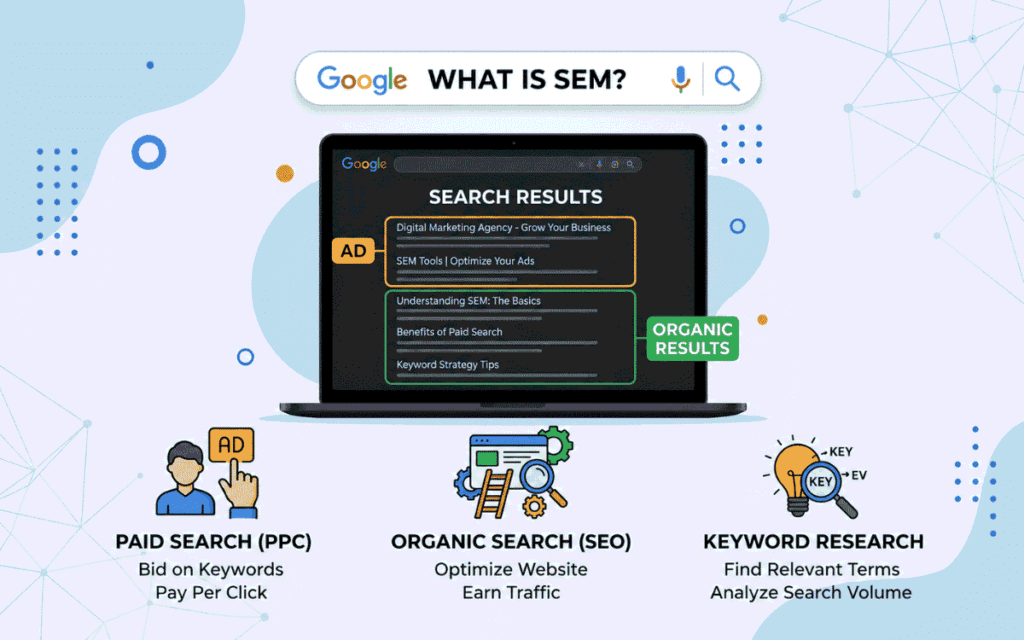
When you search on Google and see results labelled “Sponsored” at the top or bottom of the page, those are SEM ads. Businesses bid on specific keywords through an ad auction. Each time a user clicks their ad, they pay a fee – hence the term cost-per-click (CPC).
SEM delivers immediate visibility. The moment your campaign goes live, your ad can appear at the top of relevant search results. However, the moment your budget runs out, your visibility disappears entirely.
How Do SEO and SEM Differ? Key Comparisons
Now that we’ve defined both, let’s explore the specific dimensions where SEO and SEM diverge.
1. Cost Structure
SEO and SEM have fundamentally different cost models.
SEO does not require payment to search engines for traffic. You invest in content creation, technical improvements, and link building – but organic clicks are free. The costs are time and resources, not per-click fees.
SEM requires an ongoing advertising budget. Every click costs money. If you pause your spend, your ads disappear. For competitive keywords, cost-per-click can reach tens or even hundreds of dollars in some industries.
This is why many businesses rely on SEO services for organic traffic as a long-term cost-efficient strategy alongside short-term SEM campaigns.
2. Speed of Results
This is one of the most significant differences between SEO and SEM.
SEO is a long-term investment. It typically takes several months before pages gain meaningful rankings and traffic. Building authority and trust with search engines does not happen overnight.
SEM delivers instant results. Launch a campaign today, and your ads can appear in search results within hours. This makes it ideal for product launches, seasonal promotions, or any situation requiring rapid visibility.
Therefore, many businesses use SEM to generate leads while their SEO strategy matures in the background.
3. Traffic Sustainability
SEO builds sustainable, compounding traffic. A page that earns strong rankings continues to attract visitors without additional spend. Over time, this creates a growing asset for your business.
SEM traffic is entirely dependent on your budget. Stop paying, and the traffic stops immediately. There is no residual benefit once a campaign ends.
For businesses thinking long-term, understanding what SEO lead generation means helps frame organic search as a lead generation engine – not just a traffic source.
4. Credibility and Click Behaviour
Studies consistently show that many users trust organic results more than paid ads. A significant portion of searchers scroll past sponsored listings to reach organic results, particularly for research-oriented or informational queries.
However, SEM performs very well for high-intent commercial queries – searches where users are actively ready to buy. In these cases, a well-crafted paid ad with a strong offer can outperform organic results in conversion rate.
5. Targeting Capabilities
SEM offers more precise and immediate targeting options. You can target by:
- Specific keywords and match types
- Geographic location, device type, and time of day
- Audience demographics and interests
- Remarketing lists (targeting previous site visitors)
SEO targeting is less granular. You optimise content for keywords and search intent, but you cannot control who sees your results the way you can with paid ads.
That said, geo targeting in SEO is a powerful technique for businesses serving specific regions – combining local keyword optimisation with targeted content strategies to attract geographically relevant visitors.
6. Measurability and Testing
SEM allows rapid testing. You can run A/B tests on ad copy, landing pages, and bidding strategies in days. Results are immediate and clearly attributable to the spend.
SEO testing is slower by nature. Algorithm changes, competition shifts, and indexing delays mean it can take weeks or months to understand the full impact of any optimisation change.
However, both channels benefit enormously from strong content performance data – tracking which pages and campaigns drive the most meaningful traffic and conversions.
Where SEO and SEM Overlap
Despite their differences, SEO and SEM share important common ground.
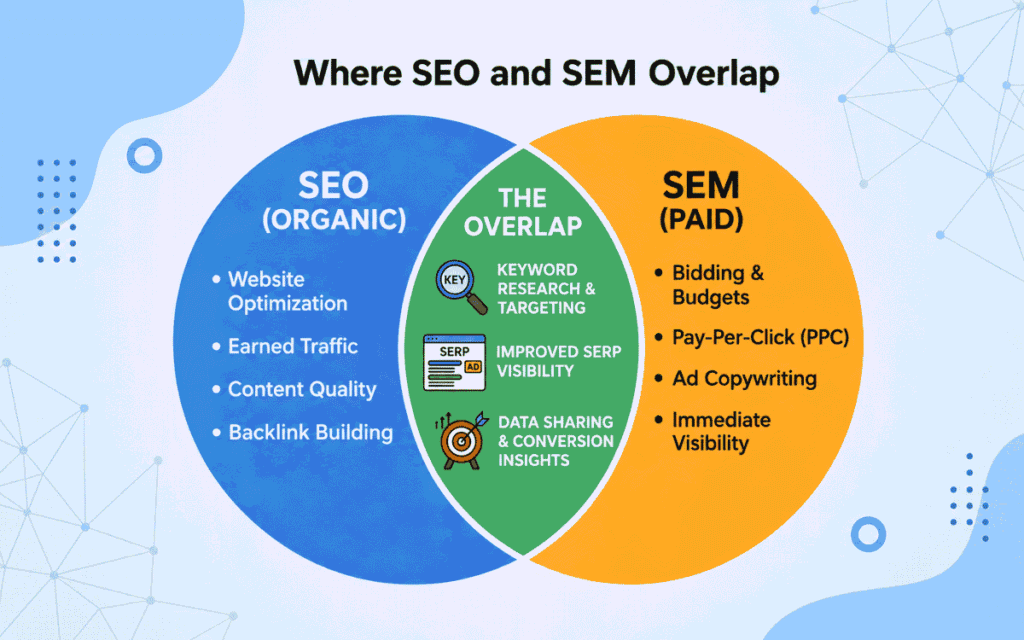
Keyword research drives both. Whether you’re writing optimised blog content or building a Google Ads campaign, understanding what your audience searches for is the foundation.
Landing page quality matters in both. Google’s Quality Score – which affects how much you pay per click in SEM – is heavily influenced by the relevance and quality of your landing page. Good on-page SEO directly improves SEM performance.
Search intent is central to both. Whether organic or paid, content that matches what users are actually looking for performs better. Misreading intent wastes money in SEM and fails to rank in SEO.
Both benefit from competitive analysis. Understanding what competitors rank for organically – and what they’re bidding on in paid search – informs strategy across both channels. A thorough competitive analysis of keywords gives you a decisive advantage in both SEO and SEM simultaneously.
When to Use SEO vs. SEM
Choosing between SEO and SEM – or deciding how to allocate between them – depends on your specific situation.
Prioritise SEO when:
- You have a longer time horizon and can invest 6+ months before expecting significant returns
- You want to build a sustainable, cost-efficient traffic source
- Your industry has moderate keyword competition
- You’re focused on informational or research-driven search queries
- You want to build brand authority and trust over time
Prioritise SEM when:
- You need immediate traffic or leads – for a new product, event, or promotion
- You want to test messaging and offers before committing to long-term content
- You’re competing in a market where top organic positions are dominated by established players
- Your business has clear short-term revenue targets tied to search traffic
- You want hyper-specific audience targeting that organic search can’t provide
Use both when:
- You have the budget to run paid campaigns while your SEO compounds
- You want to dominate the SERP by appearing in both organic and paid positions
- You’re using SEM data to identify high-converting keywords to prioritise in your SEO strategy
Many businesses – especially in competitive sectors like legal, healthcare, and finance – find that doing both digital marketing and SEO together delivers results far greater than either channel alone.
Common Mistakes When Mixing SEO and SEM
Understanding how SEO and SEM differ also means avoiding common strategic errors.
- Treating them as interchangeable – They serve different purposes at different timelines. Replacing SEO with SEM is expensive long-term. Replacing SEM with SEO is risky in the short term.
- Not sharing data between channels – SEM conversion data can reveal which keywords to prioritise in SEO. SEO ranking data can show where to reduce PPC spend. Both channels should inform each other.
- Ignoring quality scores in SEM – Poor landing page quality drives up your CPC and reduces ad performance. Good SEO practices directly lower your SEM costs.
- Neglecting long-tail keywords in SEM – Many advertisers focus only on broad, expensive keywords. Long-tail terms often convert better at a fraction of the cost.
How SurgeAIO Can Help in Terms of SEO
For businesses that want to master organic search while staying informed about the full search landscape, SurgeAIO provides a powerful unified platform.
Here’s how SurgeAIO supports your SEO strategy:
Keyword Intelligence – SurgeAIO helps you identify the most valuable organic keywords for your business – including long-tail opportunities that competitors miss. This data also informs which keywords may be worth testing in paid campaigns.
Content Optimisation – The platform analyses your existing content against top-ranking pages and identifies exactly what needs to improve. Better content means better rankings and lower SEM costs through improved Quality Scores.
Technical SEO Auditing – SurgeAIO scans your site for the technical issues that silently drag down organic performance – crawl errors, slow load times, broken links, and more.
Competitive Analysis – Understand where competitors are winning in organic search and build a targeted strategy to outrank them. Knowing where rivals are investing heavily in paid search can also reveal gaps in organic coverage.
AI Visibility Tracking – As AI-generated search results reshape how people discover businesses, SurgeAIO tracks your brand’s visibility in AI Overviews and generative search responses – a dimension that goes beyond both traditional SEO and SEM.
Performance Reporting – Clear dashboards track organic traffic growth, keyword movements, and lead generation – making it easy to demonstrate ROI and guide ongoing strategy decisions.
Whether you’re investing purely in SEO or managing a combined SEO and SEM approach, SurgeAIO gives you the data and tools to make smarter decisions and drive better results.
Final Thoughts
Understanding how SEO and SEM differ is not just academic – it directly shapes where you invest your time and budget in digital marketing.
SEO builds long-term authority and delivers sustainable, compounding traffic. SEM offers immediate visibility with precise control. Both are powerful. Both serve different strategic purposes. And when used together intelligently, they create a search marketing engine that is greater than the sum of its parts.
Start by clarifying your goals, timeline, and budget. Then build a strategy that uses each channel where it performs best – and lets data from one channel sharpen performance in the other.
Frequently Asked Questions
Q1. Is SEM the same as PPC?
Not exactly. SEM is the broader term that technically includes both organic search (SEO) and paid search. However, in common usage, SEM most often refers specifically to paid search advertising – which is also called PPC (pay-per-click). The terms are frequently used interchangeably in industry conversations.
Q2. Which is better – SEO or SEM?
Neither is universally better. SEO offers long-term, sustainable traffic without per-click costs. SEM delivers immediate visibility with precise targeting. The best approach for most businesses combines both – using SEM for short-term wins while SEO builds for the long term.
Q3. Can I do SEO and SEM at the same time?
Absolutely – and it’s often the smartest approach. Running both simultaneously means you appear in paid and organic positions, dominate more SERP real estate, and can use SEM data to sharpen your SEO strategy.
Q4. How much does SEM cost?
SEM costs vary widely depending on your industry, competition level, and targeting. Some keywords cost less than £1 per click. Others – particularly in legal, finance, and insurance – can exceed £50 per click. Your monthly budget determines how much traffic and visibility you can buy.
Q5. How long does SEO take to show results?
Most businesses see meaningful organic traffic improvement within 3 to 6 months of consistent SEO effort. Highly competitive industries may take 12 months or longer. Technical improvements and content optimisations can sometimes show results in weeks.
Q6. Does running SEM ads help my SEO rankings?
No. Running paid search ads does not directly influence your organic search rankings. Google has confirmed this repeatedly. However, paid ads can drive traffic that increases brand awareness, and users who click ads may link to your site, which can indirectly support SEO.
Q7. What is a keyword gap, and how does it affect SEO and SEM strategy?
A keyword gap refers to the keywords your competitors rank for that you currently do not. Identifying these gaps helps you target untapped opportunities in both organic content and paid campaigns – maximising your overall search visibility.
