If you run a medical practice in New York, you already know the competition is intense. Thousands of doctors, clinics, specialists, and hospitals compete for the same patients – often in the same zip code. New York medical SEO marketing is the strategy that separates practices that grow from those that stay invisible.
This guide breaks down exactly what medical SEO means in the New York market, why it matters more here than anywhere else, and how to build a strategy that consistently brings new patients through your door.
What Is New York Medical SEO Marketing?
New York medical SEO marketing is the practice of optimizing your healthcare website – and your entire online presence – so that patients in New York City and the surrounding metro area find you first on Google, Bing, and AI-powered search tools.
It combines traditional SEO for home service leads principles with healthcare-specific strategies. This includes medical keyword research, local citations, content authority, and technical site health.
However, medical SEO is not generic SEO. It requires expertise in HIPAA compliance, Google’s YMYL (Your Money Your Life) guidelines, and the trust signals patients look for before booking an appointment. Therefore, your strategy must be built specifically for a healthcare audience – not repurposed from a general business playbook.
Why New York Is a Uniquely Competitive Healthcare Market
New York City is home to over 8 million residents and draws millions more from New Jersey, Long Island, Westchester, and Connecticut. Patients have access to world-class hospitals, solo practitioners, boutique clinics, and telehealth providers – all competing for attention.
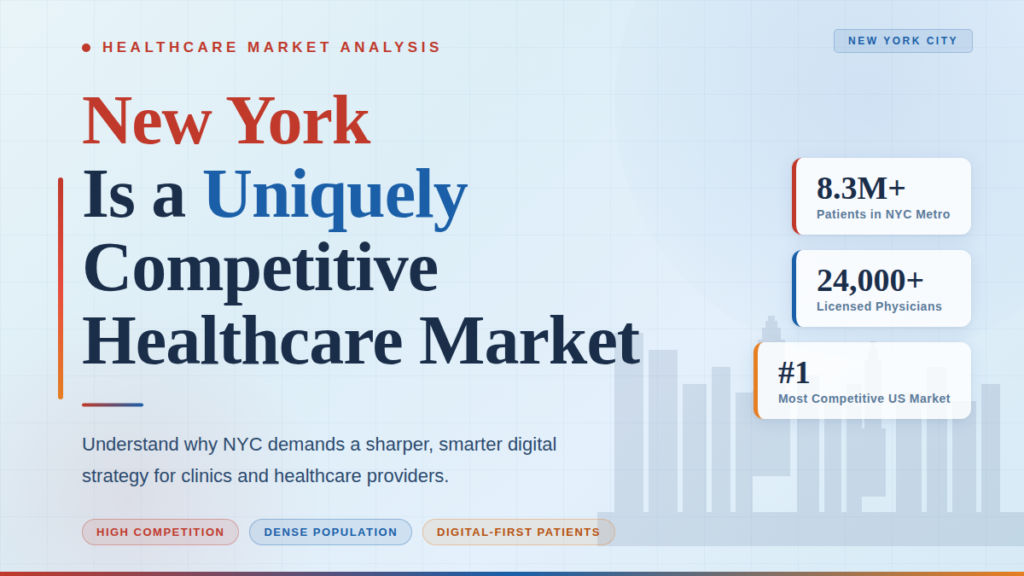
Moreover, patients in New York are digitally savvy. They search online before they call. They read reviews before they book. They compare multiple providers before they commit. If your practice does not appear on page one of Google, those patients simply go to a competitor.
This is why understanding what is SEO lead generation matters so much for healthcare providers in this market. Organic visibility is not a nice-to-have – it is the primary driver of new patient acquisition for most practices.
The Core Pillars of Medical SEO in New York
1. Local SEO and Google Business Profile Optimization
Local SEO is the foundation of any New York medical SEO marketing strategy. Patients searching “cardiologist near me” or “dermatologist in Brooklyn” are ready to book. You need to show up in those results.
Key local SEO actions include:
- Claiming and fully optimizing your Google Business Profile
- Ensuring your NAP (Name, Address, Phone) is consistent across all directories
- Building citations on Healthgrades, Zocdoc, WebMD, and Yelp
- Generating and responding to patient reviews consistently
- Adding location-specific landing pages for every borough or neighborhood you serve
AI local SEO is also becoming a major factor. AI-powered search tools increasingly pull local results from structured data and trusted directories. Therefore, ensuring your listings are accurate and complete is more important than ever.
2. Medical Keyword Research and Search Intent
Effective New York medical SEO marketing starts with the right keywords. However, keyword volume alone does not determine value. You need to understand search intent – what the patient actually wants when they type a query.
For example, someone searching “symptoms of appendicitis” is in research mode. Someone searching “emergency surgeon in Manhattan” is ready to act. Your content strategy must serve both – but your highest-priority pages should target high-intent, service-specific queries.
A strong keyword approach for a New York medical practice includes:
- Primary service keywords: “orthopedic surgeon New York,” “pediatrician Brooklyn”
- Condition-based keywords: “knee pain treatment NYC,” “diabetes management Manhattan”
- Comparative keywords: “best cardiologist in Queens,” “top-rated dermatologist near me”
- Long-tail queries: “What to expect after hip replacement surgery in New York”
Understanding competitive analyses of keywords helps you identify gaps your competitors have missed – and rank faster by targeting lower-competition, high-intent terms.
3. On-Page SEO for Healthcare Websites
On-page SEO ensures each page on your website is built to rank and convert. For medical practices, this means more than just adding keywords. It means building pages that demonstrate Expertise, Authoritativeness, and Trustworthiness – the three pillars of Google’s E-E-A-T framework for healthcare content.
Every core service page and location page should include:
- A clear, keyword-rich H1 heading
- Descriptive meta title and meta description
- Structured content that answers patient questions directly
- Physician credentials and bios linked from service pages
- Schema markup for medical providers, FAQs, and local business data
In addition, your website must load fast, render correctly on mobile devices, and meet Google’s Core Web Vitals standards. A slow, poorly structured medical site will not rank – regardless of how good the content is.
4. Content Marketing That Builds Authority
In the New York healthcare market, content marketing is one of the most powerful long-term tools available. Publishing informative, medically accurate blog posts, FAQs, and patient guides builds trust with both search engines and prospective patients.
Think about what your patients search for before they call you. A pain management clinic in Manhattan might publish content on topics like “when to see a doctor for lower back pain” or “non-surgical treatment options for herniated discs.” Over time, this content attracts consistent organic traffic and establishes the practice as a trusted authority.
Moreover, content supports SEO services for organic traffic over the long run. Unlike paid ads that stop the moment you pause your budget, well-optimized content compounds in value – attracting patients month after month without additional spend.
5. Link Building and Off-Page Authority
Google treats backlinks as votes of confidence. For medical practices in New York, earning links from local news outlets, medical associations, hospital networks, and health publications can significantly boost domain authority.
However, link quality matters far more than volume. A single link from the New York Times health section or the American Medical Association is worth more than dozens of links from low-quality directories.
To learn more about how many backlinks you realistically need, and what quality thresholds matter at different stages of growth, explore how many backlinks do I need for a detailed breakdown.
6. Technical SEO for Medical Websites
Technical SEO ensures search engines can crawl, index, and understand your site correctly. For healthcare websites, technical issues are surprisingly common – especially on older practice management systems or legacy sites built without SEO in mind.
Key technical SEO priorities for medical practices include:
- Fixing broken internal links and redirect chains
- Submitting an accurate XML sitemap to Google Search Console
- Implementing canonical tags to prevent duplicate content issues
- Ensuring HTTPS is active across all pages
- Optimizing image alt text with descriptive, keyword-relevant descriptions
- Adding structured data (schema markup) for medical providers, reviews, and services
The Role of AI Search in New York Medical SEO Marketing
AI-powered search is changing how patients find healthcare providers. Tools like Google’s AI Overviews, ChatGPT, Perplexity, and Gemini increasingly answer health-related questions directly – and they cite specific sources and providers.
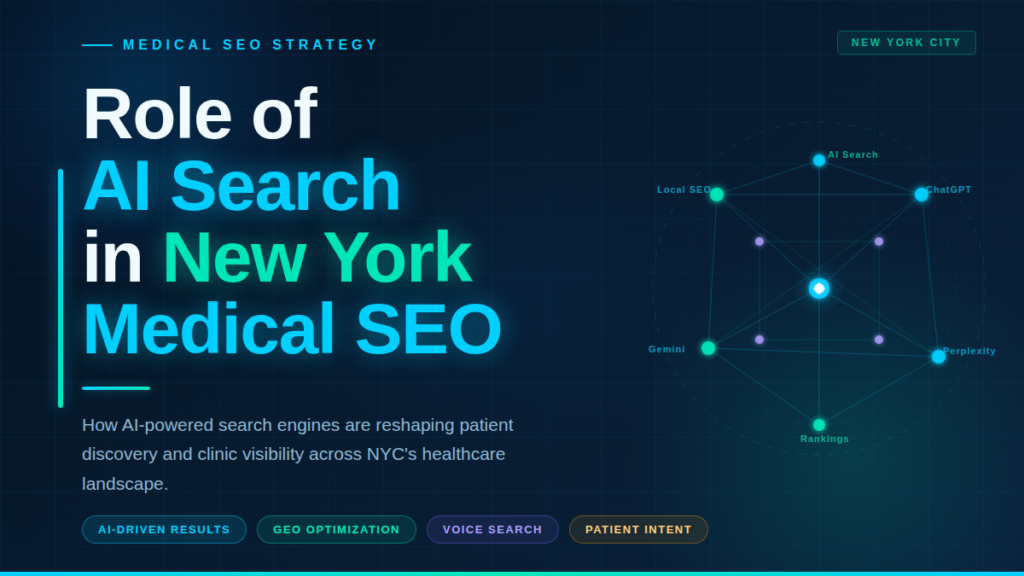
This shift makes it essential for New York medical practices to optimize not just for traditional Google rankings but also for AI visibility optimization techniques. Practices that appear in AI-generated answers gain enormous trust and visibility advantages over those that do not.
To show up in AI-powered results, your content needs to:
- Answer specific patient questions directly and clearly
- Use structured formatting (headers, bullets, FAQs)
- Demonstrate medical authority through physician credentials and citations
- Be published on a technically sound, well-linked website
In addition, understanding what is LLM in SEO gives medical marketers a clearer picture of how large language models select sources – and what it takes to become a consistently cited resource.
Common Mistakes New York Medical Practices Make with SEO
Even well-funded practices make avoidable errors. Here are the most common ones:
- Targeting the wrong keywords: Focusing on high-volume terms with no realistic chance of ranking, instead of precise, high-intent local queries.
- Neglecting local SEO: Not optimizing Google Business Profile or ignoring patient reviews – both of which heavily influence local rankings.
- Thin service pages: Creating one generic “services” page instead of individual, detailed pages for each specialty or treatment.
- Ignoring mobile performance: Most patients search on smartphones. A site that performs poorly on mobile loses rankings and patients simultaneously.
- No content strategy: Publishing inconsistently or not at all, leaving competitors to capture all the informational search traffic.
- Over-relying on paid ads: PPC drives immediate traffic, but it stops the moment you stop paying. SEO builds lasting value that compounds over time.
How SurgeAIO Can Help in Terms of SEO
SurgeAIO is built for businesses and healthcare practices that want to compete at the highest level – without wasting budget on guesswork. For New York medical practices, SurgeAIO delivers a complete SEO and AI visibility platform that addresses every layer of your digital marketing strategy.
Here is what SurgeAIO brings to the table for medical SEO:
- AI-powered keyword research that identifies high-intent, low-competition medical queries specific to your specialty and location
- Content performance tracking so you know exactly which pages are driving patient inquiries and which need improvement – aligned with content performance data best practices
- AI visibility monitoring to track whether your practice appears in AI-generated answers on ChatGPT, Google AI Overviews, Perplexity, and other platforms
- Competitive analysis tools that show you exactly what your top-ranking New York competitors are doing – and where they are vulnerable
- On-page optimization recommendations delivered in actionable, prioritized reports that your team can implement immediately
- Local SEO support to improve your Google Business Profile rankings and citation consistency across all major healthcare directories
Furthermore, SurgeAIO helps medical practices stay ahead of the curve as search evolves. Whether it is adapting to Google algorithm updates or ensuring your content surfaces in AI-powered search results, SurgeAIO gives you the data and tools to make smart decisions – not reactive ones.
For practices serious about growing their patient base through organic search, SurgeAIO is not just a tool – it is a competitive advantage.
Building a Long-Term Medical SEO Strategy in New York
SEO is not a one-time project. It is an ongoing investment that builds compounding returns over time. The practices that dominate Google in their specialty did not get there overnight – they built authority consistently, month after month.
A realistic timeline for New York medical SEO marketing looks like this:
- Months 1-3: Technical fixes, local SEO setup, foundational content creation, and keyword targeting
- Months 4-6: Rankings begin improving for lower-competition terms; traffic starts growing
- Months 7-12: Competitive keywords move to page one; patient inquiries from organic search increase noticeably
- Year 2 and beyond: Compounding growth as domain authority rises and content library expands
The key is consistency. Practices that publish high-quality content regularly, build links steadily, and monitor their performance with the right tools outperform competitors who treat SEO as a one-time task.
Final Thoughts
New York is one of the most competitive healthcare markets in the world. Patients have options – and they research those options online before making a single phone call. New York medical SEO marketing gives your practice the visibility, authority, and trust signals needed to win that search moment.
The practices that invest in a structured, data-driven SEO strategy today will dominate their specialties in the years ahead. The ones that wait will find themselves spending more on paid ads to catch up with competitors who built organic authority while they hesitated.
Start with a clear strategy, focus on the right keywords, publish content your patients actually need, and use the right tools to measure and refine your efforts. Done consistently, medical SEO is the highest-ROI marketing investment a New York practice can make.
Frequently Asked Questions
Q: How long does it take to see results from medical SEO in New York?
Most practices begin seeing meaningful improvements in rankings and traffic within 4-6 months. However, competitive specialties in dense markets like Manhattan may take 9-12 months to reach page one for their primary keywords.
Q: Is SEO better than paid advertising for medical practices?
Both have a role. Paid ads (PPC) deliver immediate traffic but stop when the budget runs out. SEO builds lasting visibility that compounds over time. Most successful New York practices use both PPC for immediate patient acquisition and SEO for long-term, cost-efficient growth.
Q: Do I need separate SEO strategies for each borough in New York?
Yes, ideally. If your practice serves patients across multiple boroughs – say, Brooklyn, Queens, and Manhattan – you should create dedicated location pages for each area. This allows you to rank for location-specific searches in each neighborhood.
Q: How does Google’s E-E-A-T affect medical website rankings?
Google applies strict quality standards to healthcare content because it directly impacts people’s health decisions. Websites that demonstrate Experience, Expertise, Authoritativeness, and Trustworthiness rank significantly better. This means featuring physician credentials, linking to credible medical sources, and publishing accurate, well-researched content.
Q: Can AI-generated content hurt my medical website’s SEO?
AI-generated content is not inherently bad, but low-quality, generic, or medically inaccurate AI content can absolutely harm your rankings and your reputation. The key is using AI as a writing tool while ensuring all content is reviewed, fact-checked, and enhanced by qualified medical professionals.
Q: What is the most important local SEO factor for New York medical practices?
Your Google Business Profile is the single most important local SEO asset. A fully optimized, actively managed GBP with accurate information, regular posts, and consistent patient reviews significantly improves your visibility in local map results – which is often the first thing patients see when searching for a doctor.
