Plastic surgery is one of the most competitive healthcare niches online. Patients research extensively before booking a consultation. Therefore, your clinic must appear where they are searching – both in Google and AI-powered search tools.
That is where SEO GEO for plastic surgery clinics comes in. This combined strategy helps your practice rank in traditional search results and inside AI-generated answers. Moreover, it builds long-term digital authority that paid ads simply cannot replicate.
In this guide, you will learn exactly how to implement SEO and GEO for your plastic surgery clinic – from keyword strategy to local optimization and AI visibility.
What Is SEO GEO for Plastic Surgery Clinics?
SEO (Search Engine Optimization) improves your visibility on platforms like Google and Bing. GEO (Generative Engine Optimization) helps your clinic appear inside AI-powered tools like ChatGPT, Google AI Overviews, and Perplexity.
Together, they form a full-funnel digital strategy. If you want to understand the foundational difference, read this overview on what SEO and GEO.
Plastic surgery patients ask very specific questions. They search for things like “best rhinoplasty surgeon near me” or “how much does a tummy tuck cost in [city].” Both SEO and GEO position your clinic as the trusted answer to those queries.
However, most clinics only focus on traditional SEO. That leaves a massive gap in AI visibility – and your competitors could fill it before you do.
Why Plastic Surgery Clinics Need a Combined SEO and GEO Strategy
Search behavior has changed dramatically. More patients now start their research on AI tools before they ever visit a website. In addition, Google itself now shows AI Overviews for many medical and cosmetic procedure queries.
This shift makes AI local SEO essential for any clinic that wants to stay visible as search evolves.
Here is why a combined approach matters for plastic surgeons specifically:
- Patients often compare multiple surgeons using AI tools before shortlisting
- AI Overviews now appear for queries like “best plastic surgeon for rhinoplasty”
- GEO signals – such as structured content and schema markup – also improve traditional SEO
- Clinics with strong GEO presence get cited in AI answers, driving high-intent traffic
- Local GEO optimization boosts visibility in both map packs and AI location responses
Moreover, the trust factor in plastic surgery is extremely high. Patients want authoritative, credible sources. A strong SEO and GEO presence signals exactly that.
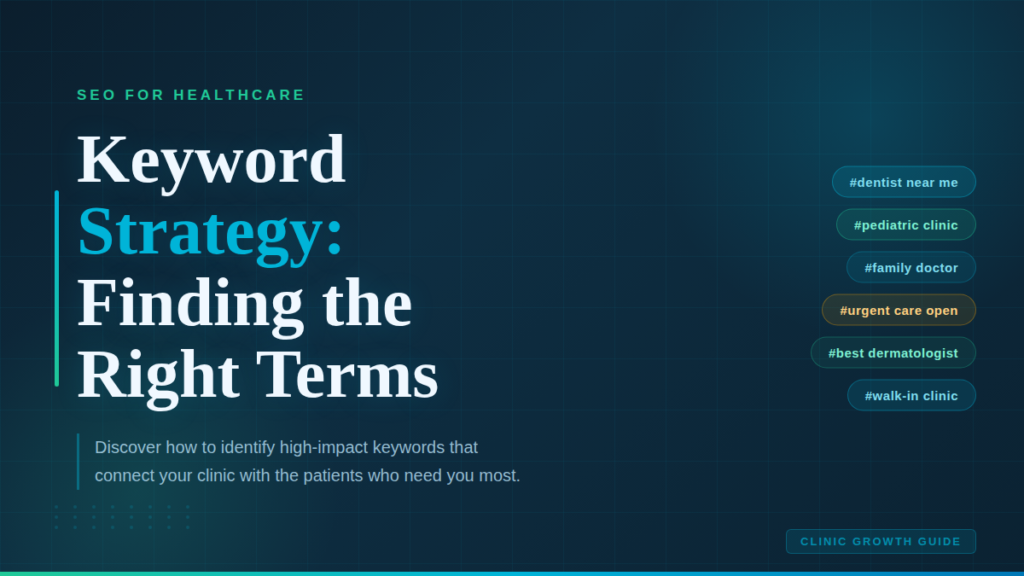
Keyword Strategy: Finding the Right Terms for Your Clinic
Focus on Procedure-Specific Keywords
Do not just target broad terms like “plastic surgery.” Instead, go deeper. Target procedure + location combinations that match real patient search intent.
Examples of high-value keyword patterns:
- “rhinoplasty surgeon in [city]”
- “breast augmentation consultation [city]”
- “tummy tuck cost [state]”
- “best facelift surgeon near me”
- “blepharoplasty recovery time” (informational)
Map Search Intent Carefully
Every keyword has a specific intent. Some patients are ready to book. Others are still researching. Your content must match that intent exactly.
A solid competitive analysis of keywords helps you identify which terms your competitors rank for – and where the gaps are that you can capture quickly.
Transactional keywords (“book rhinoplasty consultation”) need conversion-focused landing pages. Informational keywords (“what is a mommy makeover”) need educational blog content. Therefore, build your content strategy around both types.
On-Page SEO for Plastic Surgery Websites
On-page SEO forms the foundation of your entire strategy. Get this right, and everything else becomes easier.
Optimize Every Procedure Page
Each procedure you offer – rhinoplasty, breast augmentation, liposuction, facelifts – needs its own dedicated page. Do not combine multiple services on one page.
Each page should include:
- A clear H1 tag containing the procedure name and city
- A unique meta title and meta description with the primary keyword
- 500–1,500 words of original, informative content
- Patient FAQs answering common pre-consultation questions
- Internal links to related procedure pages and blog posts
- A clear call-to-action (CTA) prompting consultation booking
Moreover, use schema markup on every procedure page. Structured data helps both Google and AI platforms understand your content faster and more accurately.
Local SEO: Winning in Your City and Surrounding Areas
Local SEO is arguably the highest ROI component for plastic surgery clinics. Patients almost always choose a surgeon within a reasonable distance from home.
Optimize Your Google Business Profile
Your Google Business Profile (GBP) is your most powerful local SEO asset. Keep it fully optimized:
- Use your exact practice name, address, and phone number (NAP)
- Select the most relevant primary and secondary categories
- Upload high-quality photos of your clinic, team, and results
- Collect and respond to every patient review
- Post regular updates about promotions, events, and new procedures
In addition, maintain consistent NAP information across all directories – Healthgrades, Zocdoc, RealSelf, Yelp, and others. Inconsistent citations hurt your local rankings.
Build Location-Specific Landing Pages
If your clinic serves multiple cities or suburbs, create dedicated local landing pages for SEO for each area. Each page should be unique, informative, and optimized for that specific location’s search terms.
For example, a clinic in Dallas might create separate pages for Dallas, Plano, Frisco, and Arlington. Each page should mention local landmarks, provide area-specific information, and include location-based keywords naturally.
GEO: Optimizing for AI Search Engines and Generative Results
GEO is the newest and most important evolution in digital marketing for plastic surgery clinics. AI tools like ChatGPT, Perplexity, and Google’s AI Overviews are changing how patients find surgeons.
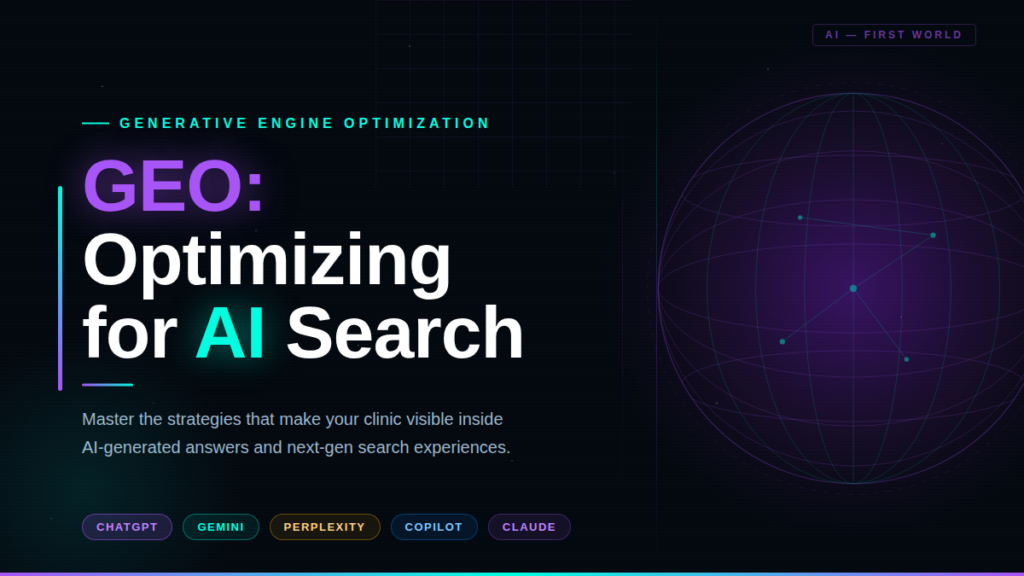
Understanding what is LLM in SEO helps you grasp how these AI systems select which sources to cite and reference in their responses.
Structure Content for AI Readability
AI systems favour content that is clearly structured, factually accurate, and directly answers specific questions. Therefore, write your website content with these principles:
- Use clear headings and subheadings (H2, H3, H4) that mirror common search questions
- Write FAQ sections on every procedure page
- Include concise, direct answers within the first paragraph of each section
- Add schema markup (FAQ schema, MedicalProcedure schema, LocalBusiness schema)
- Cite authoritative sources like medical journals, board certifications, and associations
Build Entity Authority
AI tools recognize entities – people, places, organizations. Your clinic and surgeons need to be recognized as credible entities. This means:
- Consistent mentions of your clinic name, surgeon names, and location across the web
- Wikipedia-style structured information on your About page
- Profiles and listings on authoritative medical directories
- Press mentions and local news coverage
Moreover, reviewing best practices for AI visibility SEO gives you a proven framework to implement GEO signals systematically across your entire digital presence.
Content Marketing: Building Authority Through Education
Content marketing drives organic traffic and establishes your surgeons as trusted experts. In addition, it feeds both your SEO and GEO strategies simultaneously.
Focus your blog content on:
- Procedure explanations written for non-medical audiences
- Recovery guides with realistic timelines and expectations
- Before-and-after photo posts with detailed context
- Answers to common patient concerns (cost, safety, downtime)
- Comparisons of procedures (e.g., “rhinoplasty vs septoplasty”)
Publish at least two to four blog posts per month. Over time, this builds a content library that ranks for hundreds of long-tail keywords and gets cited by AI tools.
Link Building for Plastic Surgery Clinics
Backlinks remain one of the strongest ranking signals in Google’s algorithm. For plastic surgery clinics, quality matters far more than quantity.
Focus on earning links from:
- Medical directories (Healthgrades, Zocdoc, RealSelf, WebMD)
- Local business directories and Chamber of Commerce websites
- Health and beauty publications
- Local news outlets covering your community involvement or expertise
- Guest posts on reputable medical and wellness blogs
Avoid low-quality link schemes. Google’s algorithm is sophisticated enough to identify and penalize manipulative link patterns – especially in the healthcare sector.
How SurgeAIO Can Help in Terms of SEO
SurgeAIO is built for businesses that want to win in both traditional search and the new AI-driven search landscape. For plastic surgery clinics, this dual capability is a significant advantage.
SurgeAIO helps you track AI visibility metrics alongside traditional keyword rankings – so you always know exactly where your clinic stands in both worlds.
Here is what SurgeAIO delivers for plastic surgery clinics specifically:
- Keyword tracking for both Google rankings and AI-generated mentions
- Competitor analysis reveals what your top local competitors rank for
- Content optimization tools aligned with GEO and SEO best practices
- Local SEO monitoring across multiple locations and procedure categories
- AI Overview tracking – see when and where your clinic appears in generative results
In addition, SurgeAIO’s platform supports SEO and GEO for your website and specialized medical niches alike, making it a versatile tool for clinics of any size.
Ultimately, SurgeAIO takes the guesswork out of SEO and GEO. It gives your team clear data, actionable recommendations, and a competitive edge that is difficult to achieve with generic tools.
Common SEO Mistakes Plastic Surgery Clinics Make
Even well-established clinics make preventable SEO mistakes. Avoid these common pitfalls:
- Publishing duplicate content across multiple procedure pages
- Ignoring mobile optimization – most patients search on smartphones
- Slow website load times that increase bounce rates
- Neglecting patient reviews and reputation management
- Using stock photos instead of authentic clinic and result images
- Failing to update old content with current information and pricing
Furthermore, many clinics neglect technical SEO issues like broken links, missing alt text, and unoptimized page speed. These factors directly affect both rankings and user experience.
Conclusion
The landscape of digital marketing for plastic surgery clinics is more complex than ever. However, the opportunity has never been greater.
A combined SEO GEO strategy positions your clinic in both traditional search results and the rapidly growing AI-powered search environment. From keyword research and local optimization to GEO content structuring and entity building – every element compounds over time.
Ultimately, clinics that invest in SEO and GEO today will dominate their local markets for years to come. Start with the fundamentals, stay consistent, and use the right tools to measure and refine your efforts.
SurgeAIO makes that process faster, smarter, and more measurable – helping your practice grow with clarity and confidence.
Frequently Asked Questions
Q1: How long does SEO take to show results for a plastic surgery clinic?
SEO typically takes three to six months to show measurable results. Competitive markets, such as major cities, may take longer. However, local SEO improvements – like Google Business Profile optimization – can show faster gains within four to eight weeks.
Q2: What is GEO, and how is it different from SEO?
SEO optimizes your content for traditional search engines like Google. GEO (Generative Engine Optimisation) optimises your content to appear in AI-generated answers from tools like ChatGPT, Perplexity, and Google AI Overviews. Both strategies work together and share many common tactics.
Q3: Should plastic surgery clinics invest in SEO or paid ads?
Ideally, both. Paid ads deliver immediate traffic. SEO builds long-term, compounding visibility. Moreover, clinics with strong organic rankings reduce their dependence on costly paid campaigns over time. SEO delivers a far better return on investment in the long run.
Q4: How many keywords should a plastic surgery clinic target?
Start with 10 to 20 primary keywords around your core procedures and locations. Then expand to long-tail variations as you build content and authority. Quality and relevance always outweigh raw keyword volume.
Q5: Is content marketing necessary for plastic surgery SEO?
Yes. Content is the engine that drives both SEO rankings and GEO citations. Educational blog posts, FAQs, and procedure guides attract patients in the research phase and signal expertise to both Google and AI systems.
Q6: How does local SEO differ from regular SEO for plastic surgery clinics?
Local SEO focuses on geographic relevance – helping your clinic appear in map packs, local search results, and location-based queries. It involves Google Business Profile optimization, local citations, and location-specific landing pages. Regular SEO covers broader content and technical optimization without a geographic focus.
