If your website’s traffic has stalled or your rankings feel stuck, you’ve probably heard someone suggest running an SEO audit. But what is an SEO site audit, exactly, and why does nearly every successful SEO strategy start with one?
An SEO site audit is a structured review of your website’s technical health, content quality, and off-page authority. It tells you what’s working, what’s broken, and where you’re losing visibility in both traditional search results and AI-driven answers. Without this diagnostic step, you’re essentially guessing at fixes instead of prioritizing the changes that actually move the needle.
In this guide, we’ll break down what an SEO site audit covers, why it matters, and how to perform one – step by step.
What Is an SEO Site Audit?
An SEO site audit is a comprehensive evaluation of every factor that affects how search engines and AI systems find, understand, and rank your website. It typically examines four core areas: technical SEO, on-page elements, content quality, and backlink authority.
Rather than looking at rankings alone, a proper SEO audit digs into the “why” behind your performance. It answers questions like: Can search engines crawl your site? Does your content satisfy user intent? Is your site fast and mobile-friendly? Are you earning credible backlinks?
Search behavior has also shifted. Users now ask questions directly to tools like ChatGPT and Google’s AI Overviews, not just typing keywords into a search bar. That means a modern audit also needs to evaluate whether your brand shows up in AI-generated answers, not just blue links. This is where understanding what elements are foundational for SEO with AI becomes essential to a truly complete audit.
Why Is an SEO Site Audit Important?
A site audit isn’t a one-and-done checkbox. It’s an ongoing diagnostic tool that keeps your website aligned with search engine standards and evolving algorithms.
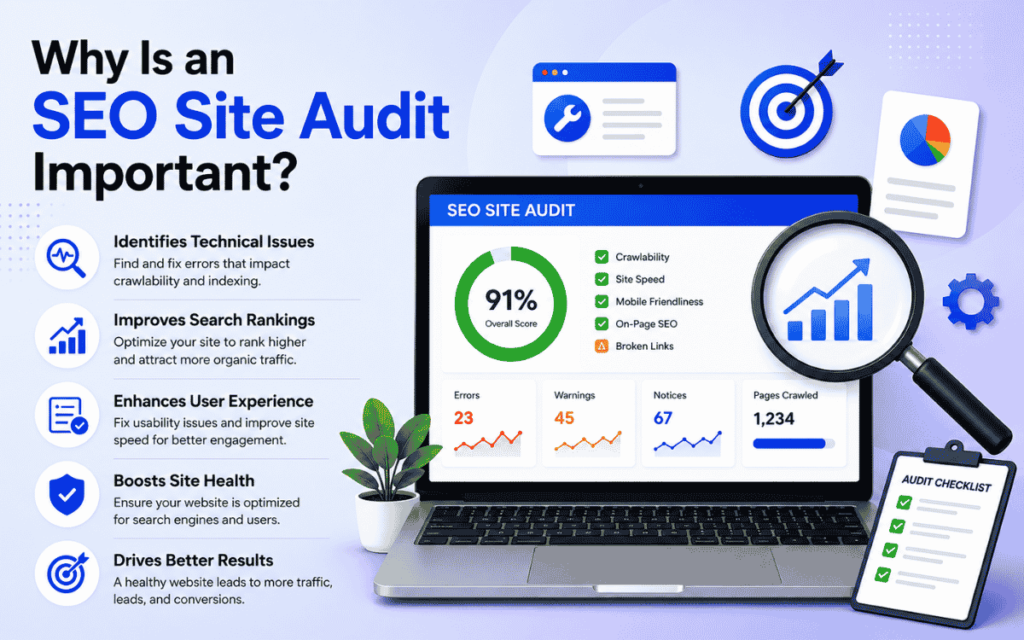
Here’s why regular audits matter:
- They catch problems before they cost you traffic. Broken links, slow pages, and crawl errors quietly erode rankings if left unchecked.
- They reveal missed opportunities. Content gaps, weak internal linking, and underused keywords often surface during an audit.
- They protect your investment. If you’ve spent months building content and links, an audit ensures those efforts aren’t undermined by technical issues.
- They keep you competitive. Search algorithms change constantly, and what worked a year ago may now be holding you back.
Businesses that skip regular audits often struggle to understand why their rankings fluctuate. Since how long SEO takes to work already depends on multiple variables, an unaddressed technical issue can quietly stretch that timeline even further.
When Should You Perform an SEO Site Audit?
Most experts recommend a full audit every three to six months, with lighter checks happening monthly. However, certain warning signs should prompt an immediate audit, including:
- A sudden or gradual decline in organic traffic
- A drop in keyword rankings across multiple pages
- A noticeable increase in bounce rate
- Lower conversion rates despite stable traffic
- A recent site migration, redesign, or CMS change
If you notice any of these signals and haven’t run an audit in the last six months, it’s time to schedule one.
Core Components of an SEO Site Audit
A thorough SEO audit generally breaks down into five key categories. Let’s walk through each one.
1. Technical SEO Audit
Technical SEO forms the foundation of your entire strategy. If search engines can’t crawl and index your site properly, nothing else matters.
During this stage, you’ll want to check:
- Crawlability and indexability: Make sure your robots.txt file isn’t blocking important pages, and confirm that your sitemap is submitted and accurate.
- Site speed and Core Web Vitals: Slow-loading pages hurt both rankings and user experience.
- Mobile-friendliness: Since Google uses mobile-first indexing, your site must perform well on smaller screens.
- HTTPS and duplicate URL versions: Multiple accessible versions of your domain can split ranking authority.
- Broken links and redirect chains: These waste crawl budget and frustrate users.
A properly configured sitemap plays a bigger role here than many site owners realize. If you’re unsure whether yours is optimized, this breakdown of how important a sitemap is for SEO covers exactly what to check.
2. On-Page SEO Audit
Once the technical foundation is solid, shift focus to individual pages. On-page SEO helps search engines understand what each page is about and who it’s meant for.
Key elements to review include:
- Title tags and meta descriptions
- Header tag structure (H1, H2, H3)
- Keyword placement and relevance
- Image alt text
- URL structure and internal linking
It’s also worth checking how many keywords you’re realistically targeting per page. Overstuffing a single page with too many unrelated terms can dilute its relevance. For guidance on this, see how many SEO keywords per page you should reasonably target.
3. Content Quality Audit
Not every ranking problem is technical. Sometimes, content simply doesn’t satisfy what users – or AI systems – are looking for.
During this step, evaluate whether your content:
- Matches search intent for its target keyword
- Demonstrates real expertise and firsthand experience
- Is comprehensive compared to top-ranking competitors
- Includes updated statistics, examples, and internal links
- Avoids thin or duplicate content across multiple pages
Since AI-generated content has become widespread, many site owners also want to know whether it hurts their rankings. If that’s a concern for your content strategy, this piece on whether AI-generated content is bad for SEO addresses it directly.
You should also track how your content performs after publishing, not just at launch. Reviewing content performance data regularly helps you spot declining pages before they drag down your overall site health.
4. Backlink and Authority Audit
Your backlink profile signals trust and authority to search engines. A healthy link profile includes a mix of relevant, high-quality referring domains.
During this phase, check:
- Total referring domains and their topical relevance
- Anchor text distribution (avoid over-optimized, keyword-heavy anchors)
- Toxic or spammy backlinks that may need disavowing
- Unlinked brand mentions that could be converted into backlinks
Many businesses ask how many links are actually “enough.” The honest answer varies by industry and competition, but this guide on how many backlinks you need offers a realistic framework for setting expectations.
5. AI Visibility Audit
This is the newest – and increasingly critical – layer of a modern SEO audit. Search no longer happens exclusively on Google. Millions of users now ask ChatGPT, Perplexity, and Gemini for recommendations directly.
To evaluate your AI visibility, check:
- Whether AI crawlers can access your site (OAI-SearchBot, PerplexityBot, ClaudeBot)
- Whether your brand appears in AI-generated answers for relevant queries
- Whether the information AI systems share about you is accurate
- How your visibility compares to competitors
If you’re new to this space, understanding software for AI visibility and generative engine optimization can help you track these metrics consistently instead of guessing. Similarly, if AI Overviews are reducing your click-through rates, learning how to rank in AI Overviews should be part of your ongoing strategy.
Tools You Need for an SEO Site Audit
You don’t need dozens of subscriptions to run an effective audit. However, a few tools cover most of what you need:
- Google Search Console: Monitors indexing, impressions, clicks, and manual actions.
- Google Analytics 4: Tracks engagement, conversions, and traffic sources.
- Google PageSpeed Insights: Measures site speed and Core Web Vitals.
- A dedicated crawler (like Screaming Frog or an all-in-one SEO platform): Identifies technical errors at scale.
- An AI visibility tracker: Monitors brand mentions and citations across AI platforms.
For businesses that want a single dashboard covering both traditional and AI visibility metrics, exploring an AI SEO analyzer can simplify the process significantly.
How to Perform an SEO Site Audit: Step-by-Step
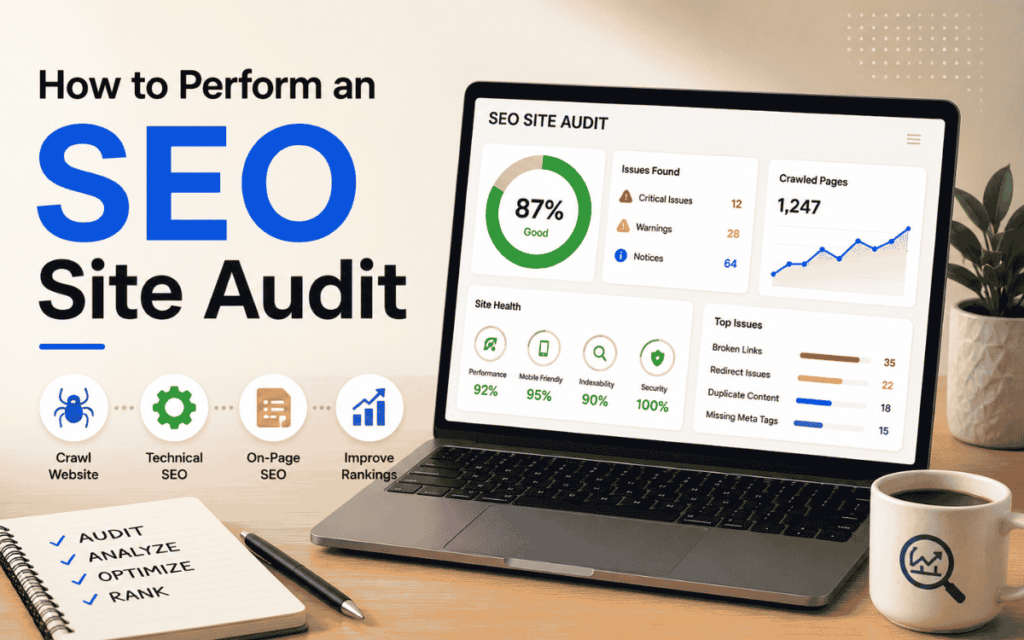
Here’s a simplified workflow you can follow:
- Confirm crawlability. Check robots.txt and your XML sitemap.
- Run a full site crawl. Identify broken links, duplicate content, and indexing issues.
- Review Core Web Vitals and speed. Fix major performance bottlenecks first.
- Audit on-page elements. Check titles, meta descriptions, and header structure page by page.
- Evaluate content quality. Compare your top pages against competitors ranking above you.
- Analyze your backlink profile. Look for toxic links and missed opportunities.
- Check AI visibility. Test how your brand appears across major AI platforms.
- Prioritize and fix. Address critical technical errors first, then content gaps, then authority-building.
This process doesn’t need to happen all at once. Breaking it into phases makes it manageable, especially for smaller teams handling SEO alongside other responsibilities.
Common Mistakes to Avoid During an SEO Audit
- Focusing only on rankings. Traffic, engagement, and conversions matter just as much.
- Ignoring AI search entirely. Traditional rankings alone no longer tell the full visibility story.
- Fixing symptoms, not root causes. A declining page might need a content rewrite, not just a meta description update.
- Skipping follow-up audits. One audit isn’t enough; SEO requires ongoing monitoring.
- Overlooking mobile experience. With most traffic coming from mobile devices, this can’t be an afterthought.
How SurgeAIO can help in terms of SEO
Running a comprehensive SEO site audit takes time, technical know-how, and the right tools – and most business owners simply don’t have the bandwidth to do it thoroughly while also running their company. That’s where SurgeAIO comes in.
SurgeAIO combines traditional technical audits with AI visibility tracking, giving you a complete picture of how your site performs across Google, ChatGPT, and other discovery platforms. Instead of generic recommendations, you get a prioritized action plan built around what will actually move your rankings and revenue forward. Whether you’re dealing with crawl errors, thin content, or invisible AI presence, SurgeAIO identifies the gaps and helps you close them efficiently.
Final Thoughts
An SEO site audit isn’t just a technical exercise – it’s the roadmap that tells you exactly where to focus your time and budget. From fixing crawl errors to improving content depth and tracking AI citations, every piece plays a role in how visible your brand becomes.
Regular audits keep your site healthy, competitive, and ready for whatever search continues to evolve into. Ultimately, the businesses that treat audits as an ongoing habit – not a one-time task – are the ones that stay ahead.
FAQs
What is an SEO site audit in simple terms?
It’s a full health check of your website that identifies technical errors, content gaps, and authority issues affecting your search visibility.
How long does an SEO site audit take?
A basic audit can take a few hours, while a comprehensive audit on a larger site may take several days.
How often should I run an SEO audit?
Most sites benefit from a full audit every three to six months, with lighter monthly checks in between.
Can I do an SEO site audit myself?
Yes, using free tools like Google Search Console and PageSpeed Insights. However, dedicated platforms speed up the process and catch issues manual reviews often miss.
Does an SEO audit include AI visibility now?
Increasingly, yes. Modern audits check whether AI platforms can crawl your site and whether they mention your brand accurately in generated answers.
What’s the difference between a technical audit and a full SEO audit?
A technical audit focuses only on crawlability, speed, and indexing. A full audit also covers content quality, backlinks, and AI visibility.
