You built a website. It loads fast, looks professional, and clearly explains what you do. You expected enquiries to follow. Instead, the phone stayed quiet, and the analytics showed barely any traffic.
This is one of the most common moments when business owners ask the question: do I need SEO for my website?
The honest answer is almost certainly yes, but the why matters just as much as the yes. Understanding what SEO actually does, and what happens when you skip it, helps you make a smarter decision rather than a panic-driven one. This guide covers everything you need to know.
What Is SEO, and What Does It Actually Do?
Search Engine Optimisation is the process of helping search engines understand what your website is about and why it deserves to rank when someone searches for a relevant topic.
SEO involves technical optimisation, page speed improvements, mobile responsiveness, content strategy, internal linking, authority building, and user behaviour signals. When done properly, your website appears in front of people who are already searching for your services. That means qualified traffic, not random visitors or accidental clicks, real prospects.
Think of it this way. Your website is like a shop. SEO is what puts it on a busy street instead of a back alley. Without it, the shop exists, it’s just invisible to almost everyone who might want what you sell.
68% of all online experiences begin with a search engine. SEO drives over 1,000% more traffic than organic social media, and the average website receives 53.3% of its traffic from organic search compared to just 5% from social media.
Those numbers put the stakes in clear perspective. Search is not a supplementary channel; it’s the primary way people find businesses online.
What Happens to a Website Without SEO?
Many business owners assume that launching a website is enough. It isn’t.
Building a website and optimising a website are two completely different things. A beautiful website without SEO is like owning a luxury car without fuel; impressive, but not moving anywhere. Search engines evaluate hundreds of ranking factors. They analyse your headings, your site structure, your loading speed, your backlinks, your content depth, and even how users interact with your pages.
Without addressing those factors, your website simply doesn’t show up when people search for what you offer. And the consequences compound quickly:
- Competitors capture your potential customers. If someone searches for your service and a competitor ranks on page one while you sit on page three, they get the call, not you.
- Referrals become your only channel. Word of mouth is valuable but unpredictable. You can’t control its volume or timing.
- Your website becomes a digital brochure. It works for people who already know you exist, but does nothing to attract new prospects.
Only 0.63% of users click on page two results; over 99% of organic traffic goes to page one listings. In other words, if you’re not on the first page of Google, you’re effectively invisible to the vast majority of searchers.
Does Every Page on Your Website Need SEO?
This is where many people overcomplicate things. Not every page needs the same level of SEO investment, and understanding the difference saves time and resources.
Pages need the components of SEO to show up on search engine results pages. If a page won’t benefit from showing up, then it doesn’t need SEO. So think about that page’s purpose and how users will interact with it.
Here’s a practical breakdown:
Pages That Need SEO
These are the pages designed to attract new visitors and answer questions:
- Homepage – your primary first impression for new visitors
- Service pages – one page per core service you offer
- Product pages – for eCommerce businesses
- Blog posts and articles – educational content that answers what people search for
- Location pages – if you serve specific cities or regions
When a user asks a question, an SEO page’s role is to answer it. Commonly searched keywords should guide your SEO pages.
Pages That Don’t Need SEO
These pages serve users who are already on your site; they have a functional role rather than a discovery role:
- Contact forms and quote request pages
- Checkout and cart pages
- Thank you, and confirmation pages
- Login pages and member dashboards
- Policy pages and terms of service
Users on your checkout page are already on the hook. They learned what you do from some other source; now they want in on the action. Your checkout page will not benefit from ranking well on search results, so it doesn’t need SEO.
The key question to ask for any page is: Would a new visitor benefit from finding this page through a Google search? If yes, it needs SEO. If not, focus on the user experience instead.
The Real Cost of Ignoring SEO
Some business owners delay SEO because they feel the upfront investment isn’t justified. However, the cost of not doing SEO is far greater; it’s just harder to see because it shows up as a missed opportunity rather than a line item on an invoice.
Without SEO, you rely heavily on word-of-mouth, miss high-intent search traffic, competitors dominate search results, and your growth becomes limited. With proper SEO, your website works 24 hours a day, you attract prospects actively searching, your brand builds credibility, and your marketing becomes measurable.
Moreover, the compound effect works powerfully in favour of those who start early. Only 22% of pages currently ranking in the top 10 on Google were created in the last 12 months. Nearly 60% of the top-ranking pages are three or more years old. This means ranking authority builds with time, and every month you delay is a month your competitors extend their head start.
Additionally, SEO leads close at 14.6% compared to 1.7% for outbound leads. SEO delivers leads that are 8.5 times more likely to convert. The quality of traffic from search is simply higher than most other channels because users are actively looking for a solution when they search.
Understanding the future of SEO helps frame this investment correctly. The landscape is evolving with AI search tools entering the picture, but organic search remains the dominant source of traffic and qualified leads for most businesses.
What Does SEO Actually Involve?
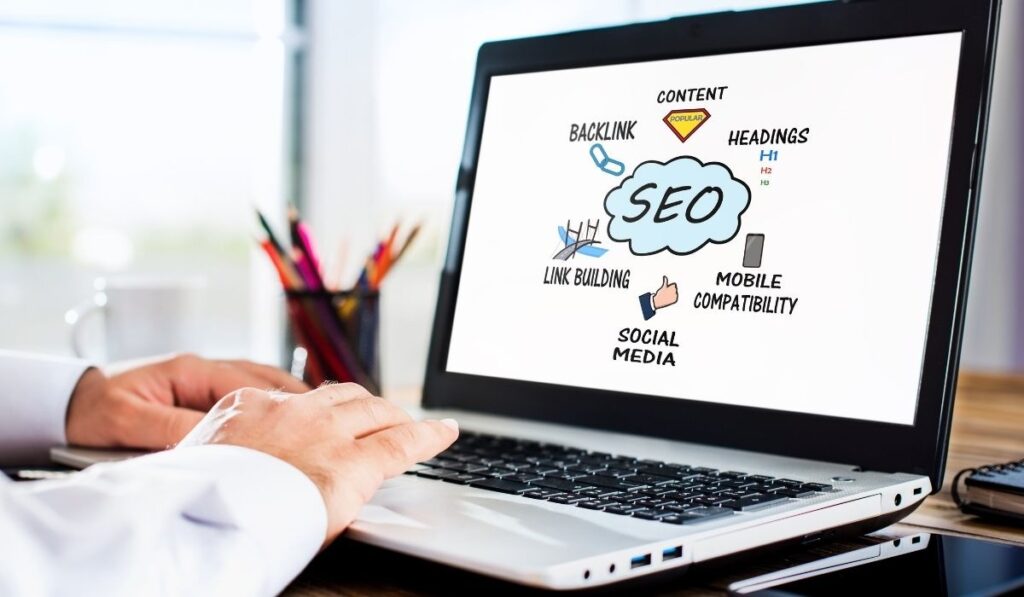
SEO is not just about inserting keywords into your content. It operates across several interconnected disciplines:
Technical SEO
This ensures search engines can find, crawl, and index your pages properly. It covers:
- Site speed and Core Web Vitals scores
- Mobile-friendly design and responsive layouts
- Clean URL structures and XML sitemaps
- Fixing crawl errors and broken links
- Implementing structured data (schema markup)
Only 33% of websites currently meet the standards set by Google’s Core Web Vitals, which means most sites still struggle to provide the optimal performance and user experience needed to rank well.
On-Page SEO
This is the optimisation you apply directly to each page. It includes:
- Writing clear, keyword-informed title tags and meta descriptions
- Using proper heading hierarchy (H1, H2, H3)
- Including your target keyword naturally in the content
- Optimising images with descriptive alt text
- Adding internal links to connect related pages
Nearly 100% of page-one results use their keyword in the title or H1, essentially making keyword placement in headings a non-negotiable ranking signal.
Content Strategy
SEO requires creating content that satisfies what people are searching for. Understanding user intent, what the person actually wants when they type a query, is what determines whether a page ranks or gets ignored.
A strong content strategy means creating pages that thoroughly answer the questions your target audience asks. Blog posts, service guides, FAQ pages, and comparison articles all attract different types of searchers at different stages of their decision-making.
Websites with an active blog earn 97% more inbound links on average than those without fresh content. Long-form content generates 77% more backlinks than shorter content and tends to rank for more long-tail keywords.
Understanding what elements are foundational for SEO with AI gives you a clear picture of how content strategy is evolving, and which structural signals matter most for ranking in both traditional and AI-driven search results.
Link Building
Google treats backlinks, links from other websites pointing to yours, as votes of authority. More high-quality backlinks generally mean higher rankings. This is one of the harder parts of SEO to do well, but also one of the most impactful.
60% of marketers say inbound strategies like SEO and content generate their highest-quality leads. Quality relationships and high-value content drive the most meaningful links.
Can You Do SEO Yourself?
Yes, and in some cases it makes perfect sense. DIY SEO can work if your industry is not competitive, your website is small, you have time to test and learn, and you enjoy analysing data.
However, there are real risks to going it alone without experience. SEO mistakes can be genuinely damaging:
- Poor technical setup can prevent pages from being indexed at all
- A weak keyword strategy wastes months of effort on terms nobody searches
- Low-quality backlinks can trigger ranking penalties
- Slow page speed loses visitors and signals a poor experience to Google
SEO is not a one-time task. It is ongoing. Algorithms change. Competitors optimise. Content needs updating. Technical issues appear. Backlinks must be earned. Most business owners underestimate two things: complexity and consistency.
For businesses in competitive markets, working with an experienced SEO professional or agency accelerates results significantly and avoids the costly trial-and-error that characterises self-managed SEO. Learning SEO prompts for ChatGPT can also help business owners understand their content gaps and keyword opportunities before engaging professional help.
SEO vs. Paid Advertising: Which Do You Need?
This is a question many website owners wrestle with. The answer for most businesses is: both, but in different proportions depending on your stage of growth.
Paid advertising (Google Ads, Meta Ads) delivers results immediately; the moment you start spending, you can appear at the top of search results. However, the moment you stop paying, the traffic disappears. There’s no compounding benefit. You’re essentially renting visibility.
SEO is the opposite. It takes longer to build momentum, typically three to six months before significant traction appears. However, once your pages rank, they continue generating traffic without ongoing spend. Think of SEO as a long-term asset. Paid ads stop when the budget stops. SEO builds equity over time.
Moreover, on one day at the end of 2024, Google’s organic search results received 4.6 billion clicks, while paid ads saw only about 16.4 million clicks; organic results dominated with over 99% of clicks.
The practical approach for most businesses is to use paid advertising for immediate lead generation while building SEO for long-term organic growth. They work well in parallel.
SEO in the Age of AI Search
AI-powered search tools, Google’s AI Overviews, ChatGPT, and Perplexity are genuinely changing how some users find information. This raises a fair question: Does AI search make SEO less relevant?
SEO is still a massive channel. AI is changing how results appear and how users interact with information, but demand for search hasn’t collapsed. The real shift is that SEO is fragmenting. There are more SERP features, more AI-driven answers, and more competition for fewer clicks on informational queries. Strategy now matters more than ever.
In fact, strong SEO is now the prerequisite for visibility in AI-generated answers. AI tools cite well-structured, authoritative, trustworthy websites, which is exactly what good SEO produces. Skipping SEO doesn’t protect you from AI disruption; it guarantees you’ll miss both traditional and AI-driven search visibility.
Understanding what is LLM in SEO and how AI is expanding traditional optimisation helps you future-proof your website for both search engines and AI platforms simultaneously. In addition, knowing how AI Overviews will change SEO gives you an early strategic advantage as the shift accelerates, particularly for businesses that depend on informational and commercial search queries.
How to Know If Your Website Needs SEO Right Now
Ask yourself these questions honestly:
- Do you want your website to generate leads and enquiries consistently?
- Are competitors in your market ranking above you on Google?
- Does your site receive very little traffic from search engines?
- Are you relying primarily on referrals and word of mouth?
- Does your site take longer than three seconds to load on mobile?
If you answered yes to any of these, SEO is not just a nice-to-have. It’s the most direct path to sustainable online growth. To get a clear picture of where your site currently stands, using an AI SEO analyser can surface technical and content gaps quickly without requiring deep technical expertise.
How SurgeAIO Can Help in Terms of SEO
Understanding that you need SEO is the easy part. Knowing exactly where to start, what to fix, and how to build momentum consistently is where most businesses get stuck. SurgeAIO is built to close that gap – giving website owners a clear, actionable path from invisible to ranking.
Instant Technical SEO Auditing
SurgeAIO runs a comprehensive technical audit of your website, identifying every issue that prevents search engines from crawling, indexing, and ranking your pages properly – from Core Web Vitals failures and broken links to missing schema markup and slow load speeds. Since technical SEO is the foundation everything else is built on, fixing these issues first delivers the fastest ranking improvements.
Keyword Research & Intent Mapping
SurgeAIO identifies the exact keywords your target audience uses at every stage of the buying journey – from broad awareness searches to high-intent commercial queries. Each keyword is mapped to search intent, so every page you build or optimise is designed to rank for the right query and attract the right visitor. This directly addresses one of the most common DIY SEO mistakes: targeting terms with no realistic ranking potential or low conversion value.
Content Gap Analysis & Topic Cluster Planning
SurgeAIO analyses your existing content against top-ranking competitors and surfaces every gap – the questions, topics, and long-tail keywords your site isn’t addressing. It then helps you structure a topic cluster strategy, with pillar pages and supporting articles mapped out clearly, so your content builds the kind of topical authority Google rewards with sustained rankings. Learn more about what elements are foundational for SEO with AI and how this structure fits into a winning long-term strategy.
On-Page SEO Optimisation Guidance
For every page you want to rank, SurgeAIO provides specific, actionable recommendations – title tags, heading structure, keyword placement, internal linking opportunities, and meta descriptions – so you’re never guessing what needs to change or why.
AI Search & GEO Visibility
As AI Overviews and LLM-powered search become a larger part of how people find businesses, SurgeAIO tracks whether your content is being cited in AI-generated answers. This is the emerging layer of visibility that most SEO tools don’t yet measure – and it’s becoming increasingly important for businesses that want to be found across both traditional and AI-powered search surfaces.
Performance Tracking That Tells the Full Story
SurgeAIO brings together your keyword rankings, organic traffic trends, content performance, and AI citation data in one clear dashboard. Instead of jumping between Google Search Console, Analytics, and multiple SEO platforms, you get a single, unified view of what’s working and where to focus next.Whether you’re starting from scratch or trying to break through a rankings plateau, SurgeAIO gives you the tools and intelligence to build sustainable SEO results without the costly trial-and-error that slows most self-managed strategies down. Use our AI SEO analyser to get a clear picture of where your site stands right now – and exactly what needs to change to start ranking.
Final Thoughts
The question “Do I need SEO for my website?” almost always has the same answer: yes, if you want your website to do more than exist.
Your website should not just exist; it should perform. SEO is not about algorithms. It is about visibility. Visibility creates trust. Trust creates conversions. And conversions create growth.
Start with the pages that matter most, your homepage and core service pages. Optimise their structure, speed, and content. Build a consistent publishing rhythm. Earn quality backlinks over time. Track what works and double down on it.
The businesses ranking at the top of Google today didn’t get there by accident. They invested in SEO consistently, early, and strategically. The window to build that advantage in your market is still open, but it closes a little more every month you wait.
Frequently Asked Questions
Do I need SEO if I already have a website?
Yes. A website without SEO is unlikely to appear in search results. Building a website and optimising it for search are two separate processes. Most websites need ongoing SEO work to rank and attract organic traffic.
How long does SEO take to show results?
Most businesses start seeing meaningful improvement within three to six months of consistent SEO work. Competitive industries may take longer. SEO is a long-term investment; the results compound over time rather than delivering instant returns.
Is SEO worth it for small businesses?
Absolutely. Small businesses often benefit most from SEO because it levels the playing field; a well-optimised small business website can outrank larger competitors for local and niche searches where authority is less dominant.
Can I do SEO myself, or do I need an agency?
You can do basic SEO yourself, particularly if your industry is not highly competitive. However, SEO in competitive markets is complex and ongoing. Mistakes can cost months of progress. Professional guidance often pays for itself in avoided errors and faster results.
Does SEO work for every type of website?
SEO benefits most types of websites, service businesses, eCommerce stores, blogs, professional practices, and local businesses. The strategy differs by website type, but the core goal is the same: appear in front of people actively searching for what you offer.
Does every page on my website need SEO?
No. Pages designed to attract new visitors through search, service pages, blog posts, and location pages need SEO. Functional pages like contact forms, checkout pages, and login screens don’t need keyword optimisation, though they should still prioritise user experience.
How does SEO connect to content marketing?
They’re deeply linked. Content gives SEO something to work with: articles, guides, and service pages that answer what people search for. SEO ensures that content gets found. Together, they build sustained organic traffic over time.
