Running a biofeedback clinic is deeply rewarding work. You help clients manage stress, anxiety, chronic pain, and performance challenges using evidence-based technology. However, your clinic cannot help people who never find you online.
That is where SEO services for biofeedback clinics become essential. A strong search engine optimization strategy puts your practice directly in front of people who are actively searching for exactly what you offer.
In this guide, we break down every key element of biofeedback clinic SEO – from keyword strategy to local search, content marketing, and how SurgeAIO can simplify the entire process for you.
Why SEO Matters for Biofeedback Clinics
Most patients begin their healthcare search on Google. They type queries like “biofeedback therapy near me” or “neurofeedback for anxiety.” If your clinic does not appear on page one, those potential clients choose a competitor instead.
Moreover, biofeedback is still a niche modality. Many people are unfamiliar with it. Therefore, your SEO strategy must do two things simultaneously: rank for search terms and educate readers about your services.
This dual approach – visibility plus education – is what separates clinics that grow steadily from those that stay invisible. Understanding SEO lead generation is the first step toward turning your website into a consistent patient acquisition channel.
In addition, unlike paid ads that stop driving traffic the moment your budget runs out, SEO compounds over time. Every optimized page, every backlink earned, and every positive review builds lasting digital equity for your clinic.
Understanding Search Intent for Biofeedback Services
Before writing a single page, you must confirm what your prospective clients are actually searching for. This is called search intent – and it is the foundation of any effective SEO strategy.
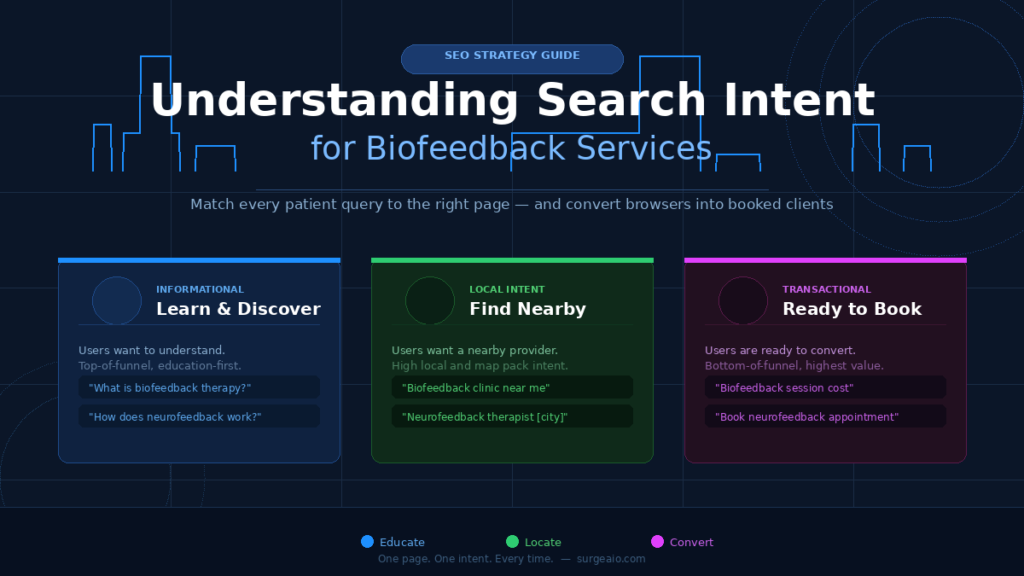
For biofeedback clinics, search intent typically falls into three categories:
- Informational intent: Users want to learn. Examples include “what is biofeedback therapy” or “how does neurofeedback work for ADHD.”
- Local intent: Users want a nearby provider. Examples include “biofeedback clinic near me” or “neurofeedback therapist in [city].”
- Transactional intent: Users are ready to book. Examples include “biofeedback session cost” or “book neurofeedback appointment.”
Each page on your website should target one specific intent. Mixing all three on a single page confuses both Google and your visitors. Conducting a thorough competitive keyword analysis helps you identify which terms your competitors rank for – and where you have the best opportunity to break through.
On-Page SEO: Optimizing Your Clinic’s Core Pages
On-page SEO refers to everything you optimize directly on your website. It is often the highest-leverage activity for a new clinic building its online presence.
Here are the most important on-page elements to address:
- Title tags and meta descriptions: Include your primary keyword naturally. Keep titles under 60 characters and meta descriptions under 155 characters.
- Header structure (H1, H2, H3): Use a clear hierarchy. Your H1 should contain the target keyword and clearly state what the page is about.
- Service page content: Each service – heart rate variability training, neurofeedback, EMG biofeedback – deserves its own dedicated page with unique, informative content.
- Schema markup: Adding structured data (MedicalBusiness, FAQPage, LocalBusiness) helps Google understand your clinic’s services and increases your chances of appearing in rich results.
- Internal linking: Link related pages together using relevant anchor text. This distributes authority across your site and improves crawlability.
Using the right content optimization tools for SEO can make this process faster and more data-driven. They show you exactly what your top-ranking competitors include on their pages – so you can match and exceed that standard.
Local SEO: Getting Found in Your City and Neighborhood
For most biofeedback clinics, local clients are the primary target. Therefore, local SEO is one of the most important investments you can make.
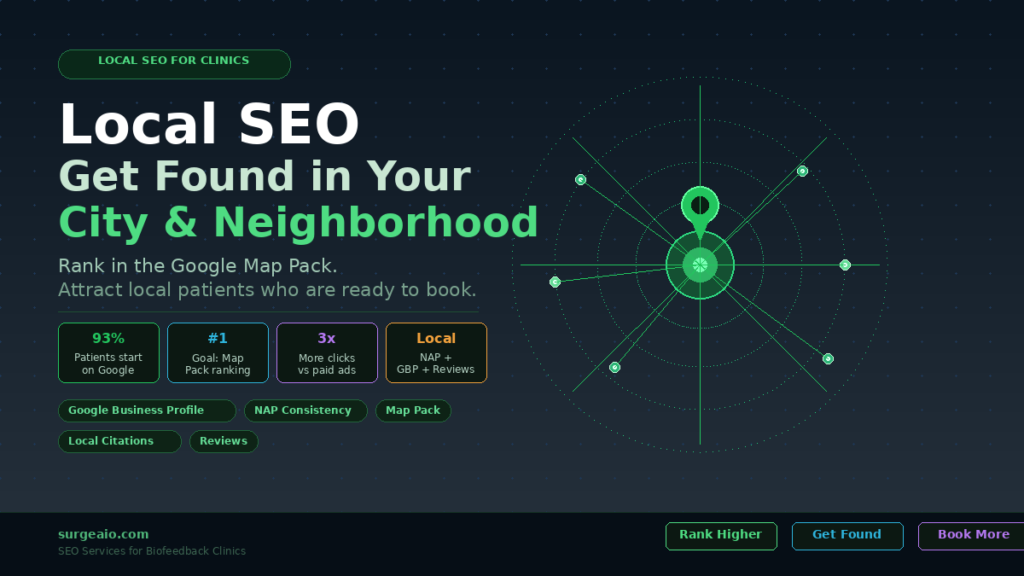
Focus on these key local SEO actions:
- Google Business Profile (GBP): Fully optimize your listing. Include accurate categories, services, hours, photos, and regular posts. This directly influences your map pack ranking.
- NAP consistency: Your Name, Address, and Phone number must be identical across all online directories – Google, Yelp, Healthgrades, Psychology Today, and more.
- Review generation: Actively ask satisfied clients to leave Google reviews. Positive reviews build trust with new patients and signal authority to Google’s local algorithm.
- Location landing pages: If you serve multiple areas, create a dedicated page for each city or neighborhood. These pages capture highly specific local searches and drive qualified traffic.
Learning how to create content for local landing pages is one of the highest-ROI tasks you can undertake as a biofeedback clinic owner. Each well-optimized location page adds a permanent traffic asset to your website.
Content Marketing: Educate First, Convert Second
Biofeedback is not a household term – yet. Consequently, content marketing plays an outsized role in driving organic traffic to your clinic’s website.
Blog posts, FAQs, condition-specific guides, and comparison articles do more than rank in Google. They answer the questions your potential clients are typing right now. When a reader finds your article helpful, they are far more likely to book a consultation.
High-performing content ideas for biofeedback clinics include:
- “How Does Biofeedback Therapy Work?” – targets informational searchers at the top of the funnel.
- “Biofeedback vs. Neurofeedback: What’s the Difference?” – captures comparison searches and positions your clinic as an authority.
- “Can Biofeedback Help with Anxiety?” – directly addresses a top patient concern and targets a high-intent keyword.
- “What to Expect at Your First Biofeedback Session” – reduces anxiety for new patients and supports conversion.
- Client success stories and case studies – build social proof and trust.
Publishing consistent, high-quality content also feeds into long-term organic traffic strategies that reduce your dependence on paid advertising over time.
Technical SEO: The Foundation That Everything Else Rests On
Even the best content will underperform if your website has technical issues. Google must be able to crawl, index, and understand your site before ranking it.
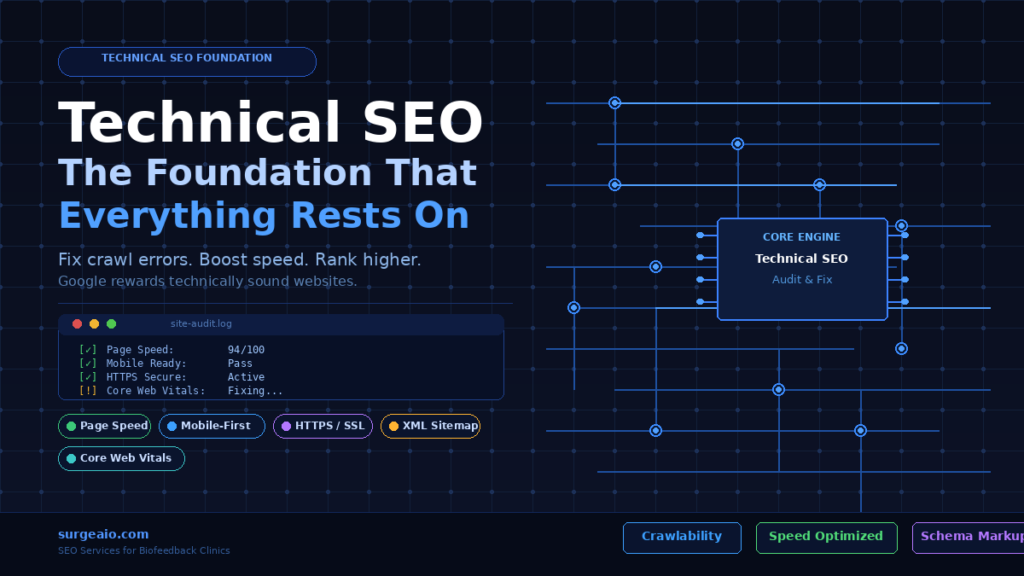
Key technical SEO priorities for biofeedback clinic websites include:
- Page speed: Slow-loading pages increase bounce rates and hurt rankings. Compress images, use a fast hosting provider, and minimize unnecessary scripts.
- Mobile responsiveness: Over 60% of local searches happen on mobile devices. Your clinic’s website must look and function perfectly on smartphones.
- HTTPS security: A secure site (SSL certificate) is a basic Google ranking factor. It also builds patient trust, which is especially important in the health space.
- XML sitemap: Submit a clean sitemap to Google Search Console so all key pages are discoverable and indexed.
- Core Web Vitals: Google measures user experience signals like loading speed, interactivity, and visual stability. Optimizing these directly impacts your rankings.
Building Authority: Backlinks and Professional Partnerships
Backlinks – links from other websites pointing to yours – remain one of Google’s top ranking signals. For biofeedback clinics, building authority requires a thoughtful approach.
Effective strategies to earn quality backlinks include:
- Partnering with local therapists, psychologists, chiropractors, and functional medicine doctors who can refer clients and link to your site.
- Getting listed in professional directories like the Biofeedback Certification International Alliance (BCIA), Psychology Today, and Healthgrades.
- Guest posting on health and wellness blogs with a link back to your clinic’s website.
- Participating in community events, health fairs, and local news features that generate online mentions and links.
Understanding how many backlinks you actually need to compete in your local market is important. Quality always outweighs quantity – a single link from a respected health publication is worth far more than dozens from low-authority sites.
AI and the Future of Biofeedback Clinic SEO
Search is evolving rapidly. AI-generated overviews, conversational search, and generative engine optimization (GEO) are changing how patients discover healthcare providers online.
However, this does not mean traditional SEO is obsolete. In fact, the core principles – high-quality content, strong authority signals, and optimized local presence – become even more important as AI models increasingly reference trustworthy sources.
Ultimately, clinics that invest in foundational SEO elements for the AI era today will be best positioned for whatever changes come next. Practices that demonstrate genuine clinical expertise and earn patient trust will always rise to the top, regardless of algorithm updates.
Staying ahead also means understanding the future of SEO and adapting your strategy before your competitors do.
How SurgeAIO Can Help in Terms of SEO
SurgeAIO is a purpose-built SEO platform designed to simplify and accelerate growth for practices and businesses that want real, measurable results from organic search.
For biofeedback clinics specifically, SurgeAIO removes the guesswork from SEO. Instead of piecing together separate tools for keyword research, content optimization, rank tracking, and competitive analysis, you get everything in one place.
Here is how SurgeAIO helps biofeedback clinic owners grow their online presence:
- AI-powered keyword research: SurgeAIO identifies high-opportunity, low-competition keywords specific to your niche. This means you target terms your ideal patients are actually searching – not just generic health keywords.
- Content optimization: The platform analyzes top-ranking pages for your target keywords and guides you to create content that outperforms the competition.
- Local SEO tools: From GBP optimization insights to local citation tracking, SurgeAIO covers the local search elements that drive real-world patient bookings.
- Competitor tracking: See exactly how your local competitors rank for every keyword and identify the gaps you can exploit to capture more market share.
- AI visibility monitoring: SurgeAIO tracks how your clinic appears across AI-generated search overviews and ChatGPT-style queries – a critical advantage as search evolves beyond traditional results pages.
- Transparent reporting: Track rankings, traffic trends, and lead attribution – so you always know exactly what your SEO investment is delivering.
Whether you are just starting with SEO or looking to accelerate an existing strategy, SurgeAIO gives biofeedback clinics the competitive intelligence and execution tools to grow consistently and confidently.
Conclusion
SEO services for biofeedback clinics are not a luxury – they are a necessity in today’s digital-first healthcare environment. The patients who need your services are searching online right now.
Moreover, the clinics that invest in search optimization today will enjoy a compounding advantage that paid advertising simply cannot replicate. Every optimized page, every earned backlink, and every positive review make your practice more visible, more trusted, and more profitable.
Start with the fundamentals: optimize your Google Business Profile, create service pages that match patient search intent, and publish content that educates and builds trust. Then, use a platform like SurgeAIO to track your progress, identify new opportunities, and stay ahead of your local competition.
Your expertise in biofeedback is already exceptional. Now it is time to make sure the right people can find it.
Frequently Asked Questions
Q1. How long does SEO take to show results for a biofeedback clinic?
SEO is a long-term investment. Most clinics start seeing meaningful ranking improvements within 3 to 6 months. However, competitive local markets may take 6 to 12 months to achieve consistent top-3 positions. The key is starting early and staying consistent.
Q2. Do I need a separate page for biofeedback and neurofeedback services?
Yes, absolutely. Biofeedback and neurofeedback are distinct services with different search audiences. Creating separate, dedicated service pages allows each page to rank for its own set of keywords and provides a better experience for potential clients exploring specific treatments.
Q3. What is the most important SEO action for a new biofeedback clinic?
For a new clinic, optimizing your Google Business Profile is typically the fastest way to appear in local search results. It costs nothing, can be set up quickly, and directly influences your visibility in the Google Map Pack – where most local patients click first.
Q4. Should a biofeedback clinic blog regularly?
Yes. Consistent blogging builds topical authority and captures informational search traffic. Aim for at least two high-quality posts per month covering conditions you treat, how your services work, and what clients can expect. Over time, this content compounds into a powerful traffic asset.
Q5. Is AI-generated content good for my clinic’s SEO?
AI tools can help you create content faster, but quality and accuracy matter enormously in health-related niches. Google evaluates health content under strict E-E-A-T (Experience, Expertise, Authoritativeness, Trustworthiness) standards. Therefore, always review and enhance AI-generated content with real clinical knowledge before publishing. Generic, thin AI content can harm your rankings. Substantive, clinically accurate content helps you rank and build patient trust simultaneously.
