You’ve probably heard that internal links matter for SEO. But the real question is – are internal links good for SEO in a way that actually moves the needle? The answer is a clear yes. However, placing links randomly across your pages isn’t enough. You need a smart, structured approach.
Internal links connect one page of your website to another on the same domain. They guide your readers, help search engines crawl your content, and distribute ranking authority across your site. When used strategically, they become one of the highest-impact tactics in any SEO plan.
In this guide, we’ll walk through every core benefit, best practice, and mistake to avoid – so you can build an internal linking strategy that actually works.
What Exactly Are Internal Links?
Internal links are hyperlinks that point from one page on your website to another page on the same domain. They are different from external or backlinks, which connect to other websites entirely.
Think of them as roads within your website. Users follow them to find related content. Search engines follow them to discover and index your pages. Without internal links, some of your content may never be found by either.
There are four common types of internal links:
- Navigational links – found in your main menu, pointing to core sections of the site
- Contextual links – embedded naturally within body copy to connect related topics
- Footer links – placed at the bottom of pages, usually pointing to legal or secondary pages
- Sidebar links – widget-style links pointing to popular or related articles
Among these, contextual links carry the most SEO weight. They sit within relevant content and pass the strongest topical signals to search engines.
Why Are Internal Links Good for SEO? The Core Benefits
1. They Make It Easier for Search Engines to Crawl and Index Pages
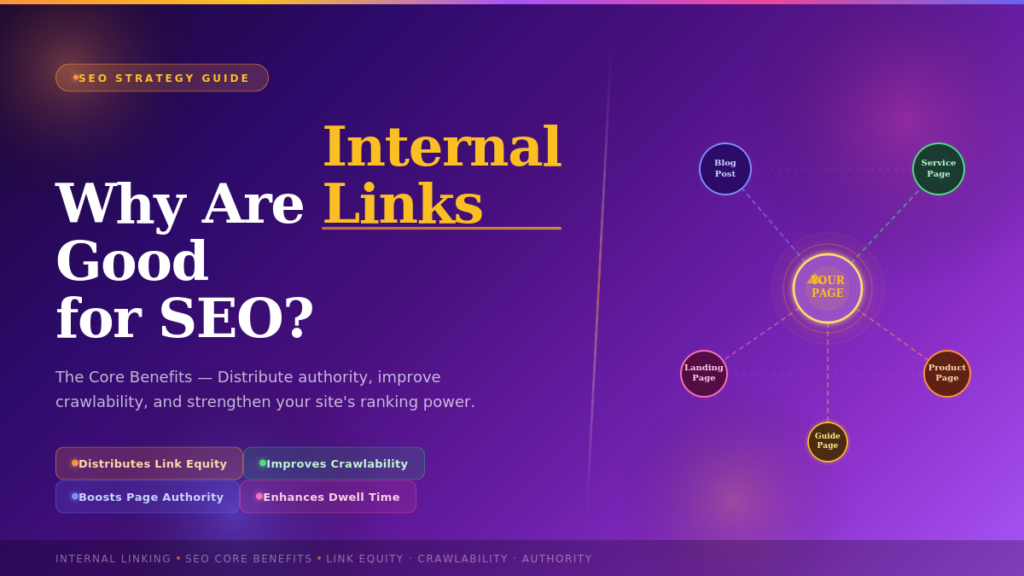
Search engine bots like Googlebot discover new pages by following links. If a page has no internal links pointing to it, crawlers may never find it – making it what SEOs call “orphaned content.”
By linking to new or underperforming pages from existing content, you create clear crawl paths. This leads to faster indexing and greater potential for ranking. Naturally, the time it takes for SEO to work can be shortened when internal links make discovery effortless for crawlers.
Moreover, a logical link structure signals to search engines which pages on your site matter most. Pages that receive more internal links are treated as higher-priority.
2. They Distribute Link Equity Across Your Site
Link equity is the ranking authority passed from one page to another through hyperlinks. Your homepage typically earns the most backlinks and therefore holds the most authority.
When you link from your homepage or high-traffic posts to deeper pages, that authority flows through. This helps pages that may not attract many backlinks still gain SEO strength. If you’ve been thinking about how many backlinks you actually need, internal links let you get the most value from the ones you already have.
Therefore, every internal link you place is an opportunity to strengthen a page without waiting for external link building.
3. They Improve User Experience and Reduce Bounce Rates
Visitors who land on your website are looking for answers. Internal links guide them toward more content they care about, naturally extending their session. This reduces bounce rate and increases pages per session – both signals that search engines use to evaluate quality.
For example, someone reading about organic traffic might click through to a related article on organic traffic strategies for SaaS businesses. That single click keeps the user engaged, increases trust, and signals content value to search engines.
In addition, a well-linked site feels more professional. Readers are more likely to convert when they can navigate your site smoothly.
4. They Build Topical Authority Through Content Clusters
Search engines reward websites that demonstrate deep expertise across a topic. Internal linking helps you build what’s known as a topic cluster – a network of related pages anchored by one central pillar page.
When you cover a subject through multiple interconnected articles, you signal to search engines that your site is an authoritative source. This is especially important for content performance data, where demonstrating depth across a topic directly impacts how well your pages rank.
Moreover, this cluster approach helps AI-driven search systems understand the relationships between your pages and surface them in relevant results.
5. They Clarify Context Through Anchor Text
Anchor text – the clickable phrase in a hyperlink – tells both users and search engines what the linked page covers. Descriptive anchor text like “best SEO practices for physiotherapy clinics” is far more valuable than vague terms like “learn more” or “click here.”
When you use keyword-rich, natural anchor text, you reinforce the relevance of the destination page for specific search queries. This is one area where internal links give you full control – unlike external backlinks, you choose the anchor text every time.
However, keep anchor text varied and natural. Over-optimizing with the same phrase repeatedly can raise red flags with search engines.
How Internal Links Shape Your Site Architecture
Internal linking isn’t just a technical checkbox – it’s a structural decision that shapes how your entire website is understood.
Build Content Hubs Around Core Topics
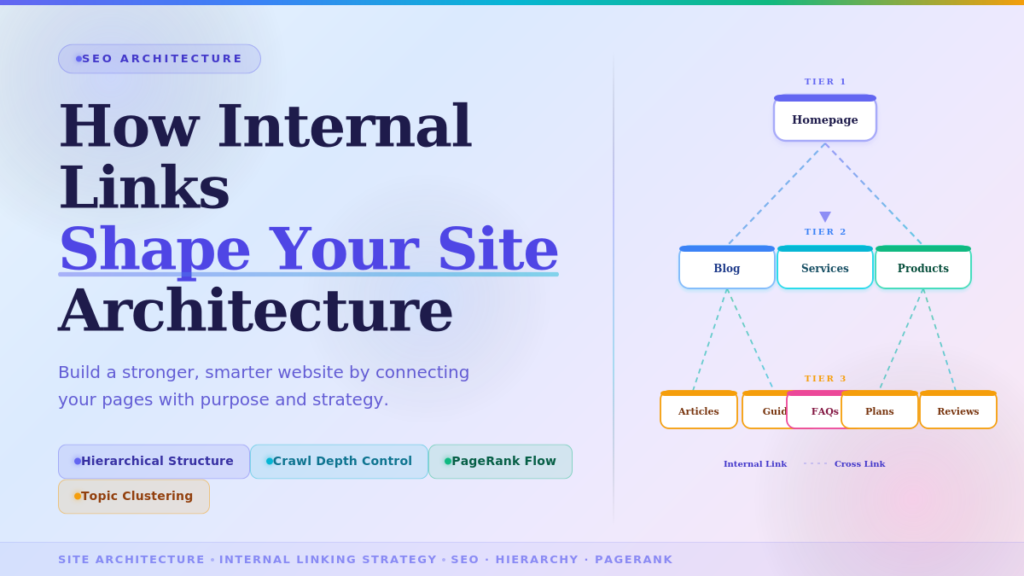
The most effective internal linking approach uses a hub-and-spoke model. One comprehensive pillar page covers a broad topic. Cluster pages explore specific subtopics in depth, and all link back to the pillar.
This creates a clear hierarchy that search engines value. It also makes your site easier for users to navigate and explore. Understanding what elements are foundational for SEO with AI helps you plan these hubs around topics that align with both traditional and AI-driven search behavior.
Identify and Fix Orphaned Pages
Run regular audits to find pages with no internal links pointing to them. These pages miss out on link equity and are often ignored by crawlers entirely. Once identified, add links from contextually relevant existing articles.
This is one of the fastest, highest-impact SEO fixes available – and it costs nothing beyond time and attention.
Prioritize Your Most Important Pages
Not every page deserves equal attention. Your key service pages, product pages, and cornerstone articles should consistently receive the most internal links. This tells search engines they are central to your site’s purpose.
However, always link naturally. Forcing links into unrelated content only dilutes your site structure and confuses readers.
Common Internal Linking Mistakes to Avoid
Even well-intentioned internal linking can cause problems if handled incorrectly. Here are the most common mistakes to watch for:
- Generic anchor text – phrases like “read more” or “click here” give search engines zero context
- Over-linking on a single page – too many links dilute the value each one passes
- Ignoring older content – older high-authority articles should regularly link to newer pages
- Linking to irrelevant pages – always match the link to the topic being discussed
- Broken internal links – dead links damage both crawlability and user experience
Furthermore, adding links purely to increase link count is never a good strategy. Every internal link must add genuine value to the reader’s journey.
Best Practices for a Strong Internal Linking Strategy
Building an effective internal link network doesn’t require a technical background. Follow these proven practices to get it right:
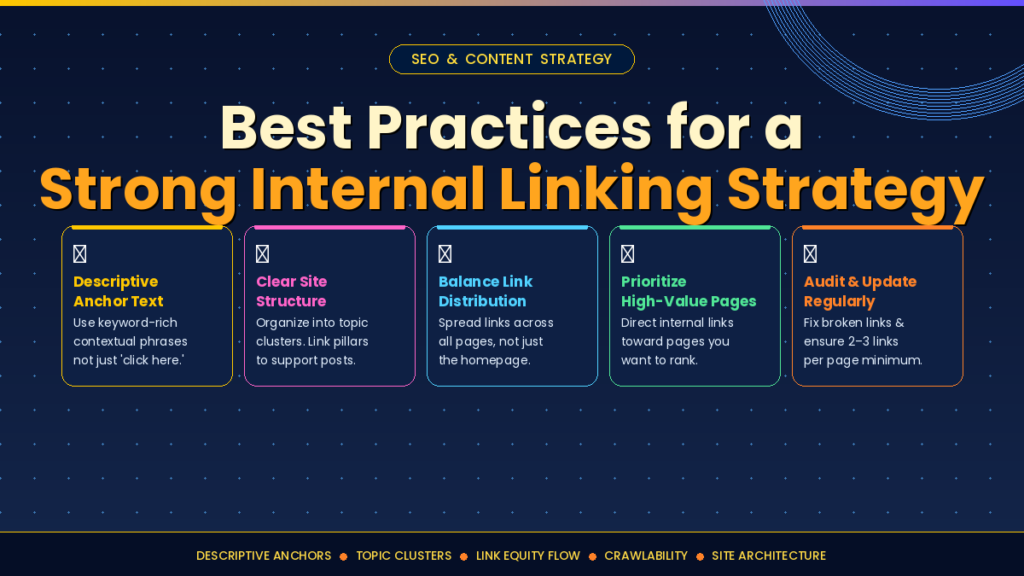
- Map your content structure first – know which pages are pillar pages and which are supporting content
- Use descriptive, keyword-aligned anchor text – help both readers and crawlers understand the destination
- Link deep, not just to your homepage – guide users to specific, useful pages
- Update older content regularly – add links to new pages from established, high-authority articles
- Keep link counts reasonable – aim for 3-10 contextual links per article, focused on quality
- Fix broken links consistently – schedule regular crawl audits to keep your link structure healthy
Additionally, think about your reader’s next logical question as you write. Asking “what would someone naturally want to explore next?” often reveals the most natural place to add an internal link.
For sites running digital marketing for distributors or complex B2B operations, internal linking also plays a key role in moving prospects through content that matches their buyer stage – from awareness to decision.
How SurgeAIO Can Help in Terms of SEO
Managing internal links manually across a growing website becomes difficult quickly. That’s exactly where SurgeAIO makes a real difference.
SurgeAIO is an AI-powered SEO platform built to help businesses identify linking opportunities, track keyword performance, and build site structures that search engines trust. Here’s specifically how it helps with internal linking:
Site Crawl and Audit: SurgeAIO crawls your site to surface orphaned pages, broken internal links, and pages that receive too few or too many inbound links. You get a complete picture of your internal link health in one place.
Topical Gap Analysis: The platform identifies content gaps based on your existing pages and keyword targets. This helps you plan new cluster content that connects naturally to your current pillar pages.
AI-Powered Link Recommendations: SurgeAIO analyzes your content and recommends which pages should link to each other based on topical relevance and keyword alignment. You stop guessing and start linking with purpose.
Rank Tracking After Implementation: Once you apply a new internal linking strategy, SurgeAIO tracks how your keyword positions respond. You can clearly see which changes are improving rankings.
AI Visibility Optimization: With search moving toward AI-generated results, SurgeAIO also helps you improve your AI visibility optimization techniques so your content appears in AI Overviews and gets cited by tools like ChatGPT and Perplexity.
In short, SurgeAIO removes the guesswork and replaces it with data, giving you a foundation to build stronger SEO faster.
Internal Links and AI Search: Why They Matter Even More Now
Search behavior is evolving rapidly. Google’s AI Overviews, ChatGPT, and similar tools now surface direct answers in response to queries. However, internal linking still plays a vital role – perhaps more than ever.
AI search systems rely on structured, well-connected content to understand what a website covers and how deeply it covers it. A clear internal link structure helps these systems recognize your site as a contextually rich, credible source. This increases the chance that your content gets referenced in AI-generated answers.
In fact, if you’re actively trying to show up in AI overviews, a strong internal link network combined with topical depth and quality content is one of the most reliable approaches available today.
Internal links give AI crawlers a roadmap – helping them understand your expertise, the breadth of your coverage, and how each piece of content connects to specific user queries.
Final Thoughts
So, are internal links good for SEO? Without question. They help search engines index your pages, distribute authority, strengthen topical relevance, and keep users engaged longer. They are one of the few SEO tactics that benefit both your visitors and your rankings at the same time.
The key is intention. Map your content structure, use clear and descriptive anchor text, update older articles regularly, and audit your links consistently. When combined with strong content and a focused keyword strategy, internal links become one of your most reliable ranking tools.
Platforms like SurgeAIO make the entire process smarter – giving you the insights to link strategically and the data to measure real results. Start building your internal link network today, and watch your site’s authority compound over time.
Frequently Asked Questions
Q1: How many internal links should I include per page?
There’s no fixed number, but 3-10 contextual internal links per article is a practical range for most sites. Always prioritize relevance over quantity. Too many links can overwhelm readers and dilute their SEO value.
Q2: Do internal links directly improve search rankings?
Yes. Internal links help search engines discover pages, pass link equity, and understand your site structure – all of which directly influence how individual pages rank in search results.
Q3: What makes good anchor text for internal links?
Use descriptive, keyword-relevant phrases that clearly describe the destination page’s topic. Avoid generic phrases like “click here.” Vary your anchor text naturally to avoid appearing manipulative.
Q4: Should I also link out to external websites?
Yes. Linking to credible external sources adds trust signals and value for readers. Make sure those links open in a new tab so users remain on your site.
Q5: How often should I audit my internal links?
Conduct a full audit every 3-6 months. Additionally, whenever you publish new content, update relevant older articles to include a link to the new page.
Q6: Can bad internal linking hurt SEO?
Poor internal linking – such as using irrelevant anchor text, over-linking, or creating circular link loops – can confuse search engines and frustrate users. Done correctly, internal links always deliver a positive SEO impact.
Q7: What is a pillar page, and why does it matter for internal linking?
A pillar page is a comprehensive article covering a broad topic. Cluster pages – focused articles on related subtopics – link back to them. This hub-and-spoke model signals topical authority and strengthens rankings across the entire cluster.
