Most businesses invest in SEO. Far fewer know whether it’s actually working.
The question “how do you measure SEO success” is one that even experienced marketers often struggle to answer clearly. Rankings feel good. Traffic looks encouraging. But do either of these metrics tell the full story? Not always.
True SEO success means different things for different businesses. However, certain core metrics reveal whether your strategy is driving real, meaningful results – or just vanity numbers that look good in a report.
This guide walks you through every metric that matters, the tools to track them, and how to build a measurement framework that connects SEO directly to business outcomes.
Why Measuring SEO Success Is Harder Than It Looks
SEO is a long-term channel. Unlike paid advertising – where spend correlates directly with results – organic search takes months to compound. This creates a measurement challenge: how do you know if your investment is working before results fully materialise?
Moreover, SEO influences multiple touchpoints across the customer journey. A blog post might introduce someone to your brand months before they convert. Standard analytics tools often miss this attribution entirely.
However, the right combination of metrics and tools makes it possible to track progress accurately – and demonstrate ROI clearly, even before your strategy reaches full maturity.
Understanding how long medical SEO takes to work offers a useful perspective – timelines vary by industry and competition, but the measurement principles remain consistent across every sector.
Metric 1: Organic Traffic
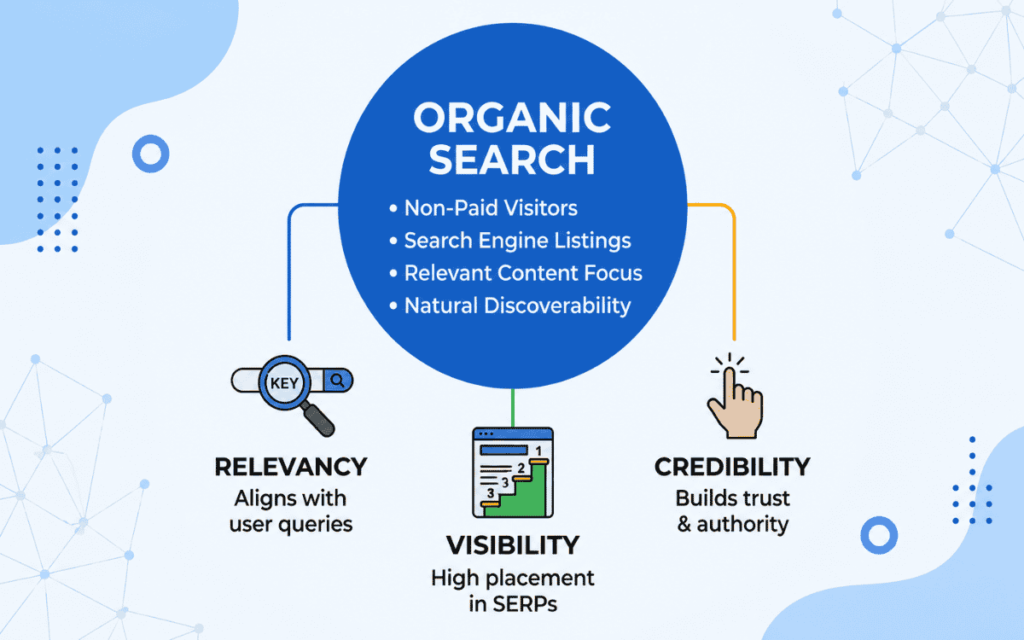
The most fundamental measure of SEO success is organic traffic – the number of visitors reaching your site through unpaid search results.
Track this metric in Google Analytics or Google Search Console. Look for:
- Total organic sessions – overall volume of visits from search engines
- Organic traffic by page – which pages attract the most search visitors
- Traffic trends over time – are numbers growing month-on-month?
- New vs returning visitors – is SEO attracting fresh audiences consistently?
Organic traffic growth confirms that your content is reaching more searchers over time. A decline signals algorithm impact, technical issues, or competitive pressure worth investigating.
However, traffic alone is not enough. A flood of irrelevant visitors does not grow your business. Always analyse traffic quality alongside volume – which brings us to the next metric.
Metric 2: Keyword Rankings
Keyword rankings show where your pages appear in search results for target queries. They are one of the clearest indicators of SEO progress.
Track rankings for:
- Primary target keywords – the main terms you’re actively optimising for
- Long-tail variations – longer, more specific queries that often convert better
- Branded keywords – searches that include your company name
- Competitor keywords – terms where rivals currently outrank you
Tools like Google Search Console, Ahrefs, SEMrush, and Moz provide detailed ranking data. Set up rank tracking from day one so you have a clear baseline to measure progress against.
One important nuance: ranking position alone does not tell you whether users are clicking. A page ranking #3 with a compelling title and meta description may attract more clicks than the #1 result. Therefore, always track rankings alongside click-through rate.
Competitive analyses of keywords help you understand not just where you rank, but where your rivals are winning – and where you have the best opportunities to close the gap.
Metric 3: Click-Through Rate (CTR)
Click-through rate measures the percentage of people who see your page in search results and actually click on it. It reveals how compelling your titles and meta descriptions are to real searchers.
A page ranking #1 with a 2% CTR is underperforming. A page at #4 with a 12% CTR is punching above its weight.
Track CTR in Google Search Console under the Performance report. Look for:
- Pages with deep impressions but low CTR – these represent quick optimisation wins
- Keywords where your CTR lags behind industry benchmarks
- Impact of title and meta description changes on CTR over time
Improving CTR improves organic traffic without changing your rankings at all. It is one of the fastest, most overlooked levers in SEO performance.
Metric 4: Organic Conversions and Revenue
Traffic and rankings are leading indicators. Conversions and revenue are the true measures of SEO success for most businesses.
Track conversions from organic search, including:
- Lead form submissions – enquiries generated from organic visitors
- Phone calls – tracked via call tracking software linked to organic sessions
- E-commerce purchases – revenue directly attributable to organic traffic
- Email sign-ups – list growth from organic-driven visitors
- Free trial or demo requests – particularly relevant for SaaS and B2B companies
Set up conversion goals in Google Analytics and segment by organic traffic source. This gives you a clear view of which SEO-driven pages are generating real business outcomes.
For B2B companies, organic traffic strategies for SaaS demonstrate how conversion tracking connects directly to pipeline and revenue – not just traffic volume.
Metric 5: Bounce Rate and Engagement Metrics
Bringing visitors to your site is only half the battle. Keeping them engaged is equally important.
Engagement metrics reveal whether your content satisfies user intent:
- Bounce rate – the percentage of visitors who leave after viewing only one page
- Average engagement time – how long visitors spend actively on your page
- Pages per session – how many pages a visitor views before leaving
- Scroll depth – how far down the page visitors read
A high bounce rate on an informational blog post is not necessarily alarming – users may have found their answer quickly. However, high bounce rates on product or service pages often signal a mismatch between what searchers expect and what your page delivers.
Analysing content performance data across your site helps identify which pages engage visitors effectively and which need improvement to drive better SEO outcomes.
Metric 6: Backlink Profile Growth
Backlinks – links from other websites pointing to yours – remain one of Google’s strongest ranking signals. Tracking your backlink profile tells you how your domain authority is growing over time.
Monitor:
- Total referring domains – the number of unique websites linking to you
- Domain authority/domain rating – overall site authority as measured by SEO tools
- New vs lost backlinks – are you gaining more links than you lose?
- Quality of linking sites – high-authority, relevant links carry far more weight
- Anchor text distribution – a natural mix of branded, generic, and keyword-rich anchors
Use tools like Ahrefs, Moz Link Explorer, or SEMrush Backlink Analytics to track these metrics. A growing backlink profile from reputable sources indicates your content is earning trust and authority across your industry.
Understanding how many backlinks you need to rank competitively in your niche helps set realistic targets and guides your link-building investment effectively.
Metric 7: Page Speed and Core Web Vitals
Technical performance directly impacts both user experience and search rankings. Google’s Core Web Vitals are now official ranking signals – making them essential SEO metrics to track.
The three Core Web Vitals are:
- Largest Contentful Paint (LCP) – how quickly the main content loads. Target: under 2.5 seconds
- Interaction to Next Paint (INP) – how quickly the page responds to user interaction. Target: under 200ms
- Cumulative Layout Shift (CLS) – how much the page visually shifts during loading. Target: under 0.1
Track these in Google Search Console under the Core Web Vitals report, or use PageSpeed Insights and the Chrome User Experience Report for detailed diagnostics.
Poor Core Web Vitals hurt both rankings and conversions. A slow, unstable page drives visitors away – regardless of how good the content is.
Metric 8: Crawlability and Indexing Health
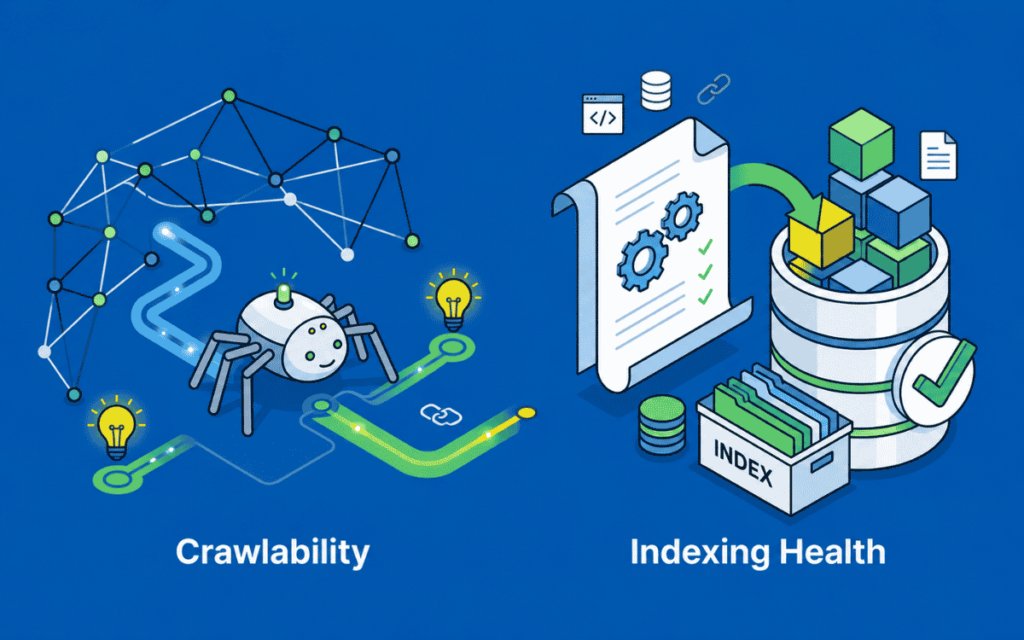
Search engines cannot rank what they cannot find and index. Crawlability and indexing health are foundational technical SEO metrics that underpin everything else.
Monitor regularly:
- Coverage report in Google Search Console – shows which pages are indexed and which have errors
- Crawl errors – 404 errors, server errors, and redirect issues that block indexing
- XML sitemap health – ensure all priority pages are included and accessible
- Robots.txt configuration – confirm you’re not accidentally blocking important pages
- Duplicate content issues – canonical tags and URL parameters can cause indexing problems
Technical issues often go undetected for months. A single misconfigured robots.txt can block entire site sections from appearing in search results. Regular technical audits prevent these silent ranking killers.
For businesses navigating website changes, understanding SEO for a site migration highlights exactly why indexing health must be monitored before, during, and after any major technical change.
Metric 9: Share of Voice and AI Visibility
Traditional SEO metrics measure your performance in standard search results. However, the landscape is rapidly evolving. AI Overviews, Perplexity, ChatGPT, and other generative AI tools now answer search queries directly.
Forward-thinking SEO measurement now includes:
- Share of voice – what percentage of total search impressions in your market you capture
- Brand mentions in AI responses – how often AI tools cite or recommend your business
- AI Overview appearances – whether your content surfaces in Google’s AI-generated summaries
- Position within AI-generated answers – early in the answer vs buried at the end
These newer metrics sit alongside traditional ones – not replacing them, but extending your visibility picture into the AI-driven search environment.
Tracking AI visibility metrics is increasingly important for brands that want to stay ahead of how search behaviour is shifting in 2026 and beyond.
Building Your SEO Measurement Framework
Measuring individual metrics is useful. Building a connected framework is transformative.
Here’s how to structure yours:
Step 1 – Define your goals. Are you driving leads, e-commerce sales, brand awareness, or something else? Your primary KPIs should align with these goals directly.
Step 2 – Establish baselines. Before measuring progress, you need to know where you started. Record current organic traffic, rankings, conversions, and technical health at the campaign’s outset.
Step 3 – Set review cadences. Some metrics change daily (rankings, traffic). Others are better reviewed monthly (backlink growth, conversion trends) or quarterly (Core Web Vitals, overall ROI).
Step 4 – Connect SEO to revenue. Use attribution modelling to understand SEO’s contribution to the full customer journey – including assisted conversions where organic was not the last touchpoint.
Step 5 – Report clearly to stakeholders. Decision-makers need simple, meaningful reports – not data dumps. Focus on trends, business impact, and next actions rather than raw numbers.
How SurgeAIO Can Help in Terms of SEO
SurgeAIO is built to make SEO measurement straightforward, comprehensive, and directly tied to business outcomes.
Here is what the platform delivers:
Unified Performance Dashboard – Track organic traffic, keyword rankings, conversions, and backlink growth from a single interface. No more switching between multiple tools to piece together a performance picture.
Keyword Rank Tracking – Monitor rankings for all your target keywords in real time. Identify upward trends, sudden drops, and new ranking opportunities as they emerge.
Content Performance Analysis – SurgeAIO analyses which pages are driving the most valuable traffic and conversions. It highlights underperforming content that needs optimisation and surfaces quick wins across your site.
Technical SEO Auditing – Regular automated audits flag crawlability issues, Core Web Vitals problems, and indexing errors before they damage rankings. Fix what matters most, in the right order.
AI Visibility Tracking – As search increasingly happens through AI tools, SurgeAIO monitors brand mentions in AI-generated responses across major platforms – extending measurement beyond traditional SERPs.
Competitor Benchmarking – Compare your SEO performance against key competitors. Understand where they’re outranking you, earning more backlinks, or capturing higher click-through rates – and build a data-driven strategy to close those gaps.
Client-Ready Reporting – Generate clear, professional reports that communicate SEO progress to clients or internal stakeholders without technical jargon. Focus on the numbers that matter most to business goals.
Whether you’re managing SEO for a single website or across multiple clients, SurgeAIO removes the complexity from measurement and gives you confidence in every strategic decision.
Final Thoughts
How do you measure SEO success? By tracking the right combination of traffic, rankings, conversions, technical health, and – increasingly – AI visibility, and by connecting all of those signals to the business outcomes that actually matter.
Vanity metrics tell a comfortable story. The right metrics tell the truth – and give you the information you need to keep improving.
Build your measurement framework early. Review it consistently. And let data guide every strategic decision you make.
Frequently Asked Questions
Q1. What is the most important SEO metric?
There is no single most important metric - it depends on your business goals. For most businesses, organic conversions and revenue are the ultimate measure of SEO success. However, rankings, traffic, and technical health are the leading indicators that predict conversion performance over time.
Q2. How often should I review my SEO metrics?
Review organic traffic and rankings weekly for early signals. Analyse conversions, backlink growth, and engagement metrics monthly. Conduct full technical audits and strategic reviews quarterly.
Q3. How long before I see meaningful SEO results?
Most businesses see measurable improvements within 3 to 6 months. Highly competitive industries may take 9 to 12 months. Technical fixes and content improvements can sometimes show results in weeks. Patience and consistency are essential.
Q4. What tools do I need to measure SEO success?
At minimum, use Google Search Console and Google Analytics. Supplement with a rank tracking and backlink tool - Ahrefs, SEMrush, or Moz are industry standards. Platforms like SurgeAIO consolidate these data points into a single measurement environment.
Q5. Can I measure SEO success without conversion tracking?
You can track traffic and rankings without conversion data, but you cannot measure true business impact. Setting up conversion goals in Google Analytics is essential to connect SEO performance to real commercial outcomes.
Q6. How do I demonstrate SEO ROI to clients or management?
Connect organic traffic growth to revenue. Show how many leads or sales came from organic search. Calculate the equivalent cost of that traffic if it had been paid - this makes the value of SEO investment immediately tangible to non-technical stakeholders.
Q7. What should I do if my SEO metrics are declining?
First, check for algorithm updates that may have affected your niche. Then audit for technical issues - crawl errors, indexing problems, or Core Web Vitals failures. Review your content for quality and relevance. Finally, analyse competitor movement to understand whether rankings shifted due to a stronger rival rather than a penalty.
