
Ask ten SEO professionals how many words a blog post should be for SEO, and you will likely get ten different answers. Some say 1,500. Others insist on 2,500. A few will tell you 3,000 or more for competitive topics.
Here is the truth: there is no single magic number. However, there are clear, data-backed ranges that consistently outperform, and understanding the logic behind them makes all the difference between content that ranks and content that sits unread on page five.
This guide gives you a complete, practical answer – based on research, not guesswork.
What Google Actually Says About Blog Post Length
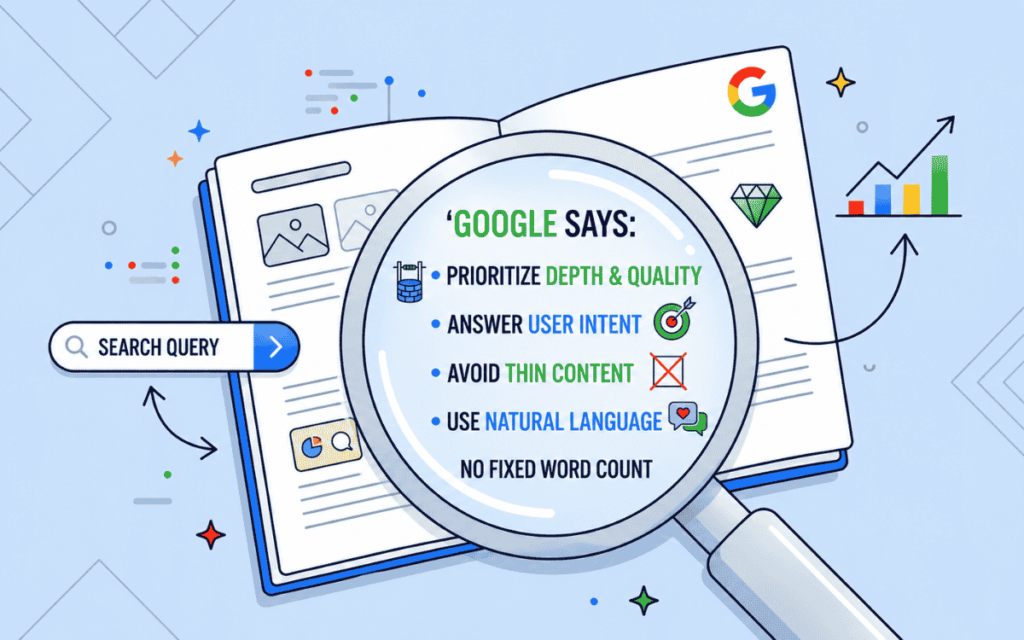
Before diving into word counts, let us address what matters most: Google’s own position. Google has stated clearly and repeatedly that word count is not a direct ranking factor. Google’s John Mueller confirmed this publicly, stating that a page with more words is not automatically seen as higher quality than a shorter page.
Google’s Martin Splitt reinforced this in the SEO Mythbusting series – the number of words on a page is not tallied up and used as a quality signal.
However, this does not mean length is irrelevant. It means length is a byproduct of quality, not a cause of it. Longer content tends to rank better because it tends to cover topics more thoroughly, earn more backlinks, and satisfy more aspects of search intent. Those are the actual ranking factors. Length is simply the result of doing those things well.
The practical takeaway: write as much as your topic genuinely requires, then stop. Do not pad content to hit a number, and do not cut content short when the topic demands depth. This principle sits at the core of what elements are foundational for SEO with AI – helpfulness and thoroughness always win over arbitrary benchmarks.
What the Data Actually Shows
Multiple large-scale studies have analyzed the relationship between content length and search performance. Their findings converge on consistent, useful conclusions.
A Backlinko analysis of 11.8 million Google search results found the average first-page result contains approximately 1,447 words. Orbit Media’s annual blogger survey landed at a similar figure of around 1,427 words. This convergence across independent studies with different methodologies gives strong confidence in the 1,400-1,500 word range as a reliable baseline for most blog content.
However, averages do not tell the full story. Semrush research found that top-performing content averages just 1,152 words, while low-performing posts average 668 words. This suggests efficiency and quality matter far more than simply maximizing length.
HubSpot’s research pointed to an ideal range of 2,100-2,400 words for blog posts targeting SEO. That is notably higher than most writers expect – and far higher than the 200-500 word posts many brands still default to.
Meanwhile, a Backlinko and BuzzSumo analysis of 912 million blog posts found that content exceeding 3,000 words receives 77.2% more backlinks on average than content under 1,000 words. This is significant because backlinks are an actual ranking factor. Longer content earns more links, which drives rankings – not the length itself.
One more important data point: Ahrefs analysis of 174,000 pages cited in Google AI Overviews found that cited content averaged just 1,282 words. More than half of all AI Overview citations went to pages under 1,000 words. This signals that for AI-generated search results, concise, direct answers are increasingly favored. Understanding how to show up in AI Overviews is becoming just as important as a traditional ranking strategy.
Turn AI Visibility Into Real Revenue.
Automate Leads With SurgeAIO. Don’t Let AI Ignore Your Brand.
Recommended Word Counts by Content Type
Different content formats serve different purposes. Here are data-backed ranges for each:
- Pillar pages and ultimate guides: 3,000-5,000+ words. These cornerstone pieces establish topical authority and compete for high-volume, competitive keywords.
- How-to guides: 1,700-2,500 words. Step-by-step instructional content needs enough space to cover each step clearly, address edge cases, and troubleshoot common issues.
- Standard informational blog posts: 1,400-1,500 words. The research consensus for regular content – substantial enough to provide real value, concise enough to maintain reader engagement.
- Listicles: 1,500-2,500 words. This allows roughly 150-250 words per item in a 10-item list, giving each point enough depth to be genuinely useful.
- Opinion and thought leadership: 1,000-1,500 words. Perspective-driven content where argument quality matters more than exhaustive coverage.
- News posts and timely updates: 400-800 words. Speed and clear information delivery take priority over depth.
- Quick-answer content (featured snippets): 300-500 words. Short, structured, direct answers perform best here.
These are starting points, not rigid rules. Always validate your target length against what is currently ranking for your specific keyword.
The 4 Factors That Should Determine Your Blog Post Length
Generic word count advice only gets you so far. These four factors give you a precise framework for every content decision.
1. Search Intent
This is the most important factor of all. What is the searcher actually trying to accomplish? Someone searching “what is SEO” wants a quick, clear definition. Someone searching “complete SEO strategy for B2B SaaS” expects a comprehensive guide.
Match your content depth to what the searcher genuinely needs – not what feels impressive. A 3,000-word article answering a simple question will frustrate readers. A 600-word article attempting to cover a complex topic will leave them unsatisfied.
Properly aligning content to intent is central to understanding whether SEO is organic or paid – organic search success depends entirely on serving what users actually want.
2. Topic Complexity
Simple topics stretched to meet word count targets produce thin, repetitive content. Complex topics compressed into too few words leave critical questions unanswered.
“How to reset a password” might work perfectly at 700-800 words with clear steps. “How to build a content marketing strategy from scratch” legitimately requires 2,500-3,000+ words to cover research, planning, creation, distribution, and measurement properly.
Let the genuine complexity of the topic guide your length – not the other way around.
3. Competitor Benchmarking
The most reliable method for determining the right length for any specific topic is analyzing what already ranks. Search your target keyword and check the word counts of the top five to ten results.
Add those counts together, divide by the number of results, and aim to produce content within plus or minus 20% of that average – while prioritizing quality over simply matching a number.
If competitors average 1,800 words, targeting between 1,440 and 2,160 words is a solid starting range. If they are all around 900 words, writing 3,000 words will not automatically win – it may just mean unnecessary padding that dilutes your focus.
This competitor-first approach pairs well with a strong competitive analyses of keywords strategy that identifies not just how your competitors write but what they rank for.
4. Audience Expertise Level
Writing for beginners requires more definitions, explanations, and context – naturally extending your word count. Content for experts can skip fundamentals entirely and focus on advanced applications, often delivering equal value in fewer words.
A technical SEO guide written for senior developers can move faster than the same guide written for business owners with no technical background. Always calibrate depth to your reader’s starting knowledge level.
Why Quality Always Wins Over Word Count
Google’s algorithm is designed to satisfy search intent, and intent determines whether short or long content wins for a given query. The biggest mistake content teams make is adding words without adding value.
Padding content with repetitive points, obvious filler sentences, or tangentially related information does not help rankings. In fact, Google’s systems can recognize content that adds little value to the web – and longer posts stuffed with filler can actually hold a site back.
Here is what Google rewards in 2026:
- Substance and evidence – Facts, data, sourced claims, and expert insight
- Clear structure – Logical headings, readable paragraphs, scannable formatting
- Comprehensive topic coverage – Addressing the questions users actually have, not just the primary keyword
- Genuine helpfulness – Content that leaves readers better informed than before they arrived
Turn AI Visibility Into Real Revenue.
Automate Leads With SurgeAIO. Don’t Let AI Ignore Your Brand.
These qualities are not functions of word count. They are functions of research, clarity, and editorial judgment. Investing in the best content optimization tools for SEO can help you audit and improve existing content rather than simply producing more of it.
When Shorter Content Beats Longer Content
The longer-is-better narrative is incomplete. There are specific scenarios where brevity consistently wins.
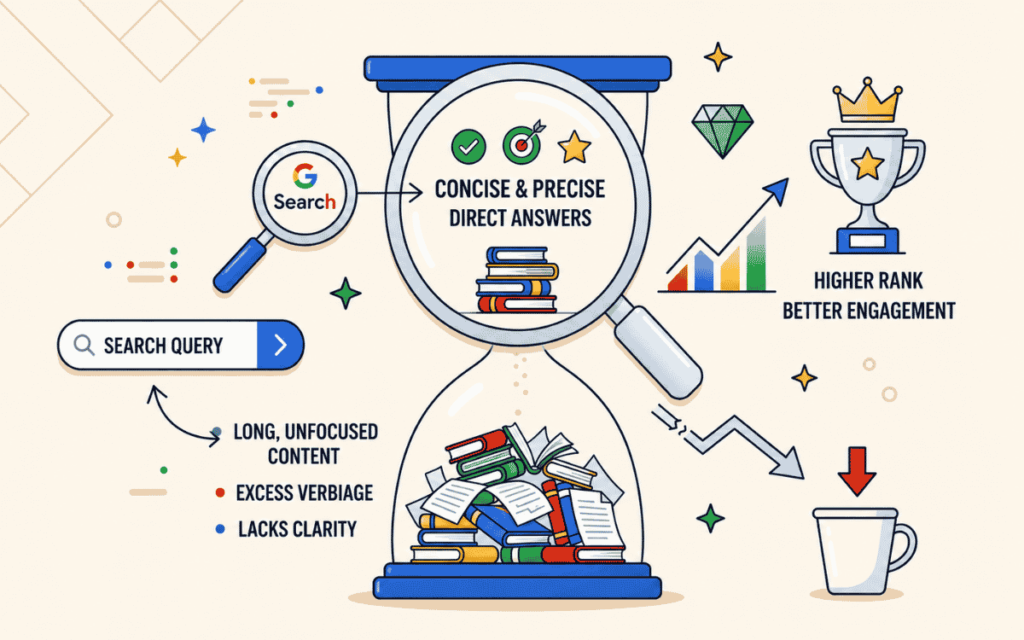
Featured snippets. Google extracts concise, direct passages for featured snippets – typically a single paragraph or short list. Overly long explanations rarely get selected. Direct, structured answers in the 40–60 word range perform best for snippet capture.
News and trending content. Timeliness matters more than depth for news posts. Readers want the key facts quickly. A clear, well-written 500-word update outperforms a padded 1,500-word article every time.
Simple how-to content. When a process has three clear steps, writing ten paragraphs to explain them wastes the reader’s time and signals poor editorial judgment to Google.
AI Overview citations. As noted above, content cited in AI Overviews averaged just 1,282 words, and over half of citations went to pages under 1,000 words. For queries where AI Overviews appear, concise and direct answers hold the advantage.
Understanding the future of SEO means recognizing that AI-driven search results are changing, which content formats win visibility – and adapting your length strategy accordingly.
A Practical Framework for Deciding Blog Post Length
Stop guessing. Follow these steps every time:
Step 1: Identify the search intent. Is it informational, navigational, commercial, or transactional? The intent type immediately narrows your appropriate format and approximate length.
Step 2: Search your target keyword. Look at the top five to ten results. Note their approximate word counts and the format they use (guides, lists, short answers, etc.).
Step 3: Calculate the competitor average. Add up the word counts and divide. Aim to stay within ±20% of that average unless you have specific, substantive reasons to go longer.
Step 4: Outline for completeness, not length. Build your outline to answer every genuine question a reader might have about your topic. If your outline naturally fills 2,000 words, write 2,000 words. If it fills 800, write 800.
Step 5: Cut what does not add value. After drafting, review every paragraph for genuine contribution. Remove repetition, obvious filler, and tangents. Tighter writing almost always ranks better than padded writing.
This process connects directly to how content performance data should inform your ongoing content decisions – using real engagement metrics to understand which lengths actually work for your specific audience.
How SurgeAIO Can Help in Terms of SEO
Deciding how many words a blog post should be for SEO is only one part of building content that ranks. SurgeAIO gives you the data to make smarter content decisions across your entire site.
With SurgeAIO, you can track which existing pages are gaining traction, identify content gaps where your competitors are ranking, and you are not, and monitor your AI visibility alongside traditional search rankings. This means you always know which posts need to be expanded, which topics you have not covered yet, and how your content strategy is performing in real time.
Turn AI Visibility Into Real Revenue.
Automate Leads With SurgeAIO. Don’t Let AI Ignore Your Brand.
Moreover, SurgeAIO helps you understand how your content appears in AI-powered results – an increasingly important visibility channel as AI visibility optimization techniques become essential to any serious SEO strategy in 2026.
Instead of guessing at word counts and hoping for the best, SurgeAIO gives you concrete, actionable direction – so your content investment consistently moves the needle.
Final Thoughts
The question – how many words should a blog post be for SEO – does not have a single right answer. The right answer is always: as many words as your topic genuinely needs to satisfy your reader completely.
Use the data as your guide. Most informational blog posts perform best between 1,500 and 2,500 words. Comprehensive guides and pillar content benefit from 3,000 words or more. Quick-answer content and timely news can succeed at under 800 words.
Focus on thorough coverage, clear structure, and genuine helpfulness. Let the word count follow from your commitment to quality – not the other way around.
Frequently Asked Questions
Q: How many words should a blog post be for SEO in 2026?
For most informational blog posts, 1,500-2,500 words hit the sweet spot. Pillar pages and ultimate guides benefit from 3,000-5,000+ words. Quick-answer content and news posts can succeed at 400–800 words. Match the length to your search intent and competitor benchmarks, not a fixed number.
Q: Does Google rank longer blog posts higher?
Not automatically. Google ranks content that best satisfies search intent. Longer content often ranks better because thorough coverage earns more backlinks and satisfies more user questions – but length alone is not the cause. Quality and relevance are.
Q: Is a 500-word blog post too short for SEO?
Not always. For simple queries, news updates, and featured snippet targets, 400-800 words can rank well. However, for competitive informational keywords, 500 words is typically insufficient to cover the topic thoroughly enough to compete.
Q: Do longer blog posts get more backlinks?
Research from Backlinko and BuzzSumo shows that content exceeding 3,000 words earns 77.2% more backlinks than content under 1,000 words. Longer content tends to be more comprehensive and therefore more linkable – but only when the extra length adds genuine value.
Q: How does blog post length affect AI Overviews?
Ahrefs research found that pages cited in AI Overviews averaged just 1,282 words, with over 53% of citations going to pages under 1,000 words. For queries that trigger AI Overviews, concise, structured, directly helpful content holds a clear advantage.
Q: Should I update short old blog posts to rank better?
Yes – if they cover topics that merit more depth. Expanding thin posts with genuine value, updated data, and additional coverage of related questions consistently improves rankings. However, do not pad them with filler just to hit a word count target.
