Hiring an SEO company is one of the most important decisions you will make for your online growth. The right partner can transform your organic visibility, drive qualified leads, and deliver measurable ROI. The wrong one can waste your budget – or worse, get your website penalised by Google.
The challenge is that the SEO industry is crowded. Thousands of agencies claim to be the best. Most use similar-sounding language on their websites. Very few make it easy to spot the difference between genuine experts and over-promising generalists.
This guide walks you through exactly how to find the best SEO company for your specific business – step by step, with clear criteria and red flags to watch for.
Why Choosing the Right SEO Company Matters
SEO is a long-term investment. Results take months to build, and the strategies an agency implements today will shape your search presence for years. A poorly executed campaign wastes both time and money – and some black-hat tactics can result in Google penalties that take even longer to recover from.
Moreover, the SEO landscape is evolving rapidly. With the rise of AI-powered search, algorithm updates, and shifting user behaviour, you need a company that stays ahead of changes – not one running outdated playbooks.
Understanding how long SEO takes to work sets realistic expectations before you begin evaluating agencies. A trustworthy company will always be honest about timelines rather than promising overnight results.
Step 1 – Define Your Goals Before You Search
Many businesses make the mistake of searching for an SEO company before they know what they need. This leads to mismatched expectations and wasted budgets.

Before you reach out to a single agency, define your objectives clearly:
- Traffic growth: Do you want more visitors from organic search overall?
- Lead generation: Do you need SEO to bring in qualified leads for your sales team?
- Local visibility: Are you targeting customers in a specific city or region?
- E-commerce revenue: Do you want to increase product sales through organic channels?
- Brand authority: Do you want to rank for industry terms and build thought leadership?
Each goal requires a different SEO approach. An agency specialising in local SEO may not be the best fit for a national e-commerce brand. Clarity on your goals also helps you evaluate proposals more critically.
In addition, think about your budget range before conversations begin. Knowing how much SEO services cost helps you benchmark proposals and identify whether a quoted price reflects genuine value or is simply the cheapest option available.
Step 2 – Know What Services You Actually Need
SEO is not a single service – it is a collection of disciplines. The best SEO companies offer a comprehensive range, but you should understand what each involves:
- Technical SEO: Fixing crawl errors, improving site speed, ensuring mobile-friendliness, and optimising site architecture.
- On-page SEO: Optimising title tags, meta descriptions, headings, content, and internal linking structures.
- Content strategy: Creating authoritative, keyword-targeted content that attracts organic traffic and builds topical authority.
- Link building: Earning high-quality backlinks from credible external websites to boost domain authority.
- Local SEO: Optimising Google Business Profile, local citations, and location-specific landing pages.
- Technical audits: Identifying and resolving issues that prevent search engines from properly crawling and indexing your site.
Some agencies specialise in one area. Others offer end-to-end SEO management. Match the agency’s strength to your biggest current need. For example, if how local SEO helps attract local customers is your priority, look for an agency with a strong track record in local search.
Step 3 – Research Agency Reputation and Track Record
Reputation is everything in SEO. Once you have a shortlist of agencies, dig into their background thoroughly.
Check independent review platforms:
Look at reviews on Google, Clutch, G2, and UpCity. Focus on patterns in feedback – not just overall scores. Look for consistent mentions of communication, transparency, reporting quality, and actual results.
Ask for case studies and client references:
Any credible SEO company should provide case studies that show specific results. Look for data: organic traffic growth percentages, keyword ranking improvements, lead volume increases, or revenue attribution. Generic testimonials without numbers are not enough.
Review their own website’s SEO:
An SEO agency that does not rank well for relevant search terms in its own industry should raise a question. If they cannot market themselves effectively through SEO, why would you trust them to do it for your business?
Verify industry experience:
Some agencies specialise in specific industries. If you are in healthcare, legal, fintech, or manufacturing, an agency with relevant sector experience will understand your compliance requirements, audience intent, and competitive landscape far better.
Step 4 – Evaluate Their SEO Process and Strategy
During initial conversations, ask every agency about their process. Vague or evasive answers are red flags.
Strong SEO companies will walk you through a clear methodology:
Discovery and audit phase:
- How do they assess your current SEO health?
- Do they conduct a technical audit before starting?
- How do they research your competitive landscape?
Strategy development:
- How do they select target keywords?
- How do they prioritise which issues to address first?
- What does their content strategy look like?
Execution and reporting:
- Who will be working on your account?
- How often do they report results?
- What metrics do they track and report?
- How do they measure ROI?
A company that cannot clearly articulate these steps is not one you want managing your SEO. Moreover, ask specifically how they approach competitive analyses of keywords – this tells you a lot about how sophisticated their strategy actually is.
Step 5 – Watch for These Red Flags
The SEO industry has its share of bad actors. These warning signs should immediately disqualify an agency from consideration:
- Guaranteed number-one rankings: No agency can guarantee specific rankings. Google’s algorithm is not under its control. Any company making this promise is either lying or planning to use manipulative tactics.
- Extremely low pricing: SEO done well requires skilled professionals and significant time. Agencies offering full SEO packages for a few hundred dollars per month are almost certainly cutting corners.
- Lack of transparency: If an agency refuses to explain what they are doing or hides their methods, walk away. Ethical SEO should be fully transparent.
- Buying links in bulk: Purchasing links from link farms or private blog networks can trigger Google penalties. Ask specifically how they build backlinks.
- Promising fast results: Sustainable SEO takes 4-6 months minimum to show meaningful results. Agencies promising results in 30 days are usually using tactics that will hurt you later.
- No reporting or vague metrics: If an agency cannot commit to regular, detailed reporting with real data, that is a serious problem.
Step 6 – Assess Communication and Cultural Fit
SEO is a long-term partnership, typically lasting 12 months or more. The agency you choose needs to be a genuine collaborator, not just a vendor.
Evaluate how they communicate during the sales process:
- Do they respond promptly and clearly to your questions?
- Do they take time to understand your business, goals, and audience?
- Do they provide honest feedback, even when it is not what you want to hear?
- Do they speak in plain language or hide behind jargon?
A company that treats you as a number during the pitch stage will likely treat you the same way once you are a client. Choose an agency that demonstrates genuine interest in your success from the very first conversation.
In addition, consider whether you want a local agency or a remote one. Remote agencies can deliver excellent results and often have specialist expertise that local agencies lack. What matters most is communication quality, not geographic proximity.
Step 7 – Compare Proposals and Pricing Critically
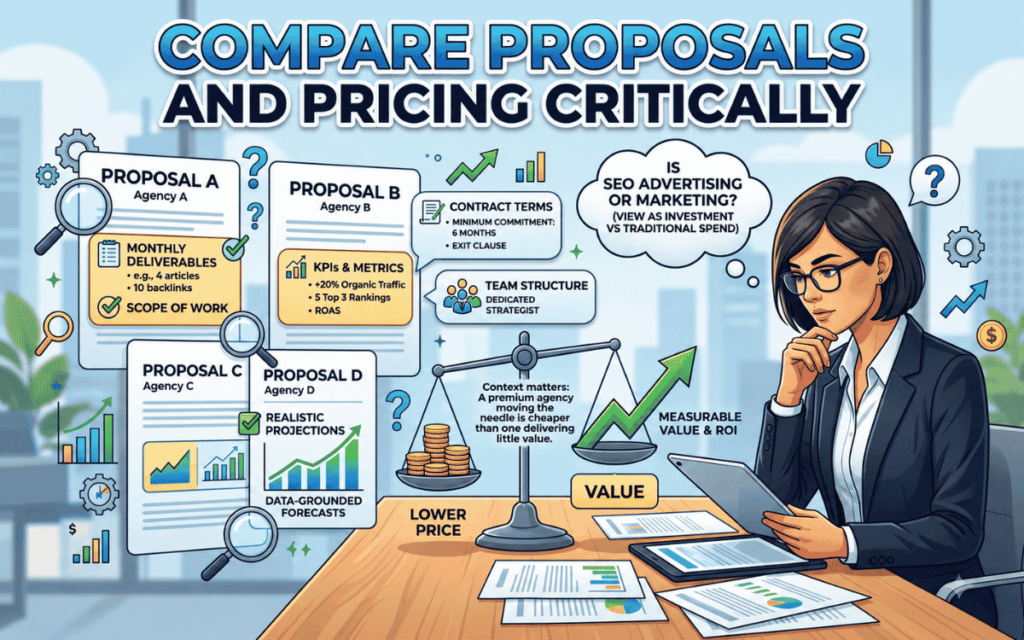
Once you have received proposals from several agencies, compare them on substance – not just price.
Look for:
- Clear scope of work: What specific deliverables will you receive each month?
- Defined KPIs: What metrics will they track and report?
- Realistic projections: Are their traffic and ranking forecasts grounded in data?
- Contract terms: What is the minimum commitment? What happens if you want to exit?
- Team structure: Who will manage your account day-to-day? Will you have a dedicated strategist?
Price should be evaluated in context. A cheaper agency that delivers little measurable value costs far more in the long run than a premium agency that consistently moves the needle. Furthermore, understanding whether SEO is advertising or marketing helps frame how you think about SEO investment versus traditional spend – and makes it easier to justify the right budget internally.
Step 8 – Start with a Trial or Audit Engagement
If you are unsure about committing to a long-term contract, many agencies offer a paid SEO audit as a starting point. This gives you a concrete sample of their analytical thinking, communication quality, and strategic depth before you sign a multi-month agreement.
A thorough SEO audit should cover:
- Technical health of your website
- Current keyword rankings and opportunities
- Competitive landscape analysis
- On-page optimisation gaps
- Backlink profile assessment
- Content strategy recommendations
Use the quality of the audit as a direct indicator of what working with the agency long-term will look like. Shallow audits with generic recommendations signal a shallow long-term strategy.
How SurgeAIO Can Help in Terms of SEO
Finding the best SEO company is one challenge – but managing your SEO strategy effectively once you have chosen a partner is another. SurgeAIO bridges both needs for businesses that want greater control and visibility over their SEO performance.
SurgeAIO provides a powerful platform that gives you the data to evaluate whether your SEO company is delivering real results. It also equips you to collaborate more strategically with your agency by understanding the metrics that matter.
Here is how SurgeAIO supports your SEO journey:
- Performance tracking: Monitor your keyword rankings, organic traffic, and visibility changes – so you can hold your agency accountable with real data.
- AI-powered SEO insights: Identify content gaps, keyword opportunities, and optimisation priorities faster than traditional methods allow.
- Competitive intelligence: See exactly what your competitors are doing and where your SEO company should be focusing efforts.
- Content optimisation tools: Ensure every piece of content your agency produces meets the quality and relevance standards Google rewards.
- Reporting clarity: Get clean, clear SEO reports that make it easy to track ROI and communicate results to stakeholders.
Whether you manage SEO in-house, work with an agency, or blend both approaches, do you need digital marketing or SEO services is a question SurgeAIO helps you answer with confidence. The platform gives you the visibility to make smarter decisions at every stage of your organic growth strategy.
Quick Checklist: How to Find the Best SEO Company
Use this checklist when evaluating any SEO agency:
- They ask about your business goals before pitching services
- They provide detailed case studies with measurable results
- They explain their process clearly and transparently
- They conduct a technical audit before building a strategy
- They track meaningful KPIs and report regularly
- They build backlinks through ethical, white-hat methods
- They set realistic timelines – not overnight promises
- They communicate proactively and respond quickly
- They have experience in your industry or niche
- Their own website ranks well for relevant keywords
Final Thoughts
Finding the best SEO company is not about choosing the biggest name or the cheapest option. It is about finding a partner whose process, expertise, communication style, and track record align with your specific business goals.
Take time to define what you need, research thoroughly, ask hard questions, and trust the evidence over the pitch. The right SEO company will not just improve your rankings – they will become a genuine growth partner that contributes measurably to your bottom line.
Start with clarity, evaluate with rigour, and choose with confidence.
Frequently Asked Questions
Q1: How do I know if an SEO company is legitimate?
Look for transparent processes, documented case studies with real data, honest timelines, and clear reporting. Legitimate agencies will never guarantee specific rankings or promise results in days. Check independent reviews on platforms like Clutch or Google before committing.
Q2: How much should I pay for a good SEO company?
Quality SEO services typically range from $1,000 to $5,000 per month for small to mid-sized businesses, and significantly more for enterprise campaigns. Be cautious of agencies charging under $500 per month – the work quality rarely justifies even that investment.
Q3: How long does it take to see results from an SEO company?
Most businesses start seeing meaningful improvements in organic traffic within 4–6 months of a well-executed campaign. Competitive niches may take 9–12 months. Any agency promising significant results in under 60 days is using short-term tactics that may hurt your rankings later.
Q4: Should I hire a local SEO company or a remote one?
Location matters far less than expertise and communication quality. Many of the best SEO companies operate entirely remotely and serve clients across multiple countries. Focus on their track record, team structure, and how well they communicate – not where their office is located.
Q5: What questions should I ask an SEO company before hiring them?
Key questions include: How do you approach keyword research? How do you build backlinks? Who will manage my account? How do you measure and report ROI? What does your onboarding process look like? What happens if I want to cancel? Strong agencies will answer all of these confidently and with specifics.
Q6: Can a small business benefit from hiring an SEO company?
Absolutely. SEO levels the playing field by giving small businesses the ability to compete for organic search visibility without massive ad budgets. The key is finding an agency with specific small-business experience and realistic expectations about what a modest SEO budget can achieve over time.
Q7: What is the difference between a good and a bad SEO company?
Good agencies focus on sustainable, white-hat strategies, communicate transparently, set realistic expectations, and measure real business outcomes. Bad agencies make big promises, use manipulative tactics, deliver vague reports, and disappear once they have your money. Always verify claims with third-party reviews and direct client references.
