Healthcare marketing comes with constraints most industries never face: strict compliance requirements, high advertising costs for competitive medical terms, and patients who are often anxious, skeptical or simply unsure where to start looking for care. Despite these challenges, effective marketing strategies for healthcare organizations don’t have to be expensive or complicated to work.
Whether you’re running a hospital system, a Speciality clinic, or an independent practice, the fundamentals of healthcare marketing closely mirror what works in other industries – just adapted for a sector where trust matters more than almost anywhere else. This guide walks through the strategies that consistently help healthcare organizations stand out, build credibility and attract the right patients.
Why Healthcare Marketing Requires a Different Playbook
Patients researching healthcare decisions behave differently from typical consumers. They’re often dealing with a health concern, comparing providers carefully, and placing significant weight on trust signals like reviews, credentials and clear communication before ever booking an appointment.
This means marketing strategies for healthcare organizations need to prioritize:
- Credibility and expertise, demonstrated through genuinely helpful content, not just promotional messaging
- Local visibility, since most patients strongly prefer providers close to home
- Trust signals, including authentic reviews and transparent, professional branding
- Patient experience, extending from the website all the way through to in-person visits
- Compliance awareness, ensuring marketing content meets relevant healthcare advertising regulations
1. Create Educational Content That Builds Authority
People turn to the internet to research health concerns constantly, and organizations that answer those questions clearly position themselves as trustworthy experts before a patient ever walks through the door.

Effective educational content includes:
- Blog articles addressing common patient questions and concerns in plain language
- Guest contributions on reputable external sites, which build authority and often earn valuable backlinks
- Short, informative videos explaining procedures, conditions or what to expect during a visit
This kind of content doesn’t just inform prospective patients – it also supports organic search visibility, since search engines consistently reward genuinely useful, well-structured healthcare content.
2. Prioritize Local SEO
Most patients don’t want to travel far for routine care or even many Speciality procedures, which makes local visibility one of the most important marketing strategies for healthcare organizations of any size. Appearing in local search results, particularly the map-based local results that show up for “near me” searches, requires more than simply claiming a listing.
Strong local SEO for healthcare involves:
- Keeping business name, address and phone number consistent across every directory
- Maintaining accurate, complete profiles on Google and relevant healthcare-specific directories
- Actively collecting and responding to patient reviews
- Regularly updating practice information, hours and services
Organizations that invest here benefit from local SEO that helps attract local customers exactly when they’re searching for nearby care.
3. Understand Your Competitive and Market Landscape
Researching how other providers in the area present themselves online reveals practical opportunities to differentiate. This includes checking how competitors rank in search results, how complete their directory listings are, and whether they’re using newer patient-facing technology like telehealth or online scheduling.
Staying aware of these trends helps a healthcare organization avoid falling behind, particularly in competitive specialties where patients frequently compare multiple providers before choosing one.
4. Build and Protect Online Reputation
Few things influence a patient’s decision more than authentic reviews from people who’ve actually been treated. Reputation management should be treated as a core, ongoing marketing strategy, not an afterthought.
Practical steps include:
- Actively requesting feedback from satisfied patients through simple, low-friction surveys
- Responding professionally and promptly to all reviews, including negative ones
- Monitoring review platforms regularly, not just occasionally
- Staying engaged on social media, where many patients now expect some level of responsiveness
Patient experience extends well beyond the clinical visit itself – it includes how billing, communication and scheduling are handled, all of which eventually show up in reviews.
5. Maintain Consistent, Professional Branding
A healthcare organization’s digital presence sends an immediate signal about the quality of care patients can expect. Inconsistent branding, outdated visuals or unclear messaging can quietly undermine trust before a patient even books an appointment.
Consistency matters across every touchpoint – the website, social media, printed materials and even internal patient communications. Organizations managing multiple locations or specialties benefit especially from centralized brand guidelines that keep every piece of content recognizable and professional.
6. Leverage Existing Patient Relationships
New patient acquisition often gets the most attention, but existing and former patients represent one of the most overlooked opportunities in healthcare marketing. Thoughtful outreach to this group – sharing relevant service updates or simply maintaining the relationship – can drive meaningful referrals and repeat visits.
Physicians who refer patients to specialists are another valuable relationship worth nurturing deliberately, since referral networks remain one of the most trusted sources of new patients in Speciality care.
7. Host Community and Educational Events
In-person and virtual open houses, educational seminars, or community health events help a healthcare organization become a recognizable, trusted presence locally – not just a name that appears in search results. These events work best when paired with genuine incentives and partnerships with local community figures who can help drive attendance.
8. Optimize the Website for Patient Experience
A healthcare website often serves as a patient’s first real impression of an organization, functioning much like the front desk of a physical practice. A strong patient-facing website should load quickly, work seamlessly on mobile devices, and make it immediately clear how to book an appointment or find relevant information.
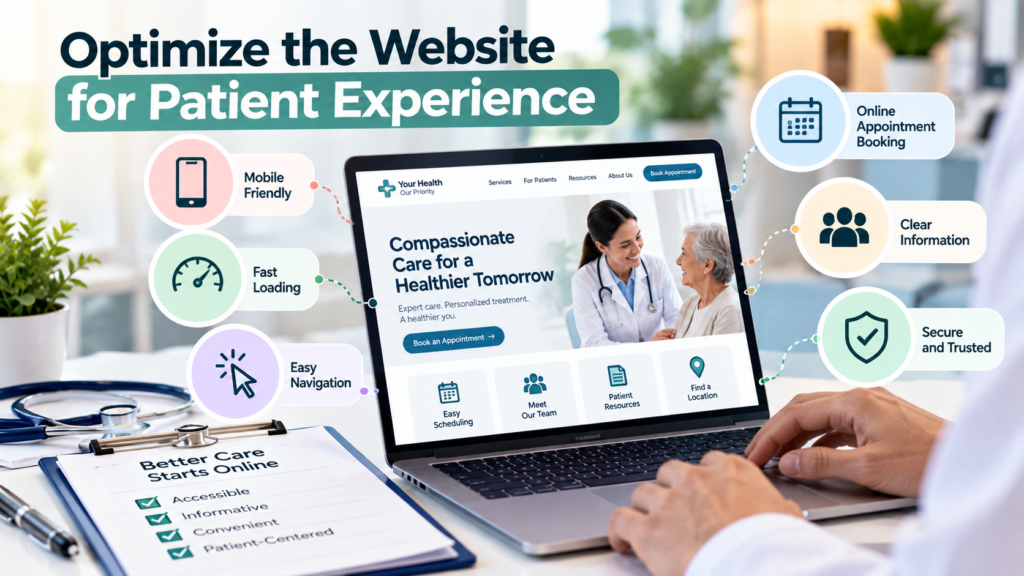
Key factors to evaluate include:
- Mobile responsiveness across devices and screen sizes
- Page load speed, since slow sites quickly lose patient attention
- Clear navigation to services, providers and appointment booking
- Accurate tracking of how patients are actually finding and landing on the site
Different specialties face different website and SEO considerations. A fertility clinic’s digital marketing needs, for example, differ meaningfully from those of an eye care practice, since patient search behavior and decision timelines vary significantly by Speciality.
9. Strengthen Internal Communication
Marketing strategies for healthcare organizations don’t operate in isolation from clinical operations. Poor internal communication has been linked to a meaningful share of medical errors and malpractice claims, which makes it, indirectly, a patient experience and reputation issue as much as an operational one.
Improving this typically involves:
- Clear, templated patient communication across departments
- Regular team coordination to reduce handoff errors
- Technology that supports two-way communication between care teams
10. Consider Specialized Outreach for Referral Growth
For Speciality practices in particular, a dedicated focus on physician relationships and referral growth can meaningfully expand the patient base. Larger organizations sometimes formalize this through a physician liaison role, while smaller practices can designate a team member to maintain these relationships consistently.
SEO Considerations by Healthcare Speciality
Different healthcare specialties face distinct marketing challenges, and a one-size-fits-all strategy rarely performs well. For example:
- Functional and integrative medicine practices often need content strategies that explain less conventional treatment approaches clearly, which is why SEO for functional medicine doctors focuses heavily on educational trust-building content
- Biofeedback and Speciality therapy clinics benefit from dedicated SEO strategies that explain niche treatments patients may not be familiar with yet
- Audiology practices rely heavily on targeted lead generation strategies built around specific, high-intent local searches
- Plastic surgery clinics require a careful balance of visual content and compliant messaging, which is why SEO and GEO strategies for plastic surgery are built specifically around this Speciality’s unique search behavior
- Physiotherapy clinics benefit from SEO best practices tailored to recurring, local-intent searches from patients seeking ongoing treatment
Common Mistakes Healthcare Organizations Make With Marketing
- Neglecting local SEO, missing the exact moment nearby patients are searching for care
- Inconsistent branding across locations, providers or marketing materials
- Ignoring online reviews, letting negative feedback go unanswered or unaddressed
- Generic content, failing to address the specific concerns patients in a given Speciality actually have
- Underestimating how long results take, abandoning strategies before they’ve had time to show measurable impact
Practical Checklist for Healthcare Marketing Strategy
- Publish educational content addressing common patient questions regularly
- Fully optimize and maintain local search listings and directory profiles
- Actively request and respond to patient reviews
- Maintain consistent, professional branding across every touchpoint
- Nurture relationships with existing patients and referring physicians
- Ensure the website loads quickly and works well on mobile
- Strengthen internal communication to support a better patient experience
How SurgeAIO can help in terms of SEO
Effective marketing strategies for healthcare organizations depend heavily on strong, compliant, speciality-specific search visibility – something generic marketing approaches often miss entirely. SurgeAIO works with healthcare practices to build organic strategies suited to how patients actually search for care.
Because healthcare SEO behaves differently from other industries, understanding how long medical SEO typically takes to show results helps practices set realistic expectations before committing to a long-term strategy. SurgeAIO tailors its approach by speciality, recognizing that a clinic’s patient journey and search intent shape everything from content strategy to local SEO priorities.
Final Thoughts
Marketing strategies for healthcare organizations work best when they combine genuine patient education, strong local visibility, consistent branding and active reputation management into one coordinated approach. Rather than chasing every new marketing trend, the organizations that see lasting results are the ones that build trust deliberately, Speciality by Speciality, and stay consistent long enough for that trust to compound into real patient growth.
Frequently Asked Questions
1. What makes marketing strategies for healthcare organizations different from other industries?
Healthcare marketing must balance compliance requirements, patient trust and sensitivity, and strong local intent, since most patients strongly prefer nearby, credible providers over distant or unfamiliar ones.
2. How important is local SEO for healthcare organizations?
Extremely important. Most patients search for care close to home, making accurate, optimized local listings and consistent directory information essential for visibility.
3. How can a healthcare organization build trust online?
Authentic patient reviews, consistent professional branding, and genuinely helpful educational content all contribute significantly to building trust before a patient ever books an appointment.
4. Do different healthcare specialties need different marketing strategies?
Yes. Patient search behavior, decision timelines and content needs vary significantly by Speciality, which is why tailored approaches typically outperform generic, one-size-fits-all marketing strategies.
5. How long does it take to see results from healthcare marketing efforts?
Results vary by strategy and Speciality, but organic strategies like SEO and content marketing generally take several months to show meaningful traction, while reputation and referral-based strategies can show impact sooner.
