
Your competitors are already ranking for keywords you want. They’re earning backlinks you haven’t targeted yet. And they’re creating content that answers questions your buyers are actively searching for.
That’s exactly why learning how to do an SEO competitor analysis is one of the smartest moves you can make. It removes the guesswork from your strategy and shows you exactly where to focus your efforts to outrank rivals and grow organic traffic.
In this guide, you’ll get a clear, actionable process – step by step.
What Is an SEO Competitor Analysis?
An SEO competitor analysis is the process of studying your rivals’ search strategies to understand what’s working for them – and what isn’t. You examine their keywords, content, backlinks, and technical setup to find opportunities you can act on.
In SEO, a competitor is any website that ranks above you for search queries that matter to your business. They may not be your direct business rivals. However, if they show up where you want to show up, they’re your SEO competitors.
The goal isn’t to copy what they do. Instead, it’s to understand the competitive landscape, identify gaps, and build a smarter strategy.
Why Does an SEO Competitor Analysis Matter?
Many businesses invest in SEO without ever looking at what their competitors are doing. This leads to wasted effort – targeting keywords that are too competitive, missing easy wins, and publishing content that never gains traction.
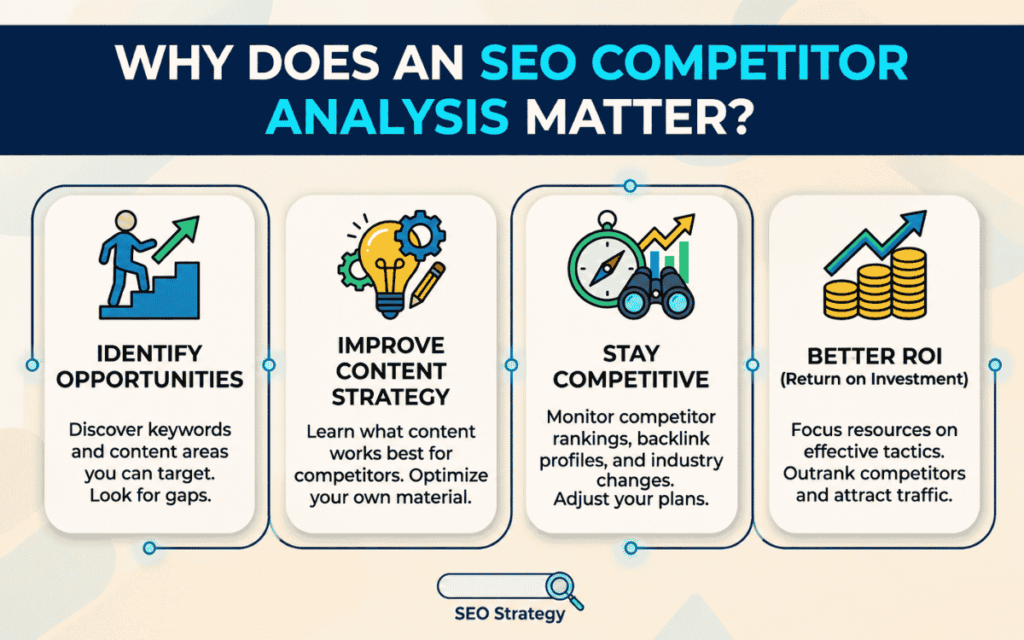
A proper SEO competitor analysis helps you:
- Discover proven strategies – Learn what’s already working in your niche instead of starting blind.
- Uncover content gaps – Find topics your competitors haven’t covered well and own them first.
- Identify keyword opportunities – Spot high-intent keywords with lower competition that you can rank for faster.
- Benchmark your performance – Understand where you stand today and measure progress over time.
- Prioritize your SEO efforts – Focus time and budget on the actions most likely to move the needle.
Moreover, competitor analysis helps you avoid costly mistakes. If a rival already tried a tactic that didn’t work, you don’t need to repeat it.
When Should You Run an SEO Competitor Analysis?
You don’t need to wait for a crisis to conduct this analysis. In fact, the best time is before you launch a new strategy. However, several specific situations make it essential:
- When you’re launching a new website or entering a new market
- When your keyword rankings have dropped significantly
- When you notice a competitor pulling ahead in organic traffic
- When you’re planning a new content strategy or product launch
- When you want to identify the lowest competition searches to rank for quickly
Make it a habit to run a competitor analysis at least once per quarter. Search results shift constantly, and your competitive landscape changes with them.
Step 1: Identify Your True SEO Competitors
Your SEO competitors are not always the same as your business competitors. A small local agency might be competing against major industry publications for the same keywords. Therefore, you need to identify competitors based on search results – not just industry knowledge.
Here’s how to find your actual SEO competitors:
- Search your primary keywords – Look at who consistently ranks on page one. Those are your SEO competitors.
- Use SEO tools – Platforms like Semrush, Ahrefs, and SurgeAIO can show you which domains compete for the same keywords you’re targeting.
- Check who ranks for your brand terms – If other sites appear when people search your business name, that’s a signal worth investigating.
Aim to identify 3-5 core competitors for your analysis. Focus on sites that consistently rank across multiple relevant keywords – not just one or two.
Step 2: Analyze Their Keyword Strategy
Keywords are the foundation of any SEO strategy. Once you know who your competitors are, the next step is to understand which keywords they rank for – and why.
Look for:
- Overlapping keywords – Terms both you and your competitor rank for. These show you where the head-to-head battle is happening.
- Competitor-only keywords – Terms they rank for that you don’t. These are your gap opportunities.
- Top-performing pages – Which pages drive the most organic traffic for them and why?
Pay close attention to intent. A competitor ranking for “what is X” attracts awareness-stage visitors. One ranking for “best X for Y” targets buyers much closer to a decision. Understanding keywords important for SEO at each funnel stage helps you build a more strategic content roadmap.
Also, look at their keyword difficulty spread. If they’re dominating low-competition, long-tail keywords, that’s a replicable tactic you can deploy immediately.
Step 3: Examine Their Content Strategy
Rankings are earned through content. Therefore, studying your competitors’ content gives you a direct view into what’s resonating with both users and search engines.
When reviewing competitor content, assess the following:
- Topics covered – What subjects do they write about most? Are there topic clusters they’ve built around certain themes?
- Content depth – Are their articles short and surface-level, or long and comprehensive? Depth often correlates with authority.
- Content formats – Do they rely on blog posts, videos, comparison pages, case studies, or tools?
- Publishing frequency – How often do they publish new content? Consistency matters for sustained organic growth.
- Content quality – Is the content genuinely helpful, or does it feel generic? Thin content is a weakness you can exploit.
When you spot a topic they’ve covered poorly, that’s your opportunity. You can create a more thorough, better-structured version and compete for the same keyword. Best content optimization tools for SEO can help you benchmark your content quality against theirs before you publish.
Step 4: Audit Their Backlink Profile
Backlinks remain one of the most powerful ranking factors in SEO. Studying your competitors’ link profiles reveals who links to them, which content attracts the most links, and where you can pursue similar opportunities.
When auditing competitor backlinks, focus on:
- Total referring domains – The number of unique websites linking to them. More domains (from high-authority sources) generally means stronger rankings.
- Top linked pages – Which pages have earned the most backlinks? This tells you what content formats and topics attract links in your niche.
- Link sources – What types of sites link to them? Industry publications, directories, guest posts, or news mentions?
- Anchor text patterns – What language do people use when linking to them? This reveals how they’re positioning their content.
Understanding how many backlinks you need to compete gives you a realistic benchmark. If a competitor’s top page has 200 referring domains and yours has 10, you know exactly what you’re working toward.
Once you identify strong link sources, you can pursue outreach to the same publications, directories, or partner sites.
Step 5: Evaluate Their On-Page SEO
On-page SEO signals give search engines context about what a page is about. Reviewing how competitors structure their pages reveals both tactics to replicate and weaknesses to exploit.
Check the following on-page elements:
- Title tags and meta descriptions – Are they optimized with clear keywords and strong calls to action?
- Header structure – Do they use H1, H2, and H3 tags logically to organize content?
- Keyword usage – Where do they place primary and secondary keywords throughout the page?
- Internal linking – How do they connect related content across their site?
- Page length and depth – Does their content comprehensively cover the topic, or leave gaps you can fill?
- Schema markup – Do they use structured data to enhance SERP appearance?
If competitors are ranking without strong on-page SEO, that’s a major opportunity. A well-optimized page on a similar topic can outperform theirs with the right structure and depth.
Step 6: Review Their Technical SEO
Content and backlinks can only take you so far if there are technical issues holding a site back. Reviewing your competitors’ technical SEO health helps you understand their foundation – and how yours compares.
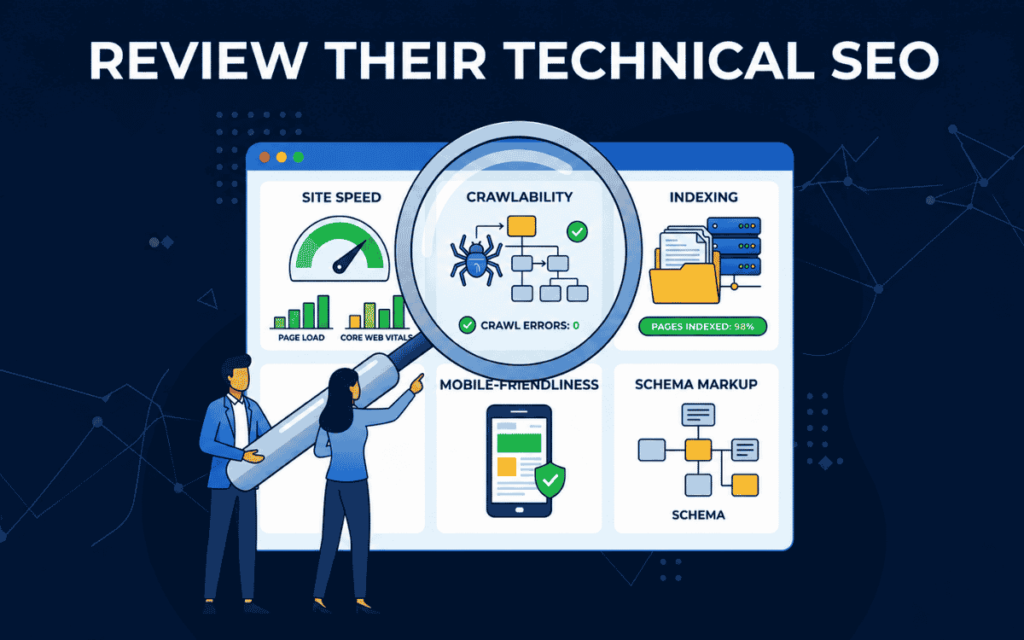
Key areas to examine:
- Site speed – Do their pages load quickly? Slow load times are a weakness you can beat.
- Mobile optimization – Is their site mobile-friendly? Google uses mobile-first indexing.
- Site structure – Is the site well-organized with clear navigation and logical URL structures?
- Core Web Vitals – How do their pages perform on Google’s key UX metrics?
How important a sitemap is for SEO becomes clear when you audit a competitor’s technical setup. A clean sitemap, fast load times, and a logical site architecture all signal to search engines that a site deserves to rank.
If your site outperforms theirs technically, that advantage compounds over time – especially in competitive niches.
Step 7: Assess Their Domain Authority and Overall Strength
Domain authority (DA) gives you a quick sense of how strong a competitor’s overall link profile is. However, don’t let a high DA discourage you. It’s not the only factor, and many sites with strong technical SEO and content quality outrank higher-DA competitors on specific terms.
When assessing overall strength, consider:
- Domain authority score – A general indicator of link profile strength.
- Organic traffic volume – How much traffic are they pulling in from search?
- Number of ranking keywords – How broad is their keyword footprint?
- Brand awareness – Do they have strong brand signals like branded searches and social mentions?
This big-picture view helps you understand how achievable it is to outrank them on specific keywords – and which battles to pick first.
Step 8: Find Content Gaps and Quick Win Opportunities
This is where the analysis starts turning into action. A content gap is any topic or keyword your competitors rank for that you don’t. These gaps represent missed traffic and missed leads.
Look for:
- Keywords where you rank on page 2 or 3 – These are near-win opportunities that need optimization, not new content.
- Topics competitors cover that you don’t – Add these to your content roadmap.
- Low-competition terms – Terms your competitors rank for with relatively few backlinks. You can move quickly here.
- Questions your audience asks – Use competitor content to identify FAQ-style content they’ve covered superficially.
Furthermore, review their keyword gap strategy from the other direction – which terms are you ranking for that they’re not? Doubling down on those areas can help you build a stronger advantage where you’re already ahead.
Step 9: Turn Insights Into an Actionable SEO Plan
Data without action is just noise. Once you’ve completed your analysis, organize your findings into a clear, prioritized plan.
Structure your plan around three phases:
Quick wins (0-30 days):
- Optimize existing pages that rank on page 2 or 3
- Fix on-page issues like missing title tags or weak meta descriptions
- Build a few targeted links to high-potential pages
Medium-term actions (1-3 months):
- Create content to fill identified topic gaps
- Begin link-building outreach to sources linking to competitors
- Improve technical SEO based on your audit findings
Long-term strategy (3-12 months):
- Build topical authority through pillar pages and content clusters
- Pursue high-authority backlinks through digital PR and guest posting
- Monitor competitor moves and adjust your strategy quarterly
This structured approach ensures you’re outranking your competition in Google with a plan that compounds over time rather than chasing short-term wins that don’t last.
How SurgeAIO Can Help in Terms of SEO
Running a thorough SEO competitor analysis takes time, the right tools, and the expertise to turn data into strategy. SurgeAIO simplifies every step of the process – from identifying competitors to tracking how you stack up over time.
With SurgeAIO, you can:
- Identify your real SEO competitors based on keyword overlap and SERP data
- Analyze competitor keyword strategies and surface the gaps you can act on immediately
- Track your rankings against competitors across all target keywords in one dashboard
- Monitor AI visibility across traditional and AI-driven search platforms
- Audit content performance to identify which pages to optimize or expand
- Build data-driven content plans aligned with what your competitors are missing
Whether you’re running your first competitor analysis or optimizing an existing SEO strategy, SurgeAIO gives you the clarity and control to move faster, make smarter decisions, and earn rankings your rivals can’t match.
Frequently Asked Questions
Q: How often should I do an SEO competitor analysis?
At minimum, run a full analysis every quarter. However, if you notice a sudden drop in rankings or a competitor appears to be surging in traffic, conduct a focused analysis immediately. Search landscapes shift constantly, so regular monitoring is essential.
Q: What’s the difference between SEO competitors and business competitors?
Business competitors sell similar products or services to you. SEO competitors are websites that rank for the same keywords, regardless of whether they sell anything similar. A major publication or industry blog may be your strongest SEO competitor even though it’s not a direct business rival.
Q: How many competitors should I analyze?
Start with 3-5 core competitors. Focus on sites that consistently rank across multiple relevant keywords – not just one or two. Trying to analyze too many at once dilutes your focus and makes it harder to take action.
Q: Can I do an SEO competitor analysis without paid tools?
Yes, partially. Google Search, Google Search Console, and free versions of tools like Ubersuggest can get you started. However, paid tools like SurgeAIO, Semrush, or Ahrefs give you far more depth – especially for backlink analysis and keyword gap research.
Q: What’s the first thing I should look at when analyzing a competitor?
Start with their top-performing pages. These pages drive the most traffic for a reason. Understand what keywords they target, how the content is structured, and how many backlinks those pages have. That single insight shapes the rest of your analysis.
Q: How do I know if I can outrank a competitor?
Look at the backlink profiles of the pages ranking above you for your target keyword. If those pages have a manageable number of referring domains and your content is more thorough and better optimized, you can compete. Domain authority alone isn’t the deciding factor – relevance, content quality, and on-page SEO all play a major role.
