
Press releases are not just for journalists anymore. Today, they serve as a powerful SEO tool that can boost your brand’s online visibility, attract quality backlinks, and drive targeted traffic to your website. However, most businesses write press releases without any SEO strategy, missing out on significant opportunities.
If you want to understand how to do press release submission in SEO the right way, this guide will walk you through every step – from writing to distribution to measuring results.
What Is Press Release Submission in SEO?
Press release submission in SEO refers to the process of writing, optimizing, and distributing news content through online channels to improve your website’s search engine visibility.
Unlike traditional press releases that only target journalists, SEO-optimized press releases are also designed to rank in search engines, earn backlinks, and generate referral traffic.
Moreover, when done consistently, press release submission can:
- Build domain authority through quality inbound links
- Improve brand awareness across news platforms
- Increase your chances of appearing in Google News
- Signal credibility to both search engines and audiences
Understanding what is SEO and how it impacts your digital presence is the first step before you dive into press release strategies.
Why Press Release Submission Still Works in SEO
Some marketers question whether press release submission in SEO still delivers results. The answer is yes – but only when done strategically.
Google’s algorithms have evolved. Spammy press releases with keyword stuffing or unnatural backlinks can actually hurt your rankings. However, a well-crafted, newsworthy release distributed on authoritative platforms still delivers measurable SEO value.
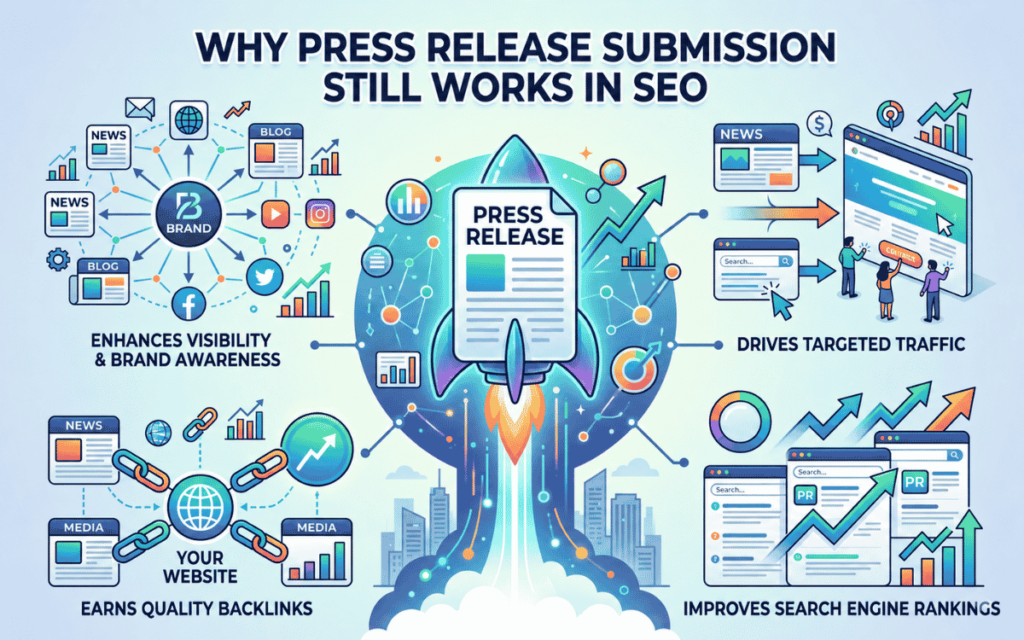
Here is why it still works:
- Earned backlinks: When journalists or bloggers pick up your story, they link back to your site. These editorial backlinks are highly valuable.
- Brand signals: Consistent press coverage tells Google your brand is active and credible.
- Referral traffic: People reading about your news on third-party sites click through to your website.
- Keyword visibility: Optimized releases can appear in search results for branded and informational queries.
Therefore, the key is quality over quantity. One well-placed release on a high-authority platform is worth more than ten releases on irrelevant directories.
Step-by-Step: How to Do Press Release Submission in SEO
Step 1 – Choose a Newsworthy Topic
Search engines and journalists both reward relevance and timeliness. Before you write anything, confirm that your story is actually news.
Examples of strong press release topics include:
- Product or service launches
- Company partnerships or acquisitions
- Awards, certifications, or milestones
- Research findings or industry reports
- Event announcements
Avoid writing releases that are purely promotional. A press release that reads like an advertisement will not get picked up by publications, and it will not rank well either.
Step 2 – Identify and Use the Right Primary Keyword
Keyword research is essential before writing your press release. Choose one primary keyword that matches the search intent of your target audience.
For example, a press release about launching a new product in your city could target a phrase like “product name + city” or an action-driven query relevant to your industry.
Place the primary keyword:
- In the headline
- In the first paragraph
- Naturally throughout the body (2–3 times)
- In the anchor text of links pointing to your site
Avoid keyword stuffing. Maintaining keyword usage to a maximum of 15 times throughout any piece of content ensures you stay within Google’s quality guidelines. Understanding how many SEO keywords per page actually help rankings is crucial before you start writing.
Step 3 – Craft an SEO-Optimized Headline
The headline is the most important element of your press release. It must grab attention and include your primary keyword naturally.
Keep it under 70 characters so it displays well in search results. Use active voice and make a clear, compelling statement. Avoid vague titles. Be specific about what the release is announcing.
For example, instead of “Company Announces New Partnership,” write “XYZ Company Partners with ABC to Launch AI-Powered Marketing Tools.”
Step 4 – Structure the Press Release Correctly
A well-structured press release looks like this:
Dateline: City, Date – Company Name announces…
Opening Paragraph: Answer who, what, when, where, why, and how in the first 40–60 words.
Body Paragraphs: Add supporting details, quotes from company executives, relevant statistics, and context. Keep paragraphs to 2–3 lines.
Boilerplate: One paragraph about your company – who you are, what you do, and why you matter.
Contact Information: Name, email, phone number, and website URL.
This structure helps search engines understand and properly index your content. It also increases the chances of journalists picking up your story.
Step 5 – Optimize On-Page Elements
Beyond keywords, you need to optimize several elements within the press release itself:
- Meta description: If the distribution platform allows it, write a 150–160 character summary with your keyword.
- Subheadings: Use H2 and H3 tags for clarity. Include secondary keywords naturally.
- Links: Add 1–2 contextual links back to relevant pages on your website. Use descriptive anchor text, not “click here.”
- Multimedia: Add a relevant image or infographic. Platforms that support multimedia tend to rank better and attract more engagement.
- Alt text: Optimize image alt text with a relevant keyword phrase.
These on-page elements work together to improve how search engines read and rank your release.
Step 6 – Choose the Right Distribution Platforms
Distribution is where most businesses go wrong. Submitting to hundreds of low-quality press release directories will not help your SEO. In fact, it can dilute your link profile.
Instead, focus on these categories of distribution:
Tier 1 – High-authority newswires:
- PR Newswire
- Business Wire
- GlobeNewswire
These platforms have enormous domain authority and are frequently indexed by Google News. They come at a cost but deliver measurable results.
Tier 2 – Industry-specific outlets:
Identify publications in your niche. A press release about a healthcare product should go to health industry publications. A technology release should go to tech media.
Tier 3 – Free distribution platforms:
Sites like PRLog, OpenPR, and 24-7 Press Release offer free submission. They will not drive major SEO gains alone, but they add breadth to your distribution.
If you want to understand how backlink companies for SEO approach link-building, press release distribution is often a key part of their strategy.
Step 7 – Use Contextual, Anchor-Rich Links
Press releases allow you to embed links back to your website. However, Google frowns on manipulative linking practices.
Follow these rules:
- Use nofollow or sponsored attributes for commercial links if required by the platform
- Keep links relevant and editorial – link to content that genuinely adds value
- Anchor text should match the context of the sentence naturally
- Limit to 1–2 links per release to avoid appearing spammy
The goal is to earn organic editorial links as journalists republish your release. Those dofollow editorial links carry real SEO weight.
Step 8 – Track Performance After Submission
Submitting is not the end. You must measure whether your press release submission in SEO is delivering results.
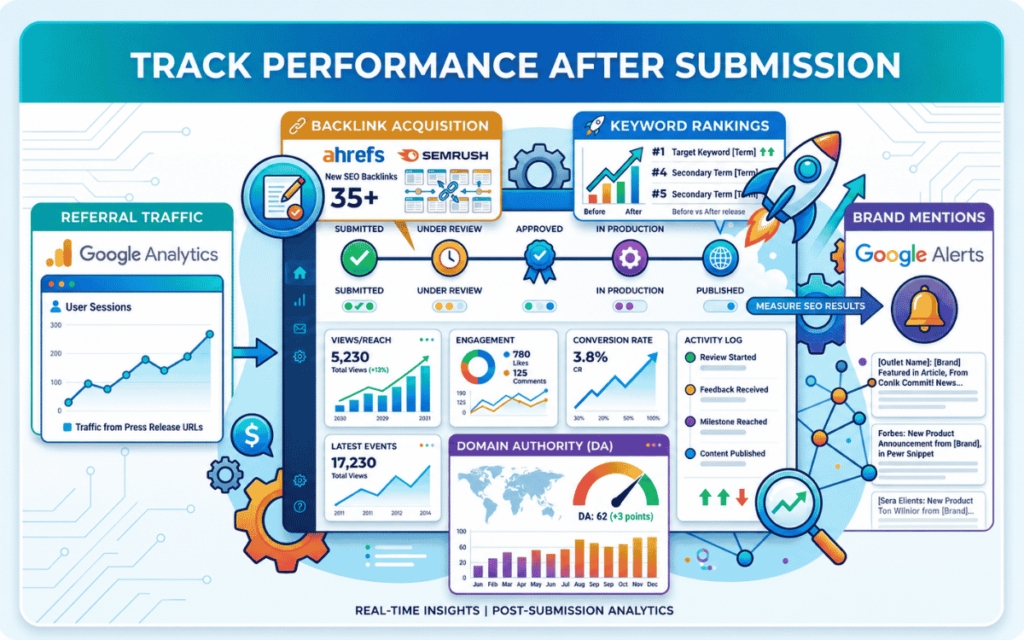
Track these metrics:
- Referral traffic: Check Google Analytics for traffic coming from press release URLs.
- Backlink acquisition: Use tools like Ahrefs or SEMrush to monitor new links earned.
- Keyword rankings: Did your target keyword improve after the release?
- Brand mentions: Set up Google Alerts to track where your release gets picked up.
- Domain authority changes: Monitor your overall domain authority over time.
Analyzing content performance data regularly helps you refine your press release strategy over time and identify what types of news generate the best SEO results.
Common Mistakes to Avoid in Press Release Submission
Even experienced marketers make avoidable errors. Here are the most common mistakes:
- Writing overly promotional content – Releases that read like ads get ignored by journalists and flagged by search engines.
- Ignoring keyword research – Submitting without a target keyword means missing search visibility opportunities.
- Submitting to irrelevant platforms – A health release on a tech directory adds no SEO or audience value.
- Overloading with links – More than 2 links signals manipulation and can trigger penalties.
- Not including multimedia – Text-only releases perform significantly lower than those with images or video.
- Skipping proofreading – Errors damage brand credibility and reduce journalist pick-up rates.
In addition, never use the same press release boilerplate repeatedly without updating it. Duplicate content across multiple submissions creates thin content issues.
How SurgeAIO Can Help in Terms of SEO
Executing a press release submission strategy manually takes time, research, and technical know-how. SurgeAIO simplifies the entire process.
SurgeAIO helps businesses at every stage of their SEO strategy – from keyword gap strategy to identifying the best opportunities for content and link-building.
Here is how SurgeAIO supports your press release SEO efforts:
- Keyword intelligence: SurgeAIO’s tools identify high-value primary keywords for your press releases so every release targets a real search opportunity.
- Competitive analysis: Understand what your competitors are doing and find gaps your press releases can fill.
- Content optimization: Ensure every release meets on-page SEO requirements before submission.
- Performance tracking: Monitor traffic, rankings, and backlinks after each release goes live.
- AI-powered insights: SurgeAIO’s AI capabilities help you identify the right timing, topics, and distribution channels for maximum impact.
Whether you are a small business or a growing enterprise, SurgeAIO gives you the data and tools to make every press release count for your SEO strategy. If you are still questioning whether you need digital marketing or SEO services, the answer becomes clear when you start seeing organic results from optimized press releases.
Press Release Submission SEO Best Practices at a Glance
Here is a quick reference checklist:
- One primary keyword per release
- Keyword placed in the headline and the first paragraph
- Headline under 70 characters
- The opening paragraph answers who, what, when, where, why, and how
- Body content is 400-600 words
- 1-2 contextual backlinks with descriptive anchor text
- Include at least one image with alt text
- Submit to 2-3 high-authority platforms
- Track results with analytics and backlink tools
- Repeat consistently – one release per month minimum
Final Thoughts
Press release submission in SEO is not a shortcut – it is a strategic practice that rewards consistency and quality. When you write a newsworthy release, optimize it with the right keywords, distribute it on authoritative platforms, and measure the results, you build lasting SEO value for your brand.
Moreover, combining press release submission with a broader SEO strategy amplifies results across all channels. The businesses that win in organic search are those that treat every piece of content – including press releases – as an opportunity to educate, inform, and connect with their audience.
Start with one well-crafted release, track its performance, refine your approach, and scale from there.
Frequently Asked Questions
Q1: Does press release submission still help with SEO in 2026?
Yes, but only when done strategically. High-quality, newsworthy releases submitted to authoritative platforms can earn editorial backlinks, improve brand visibility, and drive referral traffic. Low-quality bulk submissions, however, can hurt your rankings.
Q2: How many backlinks can a press release generate?
It varies widely based on the newsworthiness of the content and the quality of the distribution platform. A well-written release picked up by multiple outlets can generate dozens of backlinks. However, the value of those links depends on the authority of the sites linking to you.
Q3: Should I use dofollow or nofollow links in press releases?
Most reputable press release distribution platforms automatically apply nofollow attributes to links. The real SEO value comes from editorial coverage – when journalists write about your news and link to your site organically, those are typically dofollow links.
Q4: How often should I submit press releases for SEO?
Aim for at least one per month to maintain consistent brand signals. However, never publish a release without genuine news. Forced or fake news releases damage credibility with both journalists and search engines.
Q5: What is the ideal length for an SEO-optimized press release?
An SEO-optimized press release should be between 400 and 600 words. It should be long enough to provide complete information but short enough to maintain the reader’s attention. Avoid padding with filler content.
Q6: Can I use press releases for local SEO?
Absolutely. Local press releases distributed through regional news sites and local business journals can significantly improve your local search rankings. Include location-specific keywords and partner with local media for the best results.
