surgeaio.com

SurgeAIO — Navbar Mobile CTA

SEO for Painters – Simple Strategies That Work

SEO for Painters

When a homeowner needs a painter, they don’t ask a neighbour anymore. They pull out their phone and search for “painters near me.” If your business doesn’t appear in those results, you don’t get the call –  a competitor does.

That’s exactly the problem SEO for painters solves. It positions your painting business in front of local homeowners and commercial clients at the exact moment they’re ready to hire. No cold calls. No expensive ads. Just consistent, qualified leads from organic search.

This guide covers everything: keyword research, local SEO, service pages, content strategy, technical optimization, and AI-driven visibility. Follow these steps and your website becomes your most productive salesperson.

Why SEO Is the Smartest Investment for Painting Businesses

Most homeowners start their search for a painter online. They search, compare, read reviews, and check photos –  all before picking up the phone. Therefore, your ranking on Google determines whether you’re on their shortlist or completely invisible.

Paid ads work –  but they stop the moment you stop spending. SEO, however, compounds over time. A well-optimized page continues attracting leads for months and years without additional cost. Moreover, organic leads convert at a far higher rate than outbound methods because the buyer is already looking for exactly what you offer.

Local painting companies have a genuine advantage here. Unlike national franchise brands, you can implement hyper-local SEO tactics that large chains simply cannot replicate at a local level. Understanding digital marketing for remodelling contractors gives useful context for how home service businesses should approach their digital presence –  the same fundamentals apply directly to painters.


Turn AI Visibility Into Real Revenue.

Automate Leads With SurgeAIO. Don’t Let AI Ignore Your Brand.

Book A Demo →

Confirming Search Intent: What Are Painting Customers Actually Looking For?

Before targeting any keyword, confirm the search intent behind it. Painting customers search with different goals at different stages – and your content must match those goals to rank and convert.

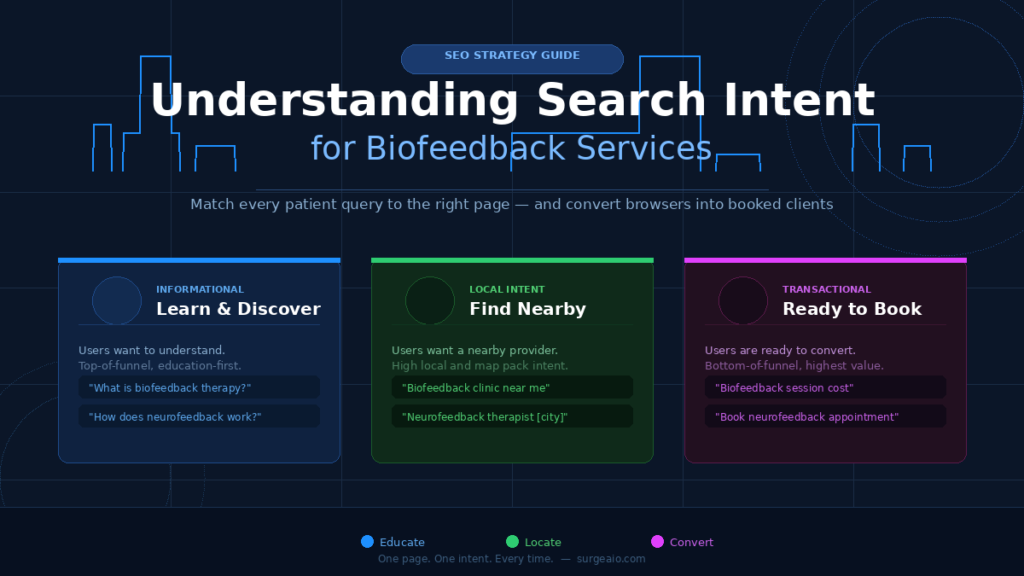
The three main search intents for painting businesses are:

  • Informational: “How much does it cost to paint a house?” or “What’s the difference between interior and exterior paint?” – researching before committing
  • Commercial: “Best residential painters in [city]” or “Top-rated painting companies near me” –  comparing local options
  • Transactional: “House painters near me” or “Get a painting quote [city]” – ready to book immediately

Your service pages should target commercial and transactional intent. Blog content should capture informational searches to build authority and attract early-stage visitors. Map every page on your site to one of these three intents – it determines your content, CTA, and keyword strategy.

Keyword Research: Finding the Terms Your Customers Use

Keyword research is the foundation of your entire SEO strategy. For painters, the goal is to find terms with real local search volume and strong buyer intent – not just broad, competitive phrases.

Structure your keyword strategy across three tiers:

  • Primary keywords: “SEO for painters,” “house painters near me,” “residential painting company [city]”
  • Service-specific keywords: “interior house painting [city],” “exterior painting contractors,” “cabinet painting service,” “commercial painting company”
  • Long-tail keywords: “how much does interior painting cost in [city],” “best painters for Victorian homes,” “deck staining service near me”

Long-tail keywords are especially powerful for painters. They have lower competition but higher conversion rates because they reflect a specific, active need. A homeowner searching “cabinet painting service in Austin” is far closer to booking than one searching “painting.”

Furthermore, understanding why keywords are important for SEO helps you build a smarter content plan –  one that prioritises terms by buyer readiness, not just traffic volume. Don’t chase broad terms you can’t realistically rank for. Chase intent.

Local SEO: The Core Strategy for Every Painting Business

Local SEO is the single most impactful channel for painting companies. Your customers are local. Your jobs are local. Therefore, your SEO must be local too.

Local SEO

Optimize Your Google Business Profile

Your Google Business Profile (GBP) is the most important local SEO asset you have. A fully optimized GBP appears in the local map pack – the top three results that dominate the search results page for local service queries.

Key GBP optimization steps:

  • Select the most accurate primary category: “Painter” or “Painting Contractor”
  • Add all service areas you cover – be specific with neighbour-hoods and suburbs
  • Upload high-quality before-and-after photos of completed jobs
  • List all services: interior painting, exterior painting, cabinet refinishing, deck staining, commercial painting
  • Publish regular GBP posts featuring completed projects, seasonal offers, and tips
  • Collect and respond to every Google review –  both positive and negative

Build Location-Specific Landing Pages

If you serve multiple cities or suburbs, build a dedicated landing page for each one. Each page should use geo-modified keywords naturally, describe your work in that area, and include local social proof such as client reviews from that specific location.

Creating content for local landing pages provides a practical framework for scaling your local presence across multiple service areas without duplicating content – a critical skill for painting companies that cover large regions.

Build Local Citations

Get listed in directories your customers trust: Yelp, Houzz, Angi, HomeAdvisor, Thumbtack, and your local Chamber of Commerce. Consistent NAP (name, address, phone) across every listing strengthens your local authority and improves map pack rankings.

Service Pages: Your Highest-Converting SEO Assets

Every painting service you offer deserves its own dedicated page. Don’t bundle all services onto one generic page. Separate pages allow you to target specific keywords, rank for specific searches, and convert visitors looking for exactly that service.

Essential service pages for painting companies:

  • Interior house painting
  • Exterior house painting
  • Cabinet painting and refinishing
  • Commercial painting services
  • Deck and fence staining
  • Wallpaper removal and prep
  • New construction painting

Follow this on-page checklist for every service page:

  • Include your primary keyword in the H1, meta title, meta description, and first 100 words
  • Write at least 600–800 words of original, helpful content – not generic filler
  • Answer common customer questions: How long does it take? What prep is needed? What brands of paint do you use?
  • Add a clear CTA: “Get a Free Quote,” “Book an Estimate,” or “Call Us Today”
  • Include before-and-after photos with descriptive alt text
  • Add customer reviews specific to that service
  • Use internal links to connect related service pages and blog content

In addition, avoid thin service pages. Many painting websites have a single paragraph per service. This tells Google – and your customer – nothing valuable. Moreover, AI SEO best practices now reward depth and specificity. Detailed pages that genuinely inform visitors rank better and convert better.


Turn AI Visibility Into Real Revenue.

Automate Leads With SurgeAIO. Don’t Let AI Ignore Your Brand.

Book A Demo →

Technical SEO: Making Your Website Fast, Clean, and Crawlable

Technical SEO is the infrastructure behind your website. Without it, great content and strong keywords underperform. Painting company websites have specific technical needs – particularly around image-heavy portfolios and mobile performance.

Technical SEO

Core technical priorities:

  • Page speed: Portfolio pages with large uncompressed images load slowly. Compress images, use a CDN, and enable browser caching. Slow pages lose customers before they even read a word.
  • Mobile optimization: The majority of “painters near me” searches happen on mobile devices. Your site must load fast and look professional on every screen size.
  • HTTPS security: Every page must load securely over HTTPS. It’s a baseline ranking signal and a trust indicator for customers.
  • Schema markup: Add LocalBusiness schema to your homepage and service pages. This helps search engines and AI tools understand your business, location, services, and reviews.
  • Clean navigation: Customers should reach any service page within two clicks. Complicated navigation increases bounce rate and signals poor user experience.
  • XML sitemap: Submit a sitemap to Google Search Console so every service page, location page, and blog post gets crawled and indexed.

Technical SEO also increasingly impacts AI overview visibility. AI-generated search results favour well-structured, technically sound pages. Therefore, fixing your technical foundation improves performance in both traditional and AI-driven search.

Content Marketing: Attracting Customers Before They’re Ready to Book

Content marketing builds long-term SEO authority. It targets homeowners early in their research phase –  when they’re asking questions but not yet ready to book. Answering those questions with helpful content earns trust and brings them back when they are ready.

High-value blog content ideas for SEO for painters:

  • Cost guides: “How Much Does It Cost to Paint a 3-Bedroom House in [City]?” – one of the most searched painting questions
  • How-to advice: “How to Prepare Walls for Painting” or “Choosing the Right Finish for Kitchen Cabinets”
  • Comparison content: “Spray vs. Roller Painting: Which Is Better for Your Home?”
  • Seasonal content: “Best Time of Year to Paint Your Home’s Exterior” or “Winter Interior Painting Tips”
  • Project showcases: Document real client projects with before-and-after photos – these rank in image search and build credibility

Furthermore, publishing consistently matters. One blog post every few months won’t build authority. Aim for at least two posts per month targeting a mix of informational and local keywords. Over time, this content funnel brings in steady organic traffic across dozens of search terms.

Additionally, explore what elements are foundational for SEO with AI to understand how AI-driven search evaluates content quality – and what painting companies need to do to stay visible as search continues evolving.

Reviews and Reputation: Your Most Powerful Local Ranking Signal

Online reviews directly influence both your local map pack ranking and your conversion rate. Homeowners trust reviews more than any other signal when choosing a painter. Therefore, a systematic approach to collecting and managing reviews is essential.

Best practices for painter reviews:

  • Ask every satisfied client for a Google review immediately after job completion – while the experience is fresh
  • Send a direct review link via text message –  remove all friction from the process
  • Respond to every review, positive or negative, professionally and promptly
  • Aim for a minimum of 50 Google reviews before considering your profile competitive in most markets
  • Distribute reviews across multiple platforms: Google, Yelp, Houzz, and Facebook

A painting company with 150 Google reviews averaging 4.8 stars will outrank a competitor with better technical SEO but only 12 reviews. Reviews are social proof and ranking signals simultaneously – don’t neglect them.


Turn AI Visibility Into Real Revenue.

Automate Leads With SurgeAIO. Don’t Let AI Ignore Your Brand.

Book A Demo →

How SurgeAIO Can Help in Terms of SEO

SurgeAIO is built for service businesses that need to compete in local search and the rapidly evolving AI-driven search landscape. For painting companies, it tackles the exact challenges this industry faces – local competition, keyword targeting, technical gaps, and AI visibility.

Here is what SurgeAIO delivers for SEO for painters:

  • AI Visibility Monitoring: Track how your painting business appears across ChatGPT, Google AI Overviews, Perplexity, and other AI platforms –  not just traditional Google rankings.
  • Keyword Intelligence: Identify high-intent local keywords your customers actually use, with competitive data and priority recommendations specific to your service area.
  • On-Page Optimization: Get clear, actionable recommendations to improve every service page, location page, and blog post for both search engines and AI tools.
  • GEO Optimization: Optimize your content so generative AI engines recommend your painting business when buyers ask for local service providers.
  • Technical SEO Audits: Uncover speed issues, missing schema, crawl errors, and mobile problems that block your pages from ranking.
  • Local SEO Management: Monitor your rankings across all service areas and identify opportunities to outperform competitors in specific neighbourhoods or suburbs.
  • Competitor Gap Analysis: See exactly which keywords competing painters rank for that you don’t –  and build a targeted content plan to overtake them.

Ultimately, SurgeAIO takes the guesswork out of SEO. Painting businesses using SurgeAIO don’t just rank today – they stay visible as search evolves. Explore AI visibility optimization techniques to see how SurgeAIO approach aligns with where search is heading and how painters can get ahead of the curve now.

Final Thoughts

SEO for painters is one of the highest-ROI digital investments a painting business can make. Every service page you optimize, every local landing page you build, and every review you collect compounds into a digital presence that generates leads on autopilot.

The painting industry is competitive – but most companies still under-invest in SEO. Therefore, the opportunity to rank above local competitors and appear in AI-driven search results is genuinely significant right now.

Start with the fundamentals: optimize your Google Business Profile, build service pages for every offering, collect reviews consistently, and publish content that answers your customers’ questions. Then layer in technical SEO and AI optimization. Ultimately, the painters who invest in this system now will own the first page of local search results for years to come.

Frequently Asked Questions (FAQs)

How long does SEO take to produce results for a painting company?

Most painting businesses see measurable improvements within 3 to 6 months. Local SEO – especially Google Business Profile optimization and review collection –  often delivers results faster, sometimes within 30 to 60 days. Competitive city markets may take 6 to 12 months for broad terms. The key is consistency: regular content, ongoing technical maintenance, and steady review collection compound over time.

What are the most important keywords for a painting company?

The most valuable keywords combine service type and location. Examples include: “interior house painters [city],” “exterior painting contractors [suburb],” “cabinet painting service near me,” and “commercial painters [city].” Long-tail terms like “how much does it cost to paint a house in [city]” also drive strong traffic from high-intent buyers in the research phase.

Do painters really need a website for SEO?

Yes – absolutely. A Google Business Profile alone is not enough. Your website is where potential customers evaluate your credibility, view your portfolio, read reviews, and request a quote. Without a website, you cannot rank for service-specific or long-tail keywords. Your website is your most important lead generation asset.

How important is Google Business Profile for painters?

It’s arguably the single most important local SEO asset for painting companies. An optimized GBP appears in the local map pack – the top results for searches like “painters near me” or “painting company [city].” Companies with complete profiles, consistent photos, and strong reviews dominate these results. If you only do one thing for local SEO, optimize your GBP.

Should painters invest in content marketing?

Yes – and it’s one of the best long-term ROI strategies available. Content marketing targets homeowners in the research phase who aren’t ready to book yet but will be. Cost guides, comparison articles, and project showcases build trust, improve rankings, and bring visitors back when they’re ready to hire. Without content, you compete only on service pages – which limits your total keyword reach significantly.

How do online reviews affect a painter’s SEO rankings?

Reviews are one of the strongest local ranking signals Google uses. The quantity, recency, and average rating of your Google reviews directly affect where your business appears in local map results. Beyond rankings, reviews also convert visitors into calls –  homeowners trust peer recommendations above everything else when choosing a home service provider.

Is SEO Advertising or Marketing? The Clear Answer Every Business Needs

Is SEO Advertising or Marketing

Businesses new to digital growth often ask the same question: Is SEO advertising or marketing

It is a fair question. The lines between advertising, marketing, and SEO blur quickly – especially when every agency seems to bundle them together.

However, confusing these three disciplines can lead to poor budget decisions and misaligned expectations. Understanding where SEO sits – and how it differs from paid advertising – helps you build a smarter, more sustainable growth strategy. Understanding what SEO and GEO mean for your website gives you the full strategic context from the very beginning.

In this guide, you will get a clear, jargon-free answer. We will also break down how SEO works, why it matters more than ever, and how to use it alongside other marketing and advertising tools.


Turn AI Visibility Into Real Revenue.

Automate Leads With SurgeAIO. Don’t Let AI Ignore Your Brand.

Book A Demo →

First, Let’s Define the Terms

Before answering the core question, it helps to define each term clearly.

What Is Marketing?

Marketing is the broad umbrella. It covers every activity a business uses to attract, engage, and retain customers. This includes content, email, social media, SEO, public relations, and paid campaigns.

Marketing focuses on building relationships and communicating value over time. It is strategic and long-term by nature.

What Is Advertising?

Advertising is a subset of marketing. It involves paid placements – display ads, social media ads, Google Ads, TV spots, and billboards. You pay for visibility, and visibility stops the moment you stop paying.

Advertising is tactical and immediate. It delivers fast results but requires continuous spending.

What Is SEO?

What Is SEO?

SEO – Search Engine Optimisation – is the practice of optimising your website so it ranks higher in organic search results. It uses content, technical improvements, and link building to earn visibility without paying per click.

SEO is a form of digital marketing, not advertising. It generates organic (unpaid) traffic, which means it builds compounding value over time rather than stopping when your budget runs dry.

So, Is SEO Advertising or Marketing?

SEO is marketing – specifically, organic digital marketing.

It does not involve paid placements. You do not pay Google to rank your page. Instead, you earn that position by creating high-quality, relevant content and building a technically sound website.

Think of it this way:

  • Advertising = paying for a billboard on a busy highway
  • SEO = becoming so well-known and trusted that people naturally recommend you

Both put your brand in front of people. However, the mechanism – and the long-term cost structure – are completely different.

Understanding this distinction matters even more today as AI SEO transforms how search engines surface and rank content across platforms.

How SEO Fits Into the Marketing Ecosystem

SEO does not operate in isolation. It connects with and strengthens every other marketing channel you use.

Here is how SEO fits into the broader marketing picture:

  • Content Marketing – SEO needs content. Blog posts, guides, and landing pages are the vehicles that carry your keywords and attract search traffic.
  • Social Media Marketing – Social signals and brand mentions can indirectly support SEO authority.
  • Email Marketing – Driving traffic back to SEO-optimised pages increases engagement signals that help rankings.
  • PR and Link Building – Press coverage and authoritative backlinks directly boost your domain authority.
  • Local Marketing – Local SEO helps businesses appear in map packs and “near me” searches.

SEO acts as the connective tissue that amplifies every other marketing investment you make. When your other channels drive branded searches, your SEO performance improves too. Understanding why LLM SEO matters helps you extend that connective tissue into AI-driven discovery channels – where a growing share of branded search is now beginning.

The Three Pillars of SEO as a Marketing Strategy

If SEO is a form of marketing, it needs to be treated with the same strategic rigor. It is built on three core pillars.

1. On-Page SEO

On-page SEO covers everything you control directly on your website:

  • Keyword optimisation – using the right terms in titles, headers, and body content
  • Content quality – answering user questions clearly and thoroughly
  • Meta titles and descriptions – crafting compelling previews for search results
  • Internal linking – connecting related pages to distribute authority across your site
  • User experience – ensuring pages load fast and are easy to navigate

Choosing keywords that are important for SEO is the starting point for every on-page optimisation effort. Without targeting the right terms, even exceptional content fails to reach the right audience.

2. Off-Page SEO

Off-page SEO builds your site’s authority and credibility through external signals:

  • Backlinks – links from other reputable websites that vouch for your content
  • Brand mentions – references to your business across the web
  • Reviews and ratings – signals that support local and trust-based rankings
  • Social proof – engagement signals from social platforms

High-quality backlinks remain one of the strongest ranking signals search engines use. Off-page SEO is earned, not owned – and it requires consistent relationship building, outreach, and content worth referencing.

3. Technical SEO

Technical SEO ensures search engines can properly find, crawl, and index your website:

  • Site speed – slow pages lose both rankings and users
  • Mobile optimisation – over 60% of searches happen on mobile devices
  • Structured data (schema markup) – helps search engines understand your content
  • Crawlability – ensuring no broken links or blocked pages exist
  • HTTPS security – a confirmed ranking signal from Google

Understanding what elements are foundational for SEO with AI helps you future-proof your technical approach as search algorithms become increasingly AI-driven. All three pillars must work together – strong content without technical health loses ground, and a fast site with poor content earns no authority.


Turn AI Visibility Into Real Revenue.

Automate Leads With SurgeAIO. Don’t Let AI Ignore Your Brand.

Book A Demo →

Why SEO Has Become More Important – Not Less

Some businesses question whether SEO still matters in a world of social media, influencers, and AI tools. The answer is a definitive yes – and the reasoning is stronger than ever.

Google processes over 8.5 billion searches every day. Organic results capture approximately 69% of all clicks on a results page. Paid ads, despite their prominence, receive a smaller share.

Furthermore, user trust favours organic results. People have become increasingly skilled at identifying and skipping paid ads. Earning a top organic position signals credibility that ads simply cannot replicate.

The rise of AI-generated search results has added a new dimension. Understanding how AI Overviews will change SEO is now a critical part of any forward-looking marketing strategy. Businesses that adapt early will hold significant advantages as AI reshapes search.

Common Misconceptions About SEO

Several myths keep businesses from fully committing to SEO as a core marketing channel.

Myth 1: “SEO is free.” SEO requires real investment in content creation, technical audits, link building, and specialist expertise. It is not paid per click, but it is far from free.

Myth 2: “SEO results are too slow.” SEO results build over three to six months for competitive terms. However, many pages start ranking within weeks for long-tail keywords. The compounding return justifies the timeline.

Myth 3: “Paid ads are better than SEO.” Neither is universally better. They serve different goals. Paid ads deliver speed. SEO delivers sustainable, cost-efficient traffic at scale.

Myth 4: “SEO is just about keywords.” Modern SEO covers technical health, user experience, structured data, backlinks, and increasingly, AI visibility. Keywords are just the starting point.

Myth 5: “SEO is a one-time task.” SEO requires continuous maintenance. Algorithms update, competitors publish new content, and search behaviour evolves. Treat it as an ongoing marketing commitment.

SEO, SEM, and GEO – Understanding the Full Landscape

As search evolves, three terms now define the modern visibility landscape:

  • SEO (Search Engine Optimisation) – earning organic rankings through content and technical excellence
  • SEM (Search Engine Marketing) – paid search advertising, such as Google Ads and PPC campaigns
  • GEO (Generative Engine Optimisation) – optimising content to appear in AI-generated answers from tools like ChatGPT, Gemini, and Perplexity

Understanding what SEO and GEO mean for your website helps you prepare for a search environment where both traditional rankings and AI-generated responses drive traffic.

Businesses that align all three channels build the most resilient, future-proof visibility strategies. Ultimately, the question is no longer just “how do I rank on Google” – it is “how do I appear wherever my audience searches?”

How to Start Using SEO as a Marketing Channel

Whether you are brand new to SEO or looking to improve an existing strategy, here is where to begin.

Start Using SEO as a Marketing Channel

Step 1: Conduct keyword research. Identify the search terms your target customers actually use. Focus on keywords with clear intent – informational, commercial, or transactional.

Step 2: Audit your existing website. Check for technical issues: broken links, slow load times, missing meta tags, and poor mobile performance. Fix these before building new content.

Step 3: Create high-quality, intent-matched content. Write content that directly answers what your target keyword searcher needs. Go deeper than competitors. Be specific and genuinely useful.

Step 4: Optimise on-page elements. Include your primary keyword in the title tag, H1, meta description, and naturally throughout the body. Use internal links to connect related content.

Step 5: Build authority through backlinks. Reach out to relevant publications, write guest posts, earn press mentions, and create link-worthy resources.

Step 6: Track and refine. Use Google Search Console and analytics tools to monitor rankings, clicks, and conversions. Adjust your strategy based on what the data shows.

Following best practices for AI visibility SEO ensures your organic strategy stays aligned with where search is heading – capturing visibility not just in traditional rankings but across the full landscape of AI-powered discovery.

SEO for Specific Industries and Business Types

SEO strategies are not one-size-fits-all. Different industries require different approaches based on audience behaviour, competition, and search patterns.

Service businesses benefit most from local SEO – appearing in map packs and “near me” searches drives direct bookings and inquiries.

E-commerce businesses need strong product page optimisation, category page SEO, and structured data for rich results.

B2B companies should invest in long-form educational content that targets informational and commercial keywords earlier in the buyer’s journey.

Professional service providers – such as medical practices, legal firms, and consultants – build trust through authoritative content, reviews, and strong local signals.

Regardless of industry, the fundamentals remain the same: relevance, authority, and technical health. Understanding AI local SEO strategies helps local and service businesses extend their visibility into AI-driven local discovery – where an increasing share of high-intent local searches now begin.


Turn AI Visibility Into Real Revenue.

Automate Leads With SurgeAIO. Don’t Let AI Ignore Your Brand.

Book A Demo →

How SurgeAIO Can Help in Terms of SEO

Whether you are just starting your SEO journey or looking to extend your organic visibility into the AI-driven search landscape, one challenge remains constant – knowing exactly where your brand stands and what it takes to grow.

That is precisely what SurgeAIO is built to deliver.

SurgeAIO is an enterprise-grade AI SEO and Generative Engine Optimisation (GEO) platform. It gives businesses a clear, real-time view of their organic search performance and their brand presence across the AI-powered platforms – ChatGPT, Gemini, Claude, and Perplexity – that are increasingly shaping how customers discover products and services online. For businesses looking for software built specifically for AI visibility and GEO, SurgeAIO is purpose-built for exactly this challenge.

1. AI Visibility Tracking

SurgeAIO helps you understand where your brand appears in AI-generated answers across platforms like ChatGPT, Gemini, and Perplexity – the same tools your prospects increasingly use to find and evaluate suppliers.

This ensures you are not just ranking on search engines but also visible in AI responses – which is rapidly becoming the first touchpoint in many buyer journeys. Using AI tools to compare brand visibility across platforms gives you the competitive intelligence needed to outperform competitors in both traditional and AI-driven search simultaneously.

2. Generative Engine Optimisation (GEO)

SurgeAIO goes beyond traditional SEO by helping you optimize content for AI-driven search results – ensuring your brand is recommended in conversational queries, not just ranked in blue-link results.

As AI Overviews continue reshaping how SEO works, businesses that optimize for GEO alongside traditional SEO will consistently outperform those who treat them as separate disciplines.

3. Competitor Insights

SurgeAIO gives you a clear picture of the competitive landscape across both traditional and AI-driven search:

  • Which queries trigger competitor mentions in AI-generated responses
  • What type of content AI tools prefer to cite and recommend
  • Where your brand is winning – and where gaps need to be closed

This intelligence helps you refine your SEO and content marketing strategy more effectively than any traditional ranking tool alone can provide.

4. Content Optimisation Suggestions

SurgeAIO provides actionable recommendations to:

  • Improve content relevance for both search engines and AI tools
  • Match search intent more precisely across buyer journey stages
  • Increase your chances of ranking higher organically and appearing in AI-generated answers

5. Real-Time Performance Monitoring

Track your full SEO performance with real-time updates, including alerts when your rankings change, when competitors outperform you, and when new AI visibility opportunities emerge. Tracking AI visibility metrics alongside traditional SEO KPIs gives you the complete picture of how your marketing investment is performing across every channel where your audience searches.

Proven Results

SurgeAIO’s clients have achieved outcomes that directly demonstrate the power of combining SEO with AI visibility strategy:

  • 50,000 organic visits in 4 months through targeted SEO and content optimisation
  • Number one rankings across 50+ keywords in 2 weeks for a competitive niche
  • 8.1% GPT visibility in 2 months – appearing in nearly 1 in 10 relevant AI-generated responses
  • Organic leads directly attributed to ChatGPT – tracked and reported as a real revenue acquisition channel

If you are ready to make SEO a systematic, measurable marketing growth engine – and extend that visibility into the AI-powered channels where organic discovery is rapidly expanding – SurgeAIO offers a free discovery call to map your current visibility gaps and build your roadmap.

Conclusion

So, is SEO advertising or marketing?

SEO is firmly a form of digital marketing. It earns organic visibility through strategy, content, and technical excellence – not paid placements.

Advertising buys visibility. SEO builds it.

Both have their place in a smart growth strategy. However, businesses that invest consistently in SEO build compounding authority that paid campaigns alone can never replicate.

The landscape is also evolving rapidly. Why LLM SEO matters is a question every marketer needs to answer now – because search is no longer limited to the ten blue links on a Google results page.

Start with the fundamentals. Research your keywords, fix your technical foundations, and create content your audience genuinely needs. Then build from there.

SEO rewards consistency, patience, and quality. Give it those three things – and it will deliver results that outlast any advertising campaign.

Frequently Asked Questions

Is SEO considered paid advertising?

No. SEO generates organic, unpaid traffic. You invest time and resources into optimisation, but you do not pay search engines for placement. Paid advertising – like Google Ads – is a separate channel where you pay per click or impression.

What is the difference between SEO and SEM? 

SEO focuses on earning organic rankings through content and technical optimisation. SEM (Search Engine Marketing) involves paid strategies like PPC campaigns. SEO builds long-term visibility; SEM delivers immediate, budget-dependent results.

Can a small business benefit from SEO? 

Absolutely. Small businesses often compete very effectively through local SEO and long-tail keyword targeting. These strategies have lower competition and attract highly specific, ready-to-buy searchers.

How long does SEO take to show results?

Most SEO campaigns show measurable progress within three to six months. Competitive keywords take longer. Local and long-tail keywords can produce results within weeks.

Is SEO better than running ads?

It depends on your goals. SEO delivers better long-term ROI and sustained traffic. Paid ads deliver immediate results. Most businesses benefit from running both simultaneously.

What is GEO, and how does it relate to SEO?

GEO (Generative Engine Optimisation) is the practice of optimising content to appear in AI-generated search answers. As tools like ChatGPT and Google’s AI Overviews gain prominence, GEO is becoming an important complement to traditional SEO.

Does social media affect SEO?

Social media does not directly influence Google rankings. However, it drives traffic, increases brand mentions, and supports content distribution – all of which can indirectly strengthen your SEO performance over time.

SEO for Heavy Equipment – A Complete Guide to Getting Found Online

SEO FOR HEAVY EQUIPMENT

The heavy equipment industry is competitive, technical, and high-stakes. Buyers don’t walk into a showroom on a whim. They research online for months before making a purchase decision. If your business doesn’t appear in search results, you lose those buyers to competitors who do.

That’s why SEO for heavy equipment companies is no longer optional. It’s a growth engine. This guide covers every core strategy you need –  from keyword research to local SEO to AI-powered optimization –  to dominate search and attract serious buyers.

Why SEO Matters for Heavy Equipment Companies

Over 74% of heavy equipment buyers start their journey online, long before they contact a sales rep. Moreover, the average buying cycle spans around 180 days and involves nearly 46 digital touchpoints. Therefore, visibility at every stage of that journey is critical.

Traditional outbound marketing is losing ground. SEO leads close at a 14.6% rate – nearly nine times higher than outbound methods. In addition, 69% of manufacturing leads now come directly from organic search traffic.

Understanding what elements are foundational for SEO with AI is the first step toward building a digital presence that drives real revenue. Without a strong foundation, every other strategy underperforms.


Turn AI Visibility Into Real Revenue.

Automate Leads With SurgeAIO. Don’t Let AI Ignore Your Brand.

Book A Demo →

Understanding Search Intent for Heavy Equipment Buyers

Before you write a single page, confirm the search intent behind your target keywords. Not all searches mean the same thing –  and targeting the wrong intent wastes time and budget.

Heavy equipment buyers typically search in three stages:

  • Informational: “How does a crawler excavator work?” – early-stage research
  • Commercial: “Best compact track loaders for construction” – comparing options
  • Transactional: “Buy used CAT 320 excavator near me” – ready to purchase

Map your content to each stage. Furthermore, align your primary keyword – SEO for heavy equipment –  with pages that target commercial or transactional intent. This directly impacts your conversion rates.

To go deeper on matching content to buyer stage, explore how to rank in AI overviews, which covers how modern search engines evaluate intent signals when ranking pages.

Keyword Research: Targeting the Right Terms

Keyword research is the backbone of any effective SEO strategy. For heavy equipment companies, the goal is to find terms that combine high buyer intent with realistic ranking potential.

Focus on three types of keywords:

  • Primary keywords: “SEO for heavy equipment,” “heavy equipment dealer SEO,” “construction equipment SEO”
  • Long-tail keywords: “buy used excavators in Texas,” “CAT 320 for rent near me,” “Komatsu dozer dealer Chicago”
  • Geo-modified keywords: “heavy equipment supplier in Houston,” “crane rental SEO New York”

Long-tail keywords convert better because they match specific buyer intent. However, don’t ignore broader terms – they build overall topical authority for your domain.

Understanding why keywords are important for SEO helps you prioritize your efforts. Ultimately, keyword selection determines whether you attract browsers or buyers.

Technical SEO: Building a Solid Foundation

Heavy equipment websites often carry large inventories – hundreds of product pages, filtered URLs, and specification sheets. Without proper technical SEO, search engines struggle to crawl and index them correctly.

Technical SEO

Key technical SEO priorities for heavy equipment sites include:

  • Fast page speed: Buyers research on mobile devices in the field. Slow pages lose them.
  • Clean URL structures: Avoid duplicate pages caused by inventory filters.
  • XML sitemaps: Ensure all product and category pages are indexed.
  • Schema markup: Add structured data so search engines understand your equipment listings, pricing, and availability.
  • Mobile optimization: Google uses mobile-first indexing – your site must perform on every device.

Schema markup deserves special attention. It helps both search engines and AI tools understand your content. Learn more about schema markup for marketing consultants as a reference model for implementing structured data across service and product pages.

Additionally, consider how LLM.txt files support SEO by helping AI crawlers understand and reference your site content properly – a growing priority in 2025 and beyond.

On-Page SEO: Optimizing Product and Category Pages

On-page SEO covers everything on the page itself –  titles, headings, descriptions, body content, and internal links. For heavy equipment companies, product and category pages are the most critical assets.

Follow these on-page SEO best practices:

  • Use your primary keyword in the H1, meta title, and first 100 words.
  • Write unique descriptions for every equipment listing –  never copy from manufacturers.
  • Include technical specifications buyers actually search for: weight, power, lift capacity, fuel type.
  • Add clear CTAs on every page: “Request a Quote,” “Check Availability,” “Get a Demo.”
  • Use internal links to guide visitors to related equipment, service pages, and blog content.

Thin content is a major problem in this industry. Many dealers simply copy manufacturer specs with no added value. Instead, write content that answers real buyer questions –  maintenance guides, comparison articles, and use-case breakdowns.


Turn AI Visibility Into Real Revenue.

Automate Leads With SurgeAIO. Don’t Let AI Ignore Your Brand.

Book A Demo →

Local SEO: Capturing Buyers in Your Service Area

Most heavy equipment purchases are location-dependent. Buyers want to know who services their region, what’s available nearby, and how quickly delivery or support can happen. Therefore, local SEO is essential.

Effective local SEO tactics for heavy equipment companies:

  • Optimize your Google Business Profile with accurate NAP data, categories, and photos.
  • Create dedicated location pages for each city or region you serve.
  • Build local citations in industry directories: Equipment Trader, MachineryTrader, Iron Planet.
  • Collect and respond to Google reviews –  they directly influence local rankings.
  • Use geo-modified keywords naturally throughout your content.

Local SEO and broader geo-targeting strategies work together. Explore geo-targeting SEO strategies to understand how location signals affect both your organic and AI-driven search visibility.

In addition, AI-powered local SEO is reshaping how businesses appear in location-based searches. Heavy equipment companies that adapt early gain a significant advantage over slower-moving competitors.

Content Marketing: Educating Buyers at Every Stage

Content marketing drives long-term SEO results. Heavy equipment buyers spend months researching –  and your content must meet them throughout that journey.

Content Marketing

High-value content formats for heavy equipment SEO include:

  • Buying guides: “How to Choose the Right Excavator for Your Project”
  • Comparison articles: “CAT vs. Komatsu: Which Bulldozer Is Better for Mining?”
  • Maintenance tips: “Heavy Equipment Maintenance Checklist for Construction Sites”
  • Case studies: Real-world projects where your equipment delivered measurable results.
  • Video content: Equipment walkthroughs and demo reels optimized for YouTube SEO.

Moreover, content consistency matters. Publishing one blog post per month isn’t enough in a competitive niche. Aim for weekly content that targets a mix of informational and transactional keywords.

AI and GEO: The Future of Heavy Equipment SEO

Search is evolving rapidly. AI-driven tools like Google’s AI Overviews and ChatGPT are changing how buyers discover products and vendors. Heavy equipment companies must adapt to this shift now.

Generative Engine Optimization (GEO) means optimizing your content so AI tools can understand, reference, and recommend your business. This goes beyond traditional SEO –  it involves structured data, authoritative content, and clear brand signals.

Understanding what SEO and GEO mean for your website is essential for staying visible in AI-powered search results. Buyers increasingly ask AI assistants for vendor recommendations –  you need to be in those answers.

Additionally, LLM SEO strategies help your content get cited by large language models. For a high-consideration purchase like heavy equipment, appearing in AI-generated recommendations builds credibility and drives qualified inquiries.


Turn AI Visibility Into Real Revenue.

Automate Leads With SurgeAIO. Don’t Let AI Ignore Your Brand.

Book A Demo →

How SurgeAIO Can Help in Terms of SEO

SurgeAIO is built for businesses that want to win in both traditional search and the new AI-driven landscape. For heavy equipment companies, it addresses the exact challenges this industry faces –  long buying cycles, technical content, local competition, and AI visibility.

Here’s how SurgeAIO delivers results for SEO for heavy equipment businesses:

  • AI Visibility Tracking: Monitor how your brand appears across ChatGPT, Perplexity, and Google AI Overviews –  not just traditional search engines.
  • Keyword Intelligence: Identify high-intent keywords your buyers actually use, and track rankings across both search and AI tools.
  • Content Optimization: Get actionable recommendations to improve on-page SEO across product pages, category pages, and blog content.
  • GEO Optimization: Optimize your content for generative engine visibility so AI tools recommend your business in response to buyer queries.
  • Technical SEO Audits: Identify crawl issues, duplicate content, and schema errors that block your inventory from ranking.
  • Competitor Analysis: See exactly where competing dealers rank and what content gaps you can exploit to outperform them.

SurgeAIO combines traditional SEO power with next-generation AI visibility tools. Therefore, heavy equipment companies using SurgeAIO don’t just rank – they stay visible as search evolves.

Final Thoughts

SEO for heavy equipment is a long-term investment with compounding returns. Every optimized page, every local citation, and every piece of content works together to build your digital authority over time.

Buyers in this industry research extensively. They compare vendors, read specs, watch videos, and check reviews –  all before reaching out. Therefore, showing up at every stage of that journey is the difference between a filled pipeline and an empty one.

Ultimately, the companies that invest in SEO now will own the first page of search results –  and the AI recommendation results –  for years to come. Start building your strategy today, measure consistently, and adapt as search evolves.

Frequently Asked Questions (FAQs)

How long does SEO take to show results for heavy equipment companies? 

SEO typically takes 3 to 6 months to show measurable results. However, competitive keywords may take 9 to 12 months. Local SEO and long-tail keywords often deliver faster wins –  sometimes within 60 to 90 days.

What are the best keywords for heavy equipment SEO? 

The best keywords combine equipment type, intent, and location. Examples include: “used excavators for sale in [city],” “compact track loader dealer [state],” and “CAT equipment rental near me.” Long-tail keywords consistently outperform broad terms for conversion rate.

Does local SEO matter for heavy equipment dealers? 

Absolutely. Most equipment sales happen within regional service areas. Local SEO ensures your dealership appears when buyers search for equipment nearby. A well-optimized Google Business Profile and consistent location pages drive significant local inquiry volume.

How does AI affect SEO for heavy equipment companies?

AI search tools are changing how buyers discover vendors. Google AI Overviews, ChatGPT, and similar platforms now surface vendor recommendations directly in results. Companies that optimize for AI visibility –  through structured data, authoritative content, and GEO strategies –  appear in these answers and reach buyers earlier.

Is content marketing necessary for heavy equipment SEO? 

Yes – and it’s one of the highest-ROI strategies available. Buyers in this industry research heavily before purchasing. Blog content, buying guides, and case studies position your company as an authority and improve rankings across all buyer-intent keywords.

What technical SEO issues are most common for equipment websites? 

The most common issues include duplicate pages from inventory filters, missing schema markup, slow page speed on image-heavy listings, thin manufacturer-copied content, and poor mobile performance. Fixing these issues alone can drive significant ranking improvements.

Is WordPress or Squarespace Better for SEO?

WordPress-or-Squarespace-Better-for-SEO

One question divides web designers, marketers, and business owners more than almost any other: Is WordPress or Squarespace better for SEO?

The debate has been running for years. Both platforms power millions of websites. Both have passionate advocates. And both offer legitimate SEO capabilities that help businesses rank on Google. However, the honest answer is more nuanced than most comparison articles let on.

Your platform choice shapes more than just your website’s appearance. It determines how much control you have over technical SEO, how fast your pages load, how easily you can scale your content strategy, and how visible you become in a world where AI-driven search is reshaping how content gets discovered. Understanding what AI SEO means for modern websites helps frame this decision far more clearly than platform feature lists alone.

In this guide, you will get a complete, honest comparison –  no platform bias, no spin. Just the facts you need to make the right decision for your specific goals.

WordPress vs. Squarespace: A Quick Platform Overview

Before comparing SEO capabilities, it helps to understand what each platform actually is. These two tools work very differently –  and that difference matters enormously for search performance.

WordPress is a self-hosted, open-source content management system. You install it on a hosting provider of your choice and have virtually unlimited control over every aspect of your website. That freedom comes with responsibility –  you manage hosting, security, updates, and technical maintenance yourself. Understanding what elements are foundational for SEO with AI becomes especially important on WordPress, where you control every technical lever directly.

Squarespace is a fully hosted, all-in-one website builder. You pay a monthly subscription, and Squarespace handles hosting, security, software updates, and core technical infrastructure automatically. The trade-off is less flexibility –  but for non-technical users, those boundaries are rarely limiting in practice. Both platforms can rank on the first page of Google. The real question is which one makes that outcome easier to achieve –  and for whom.


Turn AI Visibility Into Real Revenue.

Automate Leads With SurgeAIO. Don’t Let AI Ignore Your Brand.

Book A Demo →

SEO Fundamentals: What Both Platforms Do Well

Before highlighting differences, it is important to acknowledge that both WordPress and Squarespace cover the core SEO fundamentals that matter most for ranking. Neither platform leaves you unable to optimise effectively. Understanding what SEO and GEO mean for your website helps frame both platforms not just on traditional ranking signals, but on their readiness for AI-driven search results.

SEO features both platforms support:

  • Custom meta titles and meta descriptions for every page
  • Custom URL slugs and clean page structures
  • Automatic XML sitemap generation and submission
  • SSL certificates (HTTPS) across all pages
  • Mobile-responsive design as the default
  • Image alt text optimisation
  • 301 redirect management
  • Basic structured data and schema markup
  • Google Search Console integration

Both platforms have improved significantly over recent years. Squarespace, in particular, has closed many SEO gaps it had in earlier versions –  making the gap between the two smaller than most articles suggest.

Where WordPress Wins for SEO

WordPress has genuine, meaningful advantages over Squarespace in several SEO areas –  particularly for sites needing advanced optimisation, large-scale content strategies, or highly technical control.

Where WordPress Wins for SEO

1. Unmatched Plugin Ecosystem

WordPress’s single biggest SEO advantage is its plugin ecosystem –  particularly Yoast SEO and Rank Math. These tools provide capabilities that Squarespace simply cannot match natively. Pairing the right plugin with a strong understanding of which keywords are most important for SEO creates a powerful on-page optimisation workflow that drives consistent organic growth.

With a WordPress SEO plugin, you can:

  • Get real-time content optimisation guidance as you write
  • Generate and control breadcrumb navigation with full schema support
  • Build advanced XML sitemaps with granular inclusion/exclusion controls
  • Implement schema markup for articles, FAQs, products, and reviews
  • Conduct technical SEO audits directly inside your dashboard
  • Manage redirect rules at scale without third-party apps

This plugin depth gives WordPress a clear edge in competitive niches where technical precision makes a measurable ranking difference.

2. Complete URL Structure Control

WordPress gives you full control over your permalink structure. You can create any URL pattern you want –  short, flat, keyword-focused URLs that contain nothing but your target term. Clean, descriptive URLs are a confirmed on-page SEO signal that improves both click-through rates and search engine understanding.

Squarespace gives you less control. While you can edit URL slugs, certain page types enforce automatic prefixes you cannot remove. For most sites, this makes no meaningful SEO difference –  but for highly competitive or technically demanding campaigns, URL flexibility matters. This is particularly relevant as AI Overviews change how SEO results are displayed, and clean URL structures become more important for AI citation accuracy.

3. Superior Content and Blogging Architecture

WordPress was originally built as a blogging platform, and its content architecture reflects that heritage in ways that directly benefit SEO. It supports nested category structures, custom post types, advanced tagging systems, and full editorial workflow management. This makes it significantly easier to build the topical authority and content cluster architecture that modern LLM SEO strategy demands.

For businesses whose primary growth channel is content marketing –  B2B companies, publishers, bloggers, and service providers –  WordPress’s content capabilities provide a meaningful long-term SEO advantage that Squarespace currently cannot fully match.


Turn AI Visibility Into Real Revenue.

Automate Leads With SurgeAIO. Don’t Let AI Ignore Your Brand.

Book A Demo →

4. Greater Page Speed Optimisation Ceiling

With the right hosting provider, theme, and caching setup, WordPress sites can achieve exceptional Core Web Vitals scores. Tools like WP Rocket, Cloudflare CDN integration, and dedicated image optimisation plugins give developers precise control over every performance variable. Since page speed is a confirmed Google ranking factor, this ceiling matters in highly competitive markets.

Understanding the future of SEO makes it clear that technical performance will only grow in importance, making WordPress’s configurability a genuine long-term advantage for technical teams who know how to use it. However, this advantage requires expertise. A poorly configured WordPress site with accumulated plugin bloat can load more slowly than a clean Squarespace site.

Where Squarespace Wins for SEO

Squarespace is often unfairly dismissed as an SEO lightweight. In reality, it offers genuine strengths –  particularly for users without technical expertise or dedicated developer support.

Where Squarespace Wins for SEO

1. Fully Managed Technical SEO Infrastructure

Squarespace handles all server-side technical performance automatically –  hosting speed, SSL certificates, security patches, uptime reliability, and Core Web Vitals baseline performance. All of this happens without any configuration from the user. Following best practices for AI visibility SEO on a well-maintained Squarespace site consistently produces strong organic results without requiring a developer.

For small businesses, freelancers, and service providers who lack technical resources, this managed infrastructure is a significant advantage. A consistently maintained Squarespace site outperforms a neglected WordPress site every single time.

2. Consistent Mobile Performance

Squarespace themes are built to consistent quality standards. Every template is mobile-responsive by default, and the platform’s code base is lean and standardised. This matters because Google uses mobile-first indexing –  it evaluates your site based on its mobile version.

Real-world evidence supports this. Paige Brunton, a well-known Squarespace designer and educator, ran a genuine platform migration test –  moving over 500 blog posts from Squarespace to WordPress and Showit. Her finding: page speed scores on mobile were a key differentiator, and rankings recovered when performance was properly maintained, regardless of platform. Squarespace’s managed mobile optimisation protects users from technical degradation over time.

3. Built-In SEO Without Plugin Dependency

Squarespace includes all essential SEO settings natively. You can edit meta titles, meta descriptions, alt text, URL slugs, and schema settings directly from the page editor –  no plugins required. Every page automatically receives canonical tags, SSL, a sitemap entry, and mobile-responsive rendering from the moment it is published. This foundation makes it easier to pursue how to show up in AI Overviews, since structured data and technical health are already in place from day one.

For non-technical users, removing plugin dependency is not just a convenience –  it eliminates an entire category of SEO risk.

4. Lower Risk of Accidental SEO Damage

WordPress’s flexibility is a double-edged sword. Anyone can accidentally break their site’s SEO with a misconfigured plugin, a conflicting redirect, or an unintentional noindex setting applied site-wide.

Squarespace’s closed architecture significantly reduces this risk. You cannot install a plugin that strips your schema markup or corrupts your sitemap. For non-technical users, this lower error surface is a genuine SEO advantage. Consistent, stable technical health is one of the most underrated factors in maintaining organic rankings –  and Squarespace makes it far easier to preserve.

Head-to-Head SEO Comparison Table

SEO FactorWordPressSquarespace
Meta title and description controlFull –  via pluginsFull –  built-in natively
URL structure flexibilityComplete controlGood –  minor prefix limitations
XML sitemap generationPlugin-required (automatic with Yoast)Automatic –  no setup needed
Schema markup depthAdvanced –  extensive plugin supportBasic –  built-in, limited customisation
Page speed potentialVery high –  with correct configurationConsistently good –  managed automatically
Mobile optimisationVariable –  depends on the themeExcellent –  all themes are responsive by default
Blogging and content architectureSuperior –  built for content at scaleAdequate –  good for moderate content needs
Plugin/app SEO ecosystemLargest in the industryLimited but sufficient for most use cases
Technical SEO riskHigher –  requires active maintenanceLower –  managed infrastructure reduces errors
Best forContent-heavy, technical, large-scale sitesService businesses, portfolios, small brands

Turn AI Visibility Into Real Revenue.

Automate Leads With SurgeAIO. Don’t Let AI Ignore Your Brand.

Book A Demo →

Which Platform Should You Choose for SEO?

The right answer depends entirely on your goals, technical resources, and content strategy. Here is a practical decision framework.

Choose WordPress if you:

  • Run a content-heavy website where blogging is your primary growth channel
  • Need advanced schema markup, structured data, or technical SEO precision
  • Have developer support or strong technical knowledge to manage the platform
  • Operate in a highly competitive niche where every ranking signal matters
  • Want full URL control and maximum SEO plugin flexibility
  • Plan to build a large-scale, interconnected content library over the long term

Choose Squarespace if you:

  • Run a service business, portfolio site, or small ecommerce store
  • Do not have technical expertise and want managed infrastructure
  • Prioritise ease of use and consistent, reliable performance
  • Have moderate content needs that do not require deep editorial architecture
  • Want to publish quality content without managing a plugin ecosystem
  • Need a fast, professional website without ongoing developer maintenance

Ultimately, the best SEO platform is the one you will actually maintain well. A consistently updated, well-optimised Squarespace site beats a neglected WordPress site with outdated plugins every single time. Understanding why LLM SEO matters for content strategy reinforces this point –  high-quality, authoritative content is the true driver of organic visibility, regardless of platform.

Common Myths About WordPress and Squarespace SEO

Myth 1: “Squarespace cannot rank on Google.” False. Thousands of Squarespace sites rank on Google’s first page for competitive keywords. Platform choice is far less important than content quality and SEO strategy execution.

Myth 2: “WordPress is always better for SEO.” WordPress has more advanced capabilities, but they only produce results when properly configured and maintained. A poorly managed WordPress site consistently underperforms a clean, well-optimised Squarespace site.

Myth 3: “You need a developer for WordPress SEO.” Basic WordPress SEO is accessible through plugins like Yoast. However, advanced technical SEO on WordPress genuinely benefits from developer knowledge –  particularly for large-scale sites.

Myth 4: “Squarespace’s SEO features are too limited.” Squarespace has closed most major SEO gaps that existed in older versions. For the vast majority of small businesses, its built-in features are entirely sufficient for strong organic rankings.

Myth 5: “Platform choice is the most important SEO decision.” It is not. Content quality, keyword targeting, backlink authority, and user experience are all more important. Understanding AI visibility metrics reinforces this point –  the signals that drive visibility across traditional and AI-powered search are content-driven, not platform-driven.


Turn AI Visibility Into Real Revenue.

Automate Leads With SurgeAIO. Don’t Let AI Ignore Your Brand.

Book A Demo →

How SurgeAIO Can Help in Terms of SEO

Whether you choose WordPress or Squarespace, your platform is only part of the equation. The other part –  the part most businesses overlook –  is knowing exactly how visible your brand is, where it appears, and what it takes to improve.

That is precisely what SurgeAIO is built to do.

SurgeAIO is an enterprise-grade AI SEO and Generative Engine Optimisation (GEO) platform. It gives businesses on any platform –  WordPress, Squarespace, Shopify, or custom-built –  a clear view of their organic search performance and their brand presence across the AI tools that are increasingly shaping how buyers and customers discover products and services online. For businesses looking for software built specifically for AI visibility and GEO, SurgeAIO is purpose-built for exactly this challenge.

What SurgeAIO Does for Your Website’s SEO

Regardless of your platform choice, the search landscape your website must compete in now includes both traditional Google rankings and AI-generated answers from ChatGPT, Gemini, Claude, and Perplexity. SurgeAIO gives you full visibility and optimisation capability across both channels simultaneously.

Here is what SurgeAIO delivers for businesses on WordPress or Squarespace:

  • AI Visibility Tracking –  See exactly where and how often your brand appears in ChatGPT, Gemini, Claude, and Perplexity responses for queries relevant to your business
  • Competitor Benchmarking –  Measure your AI and search visibility against competitors and identify the exact gaps holding your rankings back
  • High-Intent Prompt Capture –  Track the specific questions your target audience asks AI tools –  and optimise your content to appear in those answers
  • Source Intelligence –  Identify which third-party websites, directories, and publications are influencing AI recommendations in your niche –  and build a strategy to earn those citations
  • SEO Foundation + AI Visibility Combined –  SurgeAIO’s core growth formula is SEO → AI Visibility → Revenue, ensuring your on-page and technical SEO work hand-in-hand with AI-driven discovery

Using AI tools to compare brand visibility across platforms gives businesses on either platform the competitive intelligence needed to outrank and out-recommend competitors –  in both traditional search and AI-generated results.

Why Platform Choice Matters Less Than Visibility Strategy

Here is the key insight that most WordPress vs. Squarespace debates miss entirely: the platform determines your technical ceiling, but your visibility strategy determines your actual results.

A WordPress site with a weak content strategy and no AI optimisation will consistently underperform a Squarespace site with great content and strong brand authority –  in both traditional search and AI-generated results. Understanding AI visibility optimisation techniques is what separates businesses that rank from those that remain invisible, regardless of platform.

SurgeAIO helps you focus on what actually moves rankings and leads, regardless of which platform you are on. It turns your SEO investment into a measurable, accountable growth system –  not just a checklist of technical tweaks.

Proven Results Relevant to Any Platform

SurgeAIO’s clients have achieved outcomes directly applicable to businesses on both WordPress and Squarespace:

  • 50,000 organic visits in 4 months – through targeted content strategy and SEO optimisation
  • Number one rankings across 50+ keywords in 2 weeks – for a competitive B2B niche business
  • 8.1% GPT visibility in 2 months – appearing in nearly 1 in 10 relevant AI-generated responses
  • Organic leads directly attributed to ChatGPT – tracked and reported as a real revenue acquisition channel

These results came not from platform choice – but from a systematic SEO and AI visibility strategy that SurgeAIO’s team executed with clear accountability.

Getting Started

Whether you are building on WordPress for its advanced plugin ecosystem or on Squarespace for its simplicity and reliability, SurgeAIO ensures your investment in either platform translates into actual search visibility, qualified traffic, and measurable revenue.

Book a free discovery call to map your current visibility gaps – across both traditional search and AI-powered platforms – and get a clear roadmap for growth on whatever platform you choose to build on.

Conclusion

So, is WordPress or Squarespace better for SEO?

WordPress wins on advanced SEO capabilities. Its plugin ecosystem, URL flexibility, content architecture, and technical control ceiling make it a stronger platform for competitive, content-heavy strategies where every ranking signal matters.

Squarespace wins on simplicity, reliability, and managed performance. Its built-in SEO tools, consistent mobile performance, and zero-maintenance infrastructure make it an excellent choice for service businesses, portfolios, and anyone without dedicated developer resources.

However, the most important insight is this: platform choice is not the primary driver of SEO success. Content quality, keyword strategy, technical health, and earned authority matter far more than whether your site runs on WordPress or Squarespace.

The best SEO platform is the one you will consistently maintain, regularly update with quality content, and actively optimise over the long term. Choose the platform that fits your workflow and technical comfort –  then invest your energy in building the content and authority that truly drives rankings.

Frequently Asked Questions

Is WordPress or Squarespace better for SEO? 

WordPress offers more advanced SEO capabilities –  particularly through its plugin ecosystem, URL control, and content architecture. However, Squarespace is well positioned to achieve strong organic rankings for most businesses. The right choice depends on your technical resources, content strategy, and growth goals.

Can Squarespace compete with WordPress for SEO rankings? 

Yes. Real-world tests show that well-optimised Squarespace sites rank alongside WordPress sites for competitive keywords. The platform matters less than content quality, technical health, and earned backlink authority.

Does WordPress have better SEO plugins than Squarespace? 

Yes. WordPress’s SEO plugin ecosystem –  led by Yoast SEO and Rank Math –  offers significantly more advanced capabilities than Squarespace’s native tools. For users needing advanced schema markup, technical auditing, and granular controls, WordPress is superior.

Is Squarespace good enough for a business website’s SEO? 

Absolutely. Squarespace provides all the essential SEO foundations most business websites need –  clean URLs, meta tags, automatic sitemaps, SSL, mobile responsiveness, and structured data basics. For service businesses, portfolios, and small e-commerce stores, Squarespace is entirely sufficient.

Which platform is better for blogging and content SEO? 

WordPress is stronger for content-heavy strategies. Its nested category structure, custom post types, and editorial workflow tools make it better suited for building large-scale topical authority. Squarespace’s blogging is adequate for moderate content needs but lacks depth for advanced content architecture.

Does page speed differ significantly between the two platforms? 

A well-optimised WordPress site can achieve faster speeds than Squarespace. However, a poorly configured WordPress site with bloated plugins loads more slowly. Squarespace provides consistent, reliable performance by default, which benefits non-technical users significantly.

Can I switch from Squarespace to WordPress later? 

Yes, but it requires careful planning. Migrating content while preserving URL structure, canonical tags, and backlink equity is technically complex. If you plan to scale your content strategy significantly, starting on WordPress may save migration effort down the road.

Landscape Lighting SEO – The Complete Guide

landscape lighting seo

Most landscape lighting companies grow their early business through referrals. A happy homeowner tells a neighbour. A neighbour calls for a quote. Business trickles in.

However, referrals alone have a ceiling. They are unpredictable, seasonal, and entirely dependent on someone else’s timing. The businesses that scale past that ceiling have one thing in common: they invest in landscape lighting SEO -a strategy that puts their name in front of homeowners actively searching for exactly what they offer.

Landscape lighting is a high-intent, visual service. Homeowners research options for weeks. They browse project photos and compare contractors carefully before making a call. When your website shows up at the top of those searches -with the right content, the right trust signals, and the right local presence -you capture those buyers at the perfect moment. Understanding what SEO and GEO mean for your website gives you the full picture of the search landscape your business needs to dominate.

In this guide, you will get a complete, practical landscape lighting SEO playbook -from keyword strategy to local optimisation, content creation, and the AI-driven search trends reshaping how homeowners find contractors today.


Turn AI Visibility Into Real Revenue.

Automate Leads With SurgeAIO. Don’t Let AI Ignore Your Brand.

Book A Demo →

Why Landscape Lighting SEO Is Different from General Contractor SEO

Landscape lighting is not a commodity service. It is a considered, premium purchase -and that changes how SEO must be approached for businesses in this niche.

Homeowners do not wake up deciding they need landscape lighting. They discover the desire through inspiration: a neighbour’s beautifully lit garden, a magazine photo, a walk through a well-lit neighbourhood. The buying journey is longer, more visual, and more emotionally driven than most home services.

This means your SEO strategy cannot rely on urgent intent keywords alone. You need to capture homeowners at the inspiration stage, educate them through the research phase, and then close them with strong trust signals when they are ready to request a consultation. That requires a layered content strategy -not a single service page. Understanding what elements are foundational for SEO with AI helps you build content that performs across both traditional search results and the AI-generated answers increasingly shaping how homeowners begin their research.

Additionally, in most local markets, landscape lighting is significantly less competitive online than general landscaping or lawn care. Many lighting contractors still rely entirely on referrals and have little to no web presence. That gap is your opportunity -and the businesses that move first will be difficult to displace once authority is established.

Keyword Research for Landscape Lighting Companies

Keyword Research for Landscape Lighting Companies

Every successful landscape lighting SEO campaign begins with understanding exactly how potential customers search for your services. Guessing at keywords wastes time and budget. Research eliminates that guesswork.

Primary Service Keywords to Target

Start with the core terms that capture high-intent buyers -people actively looking to hire a contractor now or in the near future. These are the terms that drive direct consultation requests and phone calls when your pages rank well.

High-intent landscape lighting keywords include:

  • Landscape lighting installation [city]
  • Outdoor lighting contractor [city]
  • Residential landscape lighting near me
  • Backyard lighting design [city]
  • Low-voltage landscape lighting installation
  • Pathway lighting installation [city]
  • Garden lighting company near me
  • LED landscape lighting contractor [city]

Each of these terms should have its own dedicated service or location page. Never combine multiple services or locations onto a single page -search engines reward specificity, and homeowners searching for “pathway lighting” want a page about pathway lighting, not a generic overview. Understanding which keywords are important for SEO helps you prioritise which terms to build pages around first.

Informational and Inspirational Keywords

Because landscape lighting is a considered purchase, many homeowners start their research with informational searches. Capturing these searchers early -before they are ready to call -builds awareness and positions your brand as the trusted authority in your market.

Informational keywords worth targeting:

  • How much does landscape lighting cost
  • Best landscape lighting ideas for front yard
  • How to choose outdoor lighting for a home
  • LED vs low voltage landscape lighting
  • Landscape lighting maintenance tips
  • How long does landscape lighting installation take

Blog posts targeting these questions build organic traffic, support your overall domain authority, and introduce your brand to buyers early in their decision journey. Understanding how to create content for local landing pages for SEO ensures your location-specific content is built correctly to capture both informational and high-intent local searches simultaneously.

Building the Right Website Structure for Landscape Lighting SEO

Site structure is one of the most impactful -and most overlooked -elements of landscape lighting SEO. A poorly structured website confuses search engines and loses organic ranking opportunities that a well-organised site would capture automatically.

Service-Specific Pages, Not a Single Lighting Page

The single biggest structural mistake landscape lighting contractors make is lumping all services onto one generic “outdoor lighting” page. Search engines cannot rank a single page for multiple distinct services effectively, and homeowners searching for specific solutions like “architectural lighting” or “pool and patio lighting” want a page tailored to their exact interest.

Your website should have dedicated pages for:

  • Residential landscape lighting
  • Architectural and facade lighting
  • Pathway and driveway lighting
  • Pool and patio lighting
  • Garden and planting bed lighting
  • Commercial landscape lighting
  • LED upgrades and conversions
  • Lighting maintenance and repairs

Each page needs its own keyword-optimised title, meta description, body content, service area references, and call-to-action. This structure signals to Google that you are a comprehensive specialist -not a generalist. Moreover, a well-structured site makes it far easier to show up in AI Overviews because search engines and AI tools can clearly map your expertise to specific homeowner queries.


Turn AI Visibility Into Real Revenue.

Automate Leads With SurgeAIO. Don’t Let AI Ignore Your Brand.

Book A Demo →

Location Pages for Every Service Area

If you serve multiple cities or neighbourhoods, build a dedicated location page for each one. A page titled “Landscape Lighting Installation in [City]” that includes local references, customer testimonials, and area-specific project photos will dramatically outperform a generic service page for local search queries.

These pages are the foundation of AI local SEO for service businesses -and they become increasingly valuable as AI-driven search tools pull localised answers from the most relevant, geographically specific pages available.

On-Page SEO Optimisation for Landscape Lighting Websites

Once your site structure is right, every page needs careful on-page optimisation. These are the elements search engines evaluate to determine relevance and rank. Getting them right consistently is what separates pages that rank on page one from those buried on page three.

On-Page SEO Optimisation

Title Tags and Meta Descriptions

Every page needs a unique, keyword-targeted title tag under 60 characters and a compelling meta description under 160 characters. These are the first things homeowners see in search results -and a well-crafted meta description directly improves click-through rates even before any ranking change occurs.

Example title tag: Landscape Lighting Installation in Austin, TX | [Company Name] Example meta description: Professional outdoor and landscape lighting design in Austin. Residential & commercial installs. Request your free consultation today.

Keyword Placement and Content Depth

Include your primary keyword naturally in the H1 heading, first paragraph, at least one H2 subheading, and throughout the body content. Do not stuff keywords unnaturally -write for the homeowner first, then ensure the content is search-engine-friendly. Every service page should be at least 600–800 words of original, useful content. Thin pages rarely rank for competitive local terms and send poor quality signals to search engines.

Pairing strong content with AI visibility optimisation techniques ensures your pages are built not just to rank on Google -but to be cited by AI tools when homeowners ask for contractor recommendations in your service area.

Schema Markup for Landscape Lighting Businesses

Schema markup helps search engines understand exactly who you are and what you do. For landscape lighting contractors, the most valuable schema types include:

  • LocalBusiness schema -your name, address, phone number, hours, and service area
  • Service schema -describing each specific lighting service you offer
  • Review schema -displaying star ratings in search results to improve click-through rates
  • FAQ schema -making your frequently asked questions eligible for rich result display

Implementing these correctly can significantly improve how your pages appear in both traditional results and AI-generated answers. Schema is one of the clearest best practices for AI visibility SEO that landscape lighting businesses can implement immediately.

Local SEO: Getting Found in Map Packs and Nearby Searches

For landscape lighting contractors, local SEO is often the highest-ROI investment in the entire marketing strategy. When a homeowner searches “landscape lighting near me,” the Google Map Pack appears at the top of results -above all organic listings. Appearing there drives phone calls and consultation requests directly.

Google Business Profile Optimisation

Your Google Business Profile (GBP) is the single most important local SEO asset for any service contractor. An incomplete or neglected profile loses leads to competitors who have taken the time to optimise theirs. Investing time here delivers faster local visibility gains than almost any other SEO activity.

A strong landscape lighting GBP includes:

  • Complete business name, address, and phone number (matching your website exactly)
  • Detailed service descriptions using relevant keywords
  • High-quality before-and-after project photos (updated regularly)
  • Accurate service area defined by city and radius
  • Primary and secondary business categories are correctly assigned
  • Active posting schedule with project highlights and seasonal offers
  • A strong portfolio of authentic customer reviews

Reviews are especially powerful for landscape lighting businesses because the service is high-value and visual. A homeowner reading glowing reviews about a contractor’s design sense and attention to detail is already being sold before making first contact.

NAP Consistency Across All Platforms

Your Name, Address, and Phone number must be identical across every directory, social profile, and citation source. Inconsistency confuses search engines and can suppress your local rankings. Audit your citations on platforms like Yelp, Houzz, Angi, and HomeAdvisor -and correct any discrepancies immediately.

Understanding how AI Overviews will change SEO is critical here -AI-generated local results increasingly draw from structured business data, and your GBP and citation consistency directly influence whether your business appears in those AI-powered local answers.

Content Marketing for Landscape Lighting SEO

Content is the fuel that powers long-term landscape lighting SEO. Beyond service and location pages, a consistent blog strategy builds topical authority, attracts informational traffic, and creates the kind of trust and familiarity that converts research-phase homeowners into consultation requests.

Blog Topics That Drive Landscape Lighting Traffic

High-value blog post ideas for landscape lighting contractors:

  • “How Much Does Landscape Lighting Cost in [City]? A Realistic Price Guide”
  • “10 Landscape Lighting Ideas That Transform a Home’s Curb Appeal”
  • “Low Voltage vs. LED Landscape Lighting: Which Is Right for Your Home?”
  • “How to Maintain Your Outdoor Lighting System Through Winter”
  • “5 Signs It’s Time to Upgrade Your Landscape Lighting System”
  • “Architectural vs. Garden Lighting: What’s the Difference?”
  • “Before and After: How Landscape Lighting Transformed This [City] Home”

Each post should target a specific keyword, answer a genuine homeowner question, and link back to your relevant service pages. This internal linking structure distributes authority across your site and guides readers toward conversion naturally.


Turn AI Visibility Into Real Revenue.

Automate Leads With SurgeAIO. Don’t Let AI Ignore Your Brand.

Book A Demo →

Visual Content as an SEO Asset

Landscape lighting is one of the most visible service categories in home improvement. High-quality photography and video are not just marketing tools -they are SEO assets. Image alt text, descriptive file names, and original photography all contribute to search visibility. Moreover, original project photos make your content genuinely unique -something AI tools cannot replicate or outrank you on.

Building a strong AI SEO presence for a landscape lighting business means pairing exceptional visual content with technically optimised pages -because both traditional and AI-driven search increasingly reward originality and genuine expertise.

Link Building and Authority for Landscape Lighting Contractors

Backlinks -links from other reputable websites pointing to yours -remain one of the strongest ranking signals in Google’s algorithm. For landscape lighting contractors, building local and industry-relevant backlinks builds the domain authority that sustains top rankings over the long term.

Practical Link Building Strategies for Landscape Lighting Businesses

Effective backlink sources for lighting contractors:

  • Submit your business to Houzz, Angi, HomeAdvisor, and landscape industry directories
  • Get listed on your local Chamber of Commerce and Better Business Bureau websites
  • Reach out to local home builders or landscape architects for referral partnerships
  • Contribute guest content to home improvement or outdoor living publications
  • Issue press releases when completing noteworthy commercial or residential projects
  • Earn features in local news coverage of neighbourhood beautification or award-winning design projects

Link building for local service businesses does not require hundreds of backlinks. Even a handful of high-quality, locally relevant links can significantly improve your Google Map Pack and organic rankings over time. Understanding why LLM SEO matters is increasingly relevant here -because the same authoritative third-party mentions that build traditional SEO also influence whether AI tools recommend your business when homeowners ask for contractor suggestions.

Measuring and Tracking Landscape Lighting SEO Performance

Investing in SEO without measuring results is like installing lighting in a home without checking if the fixtures are aimed correctly. Clear tracking and reporting ensure your investment is working -and help you identify where to focus next.

Key SEO Metrics to Track for Landscape Lighting Businesses

Essential metrics and what they tell you:

  • Organic traffic -How many visitors are finding your site through search (not paid ads)
  • Keyword rankings -Which service and location terms you rank for, and at what position
  • Google Business Profile views and calls -How many homeowners are finding you through maps
  • Leads from organic search -Actual consultation requests or calls attributed to SEO
  • Page-level engagement -Which service pages hold attention and which lose visitors quickly

Set up Google Search Console and Google Analytics from day one. These free tools give you direct visibility into how your pages perform in search -including which queries trigger your pages, your average position, and your click-through rate.

Tracking AI visibility metrics alongside traditional SEO metrics gives landscape lighting businesses a complete picture of their online presence -including how they perform in AI-generated answers that are increasingly driving discovery for home service searches.

What to Expect from a Landscape Lighting SEO Timeline

SEO is a long-term investment, not an overnight solution. Setting realistic expectations from the start prevents frustration and ensures your strategy stays on track.

Typical landscape lighting SEO timeline:

  • Months 1-2: Technical audit and fixes, GBP optimisation, site structure improvements, initial keyword targeting
  • Months 3-4: First ranking movements on long-tail and local terms, content publishing begins, citation building
  • Months 5-6: Traction on competitive local keywords, Map Pack visibility improves, organic leads start arriving
  • Months 9-12: Compounding results -more keywords ranking, stronger authority, consistent lead flow from organic search

For established businesses entering SEO with an existing website, traction typically comes faster. For brand-new domains, the 6–9 month window is realistic for meaningful results.

Understanding the future of SEO makes it clear why starting now is better than waiting -as AI search matures and local competition increases, the businesses that build authority early will be the ones nearly impossible to displace later.


Turn AI Visibility Into Real Revenue.

Automate Leads With SurgeAIO. Don’t Let AI Ignore Your Brand.

Book A Demo →

How SurgeAIO Can Help in Terms of SEO

Every tactic in this guide depends on one critical capability -knowing exactly where your landscape lighting business stands in search, where it is invisible, and what it takes to close the gap. That is precisely what SurgeAIO is built to deliver.

SurgeAIO is an enterprise-grade AI SEO and Generative Engine Optimisation (GEO) platform. It gives landscape lighting contractors -and any local service business -a complete, real-time view of their organic search performance and their brand visibility across the AI-powered platforms that homeowners increasingly use to discover and shortlist contractors. For businesses looking for software built specifically for AI visibility and GEO, SurgeAIO is purpose-built for exactly this challenge.

Why Landscape Lighting Businesses Need SurgeAIO

Most landscape lighting contractors have no way to know whether their business appears when a homeowner asks ChatGPT or Google AI to recommend a lighting contractor in their city. SurgeAIO solves that gap entirely.

It tracks where your brand is mentioned in AI-generated responses, which third-party sources are influencing those recommendations, and how your visibility compares to direct competitors -giving you a clear, actionable picture of where to focus your SEO investment for maximum lead generation impact. Using AI tools to compare brand visibility across platforms gives landscape lighting businesses the competitive intelligence needed to outrank and out-recommend their local competition.

What SurgeAIO delivers for landscape lighting businesses:

  • AI Visibility Tracking -Monitor how often and where your brand appears in ChatGPT, Gemini, Claude, and Perplexity responses for the searches your local buyers actually use
  • Competitor Benchmarking -See exactly how your AI and organic search visibility compares to other contractors in your market -and identify the specific gaps to close
  • High-Intent Prompt Capture -Add and track the exact homeowner queries your target audience uses -and ensure your landscape lighting business appears in those AI-generated answers
  • Source Intelligence -Identify which directories, local publications, and third-party websites are influencing AI recommendations in your service area -and build a strategy to earn those citations
  • SEO + AI Visibility Combined -SurgeAIO’s core formula is SEO → AI Visibility → Revenue, ensuring your on-page and local SEO work hand-in-hand with AI-driven discovery to generate consistent leads

The SurgeAIO Growth Formula Applied to Landscape Lighting

The landscape lighting businesses winning the most consultation requests in 2025 appear in two places simultaneously -traditional local Google search results and AI-generated contractor recommendations.

Traditional local SEO builds the authority, content depth, and citation consistency that search engines reward. AI visibility ensures that authority translates into brand recommendations when homeowners use tools like ChatGPT to find contractors in their area. SurgeAIO bridges both -giving your business a single platform to measure, optimise, and grow across the full search and AI landscape. Understanding how to rank in AI Overviews is increasingly critical for local contractors -and SurgeAIO makes that process systematic and measurable.

Moreover, SurgeAIO operates as a dedicated growth team rather than just a software tool. You get subject matter experts, a dedicated editor, an account manager, and a growth head -all accountable for measurable lead generation results, not just rankings or impressions.

Proven Results for Local Service Businesses

SurgeAIO’s clients have achieved outcomes directly applicable to landscape lighting contractors building serious SEO strategies:

  • 50,000 organic visits in 4 months through targeted SEO and content strategy
  • Number one rankings across 50+ keywords in 2 weeks for a competitive local niche
  • 8.1% GPT visibility in 2 months -appearing in nearly 1 in 10 relevant AI-generated local service responses
  • Organic leads directly attributed to ChatGPT -tracked and reported as a real revenue acquisition channel

For landscape lighting contractors, these outcomes translate directly into a more consistent, compounding pipeline of consultation requests -one that grows month over month without relying on referrals, seasonality, or continuous ad spend.

If you are ready to turn SEO into a systematic, measurable driver of landscape lighting leads -and extend that visibility into the AI-powered search environments where homeowners increasingly begin their contractor research -SurgeAIO offers a free discovery call to map your current visibility gaps and build your growth roadmap.

Conclusion

Landscape lighting SEO is one of the most effective and underutilised growth strategies available to contractors in this niche. Most of your competitors are still relying on referrals. Most of them have weak websites, incomplete Google profiles, and no content strategy.

That gap is your opportunity.

The businesses that invest in landscape lighting SEO now -building service-specific pages, optimising for local search, publishing valuable content, and earning backlinks -will own the top of local search results while competitors fight for scraps.

The formula is clear: right site structure, right keywords, right local signals, right content, and the consistency to maintain it over time. Every month you invest, the compounding effect grows. And every month you wait, a competitor has the chance to claim the ground you could have owned.

Start with your Google Business Profile, fix your site structure, and build one piece of great content. Then keep going. The results will follow.

Frequently Asked Questions

What is landscape lighting SEO? 

Landscape lighting SEO is the process of optimising a lighting contractor’s website and online presence to earn higher positions in organic search results. The goal is to attract homeowners searching for outdoor lighting services in your local area -driving qualified leads without ongoing ad spend.

How long does landscape lighting SEO take to work? 

Most landscape lighting contractors begin seeing meaningful ranking improvements within 3-6 months of consistent SEO work. Full results -including strong Map Pack visibility and steady organic lead flow -typically take 9-12 months. The results compound over time, making early investment particularly valuable.

What keywords should a landscape lighting company target? 

Focus on location-specific service keywords like “landscape lighting installation [city]” and “outdoor lighting contractor near me.” Also target informational terms like “how much does landscape lighting cost” and “best landscape lighting ideas” to capture homeowners in the research phase.

Do I need a Google Business Profile for landscape lighting SEO? 

Absolutely. Your Google Business Profile is the single most important local SEO asset for service contractors. An optimised GBP with project photos, accurate service descriptions, and strong customer reviews directly drives Map Pack visibility and consultation requests.

How many service pages does my landscape lighting website need? 

At minimum, build a dedicated page for each service you offer -pathway lighting, architectural lighting, pool lighting, LED upgrades, etc., plus a location page for every city or neighbourhood you serve. This structure dramatically outperforms a single generic “outdoor lighting” page.

Is content marketing necessary for landscape lighting SEO? 

Yes. Regular blog content builds topical authority, attracts informational traffic, and introduces your brand to homeowners before they are ready to request a quote. Blog posts also support your service pages through internal linking, improving the overall authority of your site.

How do reviews affect landscape lighting SEO? 

Reviews directly influence your Google Business Profile ranking and your click-through rate from search results. They also build the trust that converts searchers into consultation requests. Actively requesting reviews from satisfied clients is one of the highest-ROI activities in your local SEO strategy.

Is SEO Organic or Paid? 

Is SEO Organic or Paid

One question comes up constantly in digital marketing conversations: Is SEO organic or paid?

For someone just stepping into the world of search marketing, the confusion is legitimate. Google shows both organic results and paid ads on the same page. They can look similar at first glance. Agencies often sell both under the umbrella of “SEO services.”

However, the distinction matters enormously – for your strategy, your budget, and your long-term growth expectations. Understanding what SEO and GEO mean for your website gives you the full strategic context to make smarter decisions across both channels.

The short answer: SEO is organic. It is not paid search. Understanding why – and what that means in practice – gives you the clarity to build a search strategy that actually delivers.

In this guide, you will get a precise breakdown of organic SEO, paid search, how they differ, how they work together, and how to use both intelligently to grow your business online.

What Does “Organic” Mean in SEO?

The word “organic” in marketing means naturally occurring – without direct payment for placement.

Organic SEO refers to the process of optimising your website so it earns unpaid positions in search engine results pages (SERPs). You do not pay Google to place your page in those results. Instead, you earn those positions by demonstrating relevance, authority, and a strong user experience.

When someone searches “best accountant in Chicago” and clicks on a result that does not have an “Ad” or “Sponsored” label, they are clicking on an organic result. That position was earned through SEO work – not purchased through an advertising auction.

This is why so many marketers describe AI SEO as the most cost-efficient long-term visibility channel. Organic rankings, once earned, continue driving traffic without requiring ongoing per-click payments.


Turn AI Visibility Into Real Revenue.

Automate Leads With SurgeAIO. Don’t Let AI Ignore Your Brand.

Book A Demo →

What Is Paid Search – and How Is It Different?

Paid search – also called PPC (pay-per-click) or SEM (Search Engine Marketing) – is the opposite of organic SEO.

With paid search, you bid on keywords and pay each time someone clicks your ad. Your listing appears at the top or bottom of the SERP with a “Sponsored” label. The moment your budget runs out, or your campaign is paused, your visibility disappears entirely.

Key characteristics of paid search:

  • You pay per click (CPC) or per thousand impressions (CPM)
  • Ads appear immediately after campaigns launch
  • Visibility stops the moment you pause or exhaust your budget
  • Placement is determined by bid amount, ad quality score, and audience targeting
  • Results are highly measurable with immediate performance data

Paid search is not SEO. They are separate channels that operate on entirely different mechanisms – even though they both appear on the same search results page.

Is SEO Organic or Paid? The Direct Answer

SEO is organic search marketing – not paid advertising.

Here is the clearest way to think about it:

  • Organic SEO = earning your position through content quality, technical excellence, and authority
  • Paid search (PPC) = buying your position through keyword bids and advertising budget

The confusion arises because both appear on Google’s results page. However, organic listings carry no “Sponsored” label – and no per-click cost. You invest time, expertise, and content resources to earn them.

This distinction also affects how users perceive and interact with results. Organic results consistently receive approximately 69% of all clicks on a search results page. Users often trust organic listings more than paid placements – particularly for informational queries where they are researching rather than immediately buying.

Understanding what is SEO and GEO is an even broader picture of how organic search visibility works – and how generative AI is creating an entirely new organic discovery channel alongside traditional results.

The Three Pillars of Organic SEO

Because SEO is organic, it requires earning visibility rather than buying it. That earning process is built on three interconnected pillars.

Three Pillars of  Organic SEO

Pillar 1: On-Page SEO

On-page SEO covers every optimisation you make directly on your website pages. It includes:

  • Keyword research and placement – targeting the right search terms in titles, headings, and body content
  • Content quality and depth – producing genuinely helpful, well-structured content that fully answers user queries
  • Meta titles and descriptions – crafting compelling search previews that drive clicks
  • Internal linking – connecting related pages to distribute authority and guide users
  • Page experience signals – ensuring fast load times, mobile responsiveness, and easy navigation
  • Schema markup – adding structured data so search engines understand your content more precisely

Selecting the right keywords that are important for SEO is the starting point of every on-page optimisation effort. Without targeting the right terms, even exceptional content fails to reach the right audience.

Pillar 2: Off-Page SEO

Off-page SEO builds your site’s authority and trustworthiness through external signals – particularly backlinks and brand mentions.

  • Backlinks – links from reputable external websites that act as endorsements of your content
  • Digital PR – press coverage and editorial features that generate high-authority links
  • Brand mentions – references to your business name across trusted online sources
  • Organic reviews – customer feedback on platforms like Google and Yelp that strengthen local authority

These signals cannot be manufactured through payment alone. They must be earned through content quality, relationship building, and genuine community engagement. That is why off-page SEO is earned media – and one of the strongest drivers of sustained organic rankings.

Pillar 3: Technical SEO

Technical SEO ensures search engines can efficiently find, crawl, and index every page on your site. It includes:

  • Site speed – pages must load in under 3 seconds, especially on mobile
  • Mobile optimisation – over 58% of all searches now originate from mobile devices
  • Crawlability – no broken links, redirect chains, or blocked pages that prevent indexing
  • HTTPS security – a confirmed ranking signal and baseline trust requirement
  • Core Web Vitals – Google’s measurable page experience metrics (LCP, FID, CLS)
  • Structured data – schema markup that enables rich results and clearer content understanding

Understanding what elements are foundational for SEO with AI is increasingly critical – because as AI-powered search engines evolve, technical precision and structured content matter even more in determining which pages earn top organic positions.


Turn AI Visibility Into Real Revenue.

Automate Leads With SurgeAIO. Don’t Let AI Ignore Your Brand.

Book A Demo →

Organic SEO vs. Paid Search: A Full Comparison

FactorOrganic SEOPaid Search (PPC)
Cost modelInvestment in content, technical work, and authorityPay per click or per impression
Speed to results3-6 months for meaningful tractionImmediately upon campaign launch
LongevityResults compound and continue after work is doneVisibility stops when the budget stops
Click share~69% of all search clicks go to organic resultsLower CTR – users recognise and often skip ads
User trustOrganic results are perceived as more crediblePaid placements are viewed with more scepticism
Long-term ROICompounds significantly – one of the highest ROI channelsRequires ongoing spend to maintain results
TargetingIntent-driven – attracts users already searching for your topicGranular – targets by keyword, audience, location, device
Testing speedSlower – content takes time to rank and generate dataFast – immediate A/B testing of messaging and keywords
Best forSustainable brand authority and traffic growthProduct launches, seasonal campaigns, fast wins

The key takeaway: organic SEO and paid search are not competitors. They serve different purposes and different timelines. The strongest digital marketing strategies use both – paid for speed, organic for sustainability.

Why Organic SEO Delivers Superior Long-Term Value

Many businesses start with paid search because results are immediate. However, over a 12-to-24-month horizon, organic SEO consistently outperforms paid-only strategies on return on investment.

Organic SEO Delivers Superior Long-Term Value

Here is why:

1. Traffic does not stop when you stop paying. An organic page that earns a top ranking continues driving traffic indefinitely – as long as the content stays relevant and the site remains healthy. A paused PPC campaign delivers zero clicks from the moment it stops.

2. Organic results earn more clicks. Users trust organic results more. Studies consistently show that approximately 69% of clicks on a search results page go to organic listings. For informational and comparison queries, especially, paid ads receive a fraction of the click share.

3. The cost per acquisition improves over time. As your organic content builds authority and rankings, each new visitor costs progressively less to acquire. With paid search, cost-per-click tends to rise as competition increases.

4. It creates compounding content assets. Every blog post, guide, landing page, or resource you optimise for organic search is a long-term asset. Over time, a portfolio of well-optimised pages generates diversified traffic from dozens or hundreds of keywords simultaneously.

Staying informed about the future of SEO shows that the organic channel is expanding – not contracting – as AI-generated search results, voice search, and discovery platforms all draw on the same organic content quality signals that traditional SEO has always valued.

When Paid Search Makes More Sense Than SEO

Organic SEO is the right long-term foundation. However, paid search is genuinely superior in specific situations.

Use paid search when you need to:

  • Launch a new product or service, and cannot wait 3–6 months for organic traction
  • Promote a time-sensitive offer, seasonal campaign, or limited availability
  • Test keyword messaging before investing in long-form organic content
  • Target a very specific audience segment with precision demographics or remarketing
  • Fill organic ranking gaps while your SEO strategy is still building momentum

Moreover, paid search generates immediately actionable data. You learn which keywords convert, which headlines perform, and which audiences respond – often within days. That insight directly improves your organic SEO content decisions.

Therefore, the smartest approach is not to choose between organic and paid – it is to use each channel where it is strongest, and let them inform each other continuously.

The Emerging Third Channel: AI-Driven Organic Visibility

The definition of “organic” search is expanding beyond traditional blue-link results.

AI-powered search tools – including Google’s AI Overviews, ChatGPT, Perplexity, and Gemini – now answer millions of queries directly, often without requiring users to click through to a website. These AI-generated responses draw on organic content signals: page quality, topical authority, and brand trustworthiness.

This emerging channel is sometimes called GEO (Generative Engine Optimisation) or LLM SEO. It operates on organic principles – you earn inclusion through quality, not through payment.

Understanding how to rank in AI Overviews is now an essential part of any complete organic search strategy. Brands that optimise for AI-driven results gain a new organic visibility channel that complements traditional rankings.

Similarly, understanding what LLM means in SEO helps you grasp how large language models are reshaping organic discovery – and why the content quality signals that drive traditional SEO also determine AI-driven visibility.

Common Misconceptions About SEO and Paid Search

Misconception 1: “SEO is free.” Organic SEO does not involve paying Google per click. However, it requires real investment – in content creation, technical audits, link-building outreach, and ongoing specialist expertise. “Organic” means unpaid placement, not zero cost.

Misconception 2: “Running Google Ads improves organic rankings.” Google has explicitly confirmed that ad spend does not influence organic rankings. Paid and organic search operate on completely separate systems.

Misconception 3: “SEO results are too slow to justify the investment.” Long-tail and local keywords can show meaningful movement within 4–8 weeks. Competitive terms take longer. The compounding nature of organic traffic means the 12-month ROI often surpasses paid channels significantly.

Misconception 4: “Once you rank organically, you are done.” Organic rankings require ongoing maintenance. Algorithm updates, competitor content, and shifting search intent all affect positions over time. SEO is a continuous discipline, not a one-time task.

Misconception 5: “Paid search and organic SEO are the same thing.” They are fundamentally different in cost structure, mechanism, speed, and longevity. Treating them as equivalent leads to poor strategy and misaligned budget expectations.


Turn AI Visibility Into Real Revenue.

Automate Leads With SurgeAIO. Don’t Let AI Ignore Your Brand.

Book A Demo →

How to Balance Organic SEO and Paid Search in Your Strategy

Building an integrated strategy means using each channel where it performs best – and letting them strengthen each other.

Start with your organic foundation: Build a technically sound website. Create high-quality, keyword-targeted content. Fix all technical issues. Optimise internal linking. This foundation makes every other channel more effective.

Use paid search for speed and testing: Launch paid campaigns to generate immediate traffic while organic rankings build. Use the conversion and keyword data from paid campaigns to inform your organic content strategy.

Let organic rankings reduce paid dependency over time: As your organic pages earn top positions for high-converting keywords, you can reduce paid spend on those terms – reallocating budget toward new opportunities.

Track both channels separately: Organic metrics include keyword rankings, organic sessions, and organic conversions. Paid metrics include CPC, CTR, conversion rate, and ROAS. Measuring them separately gives you clear visibility into each channel’s contribution.

Following best practices for AI visibility SEO ensures your organic strategy stays aligned with where search is heading – capturing visibility not just in traditional rankings but across the full landscape of AI-powered discovery.

How SurgeAIO Can Help in Terms of SEO

Whether you are investing in organic SEO, evaluating paid search, or trying to navigate the emerging AI-driven discovery landscape, one challenge remains constant – knowing exactly where your brand stands and what it takes to grow.

That is precisely what SurgeAIO is built to do.

SurgeAIO is an enterprise-grade AI SEO and Generative Engine Optimisation (GEO) platform. It gives businesses a clear, real-time view of their organic search performance and their brand presence across the AI-powered platforms – ChatGPT, Gemini, Claude, and Perplexity – that are increasingly shaping how customers discover products and services online. For businesses looking for software built specifically for AI visibility and GEO, SurgeAIO is purpose-built for exactly this challenge.

What SurgeAIO Does for Your Organic SEO Strategy

Organic SEO success depends on understanding more than just your Google rankings. It now requires knowing where your brand appears in AI-generated answers – because that is where a growing share of organic discovery is happening.

SurgeAIO gives you full visibility and optimisation capability across both channels simultaneously. Here is what SurgeAIO delivers:

  • AI Visibility Tracking – See exactly where and how often your brand appears in ChatGPT, Gemini, Claude, and Perplexity responses for queries relevant to your business
  • Competitor Benchmarking – Measure your AI and search visibility against competitors and identify the exact gaps holding your organic rankings back
  • High-Intent Prompt Capture – Track the specific questions your target audience asks AI tools – and optimise your content to appear in those answers
  • Source Intelligence – Identify which third-party websites, directories, and publications are influencing AI recommendations in your niche – and build a strategy to earn those citations
  • SEO Foundation + AI Visibility Combined – SurgeAIO’s core growth formula is SEO → AI Visibility → Revenue, ensuring your organic search work and AI-driven discovery compound together

Using AI tools to compare brand visibility across platforms gives businesses the competitive intelligence needed to dominate both traditional organic search and emerging AI-driven discovery simultaneously.

Why Organic SEO + AI Visibility Work Best Together

The businesses generating the most sustainable organic traffic in 2025 are visible in two places – traditional Google search results and AI-generated answers. These channels are separate but deeply connected.

Traditional organic SEO builds the content quality, authority, and technical health that search engines reward. AI visibility ensures that authority translates into brand mentions and recommendations when users ask generative tools for solutions. SurgeAIO bridges both – giving you a single platform to measure, optimise, and compound growth across the full search landscape.

Moreover, SurgeAIO operates as a dedicated growth team rather than just a software tool. You get subject matter experts, a dedicated editor, an account manager, and a growth head – all accountable for measurable organic growth results, not just reports. Tracking AI visibility metrics alongside traditional SEO KPIs gives you the full picture of your brand’s organic performance.

Proven Results

SurgeAIO’s clients have achieved outcomes that directly demonstrate the power of combining organic SEO with AI visibility:

  • 50,000 organic visits in 4 months – through targeted SEO strategy and content optimisation
  • Number one rankings across 50+ keywords in 2 weeks – for a competitive B2B niche
  • 8.1% GPT visibility in 2 months – appearing in nearly 1 in 10 relevant AI-generated responses
  • Organic leads directly attributed to ChatGPT – tracked and reported as a real revenue acquisition channel

These results were not achieved through paid search. They were earned through the same organic SEO principles this guide has outlined, systematically applied and tracked with AI visibility intelligence.

Getting Started

If you are ready to make organic SEO a systematic, measurable growth engine – and extend that visibility into the AI-powered channels where organic discovery is rapidly expanding – SurgeAIO offers a free discovery call to map your current visibility gaps and build your roadmap.

Conclusion

The answer is definitive: SEO is organic – not paid.

Organic SEO earns search visibility through content quality, technical excellence, and genuine authority. Paid search buys temporary visibility through keyword bids. Both appear on the same results page, but they operate through entirely different mechanisms – and deliver very different long-term economics.

SEO’s organic nature is precisely what makes it such a powerful long-term investment. Traffic compounds. Rankings persist. Content assets keep generating value long after they are published. No per-click cost erodes your margin with every visitor.

However, organic and paid are not enemies. The strongest strategies use both intelligently – paid for immediate visibility and testing, organic for sustainable, compounding growth.

Understanding why LLM SEO matters rounds out your organic strategy for what is coming next – because AI-driven search is extending the organic channel into entirely discovery environments where content quality and brand authority determine visibility, not advertising budgets.

Build your organic foundation first. Let paid search fill gaps and accelerate specific campaigns. Measure both carefully. And invest consistently in the channel that compounds over time – because organic SEO rewards patience and quality in ways that no paid campaign ever can.

Frequently Asked Questions

Is SEO organic or paid? 

SEO is organic search marketing. It earns unpaid positions in search engine results through content quality, technical optimisation, and authority building. Paid search – also called PPC – is a separate channel where you pay per click for ad placements.

What is the difference between organic SEO and paid search? 

Organic SEO earns visibility through content and optimisation – no per-click cost. Paid search buys visibility through keyword bids – visibility disappears when the budget stops. Organic results compound over time; paid results are immediate but temporary.

Can you do both SEO and paid search at the same time? 

Absolutely. Most successful digital marketing strategies use both. Paid search delivers fast results and immediate data. Organic SEO builds sustainable, compounding traffic. Together, they cover different timelines and serve different goals.

Does running Google Ads help your organic rankings? 

No. Google has confirmed that ad spend has zero effect on organic search rankings. Organic and paid search operate on completely separate algorithmic systems.

How long does organic SEO take to show results? 

Long-tail and local keywords can show movement within 4-8 weeks. Competitive head terms typically take 3-6 months for meaningful traction. Organic traffic compounds over 12-24 months into one of the highest-ROI marketing channels available.

Why do organic results get more clicks than paid ads? 

Users often trust organic results more, particularly for informational and research-based queries. Studies consistently show organic listings capture approximately 69% of all search clicks. Many users recognise paid labels and deliberately choose organic results.

What is the difference between SEO and SEM? 

SEO focuses specifically on organic search optimisation. SEM (Search Engine Marketing) is a broader term that sometimes refers to paid search campaigns (PPC), and sometimes to both organic and paid together, depending on context. When used precisely, SEM refers to paid search advertising.

Is SEO Earned or Owned Media? 

Is SEO Earned or Owned Media

Every marketer eventually hits the same wall: Is SEO earned or owned media?

It sounds like a textbook question. But the answer has real, practical consequences for how you build strategy, allocate budget, and measure results.

The confusion is understandable. SEO involves work you do on your own website, which feels like owned media. But it also depends on rankings, backlinks, and authority signals that no one can simply purchase – which sounds like earned media.

The truth is that SEO lives in both worlds simultaneously. Understanding this dual nature gives you a clearer picture of how to invest in it – and why it delivers such lasting returns. Understanding what SEO and GEO mean for your website gives you the full strategic context before you invest in either dimension.

In this guide, you will get a precise breakdown of owned, earned, and paid media. You will learn exactly where SEO belongs in that framework, how each part of SEO maps to a media type, and how to build a smarter integrated strategy as a result.

The Media Trifecta: Owned, Earned, and Paid Defined

Before placing SEO on the media spectrum, you need a solid understanding of all three media types. Each one has a distinct role in your digital marketing mix.

What Is Owned Media?

Owned media refers to every digital asset and channel your brand fully controls. You create it, you manage it, and you decide how and when it reaches your audience.

Key examples of owned media:

  • Your website and all landing pages
  • Blog posts, guides, and resource hubs
  • Email newsletters and subscriber databases
  • Social media profiles (the profile itself, not its organic reach)
  • Branded YouTube channels and podcast feeds
  • Product descriptions and service pages

The defining quality of owned media is complete control. You dictate the message, the format, the publication timing, and the distribution strategy. No external party can alter or remove it without your permission.

However, owned media has one natural limitation. Because it comes directly from your brand, audiences perceive it as self-promotional. It builds familiarity and provides information – but it struggles to build the kind of deep credibility that comes from independent third-party validation.


Turn AI Visibility Into Real Revenue.

Automate Leads With SurgeAIO. Don’t Let AI Ignore Your Brand.

Book A Demo →

What Is Earned Media?

Earned media is any publicity or visibility you gain organically through reputation, quality, and relationships – rather than through payment or direct control.

Key examples of earned media:

  • A journalist or publication covering your brand without payment
  • An influencer recommending your product without a sponsorship deal
  • Customers leaving unprompted positive reviews on Google or Yelp
  • Other websites are linking to your content because they find it genuinely valuable
  • Social shares, mentions, and user-generated content from real customers
  • Industry awards or recognition from independent organisations

The defining quality of earned media is credibility. Because a third party – not your own brand – is doing the endorsing, audiences trust it far more than anything you publish yourself.

Moreover, earned media cannot be manufactured. It must be deserved. You earn it by creating genuinely useful content, delivering excellent service, or building a product or brand that others want to talk about.

What Is Paid Media?

Paid media refers to any channel where visibility requires a financial payment – typically on a per-click, per-impression, or flat-fee basis.

Key examples of paid media:

  • Google Ads and Bing pay-per-click campaigns
  • Meta, LinkedIn, and TikTok paid advertising
  • Display and banner ads on third-party websites
  • Sponsored content and native advertising placements
  • Affiliate marketing and influencer sponsorships

Paid media delivers fast, controllable, and measurable visibility. However, it is entirely budget-dependent. The moment you stop spending, the visibility stops. That is the core limitation that separates paid media from the compounding, longer-term returns of owned and earned channels.

So – Is SEO Earned or Owned Media?

Here is the direct answer: SEO is primarily owned media, but it contains a powerful and essential earned media component.

SEO does not fit neatly into a single box. It straddles the boundary between owned and earned – and that dual nature is precisely what makes it one of the most efficient and sustainable marketing investments available.

Let’s break down exactly how each component of SEO maps to each media type.

SEO as Owned Media: The Foundation You Control

The majority of day-to-day SEO work happens directly on assets you own. This is clearly owned media activity.

SEO as Owned Media

On-Page SEO (Owned)

Every on-page optimisation action takes place on your website – your own controlled property. This includes:

  • Writing keyword-optimised titles, headings, and body content
  • Crafting meta titles and meta descriptions for each page
  • Building a logical internal linking structure across the site
  • Optimising image alt text and file names
  • Creating and updating XML sitemaps
  • Adding schema markup to help search engines understand your content

Choosing keywords that are important for SEO is the foundation of every on-page decision you make. Without targeting the right search terms, even exceptional content sits invisible in search results.

Technical SEO (Owned)

Technical SEO is entirely your responsibility. It covers the infrastructure that allows search engines to efficiently find, crawl, and index your pages. Key elements include:

  • Page speed optimisation across desktop and mobile
  • Mobile-first responsive design
  • HTTPS security and site architecture
  • Fixing broken links, redirect chains, and crawl errors
  • Implementing structured data and schema markup

Understanding what elements are foundational for SEO with AI is increasingly important – because as AI-powered search engines evolve, technical precision and content structure matter even more than before.


Turn AI Visibility Into Real Revenue.

Automate Leads With SurgeAIO. Don’t Let AI Ignore Your Brand.

Book A Demo →

Local SEO Content (Owned)

If you serve a specific geographic market, local landing pages are owned SEO assets. You build them, optimise them, and control every element of their content.

Knowing how to create content for local landing pages for SEO ensures those owned pages attract the right local search traffic and convert visitors into customers.

SEO as Earned Media: The Authority You Must Deserve

While the work of SEO happens on owned assets, the results – particularly in terms of rankings and domain authority – depend heavily on earned media signals.

Backlinks (Earned)

Organic backlinks are the clearest example of earned media within SEO. When another website links to your content without payment or arrangement, they are essentially vouching for the quality and credibility of what you have published.

Search engines treat these links as votes of confidence. A link from a respected publication carries far more authority than dozens of links from low-quality sources.

You cannot force a backlink into existence. You earn it by producing content that other site owners find genuinely worth referencing. That is earned media at its most direct.

Brand Mentions (Earned)

When other websites, publications, or platforms reference your brand name – even without a hyperlink – those mentions contribute to your online authority.

Search engines interpret consistent brand mentions across credible sources as a signal of legitimacy and trustworthiness. This directly supports organic rankings over time.

Digital PR Coverage (Earned)

When a journalist writes about your business, when a podcast features you as a guest, or when an industry publication cites your research, that is earned media generating SEO value.

Digital PR and SEO have converged significantly. The same outreach efforts that generate press coverage also generate the high-authority backlinks that lift search rankings. Understanding AI SEO shows how this convergence is deepening further – as AI systems increasingly factor brand authority and third-party mentions into their recommendations.

Organic Reviews and User-Generated Content (Earned)

Customer reviews on Google Business Profile, Yelp, and industry directories are earned media. You cannot write them yourself – you earn them through your service quality.

These reviews directly support local SEO rankings and build the credibility signals that influence both search engines and potential customers. Understanding AI local SEO helps you extend this earned review authority into the AI-powered local discovery channels that are increasingly driving customer acquisition.

Why Understanding This Dual Nature Matters for Your Strategy

Knowing that SEO spans both owned and earned media is not just an interesting theory. It has three direct, practical implications for how you invest.

1. It Sets Realistic Expectations

Owned SEO improvements – fixing technical issues, publishing new content – can show results within weeks. Earned SEO signals – building backlink authority and brand mentions – compound over months and years.

If you treat SEO as purely owned media, you will underinvest in outreach and link building. If you treat it as purely earned media, you will neglect the technical and content foundations that make your site worth linking to in the first place.

2. It Prevents Siloed Thinking

Many organisations separate their SEO, PR, and content teams – often causing them to duplicate effort or even work at cross-purposes.

In reality, these disciplines share the same goal: building an authoritative, visible, and trusted digital presence. SEO needs PR to generate backlinks. PR benefits from SEO-optimised content. Breaking down these silos produces better results from the same investment.

This is exactly why AI visibility optimisation techniques are now being designed to bridge the gap between content quality, link authority, and AI-driven search placement – all in one integrated approach.


Turn AI Visibility Into Real Revenue.

Automate Leads With SurgeAIO. Don’t Let AI Ignore Your Brand.

Book A Demo →

3. It Shapes How You Measure Performance

Owned media metrics include organic traffic, keyword rankings, bounce rate, and on-page conversions – all measurable directly in your analytics.

Earned media metrics for SEO include domain authority growth, new backlink acquisition, branded search volume, and brand mention monitoring – requiring different tools and a longer measurement horizon.

Tracking AI visibility metrics alongside traditional SEO metrics gives you the most complete picture of how your brand performs across both organic and AI-driven search environments.

The Owned–Earned Overlap in Real Life: A Practical Example

Consider a financial advisory firm that wants to grow its search presence.

Their owned SEO actions:

  • Publish a detailed guide: “How to Build a Retirement Portfolio in Your 40s”
  • Optimise all service pages with location-specific keywords
  • Improve page speed and fix mobile display issues
  • Build a clear internal linking structure between service and blog pages

The earned SEO outcomes that follow:

  • A personal finance publication links to its retirement guide as a trusted resource
  • Three satisfied clients leave detailed Google reviews
  • A financial podcast mentions the firm and links to its website
  • Another advisory blog cites its research in an industry roundup

The owned actions created a foundation worth endorsing. The earned outcomes built the authority that elevates rankings. Neither works at its best without the other.

This is the owned-earned flywheel of SEO – and understanding the future of SEO reveals how this flywheel is accelerating as AI search engines increasingly weigh both content quality and external authority signals together.

Owned vs. Earned Media: Side-by-Side Comparison

FactorOwned MediaEarned Media
ControlFull brand controlNo direct control – third parties decide
CostContent creation and maintenanceOutreach, PR, and relationship investment
CredibilityModerate – self-promotionalHighest – independent endorsement
SpeedModerate – builds with consistencySlow and organic – compounds over time
LongevityLong-lasting with regular updatesCan compound significantly over the years
SEO roleOn-page, technical, local contentBacklinks, brand mentions, digital PR

Five Common Myths About SEO and Media Classification

Five Common Myths About SEO

Myth 1: “SEO is purely owned media.” On-page work is owned. However, organic rankings depend heavily on earned authority signals – especially backlinks. You cannot separate the two.

Myth 2: “You can buy your way to SEO rankings.” Purchasing backlinks violates Google’s guidelines and triggers penalties. Legitimate SEO requires earning links through quality content and authentic outreach – not payment.

Myth 3: “Running Google Ads improves organic SEO.” Paid ads and organic SEO operate on completely separate systems. Google has confirmed that ad spend has no direct effect on organic rankings.

Myth 4: “Social media shares directly boost SEO rankings.” Social signals are not a confirmed Google ranking factor. However, shares increase content visibility, which can lead to organic backlinks that directly support rankings.

Myth 5: “Great content earns backlinks automatically.” Quality content creates the opportunity for earned media. But consistent link acquisition requires active outreach, digital PR, and community engagement – it rarely happens purely on its own.


Turn AI Visibility Into Real Revenue.

Automate Leads With SurgeAIO. Don’t Let AI Ignore Your Brand.

Book A Demo →

How to Build a Strategy That Leverages Both Owned and Earned SEO

The most effective SEO strategies treat owned and earned media as two sides of the same coin – not as separate activities.

Build your own foundation first: Create a technically sound, fast-loading, mobile-optimised website. Publish in-depth, keyword-targeted content that genuinely answers what your audience searches for. Make your owned assets worth endorsing before asking anyone to endorse them.

Earn authority through outreach and quality: Invest in digital PR, guest posting, link-building campaigns, and community engagement. Create original research, data, or tools that other sites naturally want to reference.

Integrate SEO with your broader content marketing: Your blog, email strategy, and social presence should all feed into and support your SEO goals. Every piece of content is an opportunity to build both owned assets and earned signals simultaneously.

Track progress across both dimensions: Use Google Search Console and Google Analytics for owned metrics. Use tools like Ahrefs or Semrush to monitor backlink growth and domain authority for earned metrics.

Understanding what LLM SEO is and why it matters is also becoming essential – because large language models and AI-driven search tools draw on both the quality of your owned content and the strength of your earned authority when deciding which brands to recommend.

How SurgeAIO Can Help in Terms of SEO

Whether you are building your own SEO foundation, earning authority through backlinks and PR, or navigating the rapidly growing AI-driven discovery landscape, one challenge remains constant: knowing exactly where your brand stands across all of these dimensions.

That is precisely what SurgeAIO is built to deliver.

SurgeAIO is an enterprise-grade AI SEO and Generative Engine Optimisation (GEO) platform. It gives businesses a clear, real-time view of both their owned search performance and their earned brand authority – across traditional search engines and the AI-powered platforms that are increasingly shaping how buyers discover, evaluate, and choose brands. For businesses looking for software purpose-built for AI visibility and GEO, SurgeAIO bridges the owned-earned SEO gap in one unified platform.

How SurgeAIO Supports Both Owned and Earned SEO

Most SEO tools help you manage your owned assets – tracking keyword rankings, auditing pages, and monitoring technical health. SurgeAIO goes further.

It also tracks your earned signals in the context of AI-powered search – monitoring where your brand is mentioned in ChatGPT, Gemini, Claude, and Perplexity responses, which third-party sources are generating those mentions, and how your earned authority compares to competitors. Using AI tools to compare brand visibility across platforms gives businesses precise intelligence about where their earned signals are working – and where gaps need to be closed.

What SurgeAIO delivers across both owned and earned SEO dimensions:

  • AI Visibility Tracking – See exactly where and how often your brand appears in ChatGPT, Gemini, Claude, and Perplexity responses for queries relevant to your business – your earned authority made visible
  • Competitor Benchmarking – Measure your owned and earned SEO performance against competitors across both traditional search and AI-generated results
  • High-Intent Prompt Capture – Identify the exact queries your target audience uses in AI tools – and optimise your owned content to earn those placements
  • Source Intelligence – Discover which third-party publications, directories, and websites are driving earned mentions in AI recommendations – and build a strategy to earn more
  • SEO Foundation + AI Visibility Combined – SurgeAIO’s formula is SEO → AI Visibility → Revenue, ensuring your owned and earned SEO compound together into a measurable pipeline

The Owned-Earned Flywheel – Powered by SurgeAIO

The businesses generating the most durable organic visibility in 2025 are those that have mastered both sides of the owned-earned equation – and track both systematically.

Owned SEO builds the content depth, technical health, and structured data that search engines and AI tools reward. Earned SEO – backlinks, brand mentions, digital PR, and reviews – signals that your owned content is genuinely valuable to the world. SurgeAIO makes both measurable, optimisable, and accountable.

Moreover, SurgeAIO operates as a dedicated growth team rather than just a software tool. You get subject matter experts, a dedicated editor, an account manager, and a growth head – all accountable for measurable results across the full owned-earned SEO spectrum. Understanding best practices for AI visibility SEO is built into every strategy SurgeAIO’s team executes – ensuring your owned and earned signals translate into visibility in both traditional and AI-powered search.

Proven Results

SurgeAIO’s clients have achieved outcomes that directly demonstrate the power of combining owned and earned SEO systematically:

  • 50,000 organic visits in 4 months – through a targeted owned SEO strategy and content optimisation
  • Number one rankings across 50+ keywords in 2 weeks – for a competitive niche business
  • 8.1% GPT visibility in 2 months – appearing in nearly 1 in 10 relevant AI-generated responses, driven by both owned content quality and earned brand authority
  • Organic leads directly attributed to ChatGPT – tracked and reported as a real revenue acquisition channel

Getting Started

If you are ready to make both your owned SEO foundation and your earned authority work together as a systematic, measurable growth engine, SurgeAIO offers a free discovery call to map your current visibility gaps across both dimensions and build your roadmap.

Conclusion

The answer is clear – and worth repeating: SEO is primarily owned media, but earned media is what makes it powerful.

The work happens on assets you control. The authority that generates top rankings must be earned through quality, consistency, and genuine third-party endorsement.

Owned SEO without earned signals produces content no one links to. Earned signals without a strong owned foundation waste every opportunity they create. Both must work together.

The most successful digital brands understand this. They build owned content worth endorsing, then invest consistently in earning the backlinks, mentions, and coverage that signal credibility to search engines.

Why LLM SEO matters in this context is clear – as AI systems increasingly shape who gets found and recommended, the brands with the strongest combination of owned content quality and earned authority will hold the most durable advantages.

Build both. Measure both. And treat SEO not as a single tactic – but as the connective tissue that makes your entire digital marketing ecosystem perform at its best.

Frequently Asked Questions

Is SEO earned or owned media? 

SEO is primarily owned media – all on-page and technical work happens on assets you directly control. However, off-page SEO – particularly backlinks, brand mentions, and digital PR – is genuinely earned media. SEO uniquely and powerfully spans both categories.

Why does classifying SEO as owned or earned actually matter? 

The classification shapes how you resource, plan, and measure SEO. Owned SEO requires investment in content and technical improvements. Earned SEO requires relationship building, outreach, and a reputation worth endorsing. Misclassifying it leads to underinvesting in one dimension or the other.

Can you buy backlinks to speed up earned SEO? 

No. Purchased backlinks violate Google’s webmaster guidelines and can trigger manual penalties that devastate rankings. Legitimate link building must be earned through quality content and proactive outreach – not through payment.

Does running paid ads improve organic SEO rankings? 

No. Google has explicitly confirmed that ad spend does not influence organic search rankings. Paid and organic search operate as entirely separate systems.

How long does it take for earned SEO signals to impact rankings? 

Earned signals like backlinks and brand mentions typically take three to six months to meaningfully influence rankings. However, the compounding effect builds significantly over one to two years of consistent investment.

What is the relationship between digital PR and earned SEO? 

They are deeply connected. Digital PR efforts – securing press coverage, features, and editorial links – generate exactly the kind of high-authority earned media signals that drive SEO rankings. The two disciplines are increasingly managed together in forward-thinking marketing teams.

How does AI search change the owned vs. earned SEO equation? 

AI-powered search tools like Google’s AI Overviews and ChatGPT weigh both content quality (owned) and brand authority (earned) when deciding which sources to surface. This makes the owned-earned balance even more important – not less – as search evolves.

Is Shopify Good for SEO?

Is Shopify Good for SEO

If you are building or running an online store, the question is inevitable: Is Shopify good for SEO?

The answer matters enormously. Your platform choice affects not just how your store looks – it shapes whether Google can find you, index your pages, and rank you for the searches your customers are already making. Getting this wrong from the start costs you months of lost organic traffic.

Shopify powers over four million stores worldwide. It is beginner-friendly, fast to set up, and backed by enterprise-level hosting. However, it also has structural limitations that can quietly hinder your organic growth if you are not aware of them. Understanding what SEO and GEO mean for your website gives you the full strategic context before you commit to any platform decision.

In this guide, you will get the full picture – what Shopify does well for SEO, where it holds you back, and exactly what you need to do to maximise your organic search performance on the platform.

What Is Shopify SEO?

Shopify SEO is the practice of optimising your Shopify store to achieve higher rankings in organic search results. The goal is to attract potential customers who are already searching for the products you sell – before they even know your brand exists.

Unlike paid search, organic SEO builds compounding, long-term traffic. Every product page, collection page, and blog post you optimise becomes a permanent traffic asset that works around the clock. This is why understanding what AI SEO means for e-commerce helps you frame the investment correctly from day one.

Understanding which elements are foundational for SEO with AI is increasingly relevant for Shopify store owners, as AI-driven search tools and Google’s AI Overviews are reshaping how ecommerce products are discovered online.


Turn AI Visibility Into Real Revenue.

Automate Leads With SurgeAIO. Don’t Let AI Ignore Your Brand.

Book A Demo →

Is Shopify Good for SEO? The Direct Answer

Yes – Shopify is a solid SEO platform, especially for beginners and growing ecommerce brands.

It provides a strong foundation: fast hosting, automatic sitemaps, editable metadata, SSL security, mobile-optimised themes, and a clean technical infrastructure. For most small to mid-sized stores, Shopify’s built-in SEO capabilities are more than sufficient to achieve strong organic rankings.

However, Shopify is not perfect. It has structural limitations – particularly around URL structure and duplicate content – that can create obstacles for larger stores or highly competitive markets. Knowing how to navigate these issues is what separates high-ranking Shopify stores from those that plateau early.

The honest answer is this: Shopify is good for SEO if you know its limitations and actively work around them. Start with a solid understanding of best practices for AI visibility SEO to future-proof your store from day one.

What Shopify Gets Right for SEO

Let’s start with the significant strengths. Shopify has invested heavily in making its platform search-engine-friendly out of the box – and that investment shows in measurable ways.

Is Shopify Good for SEO

1. Fast, Reliable Hosting Infrastructure

Shopify runs on globally distributed servers with a 99.9% uptime guarantee. This matters enormously for SEO because page speed is a confirmed Google ranking factor – and a slow-loading store loses both rankings and revenue.

Studies show that a one-second delay in load time can reduce conversions by up to 7%. Shopify’s infrastructure eliminates most speed problems from the start, giving your store a technical foundation most self-hosted platforms cannot match without expensive configuration.

Additionally, all Shopify stores come with SSL certificates pre-installed. HTTPS is a direct ranking signal and a baseline trust requirement for any e-commerce site – and Shopify handles it entirely automatically.

2. Automatic XML Sitemap Generation

Every Shopify store automatically generates and maintains an XML sitemap. This file tells search engines exactly which pages exist on your site – products, collections, blog posts, and more – so they can crawl and index your content efficiently.

Submitting your sitemap to Google Search Console ensures faster indexing of new pages. Shopify handles this entire process automatically, removing a technical task that trips up many new store owners. This is one area where Shopify genuinely outperforms most competing platforms out of the box.

Understanding how to rank in AI Overviews is the next step – because once search engines index your pages, you also want them surfaced in AI-generated results, not just traditional blue-link rankings.

3. Editable Meta Titles and Descriptions

Every product page, collection page, and blog post in Shopify includes a built-in “Search engine listing preview” section. You can customise the title tag and meta description for each page directly from the editor – no coding required.

This is critical for click-through rate optimisation. A well-written meta description that includes your target keyword and a clear benefit can significantly increase the percentage of searchers who click your result – even before any ranking change occurs. Think of it as your organic advertisement in the search results.

Crafting strong metadata pairs naturally with understanding schema markup for better search visibility – structured data that further enriches how your pages appear in results.

4. Customisable URL Handles

Shopify allows you to edit the URL handle – the final part of any page URL – giving you direct control over keyword inclusion in your links. Clean, keyword-rich URLs improve both search engine understanding and user trust when clicking results.

For example, instead of /products/1234-blue-widget, you can set your URL to /products/blue-widget-for-kitchen. This small optimisation adds up across hundreds or thousands of product pages in a large catalogue.

However, it is worth noting that Shopify enforces fixed subfolder structures like /products/ and /collections/ that you cannot remove. More on this in the limitations section.

5. Mobile-Optimised Themes

All themes in the official Shopify Theme Store are mobile-responsive by default. With over 68% of global ecommerce orders now coming from mobile devices, mobile-first design is not optional – it is essential for both rankings and conversions.

Google uses mobile-first indexing, meaning it evaluates and ranks your site based on how it performs on mobile. Shopify’s default theme quality removes this barrier entirely – a significant advantage over self-hosted platforms, where mobile optimisation requires additional configuration.


Turn AI Visibility Into Real Revenue.

Automate Leads With SurgeAIO. Don’t Let AI Ignore Your Brand.

Book A Demo →

6. Built-In 301 Redirect Management

When you delete a product page, change a URL, or restructure your collections, 301 redirects preserve the link equity those pages have accumulated. Without them, you lose the ranking power of any backlinks pointing to changed or deleted pages – sometimes permanently.

Shopify includes a built-in redirect manager that allows you to set these up without technical knowledge. This protects your SEO investment every time your store evolves – whether you are renaming collections, discontinuing products, or reorganising your site architecture.

7. Editable Robots.txt File

Since 2021, Shopify has allowed store owners to customise their robots.txt file – the document that tells search engine crawlers which pages to index and which to skip. This level of control was previously unavailable on the platform.

This feature lets you manage your crawl budget efficiently, preventing search engines from wasting indexing capacity on low-value pages like thank-you pages, filtered variants, or internal search results. It is a meaningful technical SEO capability that supports effective AI visibility optimisation as AI crawlers increasingly evaluate your site alongside traditional search bots.

8. App Ecosystem for Advanced SEO

The Shopify App Store includes hundreds of SEO-focused applications for image compression, schema markup, structured data, broken link detection, and content optimisation. These apps fill the gaps where Shopify’s native features stop short.

They extend Shopify’s capabilities significantly – allowing store owners to implement advanced SEO features without custom development. However, choosing apps wisely matters. Installing too many can create performance debt that undermines your speed advantages.

Where Shopify Falls Short for SEO

Understanding the limitations is just as important as recognising the strengths. These are the areas where Shopify SEO requires extra attention and proactive management.

1. Restricted URL Structure

This is Shopify’s most widely criticised SEO limitation. The platform forces specific subfolder paths for all page types – products always include /products/, collections always include /collections/, and blog posts always include /blogs/ in the URL.

You cannot remove these subfolders. For most stores, this creates no meaningful ranking disadvantage. However, for larger stores with deep category hierarchies, the forced nesting can create longer URL strings that are less intuitive for both users and crawlers.

Knowing which keywords are important for SEO strategy helps you optimise the elements you do control – like URL handles, headings, and content – to compensate for structural constraints you cannot change.

2. Duplicate Content Issues

Shopify creates two URLs for every product when accessed through different collections. Both URLs technically display the same product page, which can split ranking signals rather than consolidating them.

  • /products/blue-widget
  • /collections/kitchen-tools/products/blue-widget

Shopify applies canonical tags by default to handle this issue. However, internal linking structures that pass equity to the wrong URL variant can still dilute your page authority silently over time. Regular technical audits are essential to catch and correct these issues.

3. Limited Blogging Functionality

Shopify includes a basic blog feature, but it is far less powerful than dedicated content management systems. You cannot create deeply structured content hubs, nested categories, or advanced editorial workflows natively.

This matters because content marketing is one of the most powerful long-term SEO strategies for e-commerce. If blog-driven organic traffic is a core part of your growth plan, understanding how AI content affects SEO helps you produce content efficiently without sacrificing quality or organic performance.

4. App Bloat Hurts Performance

The same app ecosystem that extends Shopify’s capabilities can damage your SEO if not managed carefully. Each app often adds JavaScript, CSS, and additional HTTP requests that slow your pages down – sometimes significantly.

Multiple poorly optimised apps can transform a fast Shopify store into a slow one. This undermines the very hosting speed advantage that makes Shopify attractive. Regular performance audits and removal of unused apps are essential ongoing maintenance tasks for any serious Shopify store owner.

5. Collection Architecture Built for Merchandising – Not Search

Most Shopify stores organise collections around internal product categories – not around how buyers actually search. This misalignment is often the single biggest missed SEO opportunity.

If buyers search “noise-cancelling headphones under $200” but your collection is called “Featured Audio Products,” there is no alignment between search intent and your content structure. Restructuring collections around buyer search behaviour – informed by thorough keyword research – is consistently the highest-impact change a Shopify store can make. Understanding what LLM means in SEO is also relevant here, as AI-driven search tools increasingly read collection structure to determine what products to recommend.

How to Maximise SEO on Shopify: A Practical Checklist

Knowing the strengths and limitations is only half the battle. Here is an actionable framework for building strong, sustainable Shopify SEO.

How to Maximise SEO on Shopify

Technical foundations:

  • Submit your XML sitemap to Google Search Console
  • Install an SSL certificate (done automatically by Shopify)
  • Run a full technical audit to identify crawl errors, broken links, and speed issues
  • Resolve duplicate content issues with correct canonical tag implementation
  • Regularly audit installed apps and remove any that add unnecessary page weight

On-page optimisation:

  • Write unique, keyword-targeted meta titles and descriptions for every page
  • Optimise URL handles to include primary keywords
  • Use descriptive, keyword-rich alt text on all product images
  • Implement structured data (schema markup) for products, reviews, and breadcrumbs
  • Build a logical internal linking structure that directs equity to your most important pages

Content strategy:

  • Restructure collections around how buyers search – not how you merchandise internally
  • Use Shopify’s blog to publish keyword-targeted educational content
  • Build topic clusters that link blog posts to relevant collection pages
  • Target long-tail informational keywords that attract buyers in the research phase

Authority building:

  • Create genuinely useful, linkable content resources in your niche
  • Pursue digital PR to earn backlinks from relevant publications
  • Encourage authentic customer reviews to support local and product search signals

Understanding how to show up in AI Overviews for SEO is also increasingly important for Shopify stores – because Google’s AI-generated results now appear above traditional organic listings for many commercial queries. Structured product data plays a major role in earning those placements.


Turn AI Visibility Into Real Revenue.

Automate Leads With SurgeAIO. Don’t Let AI Ignore Your Brand.

Book A Demo →

Shopify SEO vs. WordPress SEO: Which Is Better?

This is one of the most common comparisons store owners make. The answer depends entirely on your business model and growth priorities.

FactorShopify SEOWordPress SEO
Setup speedFast – SEO-ready out of the boxSlower – requires plugin configuration
Technical maintenanceManaged by ShopifyStore owner’s responsibility
URL flexibilityLimited – fixed subfolder structureFull control over URL structure
Blogging capabilityBasicAdvanced and highly flexible
Plugin/App ecosystemStrong for e-commerce SEOBroadest overall SEO plugin ecosystem
Page speedConsistently strongVariable – depends on hosting and theme
Best forE-commerce-first storesContent-heavy sites or complex architectures

For ecommerce-focused brands where the primary goal is selling products online, Shopify’s built-in infrastructure, fast hosting, and ecommerce-specific SEO features often outweigh WordPress’s greater flexibility. Understanding the future direction of SEO also helps you evaluate which platform is better positioned for where search is heading – not just where it is today.

Is Shopify Good for Local SEO?

If you operate physical retail locations alongside your Shopify store, local SEO adds another important dimension to your strategy. Local customers searching “near me” queries represent some of the highest-converting organic traffic available.

Shopify supports local SEO through location-specific landing pages, Google Business Profile integration, and structured data for business information. Understanding AI local SEO strategies helps you extend your store’s local visibility beyond traditional search – into map packs, voice search results, and AI-driven local recommendations that are becoming increasingly prominent.

Shopify and AI Search: The New Frontier

Shopify’s integration with OpenAI and ChatGPT Shopping means your products can now surface directly in AI-generated search recommendations. However, access to the integration does not automatically guarantee visibility or citations.

AI tools recommend products based on structured data quality, product page clarity, category architecture, and brand authority signals. Stores that have invested in clean product data, well-structured collections, and strong SEO foundations earn AI citations. Stores with messy data and generic descriptions do not.

This makes traditional SEO work more valuable, not less. The same optimisations that earn Google rankings also earn AI recommendation placements. Understanding AI visibility optimisation techniques positions your Shopify store to capture organic traffic across both traditional and AI-driven discovery channels simultaneously – which is where the biggest organic growth opportunities now exist.


Turn AI Visibility Into Real Revenue.

Automate Leads With SurgeAIO. Don’t Let AI Ignore Your Brand.

Book A Demo →

How SurgeAIO Can Help in Terms of SEO

Every strategy in this guide depends on one critical capability – knowing exactly where your Shopify store stands in search, where it is invisible to buyers, and what it takes to close that gap. That is precisely what SurgeAIO is built to deliver.

SurgeAIO is an enterprise-grade AI SEO and Generative Engine Optimisation (GEO) platform. It gives Shopify store owners – and ecommerce brands on any platform – a complete, real-time view of their organic search performance and their brand visibility across the AI-powered platforms that shoppers increasingly use to discover and compare products. For businesses looking for software built specifically for AI visibility and GEO, SurgeAIO is purpose-built for exactly this challenge.

Why Shopify Stores Need SurgeAIO

Most Shopify store owners have no way of knowing whether their products appear when a shopper asks ChatGPT or Google AI to recommend options in their category. SurgeAIO solves that gap entirely.

It tracks where your brand is mentioned in AI-generated responses, which third-party sources are influencing those recommendations, and how your visibility compares to direct competitors – giving you a clear, actionable picture of where to focus your SEO investment for maximum traffic and revenue impact. Using AI tools to compare brand visibility across platforms gives Shopify stores the competitive intelligence needed to outrank and out-recommend competitors – in both Google search and AI-generated product discovery.

What SurgeAIO delivers for Shopify store owners:

  • AI Visibility Tracking – Monitor exactly where and how often your brand appears in ChatGPT, Gemini, Claude, and Perplexity responses for the product queries your buyers use
  • Competitor Benchmarking – See how your AI and organic search visibility compares to competing stores – and identify the specific gaps to close
  • High-Intent Prompt Capture – Track the exact shopper queries your target audience uses – and ensure your Shopify store appears in those AI-generated answers
  • Source Intelligence – Identify which review sites, publications, and directories are influencing AI product recommendations in your category – and build a strategy to earn those citations
  • SEO + AI Visibility Combined – SurgeAIO’s core formula is SEO → AI Visibility → Revenue, ensuring your on-page and technical Shopify SEO work hand-in-hand with AI-driven discovery

The SurgeAIO Growth Formula Applied to Shopify

The Shopify stores winning the most organic revenue in 2025 appear in two places simultaneously – traditional Google product search results and AI-generated shopping recommendations.

Traditional Shopify SEO builds the authority, product page depth, and structured data that search engines reward. AI visibility ensures that authority translates into product recommendations when shoppers use tools like ChatGPT to discover what to buy. SurgeAIO bridges both – giving your store a single platform to measure, optimise, and grow across the full search and AI landscape. Understanding how AI visibility metrics work gives you clear data to make informed decisions about where to invest your Shopify SEO resources for maximum ROI.

Moreover, SurgeAIO operates as a dedicated growth team rather than just a software tool. You get subject matter experts, a dedicated editor, an account manager, and a growth head – all accountable for measurable revenue results, not just rankings.

Proven Results for E-commerce Businesses

SurgeAIO’s clients have achieved outcomes directly applicable to Shopify store owners building serious SEO strategies:

  • 50,000 organic visits in 4 months through targeted SEO and content strategy
  • Number one rankings across 50+ keywords in 2 weeks for a competitive e-commerce niche
  • 8.1% GPT visibility in 2 months – appearing in nearly 1 in 10 relevant AI-generated product discovery responses
  • Organic leads directly attributed to ChatGPT – tracked and reported as a real revenue acquisition channel

For Shopify store owners, these outcomes translate directly into a more consistent, compounding pipeline of organic orders – one that grows month over month without proportional increases in advertising spend.

If you are ready to turn Shopify SEO into a systematic, measurable driver of ecommerce growth – and extend that visibility into the AI-powered search environments where shoppers increasingly begin their product discovery – SurgeAIO offers a free discovery call to map your current visibility gaps and build your growth roadmap.

Conclusion

So, is Shopify good for SEO?

Yes, with the right strategy, it absolutely is. Shopify provides a strong, beginner-friendly SEO foundation with fast hosting, automatic sitemaps, SSL security, mobile-optimised themes, and built-in redirect management.

However, it is not without limitations. The fixed URL structure, duplicate product URLs, and basic blogging functionality require proactive management – especially for stores targeting competitive keywords or building content-led growth strategies.

The most successful Shopify SEO strategies treat the platform as a solid foundation and build systematically on top of it. They restructure collections around buyer search intent, fix technical issues before they compound, create genuinely useful content, and build authority through quality backlinks.

Staying informed about the future of SEO – including AI-driven discovery, GEO, and LLM visibility – also matters for Shopify store owners. The brands that optimise for both traditional organic rankings and AI-generated search results will hold the strongest long-term competitive positions. Build the foundation right, invest consistently in content and authority, and treat SEO as a long-term asset – not a one-time setup task.

Frequently Asked Questions

Is Shopify good for SEO in 2025? 

Yes. Shopify provides a strong organic SEO foundation with fast hosting, automatic sitemaps, editable metadata, mobile-optimised themes, and 301 redirect management. It has structural limitations – particularly around URL structure and duplicate content – but these are manageable with the right optimisation approach.

Does Shopify have duplicate content issues? 

Shopify generates two URLs for products accessed via different collections. This can create duplicate content if internal linking passes equity to the wrong URL variant. Shopify applies canonical tags by default, but proper internal linking management is essential to fully resolve the issue.

Is Shopify or WordPress better for SEO? 

Shopify is generally better for e-commerce-first stores that prioritise speed, reliability, and managed infrastructure. WordPress offers greater URL flexibility and a more powerful content management system. The right choice depends on whether your growth strategy is primarily product-led or content-led.

Can Shopify rank on the first page of Google? 

Absolutely. Thousands of Shopify stores rank on Google’s first page for highly competitive e-commerce keywords. The platform itself is not the limiting factor – strategy, content quality, technical optimisation, and authority building are what determine your ranking position.

Do I need an SEO app for Shopify? 

Shopify’s built-in SEO features cover the essentials. However, SEO apps can help with image compression, bulk metadata editing, structured data implementation, broken link monitoring, and advanced reporting. For stores with large product catalogues, apps significantly reduce the time required to maintain SEO health.

How long does Shopify SEO take to show results?

Long-tail and low-competition product keywords can see movement within 4–8 weeks. Competitive head terms in crowded niches typically take 3–6 months for meaningful traction. Organic traffic compounds significantly over 12–24 months with consistent investment.

Does Shopify support schema markup?

Yes. Shopify themes include basic schema markup by default (particularly for products and breadcrumbs). Advanced structured data – such as review schema, FAQ schema, and organisation markup – can be added through apps or custom code to enhance rich result eligibility.

Marketing and Manufacturing -The Complete Guide

Marketing & Manufacturing

The relationship between marketing and manufacturing has never been more important – or more complex.

For decades, manufacturing companies treated marketing as an afterthought. Products are sold through trade shows, distributor networks, and decades-old client relationships. That world has changed fundamentally.

Today’s industrial buyers conduct deep digital research before speaking to a single sales rep. They form supplier shortlists from LinkedIn content, Google searches, AI-generated recommendations, and peer reviews – long before your team even knows they exist. If your manufacturing business does not show up in those early research moments, a competitor fills that gap.

Moreover, AI tools like ChatGPT and Gemini are now reshaping how procurement teams discover suppliers entirely. Understanding what AI SEO means for your business is no longer optional for manufacturers – it is the foundation of modern industrial marketing.

In this guide, you will get a complete, practical breakdown of marketing and manufacturing – why alignment matters, which strategies work best, and how to build a system that generates a consistent pipeline in 2025 and beyond.

Why Marketing Matters More Than Ever in Manufacturing

Many manufacturers still believe their products sell themselves. That belief is costing them.

The average B2B manufacturing purchase now involves 11 to 20 stakeholders, according to Gartner. Engineers want specifications and reliability. Procurement wants pricing and risk control. Finance wants ROI and predictability. Each stakeholder researches independently and forms opinions well before reaching out to suppliers.

Therefore, marketing is not about promotion alone. It is about showing up across every channel where those stakeholders search, compare, and decide. That means search engines, LinkedIn, AI-powered tools, industry publications, and YouTube – all simultaneously.

Additionally, the average manufacturing buyer journey now stretches to 130 days. Staying visible, credible, and relevant across that entire cycle requires a systematic content and marketing engine – not a single brochure or trade show presence. Understanding the future of SEO and digital visibility helps manufacturers build strategies that remain effective as buyer behaviour continues to evolve.


Turn AI Visibility Into Real Revenue.

Automate Leads With SurgeAIO. Don’t Let AI Ignore Your Brand.

Book A Demo →

The Core Challenges Connecting Marketing and Manufacturing

Before building a strategy, it helps to understand why marketing and manufacturing alignment is genuinely difficult in practice.

1. Different Team Priorities

Sales teams focus on closing deals quickly and flexibly. Operations teams want right-fit leads they can service with existing capacity. Marketing teams measure brand awareness, traffic, and lead volume.

Without a unified goal, these teams pull in different directions. Marketing campaigns generate leads that sales cannot close. Operations pushes back on capacity commitments. And the buyer experience suffers as a result.

2. Long and Complex Sales Cycles

Many manufactured product sales take 6 to 24 months from first contact to signed order. Marketing strategies built around short conversion windows fail to support this reality.

However, a content-driven marketing approach – one that nurtures prospects across the full sales cycle – directly addresses this challenge. Blog posts, case studies, technical guides, and email nurture sequences keep your brand relevant across months of evaluation.

3. Technical and Complex Products

Manufacturing products often requires significant buyer education. Coatings, tolerances, materials, certifications, and production processes all need to be communicated clearly – in formats that speak to both engineers and procurement managers.

Marketing bridges this gap. It translates technical excellence into buyer-facing language that builds confidence at every stage of the decision process.

Strategy 1: Align Sales and Marketing Around Unified Goals

The single most impactful change most manufacturing companies can make is aligning their sales and marketing teams around shared objectives and shared data.

When both teams work toward the same goals – qualified lead volume, pipeline value, and conversion rate – their activities reinforce each other naturally. When they work in silos, they undermine each other without even realising it.

To build sales and marketing alignment in manufacturing, you need:

  • Shared buyer personas agreed upon by both teams
  • A unified definition of what constitutes a marketing-qualified lead (MQL) and a sales-qualified lead (SQL)
  • Joint content planning – with sales informing marketing about the objections, questions, and hesitations real buyers raise during conversations
  • Regular cross-team check-ins to review pipeline data, content performance, and campaign results
  • A CRM system that tracks every lead from the first marketing touch to closed order, giving both teams visibility into the full funnel

This alignment does not happen by accident. It requires deliberate structure, shared dashboards, and leadership commitment. However, the revenue impact of getting it right is substantial.

Strategy 2: Build a Content Marketing Engine for Long Sales Cycles

Content Marketing Engine for Long Sales Cycles

Content marketing is the most powerful long-term tool available for manufacturing businesses. It generates organic traffic, educates buyers, builds trust, and keeps your brand visible across every stage of a multi-month sales cycle.

However, most manufacturer content fails because it is written for internal audiences – full of jargon, product specs, and company achievements that mean nothing to a procurement manager evaluating three competing suppliers.

Effective manufacturing content addresses real buyer questions at each stage of their research.

Content that works at each buyer stage:

Awareness stage:

  • “How to Choose the Right Metal Fabrication Partner”
  • “What Certifications Should Your CNC Machining Supplier Hold?”
  • “5 Signs Your Current Manufacturer Is Holding Back Your Growth”

Consideration stage:

  • Case studies showing measurable client outcomes
  • Technical comparison guides (materials, processes, tolerances)
  • Video walkthroughs of your production facility

Decision stage:

  • Clear service and capability pages with detailed specifications
  • Pricing guidance and lead time expectations
  • Client testimonials and reference availability

Pairing this content strategy with best practices for AI visibility SEO ensures your content appears not only in Google searches but in the AI-generated answers that procurement teams increasingly rely on.

Strategy 3: SEO as the Foundation of Manufacturing Marketing

Search engine optimisation is the most consistent source of qualified manufacturing leads over a 12-to-24-month horizon. It compounds over time – unlike paid advertising, which stops generating leads the moment the budget runs out.

For manufacturing companies, SEO starts with understanding exactly how your buyers search for suppliers. They use specific, technical language – not generic terms.

High-intent manufacturing keyword examples:

  • ISO 9001 certified contract manufacturer [location]
  • Custom aluminium extrusion supplier UK
  • Precision CNC machining for medical devices
  • Sheet metal fabrication quotes near me
  • Contract electronics manufacturing for aerospace

Each of these terms represents an active buyer. A dedicated service page targeting that exact query – with technical depth, relevant certifications, and a clear call-to-action – positions your business to capture that lead at their highest-intent moment.

Understanding which keywords are important for SEO in your specific manufacturing niche ensures you invest optimisation effort where it generates the most qualified traffic – not just the most volume.

Strategy 4: Digital Marketing Channels That Work for Manufacturers

Modern marketing and manufacturing alignment requires using the right digital channels for the right objectives. Not every platform serves every goal equally – and spreading the budget too thin produces weak results across the board.

LinkedIn – The B2B Discovery Platform

LinkedIn is the most direct channel for reaching manufacturing decision-makers. Procurement managers, plant managers, supply chain directors, and engineering leads are all active on LinkedIn – and organic content, thought leadership, and targeted advertising reach them where they are already paying attention.

Manufacturing companies that publish regular LinkedIn content – project highlights, technical insights, client success stories, and industry commentary – build brand familiarity with buyers who are months away from entering an active procurement process. When those buyers eventually search for suppliers, your name is already familiar.


Turn AI Visibility Into Real Revenue.

Automate Leads With SurgeAIO. Don’t Let AI Ignore Your Brand.

Book A Demo →

Email Marketing – Nurturing Across Long Sales Cycles

Email remains one of the highest-ROI channels for manufacturing marketing because it keeps your brand in front of warm prospects across the months-long gaps between buying interactions.

A well-designed email nurture sequence for a manufacturing business might include: a monthly capabilities newsletter, case study announcements, new certification updates, and seasonal content relevant to the buyer’s industry. Each touchpoint maintains brand presence without requiring a sales call.

Paid Search – Filling Gaps While Organic SEO Builds

Google Ads and LinkedIn advertising both serve specific tactical purposes in manufacturing marketing – particularly for new products, new service areas, or while your organic SEO strategy is building momentum. They deliver immediate, targeted visibility but require continuous investment to sustain.

Understanding how AI Overviews will change SEO is critical for manufacturers investing in both paid and organic channels. As AI-generated results claim more search real estate, the combined value of appearing in both traditional organic results and AI-generated answers becomes even greater.

Strategy 5: GEO – Generative Engine Optimisation for Manufacturers

Generative Engine Optimisation for Manufacturers

The most significant shift in marketing and manufacturing for 2025 is the rise of AI-powered search tools as a starting point for industrial procurement research.

When a procurement manager asks ChatGPT or Gemini, “recommend precision parts manufacturers for medical device components,” the AI generates a list of suppliers. That list is not random – it is based on the quality, specificity, and authority of content published across the web.

Manufacturers who optimise for Generative Engine Optimisation (GEO) – structuring their content to be cited by AI tools, not just indexed by Google – gain visibility in a discovery channel their competitors have not yet recognised as critical.

To optimise your manufacturing business for GEO:

  • Publish deeply specific, technically accurate capability content
  • Earn citations and mentions from industry publications, directories, and partner websites
  • Build structured data (schema markup) that helps AI systems understand your business clearly
  • Maintain consistent NAP (name, address, phone) data across all platforms
  • Create content that directly answers the questions procurement teams ask AI tools

Understanding what SEO and GEO mean for your website provides the full context for building a visibility strategy that covers both traditional search rankings and emerging AI-powered discovery channels simultaneously.

Strategy 6: Local and Regional Marketing for Manufacturers

While many manufacturers operate nationally or globally, regional buyers represent high-value, lower-competition lead opportunities. Procurement managers often prefer local suppliers for quality control access, reduced lead times, and supply chain reliability.

Local SEO for manufacturers means appearing when buyers search for suppliers in your geographic area. This requires a well-optimised Google Business Profile, consistent directory citations, and location-specific service pages that clearly communicate your service area and local capabilities.

For manufacturers with multiple facilities or service regions,building dedicated local landing pages for each area dramatically improves regional search visibility – capturing buyers who specifically want a nearby supplier relationship.

Strategy 7: Measuring Marketing Performance in Manufacturing

Investing in marketing and manufacturing alignment without measuring results is like running production without quality control. Clear metrics connect marketing activity to business outcomes – and justify continued investment.

Key marketing metrics every manufacturer should track:

  • Organic traffic growth – Monthly visitors from search engines, tracked by page and keyword
  • Lead volume and source – How many enquiries arrive and from which channels
  • Lead quality – Percentage of enquiries that meet your sales-qualified lead criteria
  • Marketing-attributed pipeline – Total estimated revenue value of leads generated by marketing
  • Content engagement – Which blog posts, case studies, and pages hold buyer attention longest
  • Email open and click rates – Indicators of content relevance for your audience
  • AI visibility – How often your brand appears in ChatGPT, Gemini, and Perplexity responses for relevant queries

Tracking AI visibility metrics alongside traditional digital marketing KPIs gives manufacturers a complete view of their brand presence – across both the search channels of today and the AI-driven discovery channels that are rapidly becoming the research tools of tomorrow.

Common Marketing and Manufacturing Mistakes to Avoid

Even well-resourced manufacturing businesses make these marketing mistakes repeatedly.

Mistake 1: Treating marketing as a one-time project – A website refresh or trade show campaign is not a marketing strategy. Consistent, systematic activity is what builds lasting brand visibility and leads flow.

Mistake 2: Creating content for engineers, not buyers – Technical accuracy matters – but content that reads like a data sheet fails to connect with procurement managers, finance leaders, and operations directors who influence the buying decision.

Mistake 3: Ignoring the digital buyer journey – Today’s buyers research extensively online before making any contact. A manufacturing business with no digital presence loses consideration before it ever enters the conversation.

Mistake 4: Misaligned sales and marketing teams – When sales and marketing pursue different goals with different definitions of success, both teams underperform. Alignment is not optional – it is a revenue multiplier.

Mistake 5: Neglecting AI visibility – Generative AI tools are increasingly where industrial procurement research begins. Manufacturers without AI-optimised content miss an entirely new and rapidly growing lead generation channel.


Turn AI Visibility Into Real Revenue.

Automate Leads With SurgeAIO. Don’t Let AI Ignore Your Brand.

Book A Demo →

How SurgeAIO Can Help in Terms of SEO

Every strategy in this guide depends on one critical capability – knowing exactly where your manufacturing business stands in search and where it is invisible. That is precisely what SurgeAIO is designed to solve.

SurgeAIO is an enterprise-grade AI SEO and Generative Engine Optimisation (GEO) platform. It gives manufacturers full visibility into their organic search performance and their brand presence across the AI-powered tools – ChatGPT, Gemini, Claude, and Perplexity – that procurement teams increasingly use to discover and shortlist suppliers.

Why SurgeAIO Is Built for Manufacturing Marketing

Most manufacturers invest in SEO and content without knowing whether their brand actually appears when buyers ask AI tools for supplier recommendations. SurgeAIO closes that gap entirely.

It tracks where your brand gets mentioned in AI-generated responses, which sources are influencing those recommendations, and how your visibility compares to direct competitors – giving you a clear, actionable picture of where to focus your marketing and SEO investment.

What SurgeAIO delivers for manufacturers pursuing marketing growth:

  • AI Visibility Tracking – Monitor how often and where your brand appears in ChatGPT, Gemini, Claude, and Perplexity for the queries your buyers actually use
  • Competitor Benchmarking – See how your AI and search visibility compares to direct manufacturing competitors, and identify the specific gaps to close
  • High-Intent Prompt Capture – Add and track the exact buyer queries your target procurement audience uses – and ensure your manufacturing business appears in those answers
  • Source Intelligence – Identify which industry directories, publications, and third-party sources are influencing AI recommendations in your niche
  • SEO Foundation + AI Visibility – SurgeAIO’s core formula is SEO → AI Visibility → Revenue, ensuring your organic search efforts and AI-driven discovery work as a unified growth system

Applying SurgeAIO’s Growth Formula to Manufacturing Marketing

The manufacturers winning the most pipeline in 2025 are visible in two places simultaneously – traditional Google search results and AI-generated procurement recommendations. These are separate but deeply connected channels.

Traditional SEO builds the authority, technical depth, and content quality that search engines reward. AI visibility ensures that authority translates into brand mentions and supplier recommendations when procurement managers use generative tools for research. SurgeAIO bridges both – giving you a single platform to measure, optimise, and grow across the full search and AI landscape.

Moreover, SurgeAIO operates as a dedicated growth team rather than a standalone software tool. You get subject matter experts, a dedicated editor, an account manager, and a growth head – all accountable for measurable pipeline results, not just rankings.

Results Manufacturers Can Expect

SurgeAIO’s clients have delivered results directly applicable to manufacturing businesses building serious marketing engines:

  • 50,000 organic visits in 4 months through targeted SEO strategy and content optimisation
  • Number one rankings across 50+ keywords in 2 weeks for a competitive B2B niche
  • 8.1% GPT visibility in 2 months – appearing in AI-generated responses for nearly 1 in 10 relevant procurement queries
  • Organic leads directly attributed to ChatGPT – tracked as a real acquisition channel with measurable revenue impact

For manufacturers, these outcomes translate directly into a more consistent, compounding pipeline – one that grows month over month without proportional increases in advertising spend.

If you are ready to make SEO a systematic driver of manufacturing marketing growth – and extend that visibility into the AI-powered channels where your buyers increasingly begin their supplier research – SurgeAIO offers a free discovery call to map your current gaps and build your roadmap.

Conclusion

The relationship between marketing and manufacturing is no longer peripheral – it is central to how industrial businesses grow, compete, and sustain revenue in a rapidly changing B2B landscape.

The manufacturers who invest in systematic marketing – aligning their sales and marketing teams, building content that educates buyers across long sales cycles, optimising for both traditional search and AI-powered discovery – will consistently outperform those still relying on referrals and trade shows alone.

Start with alignment. Define shared goals across your sales and marketing teams. Then build the content, SEO, and digital marketing infrastructure that keeps your brand visible wherever your buyers research, compare, and decide.

Understanding what elements are foundational for SEO with AI gives you the technical roadmap for ensuring your manufacturing marketing is built on a foundation that performs in both today’s search landscape and the AI-driven discovery environment that is rapidly reshaping industrial procurement.

The manufacturers who build that foundation now will own the pipeline that their competitors are not yet competing for.

Frequently Asked Questions

What is the role of marketing in manufacturing? 

Marketing in manufacturing drives brand awareness, generates qualified leads, educates buyers through complex sales cycles, and aligns sales and operations around consistent demand. In the digital age, it also ensures manufacturers appear in organic search, social platforms, and AI-generated recommendations where buyers research suppliers.

How is marketing different for manufacturing companies? 

Manufacturing marketing differs from consumer marketing in several key ways – longer sales cycles, technical product complexity, multiple buying stakeholders, and a B2B buyer journey that prioritises capability, reliability, and certification over brand aesthetics.

What digital marketing strategies work best for manufacturers? 

The highest-ROI strategies for manufacturers are SEO and content marketing for long-term organic visibility, LinkedIn for stakeholder engagement, email marketing for long sales cycle nurturing, and GEO (Generative Engine Optimisation) for emerging AI-powered discovery. Paid search fills tactical gaps while organic channels build momentum.

How do you align sales and marketing in a manufacturing company? 

Alignment starts with shared buyer personas, unified definitions of qualified leads, joint content planning, and shared CRM data. Regular cross-team check-ins and shared performance dashboards ensure both teams stay coordinated toward the same revenue goals.

How long does manufacturing marketing take to show results? 

Paid channels deliver results immediately but require ongoing investment. Content marketing and SEO typically show meaningful traction within 3-6 months, with compounding results building strongly over 12-24 months. AI visibility improvements can emerge within weeks of targeted optimisation.

Do manufacturers need social media marketing? 

Yes – particularly LinkedIn. LinkedIn is the primary B2B platform where procurement managers, engineers, and supply chain directors actively consume industry content. Regular posting builds brand familiarity with buyers months before they enter an active purchasing process.

How does AI search affect manufacturing marketing? 

AI tools like ChatGPT and Google AI Overviews are increasingly used by procurement teams to generate supplier shortlists. Manufacturers with technically detailed, well-structured, and widely cited content appear in those AI-generated recommendations – gaining organic visibility in a channel that most competitors are not yet optimising for.

Your Blog Post
↗ ZERO RISK
Free SEO + Content (30 Days)

No cost. See results first.