If you’re building a marketing plan, you’ve almost certainly run into the question of what SEO and PPC in digital marketing are and which one deserves your budget first. Both are search-based strategies, but they work in completely different ways, on completely different timelines, and with completely different cost structures. Understanding the difference is the first step to spending your marketing dollars wisely.
In simple terms, SEO (search engine optimization) is the process of improving your website so it ranks higher in organic, unpaid search results. PPC (pay-per-click) is a paid advertising model where you bid on keywords and pay only when someone clicks your ad. Neither approach is inherently better – they solve different problems, and most mature businesses eventually use both. This guide breaks down what SEO and PPC are in digital marketing, how each one works, their pros and cons, and how to decide where to put your first dollar.
What is SEO?
SEO is the practice of optimizing your website’s content, structure, and technical foundation so that search engines like Google consider it relevant and trustworthy enough to rank for a given query. Unlike ads, you don’t pay for the click itself – you invest time, content, and technical work instead.
SEO generally rests on three pillars:
- On-page SEO: keyword-optimized titles, headings, meta descriptions, and body content that directly answers what searchers are looking for.
- Technical SEO: site speed, mobile-friendliness, crawlability, and a clean site structure that search engines can index without friction.
- Off-page SEO: backlinks, brand mentions, and external signals that tell search engines your site is credible.
Because SEO is a long game, it can take several months before you see meaningful movement in rankings. However, once you’re ranking well, that visibility tends to be far more durable than a paid placement that disappears the moment your budget runs out. If you want a deeper breakdown of realistic timelines, our guide on how long SEO take to work walks through what to expect month by month.
What is PPC?
PPC, or pay-per-click advertising, is a model where advertisers bid on keywords so their ads appear at the top of search results or across a network of partner sites. You only pay when someone actually clicks your ad, which is what makes it “pay-per-click” rather than pay-per-impression.
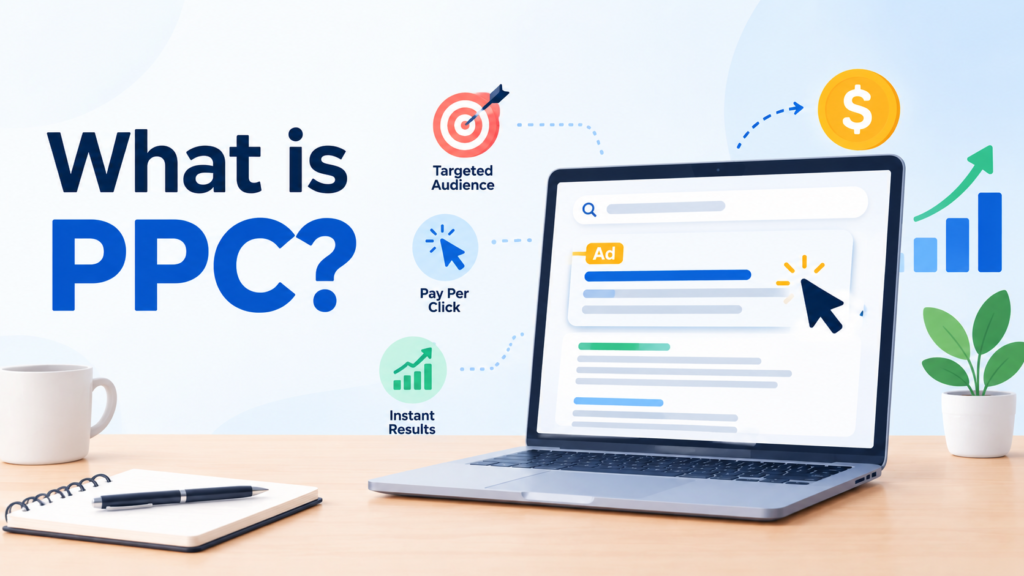
Google Ads is the most recognizable PPC platform, though social platforms and other search engines run comparable systems. In a PPC campaign, you can control:
- The exact keywords you want to bid on
- Your daily or monthly budget
- The geographic area and audience you want to target
- The ad copy, landing page, and offer shown to searchers
The biggest advantage of PPC is speed. As Google’s own advertising resources put it, a PPC ad lets you reach potential customers at the exact moment they’re searching for a business like yours; moreover, campaigns can be launched and adjusted almost instantly. That immediacy is why PPC is often the go-to channel for time-sensitive promotions, product launches, or businesses that need SEO lead generation results faster than organic growth allows.
How SEO and PPC Actually Differ
Although both SEO and PPC live inside the search engine results page, the mechanics behind them are almost opposites. Here’s a side-by-side look at the core differences.
Cost structure
- SEO: No direct cost per click; investment goes into content, tools, and expertise.
- PPC: You pay for every click, and costs scale directly with traffic volume.
Speed to results
- SEO: Typically takes weeks to months to show measurable ranking improvement.
- PPC: Can generate visibility and clicks within hours of launching a campaign.
Longevity
- SEO: Rankings can persist for months or years with ongoing maintenance.
- PPC: Traffic stops the moment you pause your budget.
Trust and click-through
- SEO: Many users trust organic results more because they aren’t labeled as ads.
- PPC: Ads are clearly marked, but they occupy prime real estate at the top of the page.
Targeting precision
- SEO: Optimizes for relevance to a topic or intent over time.
- PPC: Allows granular targeting by location, device, time of day, and audience segment.
This is essentially the same distinction that comparison guides on SEO versus PPC tend to highlight – one is an investment in owned visibility, the other is a rental of paid placement. Once you understand that framing, the decision of where to spend first becomes much easier to reason through.
Why SEO Matters for Long-Term Growth
SEO’s biggest strength is compounding value. A blog post or landing page that ranks well can keep bringing in traffic for years without additional spend, which is part of why so many businesses eventually treat it as a core growth channel rather than a one-off project. Strong technical foundations, such as a clean sitemap, also make it easier for search engines to discover and index new pages as your site grows.
That said, SEO isn’t free in the way people sometimes assume. It requires research, consistent content production, and technical maintenance. Businesses often wonder how much SEO services cost before committing, and the honest answer is that pricing varies widely depending on competition, industry, and the scope of work involved.
A few practical SEO tactics worth prioritizing:
- Publish content that directly matches search intent, not just keyword volume
- Build a logical internal linking structure between related pages
- Improve page speed and mobile usability
- Earn backlinks from credible, relevant sites
- Keep content updated as search behavior shifts
Why PPC Matters for Immediate Visibility
PPC exists to solve the problem SEO can’t: speed. If you’re launching a new product, running a seasonal promotion, or need organic traffic strategies for SaaS to be supplemented with something faster, PPC delivers immediate placement in front of people actively searching.
PPC also gives advertisers a level of control that SEO simply can’t match. You can pause a campaign instantly, reallocate budget between keywords, and test multiple ad variations in real time to see what converts best. This flexibility is especially valuable for businesses managing tight budgets or promotions with a fixed end date.
The tradeoff, of course, is that visibility disappears the moment spending stops. Unlike a well-ranked blog post, a paid ad doesn’t leave any lasting footprint in the search results once the campaign ends. That’s an important consideration when weighing whether SEO advertising or marketing is more valuable in terms of long-term strategic value.
Does PPC Help SEO Rankings?
This is one of the most common misconceptions in digital marketing, so it’s worth addressing directly: running paid ads does not improve your organic search rankings. Search engines are designed to keep their organic results as unbiased and relevant as possible, so a business can’t simply pay its way to a higher organic position. If that were possible, the credibility of search results would collapse for everyone.
That doesn’t mean SEO and PPC can’t support each other indirectly. PPC data – like which keywords convert best – can inform your SEO content strategy, and a strong PPC presence can reinforce brand recognition that indirectly boosts click-through rates on your organic listings too.
SEO vs. PPC: Which Should You Invest In First?
The honest answer is that it depends on your goals, timeline, and budget. Businesses that need traffic immediately, such as a new location launch or a seasonal sale, usually lean toward PPC first. Businesses playing a longer game, focused on sustainable brand visibility, usually prioritize SEO.
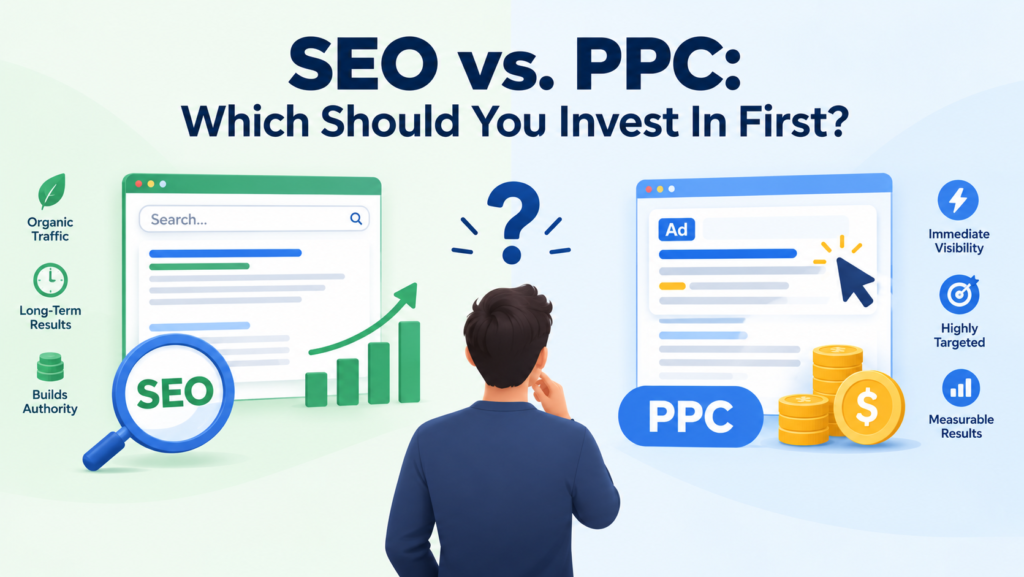
In practice, most established businesses run both channels simultaneously because they complement each other so well. PPC fills the visibility gap while your SEO efforts mature, and SEO eventually reduces your dependency on paid spend. This blended approach is echoed across most modern comparisons of SEO, PPC, and social media, which generally agree that small businesses see the strongest return when they diversify rather than commit entirely to one channel.
If you’re still narrowing down priorities, consider asking yourself:
- Do I need results this month, or can I invest in growth over the next year?
- What’s my available budget, and can it sustain ongoing PPC spend?
- Is my industry highly competitive in organic search?
- Do I have the content resources to support a long-term SEO strategy?
Answering these honestly will usually point you toward whether you need to hire an SEO company, start a PPC campaign, or begin building both channels in parallel.
Common Mistakes Businesses Make with SEO and PPC
Even experienced marketers fall into a few predictable traps when managing these channels:
- Treating SEO as a one-time project instead of an ongoing process that needs regular content and technical updates.
- Bidding on overly broad PPC keywords, which drains budget quickly without generating qualified leads.
- Ignoring landing page quality, which can tank PPC conversion rates even when ad targeting is strong.
- Skipping keyword research, leading to content and ads that don’t match real keywords important for SEO.
- Failing to track ROI separately for each channel, which makes it impossible to know where budget is actually working.
Avoiding these mistakes usually comes down to treating both channels with the same level of strategic rigor rather than launching campaigns reactively.
How SurgeAIO can help in terms of SEO
Balancing SEO and PPC well requires more than just picking one channel – it requires a strategy built around your specific market, competitors, and search behaviour. That’s exactly where SurgeAIO comes in. Our team helps businesses build sustainable organic visibility while making sure every piece of content is grounded in real content performance data rather than guesswork.
Whether you’re trying to figure out how many keywords to target per page, how to structure internal links, or how to make your site show up in AI-driven search results alongside traditional Google rankings, SurgeAIO builds a roadmap tailored to your goals. Ultimately, the businesses that grow fastest are the ones that treat SEO as an investment, not an expense, and pair it strategically with paid channels when speed matters most.
Frequently Asked Questions
Is SEO or PPC better for a new business?
It depends on urgency. PPC gets you visibility immediately, which is useful for a new business that needs leads right away. SEO takes longer but builds an asset that keeps generating traffic without ongoing ad spend.
Can I do SEO and PPC at the same time?
Yes, and many businesses do. Running both allows you to capture immediate traffic through ads while your organic rankings build in the background.
Does PPC spending improve my organic rankings?
No. Search engines keep paid and organic rankings separate specifically to preserve the credibility of organic results.
How much does PPC cost compared to SEO?
PPC costs scale directly with clicks and competition, so budgets can range widely by industry. SEO doesn’t have a per-click cost, but it does require ongoing investment in content, technical work, and expertise.
Which channel gives a better long-term ROI?
SEO generally delivers stronger long-term ROI because rankings can persist without continuous spend, while PPC traffic stops as soon as the budget does.
Do I need a big budget to start with SEO?
Not necessarily. SEO can start small with focused content and technical fixes, though results scale with the resources and consistency you put into it.
