B2B buyers don’t make quick decisions. They research, compare, and evaluate before they ever talk to sales. So if your business is not showing up during that research phase, you’re already losing ground to competitors.
A well-planned B2B SEO campaign does more than improve rankings. It builds trust, attracts qualified leads, and supports the full buyer journey – from awareness to conversion. However, many businesses approach it the wrong way and end up wasting time and budget.
In this guide, you’ll learn exactly how to create a winning B2B SEO campaign that drives real results.
What Makes B2B SEO Different?
B2B SEO is not the same as B2C. The stakes are higher, the sales cycles are longer, and there are multiple decision-makers involved in every purchase. Therefore, your strategy must reflect that complexity.
In B2B, buyers research problems before solutions. They read blog posts, compare vendors, download whitepapers, and read case studies – sometimes over weeks or months. Moreover, they rarely act on impulse. Your SEO strategy must reach them at every stage of this journey.
Here’s what makes B2B SEO unique:
- Longer sales cycles – Buyers need time to build internal consensus.
- Multiple stakeholders – Your content must speak to different roles (IT, finance, operations).
- Intent over volume – A low-volume keyword with strong buyer intent beats a high-traffic irrelevant one.
- Trust is everything – Decision-makers are putting their reputation on the line with every vendor choice.
Understanding these differences is the first step toward building a campaign that actually works.
Step 1: Define Your Goals and KPIs
Before you research keywords or write a single word of content, get clear on what success looks like. Vague goals lead to vague results.
Ask yourself: Are you trying to generate more qualified leads? Improve visibility in a new market? Reduce dependency on paid ads? Each goal requires a different approach.
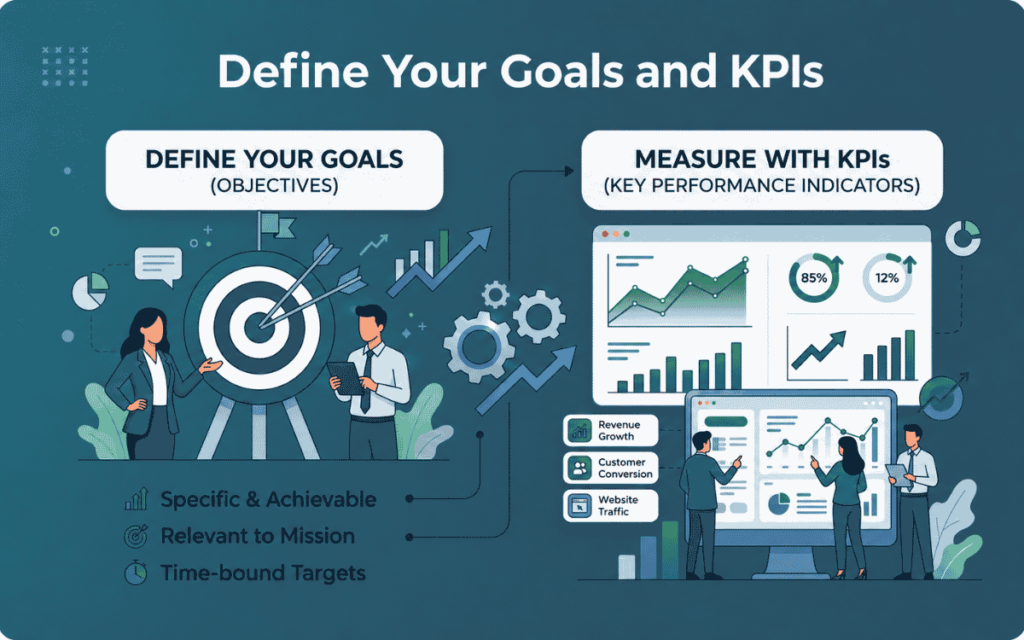
Once your goals are set, identify the KPIs that matter. For a B2B SEO campaign, focus on:
- Organic lead volume and quality
- Keyword rankings for buyer-intent terms
- Organic traffic to conversion pages
- Pipeline contribution from organic search
Vanity metrics like total traffic and page views can be misleading. Instead, track metrics that connect directly to revenue. This also helps you justify SEO investment to stakeholders.
Step 2: Know Your Audience and Competitors
Effective B2B SEO starts with a deep understanding of your buyers. Who are they? What problems are they trying to solve? How do they search for solutions?
Build a clear picture of your ideal customer profile (ICP). Map out the different stakeholders involved in the buying decision and identify what each one cares about. A CFO thinks about ROI. A technical lead thinks about integration. Your SEO content needs to speak to both.
Next, analyze your competitors through keyword research. Look at what keywords they rank for, which pages drive the most traffic, and where the content gaps are. This research reveals opportunities you can act on quickly.
Competitive analysis also helps you understand the level of effort needed. If your top competitors have strong domain authority and hundreds of backlinks, you’ll need a longer-term strategy to outrank them.
Step 3: Build a Keyword Strategy Around Buyer Intent
Keyword research is the engine of your B2B SEO campaign. However, it’s not about finding the keywords with the highest search volume. It’s about finding keywords that match what your buyers are actually searching for.
Focus on intent-driven keywords at every stage of the funnel:
- Awareness stage – “What is [problem]?” or “How to fix [pain point]”
- Consideration stage – “Best [solution] for [industry]” or “[Product A] vs [Product B]”
- Decision stage – “[Company name] pricing” or “hire [service type] agency”
Understanding how many SEO keywords per page to target helps keep each page focused. Generally, one primary keyword per page with supporting related terms works best.
Also, don’t ignore long-tail keywords. In B2B, there’s often low competition and high intent. A phrase like “enterprise inventory management software for distributors” may have lower volume, but the person searching for it is much closer to buying.
Step 4: Create Content That Matches Every Funnel Stage
Content is the core of your B2B SEO campaign. But random blog posts won’t cut it. You need a structured content plan that covers every stage of the buyer journey.
Think of your content in three layers:
Top of Funnel (Awareness): Educational blog posts, guides, and explainers that answer broad questions. These attract buyers who are just beginning their research.
Middle of Funnel (Consideration): Comparison guides, use cases, and industry-specific content that help buyers evaluate options.
Bottom of Funnel (Decision): Case studies, testimonials, ROI calculators, and product-specific pages that push buyers toward action.
Organic traffic strategies for SaaS and B2B brands both emphasize that full-funnel content coverage is what separates campaigns that generate leads from those that only generate traffic.
Additionally, knowing how many words a blog post should be for SEO matters. Aim for depth over length – cover the topic thoroughly, but don’t pad for the sake of word count.
Step 5: Organize Content Around Topic Clusters
Topic clusters are one of the most effective structures for B2B SEO. Instead of publishing isolated blog posts, you build interconnected content hubs around your core topics.
Here’s how it works:
- Create a pillar page that covers a broad topic in depth (e.g., “B2B Digital Marketing”).
- Build cluster content – supporting articles that dive into specific subtopics.
- Internally link all cluster content back to the pillar page and to each other.
This structure signals topical authority to search engines. It also helps users find more of your content, which keeps them on your site longer and moves them further down the funnel.
Internal linking is a critical part of this model. Strategic links guide both users and crawlers through your site, distributing authority and context to your most important pages.
Step 6: Optimize On-Page SEO Across All Key Pages
Even great content won’t rank without proper on-page optimization. Each page of your site should be set up to clearly tell search engines what it’s about.
Key on-page elements to optimize include:
- Title tags – Include your primary keyword and keep them under 60 characters.
- Meta descriptions – Write compelling summaries under 155 characters.
- Header structure – Use H1 for your main topic, H2s for subtopics, and H3s for details.
- URL structure – Keep URLs short, descriptive, and keyword-aligned.
- Internal links – Connect related pages with descriptive anchor text.
- Image alt text – Describe images clearly for accessibility and SEO.
Avoid keyword stuffing. Search engines today reward relevance and readability. Write for your reader first, then optimize for the algorithm. Moreover, using the best content optimization tools for SEO can help you fine-tune on-page elements without guesswork.
Step 7: Fix Technical SEO and Site Performance
Your content and on-page optimization mean nothing if search engines can’t crawl and index your site properly. Technical SEO is the foundation on which everything else builds.
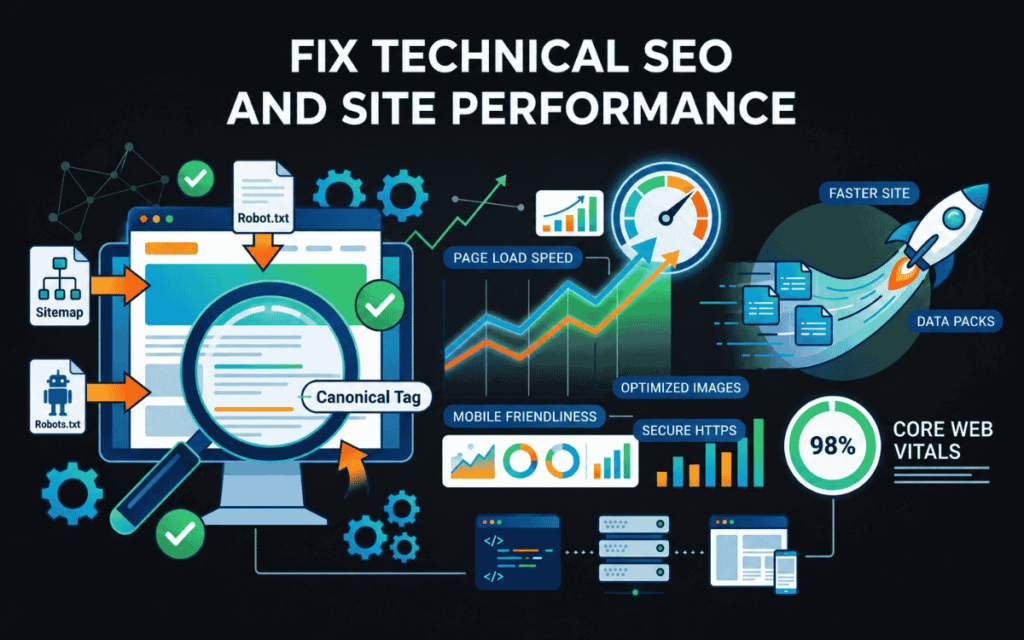
Start with a full technical audit. Identify and fix:
- Broken links and 404 errors
- Slow page load times and Core Web Vitals issues
- Mobile usability problems
- Missing or incorrect XML sitemaps
- Duplicate content and thin pages
- Crawl errors in Google Search Console
Understanding how important a sitemap is for SEO is often underestimated. A properly structured sitemap helps search engines discover and index your content faster – especially on large B2B websites with many pages.
Site speed is also critical. If your pages load slowly, users bounce, and rankings drop. Prioritize Core Web Vitals, compress images, and use caching where possible.
Step 8: Build Authority With Link Building
Backlinks remain one of the strongest ranking signals in SEO. However, not all links are equal. In B2B, quality far outweighs quantity.
Focus on earning links from authoritative, industry-relevant sources. Effective B2B link-building tactics include:
- Writing guest posts for reputable industry publications
- Creating original research or data reports that others want to reference
- Getting listed in industry directories and resource pages
- Building digital PR campaigns around newsworthy stories
- Earning citations through thought leadership and expert commentary
Reputable backlink companies for SEO can help scale your link-building efforts – but vet them carefully. Low-quality links from spammy sources can damage your site’s authority rather than build it.
Also, track how many backlinks you need for your target keywords. In competitive B2B niches, the link gap between you and competitors is often the key factor determining how quickly you rank.
Step 9: Measure, Track, and Continuously Improve
SEO is not a one-time project. It’s an ongoing campaign that requires regular monitoring and optimization. Therefore, set up proper tracking from day one.
Use a combination of tools to measure performance:
- Google Analytics – Track organic traffic, conversions, and user behavior.
- Google Search Console – Monitor rankings, indexing, and technical issues.
- CRM integration – Connect organic leads to actual revenue in your pipeline.
Review performance monthly. Identify which pages are driving leads and which are underperforming. Update old content, improve weak pages, and build on what’s working.
Content performance data is invaluable here. It tells you which topics resonate with your audience and which need rethinking. Over time, this feedback loop compounds – making your campaign smarter and more efficient with every cycle.
Common B2B SEO Mistakes to Avoid
Even experienced marketers fall into traps that limit campaign performance. Here are the most common ones to watch for:
- Targeting high-volume keywords with no buyer intent – Traffic without intent doesn’t convert.
- Ignoring the middle and bottom of the funnel – Most B2B content only addresses awareness, leaving buyers without the decision-stage info they need.
- Neglecting technical SEO – A beautifully written blog post won’t rank on a slow, broken website.
- No sales-marketing alignment – Your SEO content should reflect what your sales team hears from prospects every day.
- Measuring rankings without measuring revenue – Rank #1 for a keyword that never generates leads, and you’ve achieved nothing.
Avoiding these pitfalls can be just as impactful as the strategies you implement. B2B SEO requires discipline, patience, and consistent execution.
How SurgeAIO Can Help in Terms of SEO
Building and executing a winning B2B SEO campaign takes expertise, tools, and time. SurgeAIO brings all three together in one platform designed specifically for businesses that want measurable organic growth.
SurgeAIO helps you:
- Research intent-driven keywords that match your buyers at every funnel stage
- Audit your technical SEO and identify the issues holding your rankings back
- Build a content strategy aligned with your buyer journey and business goals
- Track AI visibility and rankings across traditional search and AI-driven platforms
- Monitor content performance with actionable data to refine your campaign over time
Whether you’re building a B2B SEO campaign from scratch or optimizing an existing one, SurgeAIO gives you the visibility and control you need to outrank competitors and turn organic search into a reliable lead-generation channel.
Frequently Asked Questions
Q: How long does a B2B SEO campaign take to show results?
B2B SEO typically takes 3-6 months to show meaningful results, and 6–12 months for significant organic lead growth. The timeline depends on your domain authority, competition level, and how consistently you execute.
Q: What’s the difference between B2B and B2C SEO?
B2B SEO targets professional decision-makers with longer buying cycles and multiple stakeholders. B2C focuses on individual consumers with faster, more emotional purchase decisions. B2B SEO prioritizes intent and trust over volume.
Q: How many keywords should a B2B website target?
There’s no fixed number. Focus on one primary keyword per page, with a cluster of related supporting terms. A typical B2B site might target dozens of pillar topics and hundreds of long-tail variations across all its content.
Q: Is content marketing the same as B2B SEO?
They overlap heavily but are not the same. Content marketing is about creating valuable content to attract and nurture buyers. SEO ensures that content is found through search. An effective B2B campaign combines both – content built for humans and optimized for search engines.
Q: Do I need to hire an SEO agency for B2B SEO?
It depends on your internal resources and expertise. Many businesses start in-house and bring in an agency when they need to scale. An experienced B2B SEO agency can accelerate results and avoid costly mistakes. Weigh the costs and capabilities before deciding.
Q: What is the most important element of a B2B SEO campaign?
Buyer intent. Every decision – keywords, content topics, page structure, link building – should connect back to what your buyers are actually searching for and what problems they’re trying to solve. Intent is the compass of a winning campaign.
