Affiliate marketing and SEO are two of the most powerful strategies in digital marketing. On their own, each delivers results. Together, they create a compounding growth engine that drives consistent, long-term revenue without heavy ad spend.
However, most affiliate marketers treat SEO as an afterthought. They build websites, stuff in affiliate links, and wonder why Google never rewards them with traffic. The truth is, learning how to do SEO for affiliate marketing requires a deliberate and structured approach – from niche selection to content strategy to technical optimization.
This guide walks you through every key step so you can build an affiliate site that both search engines and readers trust.
What Is SEO for Affiliate Marketing?
SEO for affiliate marketing is the process of optimizing your affiliate website and content so it ranks higher in search engine results pages (SERPs). The goal is to attract organic traffic from people who are actively searching for products, reviews, or comparisons – and then guide them toward affiliate offers through your content.
Unlike paid advertising, SEO-driven affiliate traffic is free, sustainable, and compounds over time. Moreover, visitors who find you through organic search tend to have stronger purchase intent, which translates into higher conversion rates.
Understanding what is SEO lead generation is a great starting point, because affiliate marketing is essentially a lead and conversion funnel built on organic search visibility.
Step 1 – Choose a Profitable and Focused Niche
Every successful affiliate SEO strategy starts with niche selection. A niche that is too broad makes it nearly impossible to rank against established authority sites. A niche that is too narrow limits your earning potential.

The ideal niche has three characteristics:
- Commercial intent: People in this niche actively research and buy products online.
- Keyword opportunities: There are low-to-medium competition keywords you can realistically rank for.
- Affiliate programs available: Reputable programs exist with decent commission rates.
For example, instead of targeting “fitness,” focus on “home gym equipment for small apartments.” This specific angle allows you to create highly targeted content that ranks faster and converts better.
In addition, consider your own expertise. Writing authoritatively about a topic you understand builds credibility with readers and signals expertise to Google – a key ranking factor today.
Step 2 – Conduct Thorough Keyword Research
Keyword research is the backbone of SEO for affiliate marketing. Without it, you are writing content with no clear path to ranking.
Focus on three types of keywords:
Informational keywords: These attract readers early in the buying cycle. Examples include “how to choose a standing desk” or “benefits of a mechanical keyboard.” These build topical authority.
Comparison keywords: These target buyers are in the middle of their decision process. Examples include “X vs Y,” “best [product category] for [use case],” or “alternatives to [brand].”
Transactional keywords: These target people ready to buy. Examples include “best [product] under $100,” “buy [product] online,” or “[product] review.”
The smartest affiliate SEO strategies target all three keyword types. This creates a content funnel that captures readers at every stage of the buyer journey. Building a strong keyword gap strategy helps you identify what your competitors rank for that you currently miss.
Step 3 – Build Topical Authority with a Content Cluster Strategy
Google increasingly rewards websites that demonstrate deep expertise in a specific topic area. A single blog post rarely ranks for competitive affiliate keywords anymore. You need a network of related content – commonly called a content cluster.
Here is how to build one:
- Create a pillar page: This is a comprehensive, long-form guide on your main topic (e.g., “The Ultimate Guide to Home Office Desks”).
- Build cluster content: Write supporting articles that cover subtopics in detail (e.g., “Best Standing Desks Under $300,” “How to Set Up an Ergonomic Desk,” “Standing Desk vs Sitting Desk”).
- Internal link everything together: Link cluster articles back to the pillar page, and link the pillar page to relevant cluster articles.
This structure tells Google that your site covers the topic comprehensively, which boosts the authority of all pages in the cluster. Understanding how important a sitemap is for SEO is equally critical, as it ensures Google crawls and indexes every page in your cluster correctly.
Step 4 – Optimize Every Affiliate Page for On-Page SEO
Writing great content is not enough. Every page needs proper on-page SEO to compete in search results.
Follow this checklist for each affiliate page:
- Title tag: Include the primary keyword near the beginning. Keep it under 60 characters.
- Meta description: Write a compelling 150-160 character summary. Include the keyword and a clear benefit statement.
- H1 heading: Use your primary keyword in the H1 tag naturally.
- Subheadings (H2, H3): Use secondary keywords and related phrases in subheadings throughout the content.
- First paragraph: Mention the primary keyword within the first 100 words.
- Image alt text: Describe images using relevant keyword phrases.
- URL structure: Keep URLs short, descriptive, and keyword-rich (e.g., /best-standing-desks/).
- Content length: Comprehensive affiliate review pages typically need 1,500–3,000 words to outrank competitors.
Moreover, write for your reader first and search engines second. Pages that satisfy search intent always outperform pages written purely for keyword density. Knowing how many SEO keywords per page actually work will prevent you from over-optimizing and triggering Google penalties.
Step 5 – Handle Affiliate Links the Right Way
This is where many affiliate marketers unknowingly damage their SEO. Affiliate links need to be managed carefully to stay compliant with Google’s guidelines.
Always use nofollow or sponsored attributes:
Google requires that affiliate links carry a rel=”sponsored” or rel=”nofollow” attribute. This tells Google not to pass PageRank through the link. Failing to do this can be interpreted as a paid link scheme, which can result in ranking penalties.
Use link cloaking thoughtfully:
Link cloaking replaces long, ugly affiliate URLs with clean, branded links (e.g., yoursite.com/go/product-name). This improves user trust and click-through rates. However, ensure the destination URL is not hidden from crawlers in a deceptive way.
Do not overload pages with affiliate links:
Too many affiliate links signals to Google that a page exists purely to monetize, not to inform. Aim for a balanced ratio – typically no more than 2–4 affiliate links per 1,000 words of content.
Disclose affiliate relationships:
Google and the FTC both require clear disclosure when you earn commissions from links. Add a brief disclosure at the top of every affiliate page. This builds user trust and keeps you legally compliant.
Step 6 – Build Backlinks to Your Affiliate Site
Backlinks remain one of Google’s most important ranking signals. However, building links to an affiliate site requires a thoughtful strategy because Google scrutinizes affiliate sites more closely than informational websites.
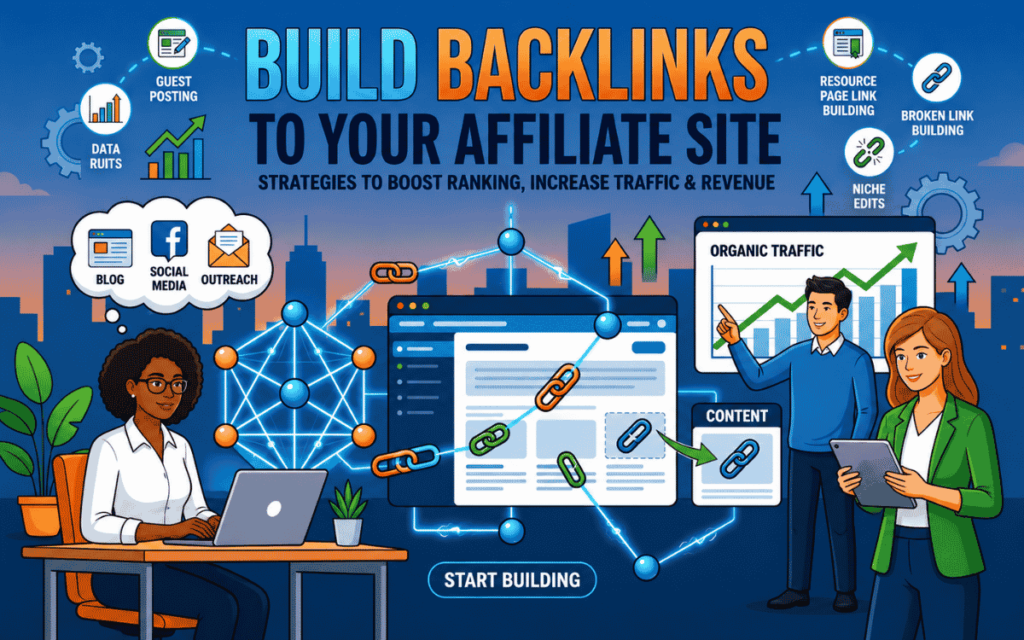
Effective link-building tactics for affiliate marketers include:
- Digital PR: Publish original research, surveys, or data studies that journalists and bloggers want to reference. These earn editorial backlinks naturally.
- Guest posting: Write valuable guest articles for relevant industry blogs. Include a contextual link back to your pillar content.
- Resource page link building: Find resource pages in your niche and pitch your best content as a useful addition.
- HARO (Help a Reporter Out): Respond to journalist queries as an expert source. Successful responses often earn high-authority backlinks from news sites.
- Broken link building: Find broken links on relevant sites and suggest your content as a replacement.
Understanding how many backlinks you need to outrank competitors in your niche helps you set realistic targets and allocate your link-building efforts efficiently.
Step 7 – Focus on Technical SEO
Technical SEO ensures that search engines can crawl, index, and rank your affiliate site without obstacles. Even the best content will not rank if your technical foundation is broken.
Key technical SEO priorities for affiliate sites:
- Site speed: Google uses page speed as a ranking factor. Compress images, use a fast hosting provider, and enable caching. Slow sites lose both rankings and conversions.
- Mobile-friendliness: Most affiliate traffic now comes from mobile devices. Your site must render perfectly on all screen sizes.
- HTTPS: A secure site (SSL certificate) is a basic requirement. Google flags non-HTTPS sites as insecure.
- Core Web Vitals: Google measures Largest Contentful Paint (LCP), Cumulative Layout Shift (CLS), and Interaction to Next Paint (INP). All three must be within acceptable thresholds.
- Crawlability: Ensure your robots.txt file is not accidentally blocking important pages. Verify your sitemap is submitted to Google Search Console.
- Canonical tags: If you have similar product comparison pages, use canonical tags to prevent duplicate content issues.
Step 8 – Create Content That Satisfies Search Intent
Search intent is the reason behind a user’s query. Google’s algorithm is extremely effective at detecting whether your content actually answers what the searcher wants. If your content misses intent, it will not rank regardless of keyword optimization.
There are four main types of search intent:
- Informational: The user wants to learn something. (“How does affiliate marketing work?”)
- Navigational: The user is looking for a specific site or page. (“Amazon affiliate login”)
- Commercial: The user is researching before buying. (“Best noise-cancelling headphones 2026”)
- Transactional: The user is ready to purchase. (“Buy Sony WH-1000XM5 cheap”)
For affiliate marketing, commercial and transactional intent pages are where you earn commissions. However, building informational content around your niche first establishes trust and topical authority – making your commercial pages rank faster.
Exploring organic traffic strategies for SaaS offers useful parallels, since the content funnel principles apply directly to affiliate content strategy.
Step 9 – Track, Analyze, and Improve Continuously
SEO for affiliate marketing is not a set-and-forget activity. You must monitor performance regularly and make data-driven improvements.
Track these metrics consistently:
- Organic traffic: Use Google Analytics 4 to monitor traffic trends by page and keyword group.
- Keyword rankings: Track your target keywords weekly using a rank-tracking tool.
- Affiliate conversions: Measure which pages and which keywords drive the most clicks and commissions.
- Bounce rate and time on page: Low engagement signals indicate content that is not meeting user expectations.
- Backlink growth: Monitor new and lost backlinks monthly to maintain a healthy link profile.
Use content performance data to identify which affiliate pages are underperforming and prioritize them for updates. Refreshing outdated content with new information, better structure, and additional keywords consistently recovers lost rankings.
How SurgeAIO Can Help in Terms of SEO
Executing a full SEO strategy for affiliate marketing while also managing content production and link building is demanding. SurgeAIO simplifies every layer of this process.
SurgeAIO gives affiliate marketers access to powerful SEO tools that cover keyword research, competitive analysis, content optimization, and performance tracking – all in one platform.
Here is how SurgeAIO supports your affiliate SEO efforts:
- Keyword intelligence: Identify high-opportunity, low-competition keywords that match buyer intent in your niche.
- Competitive gap analysis: Discover what competing affiliate sites rank for and find the content gaps you can fill.
- On-page optimization guidance: Get actionable recommendations to improve every affiliate page before and after publishing.
- AI-powered insights: Leverage AI features to identify trends, optimize for featured snippets, and improve overall topical authority.
- Rank tracking: Monitor keyword positions over time and get alerts when rankings change.
Whether you are launching a new affiliate site or scaling an existing one, SurgeAIO helps you make smarter decisions faster. If you are wondering whether you need an SEO company to handle your affiliate strategy, SurgeAIO gives you the tools to manage much of it in-house with professional-grade data.
Common Mistakes to Avoid in Affiliate SEO
Even experienced affiliate marketers repeat these costly errors:
- Targeting keywords that are too competitive – Starting with low-competition, long-tail keywords builds momentum faster.
- Publishing thin content – Pages with fewer than 800 words rarely rank for competitive affiliate terms.
- Ignoring E-E-A-T – Google rewards Experience, Expertise, Authoritativeness, and Trustworthiness. Build author profiles and cite credible sources.
- Not disclosing affiliate links – Failing to disclose is both an FTC violation and a trust killer with readers.
- Over-optimizing anchor text – Using the same exact-match anchor text repeatedly triggers spam signals.
- Skipping technical audits – Crawl errors, slow pages, and broken links silently drain rankings over time.
Final Thoughts
Learning how to do SEO for affiliate marketing is a long-term investment that pays compounding dividends. The marketers who win are those who treat their affiliate sites like real media businesses – publishing authoritative content, building genuine backlinks, and continuously improving based on data.
Start with a focused niche, conduct thorough keyword research, build content clusters, and optimize every page for both search engines and readers. Above all, prioritize trust – with Google and with your audience.
The foundation you build today will drive affiliate revenue for years to come.
Frequently Asked Questions
Q1: Does SEO work well for affiliate marketing?
Yes. SEO is one of the most cost-effective traffic sources for affiliate marketing. Organic traffic compounds over time, requires no ongoing ad spend, and tends to attract visitors with strong purchase intent. However, it requires consistent effort and patience – results typically take 3–9 months to materialize.
Q2: How long does SEO take to show results for an affiliate site?
For new affiliate sites, expect 4-6 months before seeing meaningful organic traffic. Sites with existing authority can see results faster. Publishing high-quality content consistently and building backlinks accelerates the timeline.
Q3: Can I use affiliate links without hurting my SEO?
Yes, as long as you follow Google’s guidelines. Always use the rel=”sponsored” or rel=”nofollow” attribute on affiliate links. Avoid overloading pages with links and ensure the content genuinely helps readers rather than just pushing products.
Q4: How many affiliate links should I include per page?
There is no fixed rule, but 2-4 affiliate links per 1,000 words is a reasonable benchmark. What matters most is that every affiliate link is relevant and adds value to the reader’s experience. Excess links dilute trust and signal low-quality content to search engines.
Q5: Should I build a niche site or a general affiliate site?
Niche sites almost always outperform general affiliate sites in SEO. Focusing on one topic area allows you to build topical authority faster, rank for competitive keywords more easily, and attract a more targeted audience with higher conversion rates.
Q6: What type of content ranks best for affiliate marketing?
Product reviews, comparison articles (“X vs Y”), best-of roundups, and buyer’s guides consistently perform well in affiliate SEO. These formats match commercial and transactional search intent, where visitors are close to making a purchase decision.
Q7: Is it better to use a blog or a dedicated product review site for affiliate SEO?
Both can work. A blog with a strong informational content strategy can build authority and then convert readers through targeted review and comparison pages. A dedicated review site builds commercial intent from day one, but may take longer to earn Google’s trust without informational content supporting it.
