
If you’ve spent any time researching SEO metrics, you’ve likely come across the terms PA and DA. These two metrics, Page Authority and Domain Authority, help marketers gauge how likely a webpage or website is to rank well in search results. Understanding what PA and DA in SEO gives you a practical way to benchmark your site against competitors and track progress over time.
This guide explains both metrics in detail, how they’re calculated, why they matter, and how to actually improve them.
What Is Domain Authority (DA)?
Domain Authority is a metric developed by Moz that predicts how likely an entire website is to rank in search engine results pages. DA scores range from 1 to 100, and higher scores indicate stronger ranking potential across the whole domain.
DA looks at your website as a whole rather than any single page. It factors in elements like:
- The total number of linking root domains pointing to your site
- The overall quality and trustworthiness of those backlinks
- The age and history of your domain
- The general health and quality of your content
Because DA reflects the entire domain, it changes gradually. A single blog post won’t move your Domain Authority much, but sustained link-building and content efforts will.
What Is Page Authority (PA)?
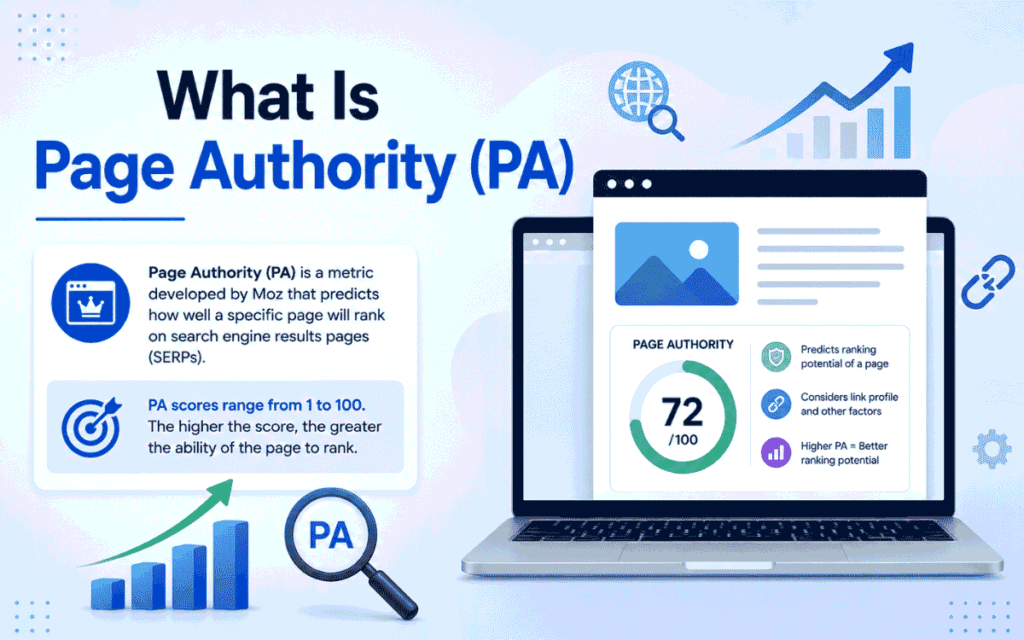
Page Authority is also a Moz-developed metric, but it predicts how likely a single, specific page is to rank rather than the whole site. Like DA, PA is scored from 1 to 100, with higher numbers signalling stronger ranking potential for that individual URL.
PA is influenced by:
- The number and quality of backlinks pointing directly to that page
- The relevance and quality of the content on that page
- Internal linking that directs authority toward the page
- Social signals and engagement tied to that specific content
This means a single article can rank well even if the rest of the website has a lower overall Domain Authority. Strong, well-linked content on one page can outperform pages on sites with a higher DA overall.
PA vs. DA: Key Differences
Since both metrics look similar on the surface, it helps to break down exactly where they diverge.
| Aspect | Domain Authority (DA) | Page Authority (PA) |
| Scope | Entire website | One specific page |
| Purpose | Predicts overall site ranking strength | Predicts individual page ranking strength |
| Main influence | Sitewide backlink profile and domain age | Page-level backlinks and content quality |
| Application | Comparing websites or evaluating link sources | Auditing and improving a single page |
In short, DA tells you how trustworthy your website is as a whole, while PA tells you how competitive one particular page is. Both scores use the same 1-100 scale, and higher numbers always indicate stronger authority.
Why Do PA and DA Matter for SEO?
Neither metric is an official Google ranking factor. Google has never confirmed using Moz’s DA or PA scores directly. Still, both metrics matter for practical reasons.
- Benchmarking competitors: PA and DA let you quickly compare your site’s authority against competing websites in your niche
- Evaluating link opportunities: When pursuing backlinks, checking a site’s DA helps you judge whether that link is worth pursuing
- Tracking progress: Watching your DA and PA scores rise over time gives you a tangible way to measure your SEO efforts
- Prioritizing pages: Low PA on an important page can signal it needs more internal links, better content, or additional backlinks
Because these scores correlate loosely with ranking potential, they remain a useful diagnostic tool even though they aren’t a direct Google ranking signal. This is why many SEO teams track them alongside other content performance data when evaluating a page’s overall health.
How Are PA and DA Calculated?
Moz calculates both scores using a machine-learning model that considers dozens of factors. While the exact algorithm isn’t public, the key inputs generally include:
- Linking root domains: The number of unique websites linking to your domain or page
- Total backlinks: The overall volume of links, though quality typically outweighs quantity
- Link quality: Links from authoritative, trustworthy sites carry more weight than links from low-quality or spammy sites
- Content relevance: Well-optimized, topically relevant content tends to score higher
It’s worth noting that Moz periodically updates its algorithm, so scores can shift even without any changes to your website. This is normal and doesn’t necessarily reflect a drop in actual ranking ability.
Common Misconceptions About PA and DA
A few misunderstandings about these metrics persist across the SEO community. Clearing them up helps you use PA and DA more accurately.
1. A High DA Guarantees High Rankings
DA is a predictive metric, not a guarantee. A site with a high DA can still fail to rank for a competitive keyword if the content is thin, outdated, or poorly targeted. Meanwhile, a site with moderate DA can outrank bigger competitors with sharper, more relevant content.
2. PA and DA Are Official Google Metrics
Google does not use Moz’s PA or DA scores in its ranking algorithm. These are third-party estimates designed to approximate ranking potential, not confirmed Google signals.
3. Every SEO Tool Calculates DA the Same Way
Different platforms use different proprietary formulas. Ahrefs has its own Domain Rating, and Semrush has its own Authority Score. These numbers aren’t directly comparable to Moz’s DA, even though they measure similar concepts.
How to Improve Your PA and DA Scores
Improving these metrics takes sustained effort rather than quick fixes. Here are the most effective strategies.
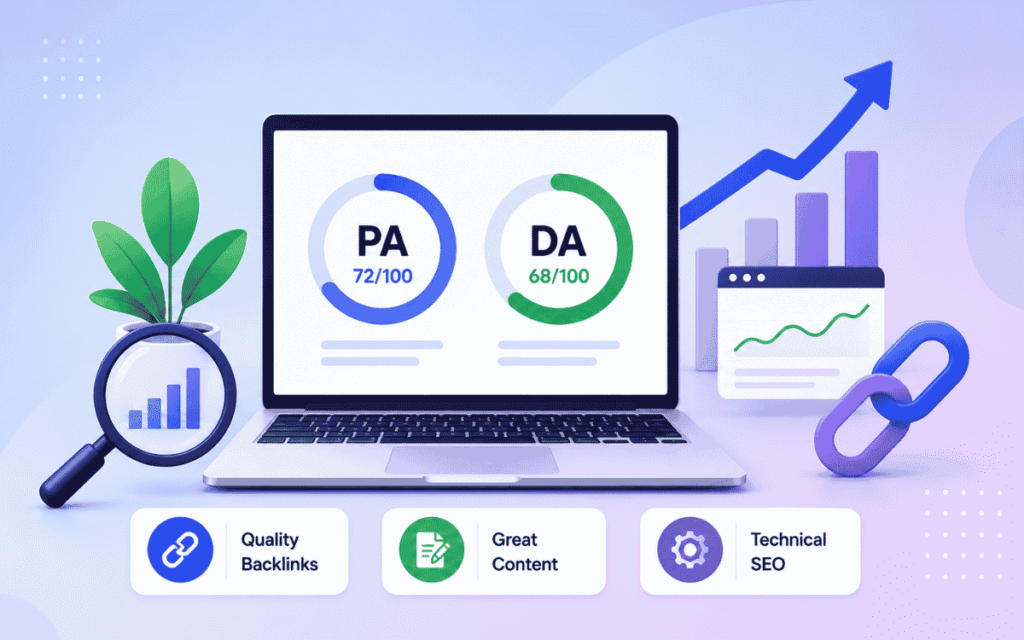
1. Build High-Quality Backlinks
Since backlinks heavily influence both scores, earning links from authoritative, relevant websites is one of the most effective strategies. Rather than chasing volume, focus on relevance and trustworthiness. If you’re unsure how many links your site actually needs, reviewing benchmark data on backlink requirements for your industry can help set realistic goals. Partnering with a reputablebacklink-building service can also accelerate this process safely.
2. Strengthen Internal Linking
Internal links distribute authority across your website. Linking from high-authority pages to newer or weaker pages helps spread ranking strength throughout your site, gradually improving PA on individual pages.
3. Publish Consistently Strong Content
Both DA and PA reward websites that consistently produce valuable, well-researched content. Thin or duplicate content drags down authority signals over time, while thorough, well-structured articles tend to attract more natural backlinks.
4. Target the Right Keywords
Choosing keywords that align with your site’s authority level and audience intent supports stronger content performance. Reviewing why certain keywords matter for SEO helps you prioritize terms that realistically match your current ranking potential.
5. Conduct Competitive Analysis
Comparing your PA and DA against competitors reveals gaps in your strategy. A thorough competitive keyword analysis can highlight which competitors are outranking you and why, giving you a roadmap for closing the gap.
6. Maintain Technical SEO Health
A well-structured, crawlable website supports both metrics indirectly. Ensuring search engines can properly index your pages, partly through a properly maintained sitemap, helps your content get discovered and linked to more easily.
How Long Does It Take to Improve PA and DA?
Authority metrics build gradually rather than overnight. Most websites see measurable movement over several months of consistent effort. Just as SEO results generally take time to materialize, PA and DA improvements follow a similar timeline. Expect incremental gains rather than sudden jumps, especially for competitive niches.
Additionally, whether your traffic comes from organic or paid channels, your authority metrics are influenced primarily by organic backlink growth and content quality, not paid campaigns.
PA and DA vs. Other Authority Metrics
Moz isn’t the only company measuring website authority. It’s useful to know how PA and DA relate to alternatives:
- Ahrefs Domain Rating (DR): Focuses primarily on backlink profile strength
- Semrush Authority Score: Combines backlink data, organic traffic estimates, and spam signals
- Majestic Trust Flow and Citation Flow: Separates link quality from link quantity
None of these tools measures the same thing, so it’s best to pick one platform and track your progress consistently rather than comparing scores across different tools.
How SurgeAIO can help in terms of SEO
Improving PA and DA requires a coordinated strategy across content, backlinks, and technical SEO, which can be difficult to manage without dedicated expertise. SurgeAIO helps businesses build sustainable authority through targeted link-building, competitive analysis, and content strategies designed to strengthen both page-level and domain-level trust. Whether you’re evaluating your current SEO service costs or planning a long-term authority-building roadmap, SurgeAIO provides the strategy and execution needed to move your PA and DA scores in the right direction.
Final Thoughts
Understanding what PA and DA in SEO give you provides a practical lens for evaluating your website’s competitive standing. While neither metric is a confirmed Google ranking factor, both offer valuable insight into your site’s authority, backlink profile, and content strength. By focusing on quality backlinks, strong internal linking, and consistent content creation, you can steadily improve both scores and strengthen your site’s overall search visibility.
FAQ
What is PA and DA in SEO?
PA (Page Authority) and DA (Domain Authority) are Moz-developed metrics that predict how likely a page or website is to rank in search results, scored from 1 to 100.
Is a higher DA always better?
Generally yes, but DA is comparative. It’s most useful when benchmarked against competitors in your specific niche rather than viewed as an absolute number.
Can a page have high PA even if the site has low DA?
Yes. A single well-optimized, well-linked page can achieve strong Page Authority independent of the overall Domain Authority.
Does Google use DA and PA as ranking factors?
No. These are third-party metrics from Moz. Google has never confirmed using them directly in its ranking algorithm.
How often do PA and DA scores update?
Moz updates its scoring model periodically, meaning your numbers can shift even without changes to your own website.
What’s the fastest way to improve DA?
Consistently earning backlinks from authoritative, relevant websites while publishing high-quality content tends to produce the most reliable improvement.
