If you’ve ever asked what the difference between onsite and offsite SEO is, you’re really asking about the two halves of every successful search strategy. Onsite SEO covers everything you control directly on your website – content, structure, and technical setup. Offsite SEO covers everything that happens outside your website – backlinks, mentions, and reputation signals. Neither works particularly well alone, and understanding how they fit together is essential before you invest serious time or budget into either one.
This guide breaks down what the difference is between onsite and offsite SEO, why both matter, and how to decide where to focus your energy first.
What is Onsite SEO?
Onsite SEO, sometimes called on-page SEO, refers to every optimization you make directly on your website to help it rank better and serve visitors more effectively. Because you own and control these elements, onsite SEO is usually the first place businesses start.
Core onsite SEO elements include:
- Content quality: Clear, relevant content that directly answers what a searcher is looking for
- Keyword placement: Naturally including your target terms in titles, headings, and body copy
- Site structure: A logical hierarchy of pages that’s easy to navigate
- Internal linking: Connecting related pages so users and search engines can discover more of your content
- Technical performance: Page speed, mobile responsiveness, and clean HTML
- Meta elements: Title tags and meta descriptions that accurately summarize each page
Because these elements are entirely within your control, improvements here tend to show impact faster than off-site work. If you’re wondering how many SEO keywords per page you should realistically target, that’s a core onsite SEO decision that affects both relevance and readability.
What is Offsite SEO?
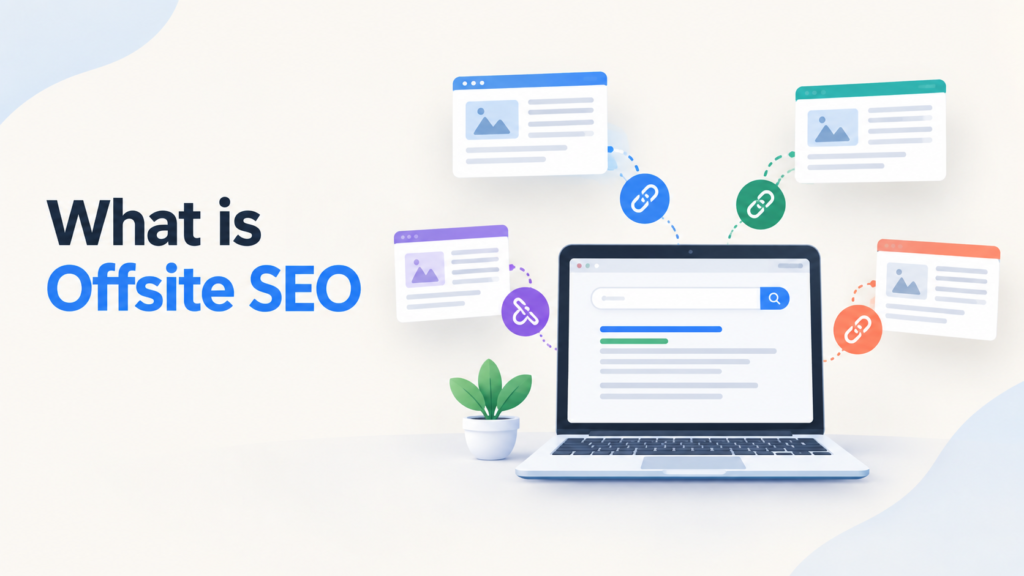
Offsite SEO, also known as off-page SEO, refers to actions taken outside your own website that build trust, authority, and credibility in the eyes of search engines. The most common offsite tactic is link building – earning backlinks from other reputable websites that point back to your content.
Offsite SEO typically includes:
- Backlinks: Links from other websites that vouch for your content’s credibility
- Brand mentions: References to your business across the web, even without a direct link
- Social signals: Shares and engagement that indicate content resonates with real audiences
- Guest content: Contributing articles to industry publications that link back to your site
- Digital PR: Press coverage and outreach that builds broader visibility
Offsite SEO generally takes longer to show results because it depends on relationships, outreach, and content that other sites actually want to link to. Businesses often ask how many backlinks do I need to see meaningful ranking improvement, and the honest answer is that quality and relevance matter far more than raw volume.
Onsite vs. Offsite SEO: The Core Differences
While both strategies aim to improve search visibility, they operate through very different mechanisms. Here’s how they compare directly.
Control
- Onsite: Fully within your control – you decide the content, structure, and technical setup.
- Offsite: Largely outside your control – you can influence it through outreach, but you can’t force other sites to link to you.
Speed of impact
- Onsite: Changes can influence rankings relatively quickly, especially technical fixes.
- Offsite: Authority-building is slower and compounds gradually over time.
Primary goal
- Onsite: Relevance – proving your page directly answers the search query.
- Offsite: Trust and authority – proving other credible sources vouch for you.
Common tactics
- Onsite: Keyword optimization, internal linking, page speed, content structure.
- Offsite: Backlink building, guest posting, digital PR, brand mentions.
Measurement
- Onsite: Site audits, keyword rankings, page-level engagement metrics.
- Offsite: Domain authority, referring domains, backlink quality.
This distinction lines up closely with how leading SEO resources define the two categories – onsite SEO is about optimizing what’s on your webpages, while offsite SEO is about building credibility through external signals.
Why Onsite SEO Should Come First
Most SEO practitioners recommend starting with onsite SEO because it lays the foundation everything else depends on. There’s little value in earning backlinks to a page that’s slow, poorly structured, or doesn’t actually answer the searcher’s question.
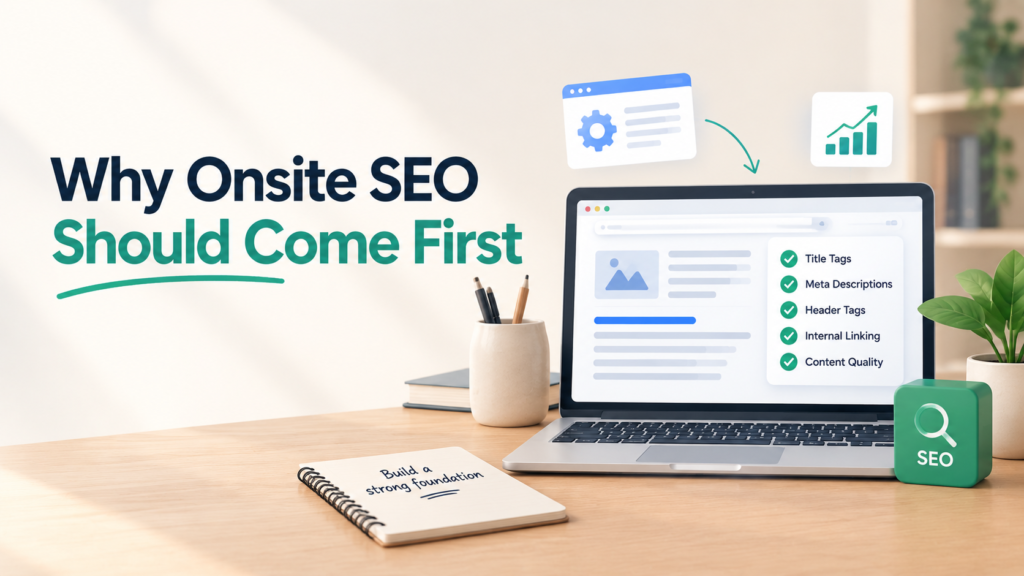
A strong onsite foundation typically starts with:
- Auditing your sitemap to make sure search engines can crawl and index every important page
- Reviewing content length and depth, since how many words a blog post should be for SEO varies by topic and competition
- Fixing broken links, slow-loading pages, and mobile usability issues
- Ensuring every page has a clear, unique purpose tied to a specific search intent
Once these fundamentals are solid, offsite efforts have something worth linking to – which makes link-building campaigns far more effective.
Why Offsite SEO Still Matters
Even with perfect onsite optimization, a website without any external authority will struggle to outrank established competitors. Search engines use backlinks and brand signals as a proxy for trustworthiness, since a genuinely useful page tends to earn organic mentions from other sites over time.
Offsite SEO becomes especially important in competitive industries. For example, businesses considering SEO proposals for personal injury law firms know that competitive legal markets often require a strong backlink profile just to compete on page one. In these cases, offsite work isn’t optional – it’s often the deciding factor between ranking and not ranking at all.
Effective offsite strategies include:
- Building relationships with industry publications and bloggers
- Creating genuinely link-worthy content, such as original research or data studies
- Actively managing brand mentions and online reputation
- Pursuing digital PR opportunities tied to newsworthy company updates
Common Misconceptions About Onsite and Offsite SEO
A lot of confusion around onsite and offsite SEO comes from a few persistent myths. Clearing these up helps set realistic expectations.
- “More backlinks always means better rankings.” In reality, a handful of high-authority, relevant backlinks usually outperforms hundreds of low-quality ones.
- “Onsite SEO is a one-time task.” Search engines and user expectations evolve, so onsite elements need regular review and updates.
- “Offsite SEO is just link building.” While backlinks are central, brand mentions, PR, and social engagement all contribute to offsite authority.
- “You can skip one and focus only on the other.” Neither works well in isolation; a page with great content but zero authority, or strong backlinks pointing to weak content, both underperform.
Understanding these distinctions is especially important for niche industries. For example, SEO for functional medicine doctors often requires both airtight onsite content that meets strict E-E-A-T standards and offsite authority from credible health-related citations.
How Onsite and Offsite SEO Work Together
The most effective SEO strategies treat onsite and offsite work as complementary, not competing, priorities. Strong onsite content gives you something worth promoting, and offsite authority amplifies the visibility of that content once it’s built.
A practical way to think about the relationship:
- Build a strong onsite foundation with content that matches real search intent
- Ensure technical elements support crawlability and indexing
- Promote that content through outreach, guest posting, and PR to earn backlinks
- Monitor performance and refine both onsite and offsite tactics based on results
Businesses evaluating their overall approach often benefit from a broader competitive analysis of keywords to understand where competitors are winning on both fronts – content relevance and backlink authority – before deciding where to focus resources next.
How Long Does It Take to See Results?
Timelines vary significantly depending on competition, industry, and how much work is needed upfront. Onsite fixes, such as correcting technical errors or rewriting underperforming content, can sometimes show movement within weeks. Offsite work, on the other hand, tends to compound gradually, and meaningful authority-building can take several months to materialize into ranking improvements.
Patience matters here – businesses that abandon offsite efforts too early often lose momentum right before backlinks start paying off.
How SurgeAIO can help in terms of SEO
Balancing onsite and offsite SEO effectively requires a strategy that accounts for your industry, competitors, and growth stage – not a generic checklist. SurgeAIO helps businesses build that strategy from the ground up, starting with a thorough audit of your website’s technical health and content structure before layering in offsite authority-building tactics.
Our approach is grounded in real content performance data rather than guesswork, so every recommendation – from internal linking improvements to outreach targets – is tied to measurable outcomes. Whether you’re just starting to build your onsite foundation or ready to scale offsite authority through PR and backlinks, SurgeAIO builds a roadmap that fits where your business actually is today.
Frequently Asked Questions
Which is more important: onsite or offsite SEO?
Both are essential, but onsite SEO should generally come first since it creates the foundation that makes offsite efforts effective.
Can I improve my rankings with only onsite SEO?
You can see some improvement, especially for low-competition terms, but most competitive industries also require offsite authority to rank well.
How long does offsite SEO take to show results?
It varies, but offsite efforts like backlink building typically take several months to meaningfully influence rankings, since they depend on external relationships and content credibility.
What’s the fastest onsite SEO fix I can make?
Improving page speed, fixing broken links, and updating outdated content are usually the quickest wins with measurable impact.
Do social media shares count as offsite SEO?
They aren’t a direct ranking factor, but social engagement can indirectly support offsite SEO by increasing visibility and the chances of earning backlinks.
How many backlinks do I actually need?
There’s no fixed number – quality and relevance matter more than quantity, and a few authoritative links often outperform many low-quality ones.
