Most businesses reach a point where organic growth stalls. Rankings plateau. Traffic stops are climbing. Competitors keep appearing above you in search results.
At that moment, one question becomes urgent: how do you hire an SEO marketing company that actually moves the needle?
The answer is not as simple as picking the agency with the most polished website. It requires research, clear goal-setting, and knowing exactly what to look for – and what to walk away from.
This guide walks you through every step. By the end, you will know how to evaluate, question, and choose an SEO partner that delivers real, lasting results.
Why Hiring an SEO Marketing Company Is Worth It
SEO is not a one-time project. It demands consistent effort across technical optimisation, content creation, link building, and performance analysis.
Most in-house teams do not have the bandwidth – or the specialised skill set – to manage all of that well. Moreover, search engines update their algorithms regularly, and staying current is a full-time job by itself.
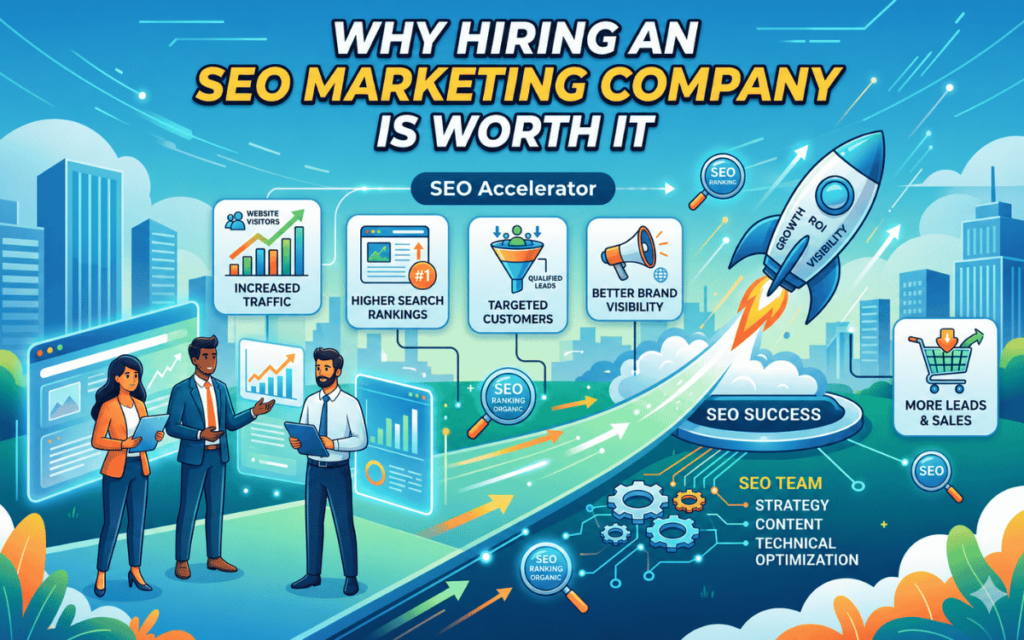
When you hire an SEO marketing company, you gain:
- A dedicated team focused entirely on your visibility
- Access to premium tools like Ahrefs, Semrush, and Screaming Frog
- Proven processes refined across multiple industries
- Faster results backed by structured execution
- Objective analysis free from internal bias
In addition, the long-term ROI of SEO significantly outperforms paid advertising. Organic rankings build equity over time. Paid clicks, however, vanish the moment the budget runs out.
Step 1: Clarify Your Goals Before You Start Looking
Before you contact a single agency, you need to define what success looks like for your business.
Many companies hire an SEO firm without knowing what they actually want. That ambiguity leads to mismatched expectations and wasted budgets.
Ask yourself these questions first:
- Do you want more organic traffic or more qualified leads?
- Are you targeting a local audience or a national one?
- Do you need visibility across AI platforms and voice search, as well as Google?
- What is a realistic monthly budget for this investment?
- How quickly do you expect to see measurable progress?
Understanding how long SEO takes to work is especially important before entering any agency conversation. Unrealistic timelines are one of the most common causes of frustration in SEO partnerships.
Once you have clear answers, you can evaluate proposals with confidence – instead of being sold to.
Step 2: Understand What Services a Strong SEO Agency Provides
Not every agency offers the same services. Some focus on content. Others specialise in technical audits or link acquisition. A full-service agency should cover all key areas.
Here is what a comprehensive SEO marketing company should include in their offering:
Technical SEO
This covers site speed, crawlability, mobile performance, structured data, Core Web Vitals, and indexation. Without a clean technical foundation, even excellent content struggles to rank.
On-Page Optimisation
Keyword targeting, title tags, meta descriptions, header structure, and internal linking all fall under on-page work. This layer is often the fastest to show early gains.
Content Strategy
Modern SEO and content are inseparable. A strong agency builds topical authority – not just keyword-stuffed pages. They research what your audience actually needs, then produce content that answers those needs with depth and clarity. Understanding how many words a blog post should be for SEO matters more than most businesses realise.
Link Building
Backlinks remain one of the most powerful ranking signals in Google’s algorithm. However, quality matters far more than volume. A trustworthy agency builds links through editorial outreach, digital PR, and legitimate content partnerships – not bulk directories or link farms.
Keyword Research and Competitive Analysis
A reliable agency conducts thorough competitive analyses of keywords before building any strategy. They identify gaps your competitors have not filled, and opportunities you can realistically win.
Local SEO (Where Applicable)
If your business serves a specific geographic area, how local SEO helps attract local customers becomes directly relevant to your growth. Local SEO requires its own set of tactics – Google Business Profile management, local citations, geo-targeted content, and review signals.
Step 3: Research and Build a Shortlist
Once you understand what services you need, start identifying agencies worth evaluating.
Use a mix of sources to build your shortlist:
- Google searches for agencies in your niche or city
- Review platforms like Clutch and G2
- LinkedIn for team size, expertise, and thought leadership
- Referrals from business peers in non-competing industries
- Case studies published on agency websites
When reviewing case studies, look beyond traffic graphs. Ask whether they show ranking improvements for commercially valuable keywords, conversion lifts, or revenue impact.
An agency that only highlights vanity metrics – impressions, clicks with no conversions – may not deliver the business outcomes you actually need.
Step 4: Ask the Right Questions on Discovery Calls
Shortlist 3–5 agencies and schedule a discovery call with each. These conversations reveal far more than any written proposal.
Here are the most important questions to ask:
On Strategy:
- How do you approach a new SEO engagement from day one?
- How do you research and prioritise keywords?
- How do you build content that earns rankings over time?
On Transparency:
- What metrics do you report, and how often?
- Will we have direct access to dashboards and tools?
- How do you communicate when results fall short of projections?
On Ethics:
- Do you follow Google’s Webmaster Guidelines?
- What does your link-building process look like in practice?
- Have any of your clients ever received a manual penalty? How did you handle it?
On Results:
- What realistic outcomes can we expect at 3, 6, and 12 months?
- Can you share references from clients in a similar industry?
Any agency that guarantees specific rankings, avoids explaining their tactics, or cannot produce verifiable results should come off your list immediately.
Step 5: Evaluate Proposals Carefully
After discovery calls, reputable agencies will send a written proposal. Evaluate each one across four dimensions:
Clarity of Scope Does the proposal define exactly what gets done each month? How many pages will they optimise? How many content pieces will they produce? How many links will they target? Vague scopes create disputes.
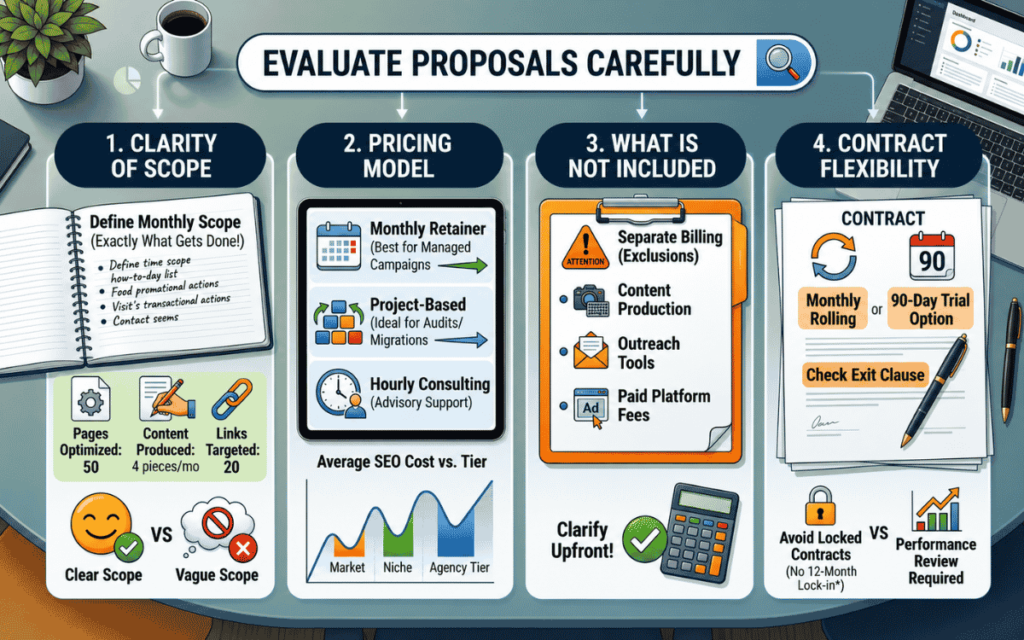
Pricing Model: The three most common structures are:
- Monthly retainer – most suitable for ongoing, managed campaigns
- Project-based pricing – ideal for one-time audits or migrations
- Hourly consulting – best for advisory support, not full execution
Also, understand how much SEO services cost before comparing proposals side-by-side. Pricing varies dramatically between markets, niches, and agency tiers.
What Is Not Included: Content production, outreach tools, or paid platform fees are sometimes billed separately. Clarify all of this upfront.
Contract Flexibility: Check the exit clause. A confident agency will not lock you into a 12-month contract with no performance review. Look for 90-day trial options or monthly rolling terms.
Step 6: Verify Before You Sign
Do not skip due diligence. Before signing any contract, take these steps:
- Read third-party reviews on Clutch, Google, and G2 – look for consistency and how the agency responds to negative feedback
- Speak to past or current clients referenced in case studies
- Confirm who will work on your account – many agencies pitch senior talent but assign work to junior staff
- Review the contract for IP ownership, data access, and exit terms
A reliable agency will welcome this process. They understand that trust takes time to build, and they are not threatened by scrutiny.
Step 7: Start With a Focused Audit or Trial Engagement
Rather than committing to a long retainer on day one, begin with a paid SEO audit or a 3-month trial.
This approach protects your budget. It also tests the agency’s analytical rigour before deeper commitment.
A thorough SEO audit should cover:
- Technical health issues (crawl errors, page speed, indexability)
- Content gap analysis against top-ranking competitors
- Backlink profile review and toxic link identification
- Keyword opportunity mapping with search volume and difficulty data
- Competitor benchmarking across target search terms
Treat the audit as a strategic blueprint – not a sales document. If the audit is generic and could apply to any website in any industry, that is a warning sign.
Red Flags to Avoid When Hiring an SEO Marketing Company
Even experienced buyers get misled. Watch out for agencies that:
- Guarantee page-one rankings – no ethical agency can promise specific positions
- Refuse to explain their tactics – transparency is non-negotiable
- Offer suspiciously low pricing – cheap SEO often means black-hat methods and eventual penalties
- Skip discovery – if they do not ask about your business, audience, or goals, they cannot build a relevant strategy
- Lock you into long contracts with no performance accountability
- Send generic proposals that look identical regardless of your industry or market
Moreover, be cautious about agencies that promise fast results. Meaningful SEO growth takes time. Anyone claiming significant ranking improvements in 30 days is either misleading you or using tactics that put your site at risk.
How SurgeAIO Can Help in Terms of SEO
SurgeAIO is built for businesses that want clarity, precision, and measurable outcomes from SEO.
Rather than guessing what works, SurgeAIO gives you the tools and visibility to make confident decisions at every stage of your SEO journey.
Here is how SurgeAIO supports you:
Strategic keyword intelligence – SurgeAIO helps you identify keyword opportunities with real competitive data. You can discover whether you even need to hire an SEO company or whether specific tools and strategies can close the gap faster.
Content performance tracking – SurgeAIO monitors how your content performs over time. Using content performance data, you can identify what is working, what needs improvement, and where new opportunities exist.
AI visibility monitoring – Search has evolved beyond Google. SurgeAIO tracks how your brand and content appear across AI-generated results, giving you an edge in the era of generative search.
Competitive gap analysis – SurgeAIO surfaces the exact keyword and content gaps your competitors have not yet addressed, giving your SEO team a clear, prioritised action plan.
Reporting you can actually use – Instead of vanity dashboards, SurgeAIO delivers insights that connect directly to business outcomes – traffic quality, lead potential, and ranking momentum.
Whether you manage SEO in-house, work with an agency, or are still evaluating your options, SurgeAIO provides the data and structure you need to move forward with confidence.
What to Expect After You Hire an SEO Marketing Company
Signing a contract is only the beginning. A successful SEO partnership requires active collaboration from your side too.
Here is how to set the relationship up for success:
- Assign a dedicated internal contact for faster approvals and feedback
- Share product updates, seasonal priorities, and campaign changes with the agency
- Participate in monthly strategy reviews – not just report check-ins
- Give your agency clear brand voice guidance and subject matter input
- Be patient: meaningful SEO progress typically appears between months 3 and 6
Furthermore, track results independently using Google Search Console and Google Analytics. You should always have direct visibility into your own data – not just what the agency chooses to report.
Final Thoughts
Learning how to hire an SEO marketing company is ultimately about finding the right partner – not just the agency with the best pitch.
The right agency asks thoughtful questions, builds a strategy around your specific goals, communicates transparently, and proves its value through measurable results.
Take your time. Do your research. Ask hard questions. Start small before committing fully. And use tools like SurgeAIO to stay informed, track progress, and hold any partner accountable throughout the engagement.
The companies that treat SEO as a strategic long-term investment – not a quick fix – consistently outperform those that cut corners. That mindset starts at the very first step: choosing who you work with.
Frequently Asked Questions
Q1. How long does SEO take to show results?
Most businesses see measurable improvements within 3–6 months. Competitive industries or technically troubled websites may take longer. Any agency promising ranking results in weeks is likely using risky methods.
Q2. What should I budget to hire an SEO marketing company?
Budgets vary significantly by scope and market. Entry-level retainers often start from $500–$1,500/month. Full-service enterprise campaigns can run $5,000-$20,000/month or more. Avoid selecting an agency purely on price.
Q3. Should I hire a freelancer or a full-service SEO agency?
Freelancers suit narrow, defined tasks – audits, keyword research, content writing. Full-service agencies handle end-to-end strategy, execution, and ongoing management. If your needs are comprehensive, an agency offers more capacity and accountability.
Q4. Can an SEO company guarantee first-page rankings?
No ethical agency can. Google’s algorithm considers hundreds of signals and updates constantly. Any guarantee of specific rankings is either misleading or backed by tactics that risk your site’s long-term health.
Q5. What questions should I ask an SEO company before hiring them?
Ask about their keyword research process, content strategy approach, link-building methods, reporting structure, and how they have handled algorithm updates and past penalties for clients.
Q6. What is the difference between on-page and off-page SEO?
On-page SEO refers to changes made directly on your website – content, metadata, internal links, and structure. Off-page SEO refers to external signals, primarily backlinks from other websites, that build your site’s authority.
Q7. How do I know if my SEO company is actually doing the work?
Request access to live reporting dashboards. Review a monthly summary of completed tasks. Track rankings and traffic independently. Regular check-ins with a named account manager are also a healthy sign of a transparent agency.
