Most SaaS companies pour money into paid ads. The moment the budget stops, the traffic vanishes.
That is exactly why organic search matters so much. When you improve SEO for SaaS companies, you build a growth engine that compounds over time – without paying for every click.
But SaaS SEO is not the same as SEO for a local restaurant or an e-commerce store. It demands a different strategy, a different content approach, and a deeper understanding of how software buyers actually search.
This guide walks you through every critical step. By the end, you will have a clear, actionable roadmap to grow your SaaS product’s organic visibility in 2026.
What Makes SaaS SEO Different?
Before diving into tactics, you need to understand what separates SaaS SEO from traditional SEO.
SaaS buyers rarely make impulse decisions. They research extensively, compare multiple tools, and often involve 5-10 stakeholders before committing. The average B2B SaaS sales cycle stretches across 2-3 months.
That means your SEO strategy must support a longer journey. You need content that educates, nurtures, and converts – not just pages that rank for one transactional keyword.
Moreover, SaaS companies target multiple audience types simultaneously. A project management tool might need to rank for developers, marketing managers, and C-suite buyers – each searching with a completely different language and intent.
Therefore, a cookie-cutter SEO approach simply does not work here. You need a layered, funnel-aligned strategy.
Step 1: Map Keywords to Every Stage of the Buyer Funnel
The most important foundation for SaaS SEO is keyword strategy. Specifically, you need keywords across all three funnel stages.
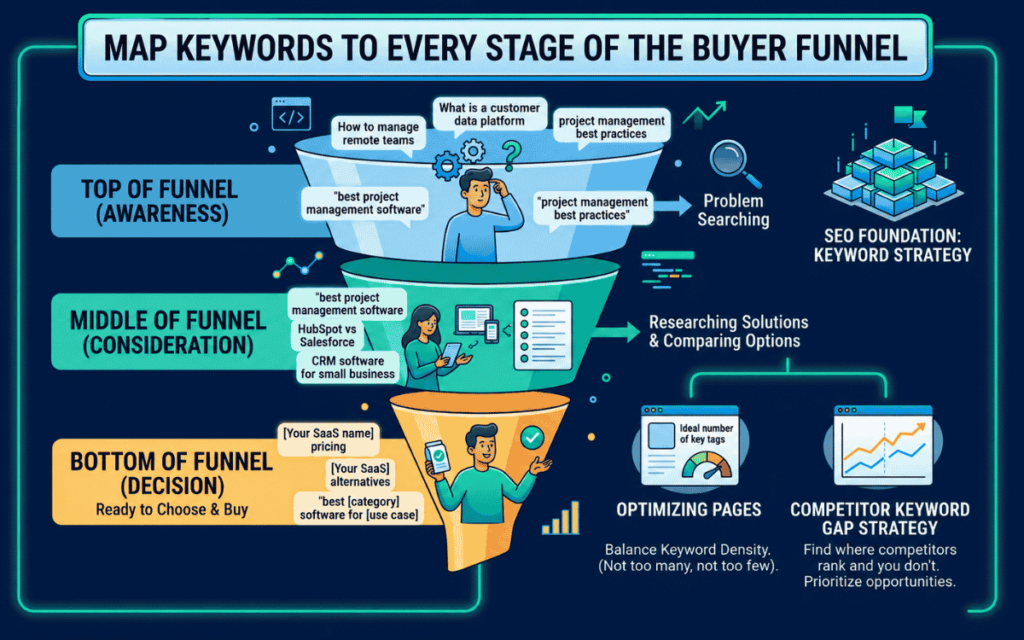
Top of Funnel (Awareness)
These are informational queries. Users do not yet know your product exists. They are searching for answers to problems.
Examples:
- “How to manage remote teams”
- “What is a customer data platform”
- “project management best practices”
Middle of Funnel (Consideration)
Users understand the problem. They are now researching solutions and comparing options.
Examples:
- “best project management software”
- “HubSpot vs Salesforce”
- “CRM software for small business”
Bottom of Funnel (Decision)
Users are ready to choose. They search for specific tools, pricing, and reviews.
Examples:
- “[Your SaaS name] pricing”
- “[Your SaaS] alternatives”
- “best [category] software for [use case]”
Understanding how many SEO keywords per page is essential at this stage. Targeting too many dilutes your relevance. Targeting too few limits your reach.
In addition, pay close attention to competitor keyword gaps. A strong keyword gap strategy reveals exactly where your competitors rank, but you do not – giving you a prioritised list of opportunities to pursue.
Step 2: Build Topical Authority Through Content Clusters
Google rewards websites that demonstrate deep expertise on a topic. SaaS companies, however, often make one critical mistake: they publish random blog posts with no structural logic.
Instead, build topic clusters. Each cluster consists of:
- A pillar page – a comprehensive guide covering a broad topic
- Cluster pages – supporting articles that go deep on specific subtopics
- Internal links – connecting every cluster page back to the pillar and to each other
For example, if your SaaS is a CRM tool, your pillar page might be “Complete Guide to Customer Relationship Management.” Cluster pages would then cover topics like “how to use CRM for sales teams,” “CRM reporting best practices,” or “CRM integration with email tools.”
This structure does two things. First, it helps Google understand the full scope of your expertise. Second, it keeps users moving deeper into your content – which builds engagement signals that support rankings.
Furthermore, consistent, well-structured content is one of the strongest organic traffic strategies for SaaS companies available today. The SaaS companies that commit to topical authority consistently outpace competitors relying on ad-hoc publishing.
Step 3: Optimise Your Product Pages for High-Intent Keywords
Many SaaS companies invest heavily in blog content but neglect their core product pages. That is a significant missed opportunity.
Your homepage, feature pages, and use-case pages carry enormous ranking potential for bottom-of-funnel keywords – the searches that indicate purchase intent.
Here is what each page type needs:
Homepage
- Target your primary brand + category keyword
- Clear headline that communicates the core value proposition
- Structured data markup for enhanced search appearance
Feature Pages
- One dedicated page per major feature
- Target feature-specific long-tail keywords
- Include use cases, screenshots, and social proof
Integration Pages
- A page for every major tool you integrate with (e.g., “CRM + Slack integration”)
- These capture high-intent searches from users evaluating compatibility
Comparison Pages
- “[Your SaaS] vs [Competitor]” pages
- Buyers actively search for these when finalising their decision
- Be honest, clear, and focused on genuine differentiators
Step 4: Nail the Technical SEO Foundation
Even the best content strategy fails without a technically sound website. SaaS platforms often have complex site structures – and this creates unique technical challenges.
Focus on these core areas:
Site Speed: Google’s Core Web Vitals directly influence rankings. A slow SaaS site loses rankings and users simultaneously. Aim for a Largest Contentful Paint (LCP) under 2.5 seconds and a Cumulative Layout Shift (CLS) score under 0.1.
Crawlability and Indexation: Ensure Google can find and index all your important pages. Check your robots.txt file. Audit your sitemap. Understanding how important a sitemap is for SEO becomes especially critical for SaaS sites with large page counts and dynamic content.
Duplicate Content: SaaS websites frequently generate duplicate content through URL parameters, faceted navigation, or app login flows. Use canonical tags to consolidate authority onto the correct page.
Mobile Optimisation: Google uses mobile-first indexing. Your SaaS site must deliver a flawless mobile experience – not just a responsive layout, but a genuinely usable interface on smaller screens.
Structured Data: Schema markup helps Google understand your content. Use the SoftwareApplication schema on product pages and the FAQ schema on content pages to earn enhanced search results.
Step 5: Build a High-Quality Backlink Profile
Backlinks remain one of the most powerful ranking signals in Google’s algorithm. For SaaS companies, building authoritative links is particularly impactful because your competitors are often well-funded and well-linked.
However, volume without quality is worthless. One link from a respected industry publication outperforms 100 links from low-authority directories.
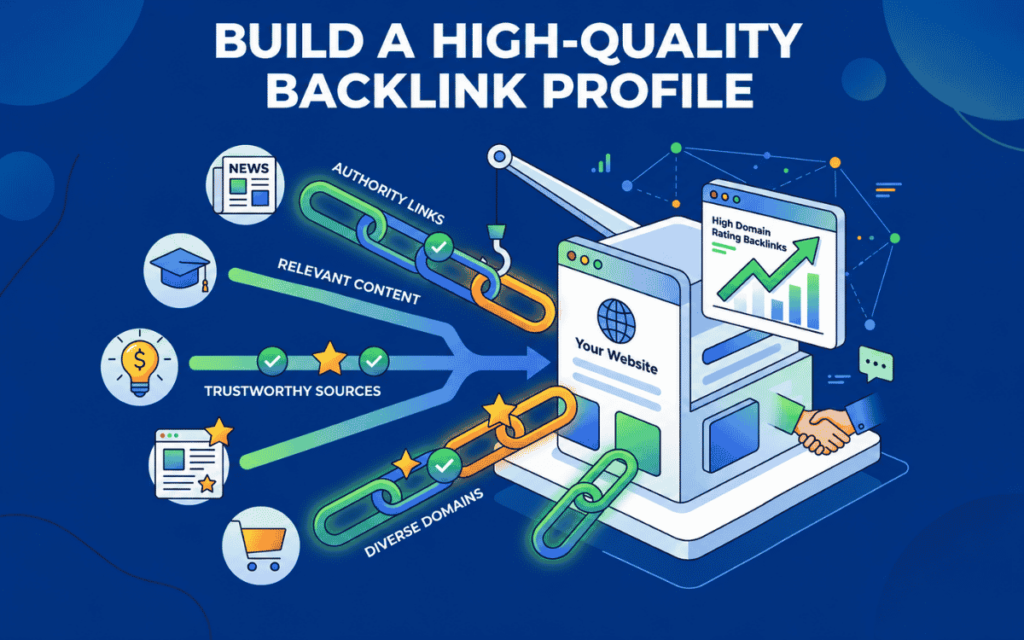
Here are the most effective link-building tactics for SaaS:
- Digital PR – publish original research, data studies, or industry reports that journalists and bloggers naturally cite
- Product integrations – partner tools often link to your integration page from their own documentation
- Guest contributions – write expert articles for industry publications in your niche
- HARO and journalist platforms – respond to queries from reporters seeking software expert quotes
- Resource page outreach – identify curated tool lists in your category and request inclusion
Moreover, knowing how many backlinks you actually need to rank for your target keywords is more useful than chasing arbitrary link counts. Analyse your top-ranking competitors first, then set realistic targets.
Step 6: Create Conversion-Focused Content at Every Funnel Stage
SaaS SEO is not just about rankings. Ultimately, it is about converting organic visitors into trial users and paying customers.
Therefore, every piece of content needs a clear next step. Top-of-funnel posts should lead to middle-of-funnel resources. Middle-of-funnel pages should lead to product demos or free trials. Bottom-of-funnel pages should make signing up frictionless.
Content types that convert well for SaaS:
- Free tool pages – mini tools that solve a specific problem (e.g., a free ROI calculator or a word count tool)
- Case studies – real customer stories with measurable outcomes
- Template libraries – downloadable templates related to your software’s use case
- Comparison guides – honest competitor comparisons that highlight your strengths
- Video-embedded tutorials – walk users through solving a real problem using your tool
In addition, tracking content performance data on a regular basis helps you identify which pieces drive sign-ups versus which ones only attract passive readers. That insight allows you to prioritise and double down on what actually moves revenue.
Step 7: Track the Right Metrics – Not Just Traffic
Many SaaS teams celebrate traffic growth without connecting it to revenue. That is a dangerous habit.
Instead, track metrics that reflect real business impact:
- Organic traffic by funnel stage – how much traffic lands on top-, middle-, and bottom-of-funnel pages
- Organic trial sign-ups – how many free trials originate from organic search
- Keyword ranking progress – movement across your priority target terms
- Organic conversion rate – what percentage of organic visitors take a desired action
- Backlink growth – number and quality of new referring domains over time
Furthermore, monitor how your content performs in AI-generated search results. In 2026, ranking in AI overviews has become a meaningful source of brand visibility – particularly for SaaS companies targeting research-stage buyers.
Common SaaS SEO Mistakes to Avoid
Even experienced growth teams make these mistakes. Watch out for:
- Targeting only high-volume keywords – high volume often means high competition and low purchase intent. Balance your keyword mix.
- Publishing thin content – a 300-word blog post rarely earns rankings in a competitive SaaS category. Depth signals expertise.
- Ignoring product page SEO – product pages are your highest-converting pages. They deserve the same attention as your blog.
- Skipping internal linking – every new piece of content needs to connect to existing pages. Orphaned pages waste authority.
- Expecting fast results – meaningful SaaS SEO results typically emerge between months 4 and 9. Patience is not optional.
- Not updating old content – outdated posts lose rankings over time. Refreshing high-performing content is often faster than creating new pieces.
How SurgeAIO Can Help in Terms of SEO
SaaS companies need more than generic SEO tools. They need a platform built around data clarity, competitive intelligence, and actionable insights – not vanity dashboards.
SurgeAIO delivers exactly that.
Keyword and competitive intelligence – SurgeAIO surfaces keyword opportunities your competitors rank for, but you have not yet targeted. It helps you identify the highest-value gaps in your content coverage and prioritise content production accordingly.
AI visibility tracking – In 2026, your SaaS brand needs to appear in AI-generated answers, not just traditional blue links. SurgeAIO monitors how your content performs across AI search environments, including Google AI Overviews and LLM-powered tools. This aligns directly with understanding AI visibility metrics that matter for modern SaaS growth.
Content performance monitoring – SurgeAIO tracks which content drives organic conversions, not just traffic. You see clearly what is working, what needs updating, and where new opportunities exist.
Top SEO platform for B2B – SurgeAIO is purpose-built for B2B and SaaS contexts. It connects organic performance data directly to pipeline signals, giving you a clearer picture of SEO’s impact on revenue. If you are evaluating tools, exploring the top SEO platform for B2B options is a worthwhile starting point.
Structured reporting – SurgeAIO produces reports that connect keyword rankings and traffic trends to actual business outcomes – making it easy to justify SEO investment to leadership.
Whether you are building your SaaS SEO programme from scratch or scaling an existing one, SurgeAIO gives you the infrastructure to move faster and smarter.
Final Thoughts
Learning how to improve SEO for SaaS companies is ultimately about playing a long game with a clear strategy.
You need keyword coverage across the full funnel. You need topical authority built through clustered, interconnected content. You need a technically sound website. And you need backlinks that carry genuine editorial weight.
None of that happens overnight. However, every action you take compounds. Rankings you earn today keep delivering traffic six months from now – without additional spend.
The SaaS companies that treat SEO as a core growth channel consistently reduce their customer acquisition costs and build more predictable, defensible revenue. Start with the fundamentals, track what matters, and use platforms like SurgeAIO to stay sharp as the search landscape keeps evolving.
Frequently Asked Questions
Q1. How long does SaaS SEO take to show results?
Most SaaS companies see meaningful ranking improvements between months 4 and 9. Competitive categories can take longer. Early wins often come from optimising existing pages that already rank in positions 10–30 pushing them onto page one requires less effort than building new authority from scratch.
Q2. What is the difference between SaaS SEO and traditional SEO?
The core mechanics are the same – technical optimisation, content, and backlinks. However, SaaS SEO specifically accounts for longer sales cycles, multiple buyer personas, and the need to map content across awareness, consideration, and decision stages rather than targeting a single conversion point.
Q3. How many blog posts does a SaaS company need to rank?
There is no fixed number. What matters is relevance, depth, and topical authority – not volume. A SaaS company with 40 well-structured, deeply researched articles organised into clear topic clusters will consistently outperform one with 200 thin, disconnected posts.
Q4. Should SaaS companies target branded or non-branded keywords?
Both. Non-branded keywords build awareness and attract new prospects. Branded keywords capture demand from users already familiar with your product. A healthy SaaS SEO strategy develops both simultaneously.
Q5. What type of content converts best for SaaS SEO?
Bottom-of-funnel content – comparison pages, pricing pages, use-case pages, and case studies – converts at the highest rate. However, top-of-funnel content builds the pipeline that feeds those conversions. You need both working together.
Q6. Is AI-generated content good for SaaS SEO?
AI tools can accelerate content production, but AI-generated content without expert review and original insight rarely ranks well in competitive SaaS categories. Google rewards E-E-A-T (Experience, Expertise, Authoritativeness, Trustworthiness) – qualities that require genuine human expertise layered into content.
Q7. How do backlinks affect SaaS SEO specifically?
Backlinks signal authority and trust to Google. In competitive SaaS categories, domain authority plays a major role in determining which companies rank on page one. Building links from respected industry publications, partner tools, and original research is the most reliable path to authority growth.
