Most property owners and renters start their search online. They type a location, add a service phrase, and click the first result they trust.
If your property management company does not appear in those top results, you are invisible to your best prospects – no matter how great your service is.
That is exactly why knowing how to improve SEO on a property management company website matters more than ever in 2026. The competition for local visibility has intensified. And the property managers who invest in a structured, long-term SEO strategy are consistently capturing the leads that others miss.
This guide gives you a clear, step-by-step roadmap – from keyword research to technical fixes – so you can start building organic visibility that delivers real business results.
Why SEO Is Non-Negotiable for Property Management Companies
Before diving into tactics, consider these facts:
- 91% of renters begin their property search online
- 75% of clicks go to the top three organic search results
- 60% of smartphone users contact businesses directly from search results
- Local search results drive high-intent traffic from people ready to act
Moreover, unlike paid advertising, SEO builds compounding equity. Every page you optimise, every review you earn, and every backlink you acquire continues working for you long after the initial effort.
Therefore, property management companies that treat SEO as a strategic priority consistently outgrow those relying solely on word-of-mouth or paid directories.
Step 1: Build a Smart Keyword Strategy
Keyword research is the foundation of every successful property management SEO campaign. Without it, you create content that nobody searches for.
Start by identifying two categories of keywords:
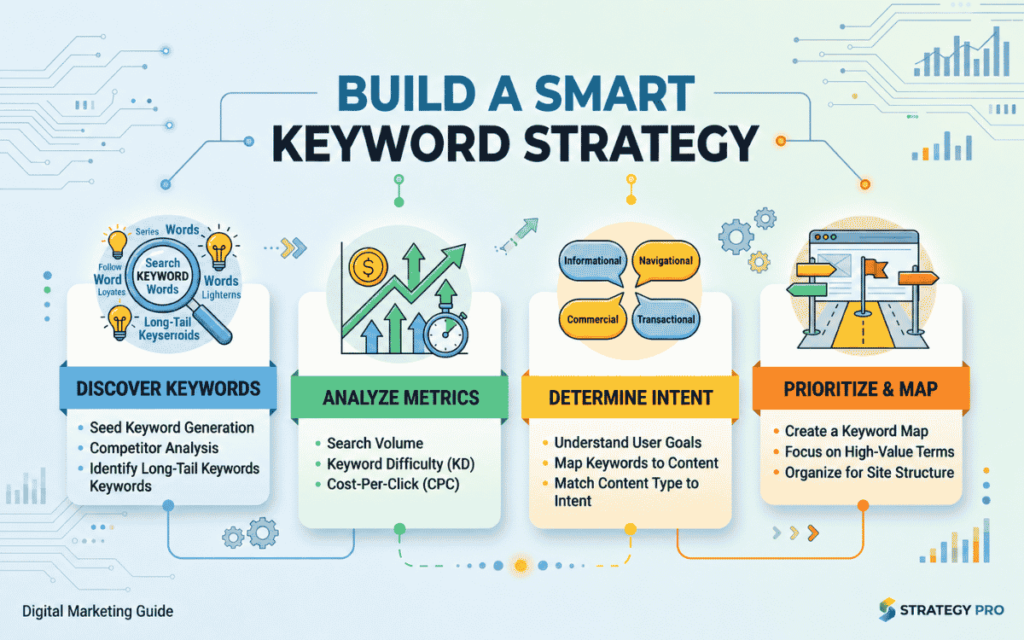
Seed Keywords (Broad Terms)
These describe your core services and capture high search volume:
- Property management company
- Rental property management
- Property management services
- Tenant placement services
- Landlord property management
Long-Tail Keywords (Specific Phrases)
These attract highly targeted traffic with clearer intent:
- Property management company in [your city]
- Best property managers in [neighbourhood]
- Affordable rental management services near me
- How to find a property manager in [location]
- Property management fees in [city]
Long-tail keywords account for approximately 70% of all search traffic. They are generally easier to rank for and attract prospects who are already close to making a decision.
In addition, always research what your local competitors rank for. Identifying keyword gaps – terms your competitors own but you do not – reveals your fastest path to ranking gains. A thorough keyword gap strategy helps you prioritise the highest-value opportunities rather than guessing.
Step 2: Optimise Your On-Page SEO
Once you have your keyword list, the next step is on-page optimisation. This means structuring every page on your website so Google can understand exactly what it is about and who it serves.
For each key page, focus on:
Title Tags: Include your primary keyword and location naturally. Keep it under 60 characters. Example: “Property Management Services in Austin, TX | [Your Company Name]”
Meta Descriptions: Write a 150–160 character summary that includes your keyword and a clear value proposition. This is what appears in search results – it directly impacts click-through rate.
Header Tags (H1, H2, H3): Use your primary keyword in the H1 tag. Structure subheadings logically to guide both readers and search engines through your content.
Image Alt Text: Add descriptive, keyword-rich alt text to every image. Google cannot see images – it reads their alt text.
URL Structure: Keep URLs short, descriptive, and keyword-rich. Example: yoursite.com/property-management-austin-tx
Furthermore, ensure you target the right number of keywords on each page. Overloading one page with 15 different search terms dilutes your ranking signal. Understanding how many SEO keywords per page gives you a practical benchmark to follow.
Step 3: Prioritise Local SEO – This Is Where You Win Leads
For property management companies, local SEO is not optional. It is the single highest-impact channel available. Your ideal clients are searching within specific neighbourhoods, suburbs, and cities. You need to dominate those local results.
Here is how to build strong local visibility:
Claim and Optimise Your Google Business Profile
Your Google Business Profile (formerly Google My Business) is your most powerful local SEO asset. Optimise it by:
- Adding your exact business name, address, and phone number (NAP)
- Selecting the most relevant primary category (Property Management Company)
- Writing a keyword-rich business description
- Uploading high-quality photos of your team, properties, and office
- Posting regular updates about your services, offers, and market insights
Build Local Citations
A citation is any online mention of your business name, address, and phone number. Google uses citations to verify your business’s legitimacy and local relevance.
Submit your business to:
- Yelp, Angie’s List, and HomeAdvisor
- Local Chamber of Commerce directories
- Industry-specific platforms like AllPropertyManagement.com and NARPM
- Local business associations and neighbourhood directories
Consistency is critical. Your NAP details must match exactly across every listing. Even minor inconsistencies – like “St.” versus “Street” – can confuse Google and hurt your local rankings.
Earn and Respond to Reviews
Google reviews directly influence local search rankings. Moreover, positive reviews build the social proof that converts searchers into enquiries.
Ask satisfied clients to leave reviews on Google after a successful tenancy placement or lease renewal. Respond to every review – positive and negative – within 48 hours. This signals to Google that your business is active and engaged.
Understanding how local SEO helps attract local customers gives you a deeper foundation for building a strategy that goes beyond surface-level optimisation.
Step 4: Create High-Quality, Relevant Content
Content is what earns your rankings over time. Property management companies that publish genuinely helpful content consistently outrank those that rely on static service pages alone.
Build a content strategy around these three content types:
Service Pages
Create dedicated pages for every service you offer:
- Tenant screening and placement
- Lease management and renewals
- Rent collection and financial reporting
- Maintenance coordination
- Property inspections
- Eviction management
Each page should target specific keywords, include local modifiers, and clearly explain the value you deliver.
Location-Specific Landing Pages
If you serve multiple areas, build a dedicated landing page for each location. These pages allow you to rank for “[service] in [city]” searches across your entire service territory.
Educational Blog Content
A well-maintained blog builds topical authority and attracts top-of-funnel traffic. Write about topics your target audience actively searches for:
- “How much do property management companies charge?”
- “What to look for in a property manager”
- “How to screen tenants effectively”
- “Landlord responsibilities vs property manager responsibilities”
- “How to prepare your rental property for the market”
However, publishing thin, surface-level posts rarely earns rankings in competitive markets. Depth, original insight, and practical value are what Google rewards. Knowing how many words a blog post should be for SEO helps you set the right content length benchmarks from the start.
Step 5: Fix Your Technical SEO Foundation
Even the best content strategy fails on a technically broken website. Technical SEO ensures Google can crawl, index, and rank your pages without friction.
Focus on these critical technical elements:
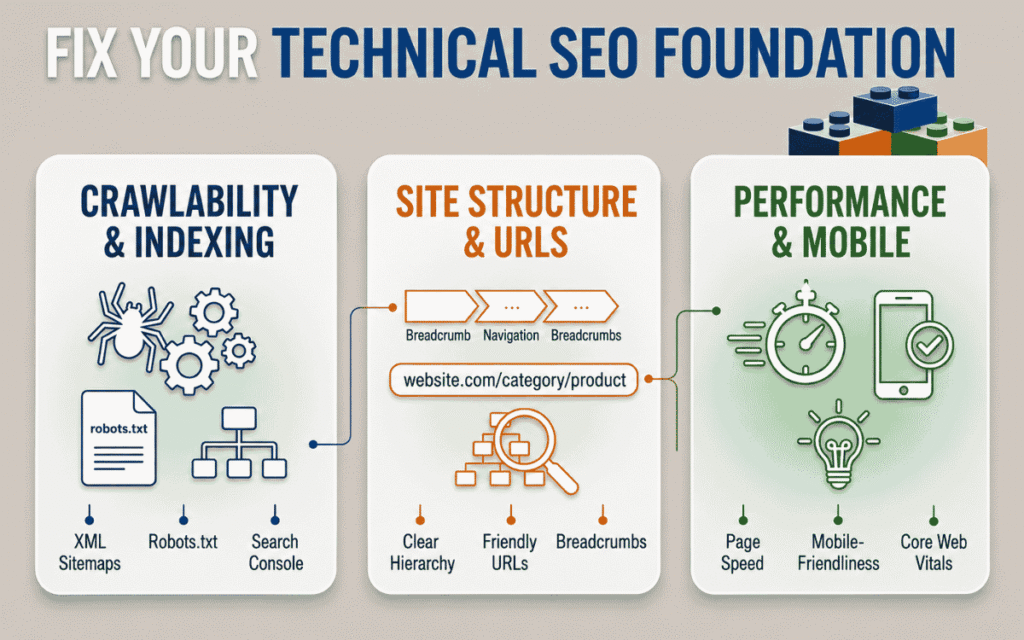
Site Speed: A slow website loses both rankings and leads. Google’s Core Web Vitals now directly influence search rankings. Aim for pages that load in under 3 seconds. Compress images, use caching, and choose a fast hosting provider.
Mobile Optimisation: Google uses mobile-first indexing – it evaluates the mobile version of your site first. Your property management website must deliver a seamless experience on phones and tablets, not just desktops.
SSL Certificate (HTTPS) Google treats HTTPS as a ranking signal. If your website still shows as “Not Secure,” fix this immediately. It also destroys trust with visitors before they even read your content.
XML Sitemap: An XML sitemap tells Google about every important page on your site and helps it crawl your content more efficiently. Understanding how important a sitemap is for SEO is especially relevant for property management sites with large numbers of listings and location pages.
Structured Data Markup: Add LocalBusiness schema markup to your homepage and service pages. This helps Google understand your business type, service area, contact details, and operating hours – improving your chances of appearing in rich search results.
Step 6: Build Authoritative Backlinks
Backlinks – links from other websites pointing to yours – remain one of Google’s strongest ranking signals. A property management company with strong backlinks consistently outranks competitors with similar content but fewer quality links.
Effective link-building strategies for property management companies include:
- Local media outreach – share market data, rental trend insights, or expert commentary with local journalists and property news outlets
- Industry directories – get listed on NARPM, IREM, and other credible industry association websites
- Guest content – write educational articles for local real estate blogs, landlord associations, or neighbourhood websites
- Partner referrals – build reciprocal relationships with real estate agents, mortgage brokers, and maintenance contractors who can link to your site
- Sponsorships – sponsor local community events, sports teams, or neighbourhood associations that feature your brand on their websites
Moreover, knowing how many backlinks you need to outrank your competitors in local search is more valuable than building links blindly. Analyse the top-ranking competitors in your market first, then set realistic targets.
Step 7: Track Performance and Refine Continuously
SEO is not a set-and-forget activity. You need to monitor what is working, identify what needs improvement, and adapt as search behaviour evolves.
Track these metrics monthly:
- Organic traffic – total visitors arriving from search engines
- Keyword rankings – movement across your target local and service keywords
- Google Business Profile performance – search impressions, direction requests, and calls
- Local pack appearances – how often your business appears in the map results
- Conversion rate – what percentage of organic visitors submit an enquiry or call
In addition, monitor how your content performs against traffic and lead generation goals. Reviewing content performance data regularly helps you identify which pages drive qualified enquiries versus which ones attract casual browsers who never convert.
Use Google Search Console to track keyword impressions, clicks, and indexation status. Use Google Analytics to monitor user behaviour and traffic sources.
How SurgeAIO Can Help in Terms of SEO
Property management companies operate in highly localised, competitive markets. Generic SEO tools designed for e-commerce or SaaS simply do not reflect the nuances of local service-area businesses.
SurgeAIO is built to deliver the kind of focused, data-driven insight that property management companies need to compete and grow.
Local keyword intelligence – SurgeAIO identifies the highest-opportunity keywords in your specific service area, including low-competition terms your competitors have overlooked. This directly supports your effort to capture the searches that convert into owner and renter enquiries.
Competitive gap analysis – SurgeAIO shows you exactly which keywords your local competitors rank for – and which gaps they have left open. You get a prioritised list of keyword and content opportunities, removing all guesswork from your editorial calendar.
Content performance tracking – SurgeAIO monitors how your blog posts, service pages, and location pages perform over time. You see clearly which content drives leads and which needs refreshing.
AI visibility monitoring – In 2026, property searches increasingly surface AI-generated answers alongside traditional results. SurgeAIO tracks how your business appears across both environments, ensuring you capture visibility in AI-powered search as well as organic listings. This aligns with tracking SEO services for organic traffic in a meaningful, revenue-connected way.
Structured, actionable reporting – SurgeAIO delivers reports that connect ranking progress and traffic trends directly to business outcomes – making it simple to demonstrate the ROI of your SEO investment to ownership and leadership teams.
Whether you manage 50 units or 5,000, SurgeAIO gives your property management SEO programme the structure and intelligence to scale effectively.
Common Property Management SEO Mistakes to Avoid
Even experienced operators make these errors. Watch out for:
- Skipping local keyword targeting – national terms with no local modifier rarely convert for property management businesses
- Inconsistent NAP data – mismatched business details across directories confuse Google and weaken local authority
- Ignoring Google reviews – failing to respond to reviews signals inactivity and costs you rankings
- Publishing thin blog posts – short, generic content fails to earn rankings in competitive local markets
- No internal linking strategy – every new page should connect logically to existing pages on your site
- Not tracking conversions – traffic without conversion tracking means you cannot identify what is actually working.
Final Thoughts
Learning how to improve SEO on a property management company website is ultimately about showing up consistently in the moments that matter most – when landlords are searching for a manager, or when renters are looking for their next home.
The strategy is not complicated. Build a strong local presence. Create genuinely useful content. Fix technical issues. Earn credible backlinks. And track what works.
Every improvement you make compounds over time. The rankings you build today keep attracting qualified leads six months from now – without ongoing ad spend.
Start with one step. Improve your Google Business Profile this week. Publish one new location page next week. Add one new blog post the week after. Consistency, not perfection, is what builds lasting organic visibility in property management.
Frequently Asked Questions
Q1. How long does property management SEO take to show results?
Most property management companies see meaningful ranking improvements within 4-6 months. Local SEO results – particularly Google Business Profile visibility – can appear faster, sometimes within 6–8 weeks of consistent optimisation.
Q2. Is local SEO more important than general SEO for property management?
Yes. Property management is an inherently local service. Local SEO – including Google Business Profile, local citations, and geo-targeted content – delivers the highest return for companies serving a defined geographic area.
Q3. How many location pages does a property management company need?
Create one dedicated location page for every city, suburb, or neighbourhood you actively serve. Each page should be unique, locally specific, and target relevant long-tail keywords for that area.
Q4. Do online reviews really affect SEO rankings?
Yes – directly. Google uses review quantity, recency, and quality as ranking signals for local search results. A property management company with 50 recent, positive reviews will consistently outrank a competitor with 10 older reviews.
Q5. What is the most important on-page SEO element for property management websites?
Title tags and H1 headers carry the most weight. These should include your primary keyword and location naturally – not stuffed or forced. They signal to Google exactly what each page is about.
Q6. Should property management companies have a blog?
Absolutely. A regularly updated blog builds topical authority, attracts long-tail keyword traffic, and establishes your company as a trusted local resource. Educational content that answers real landlord and tenant questions consistently earns organic rankings over time.
Q7. How much does property management SEO cost?
Costs vary significantly based on market competitiveness, geographic scope, and service depth. Local SEO retainers for property management companies typically range from $500–$3,000/month. Understanding how much SEO services cost in your specific market helps you set realistic budget expectations.
