One question comes up constantly in digital marketing conversations: Is SEO organic or paid?
For someone just stepping into the world of search marketing, the confusion is legitimate. Google shows both organic results and paid ads on the same page. They can look similar at first glance. Agencies often sell both under the umbrella of “SEO services.”
However, the distinction matters enormously – for your strategy, your budget, and your long-term growth expectations. Understanding what SEO and GEO mean for your website gives you the full strategic context to make smarter decisions across both channels.
The short answer: SEO is organic. It is not paid search. Understanding why – and what that means in practice – gives you the clarity to build a search strategy that actually delivers.
In this guide, you will get a precise breakdown of organic SEO, paid search, how they differ, how they work together, and how to use both intelligently to grow your business online.
What Does “Organic” Mean in SEO?
The word “organic” in marketing means naturally occurring – without direct payment for placement.
Organic SEO refers to the process of optimising your website so it earns unpaid positions in search engine results pages (SERPs). You do not pay Google to place your page in those results. Instead, you earn those positions by demonstrating relevance, authority, and a strong user experience.
When someone searches “best accountant in Chicago” and clicks on a result that does not have an “Ad” or “Sponsored” label, they are clicking on an organic result. That position was earned through SEO work – not purchased through an advertising auction.
This is why so many marketers describe AI SEO as the most cost-efficient long-term visibility channel. Organic rankings, once earned, continue driving traffic without requiring ongoing per-click payments.
What Is Paid Search – and How Is It Different?
Paid search – also called PPC (pay-per-click) or SEM (Search Engine Marketing) – is the opposite of organic SEO.
With paid search, you bid on keywords and pay each time someone clicks your ad. Your listing appears at the top or bottom of the SERP with a “Sponsored” label. The moment your budget runs out, or your campaign is paused, your visibility disappears entirely.
Key characteristics of paid search:
- You pay per click (CPC) or per thousand impressions (CPM)
- Ads appear immediately after campaigns launch
- Visibility stops the moment you pause or exhaust your budget
- Placement is determined by bid amount, ad quality score, and audience targeting
- Results are highly measurable with immediate performance data
Paid search is not SEO. They are separate channels that operate on entirely different mechanisms – even though they both appear on the same search results page.
Is SEO Organic or Paid? The Direct Answer
SEO is organic search marketing – not paid advertising.
Here is the clearest way to think about it:
- Organic SEO = earning your position through content quality, technical excellence, and authority
- Paid search (PPC) = buying your position through keyword bids and advertising budget
The confusion arises because both appear on Google’s results page. However, organic listings carry no “Sponsored” label – and no per-click cost. You invest time, expertise, and content resources to earn them.
This distinction also affects how users perceive and interact with results. Organic results consistently receive approximately 69% of all clicks on a search results page. Users often trust organic listings more than paid placements – particularly for informational queries where they are researching rather than immediately buying.
Understanding what is SEO and GEO is an even broader picture of how organic search visibility works – and how generative AI is creating an entirely new organic discovery channel alongside traditional results.
The Three Pillars of Organic SEO
Because SEO is organic, it requires earning visibility rather than buying it. That earning process is built on three interconnected pillars.
Pillar 1: On-Page SEO
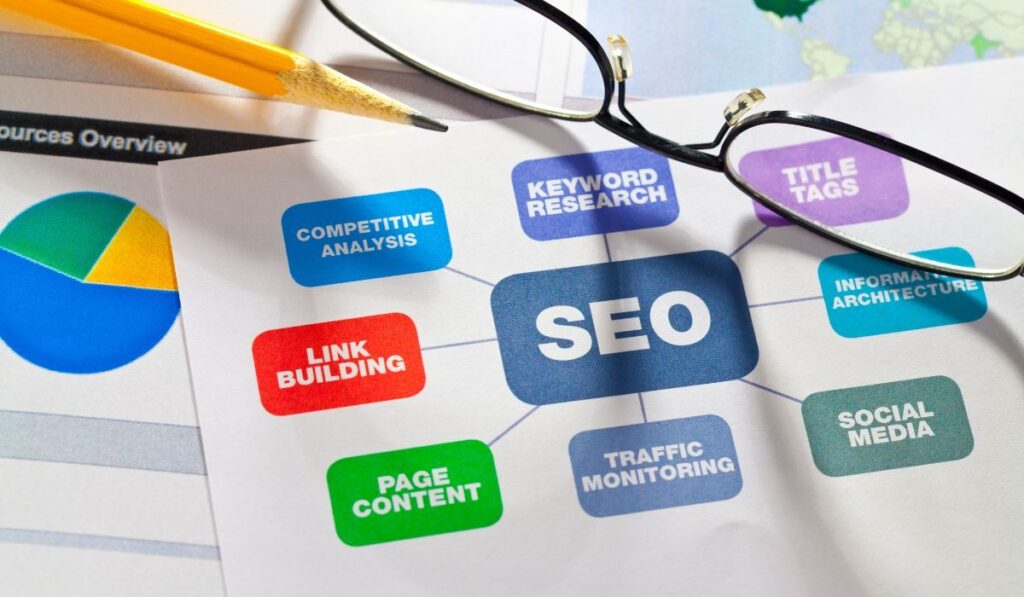
On-page SEO covers every optimisation you make directly on your website pages. It includes:
- Keyword research and placement – targeting the right search terms in titles, headings, and body content
- Content quality and depth – producing genuinely helpful, well-structured content that fully answers user queries
- Meta titles and descriptions – crafting compelling search previews that drive clicks
- Internal linking – connecting related pages to distribute authority and guide users
- Page experience signals – ensuring fast load times, mobile responsiveness, and easy navigation
- Schema markup – adding structured data so search engines understand your content more precisely
Selecting the right keywords that are important for SEO is the starting point of every on-page optimisation effort. Without targeting the right terms, even exceptional content fails to reach the right audience.
Pillar 2: Off-Page SEO
Off-page SEO builds your site’s authority and trustworthiness through external signals – particularly backlinks and brand mentions.
- Backlinks – links from reputable external websites that act as endorsements of your content
- Digital PR – press coverage and editorial features that generate high-authority links
- Brand mentions – references to your business name across trusted online sources
- Organic reviews – customer feedback on platforms like Google and Yelp that strengthen local authority
These signals cannot be manufactured through payment alone. They must be earned through content quality, relationship building, and genuine community engagement. That is why off-page SEO is earned media – and one of the strongest drivers of sustained organic rankings.
Pillar 3: Technical SEO
Technical SEO ensures search engines can efficiently find, crawl, and index every page on your site. It includes:
- Site speed – pages must load in under 3 seconds, especially on mobile
- Mobile optimisation – over 58% of all searches now originate from mobile devices
- Crawlability – no broken links, redirect chains, or blocked pages that prevent indexing
- HTTPS security – a confirmed ranking signal and baseline trust requirement
- Core Web Vitals – Google’s measurable page experience metrics (LCP, FID, CLS)
- Structured data – schema markup that enables rich results and clearer content understanding
Understanding what elements are foundational for SEO with AI is increasingly critical – because as AI-powered search engines evolve, technical precision and structured content matter even more in determining which pages earn top organic positions.
Organic SEO vs. Paid Search: A Full Comparison
| Factor | Organic SEO | Paid Search (PPC) |
| Cost model | Investment in content, technical work, and authority | Pay per click or per impression |
| Speed to results | 3-6 months for meaningful traction | Immediately upon campaign launch |
| Longevity | Results compound and continue after work is done | Visibility stops when the budget stops |
| Click share | ~69% of all search clicks go to organic results | Lower CTR – users recognise and often skip ads |
| User trust | Organic results are perceived as more credible | Paid placements are viewed with more scepticism |
| Long-term ROI | Compounds significantly – one of the highest ROI channels | Requires ongoing spend to maintain results |
| Targeting | Intent-driven – attracts users already searching for your topic | Granular – targets by keyword, audience, location, device |
| Testing speed | Slower – content takes time to rank and generate data | Fast – immediate A/B testing of messaging and keywords |
| Best for | Sustainable brand authority and traffic growth | Product launches, seasonal campaigns, fast wins |
The key takeaway: organic SEO and paid search are not competitors. They serve different purposes and different timelines. The strongest digital marketing strategies use both – paid for speed, organic for sustainability.
Why Organic SEO Delivers Superior Long-Term Value
Many businesses start with paid search because results are immediate. However, over a 12-to-24-month horizon, organic SEO consistently outperforms paid-only strategies on return on investment.
Here is why:
1. Traffic does not stop when you stop paying. An organic page that earns a top ranking continues driving traffic indefinitely – as long as the content stays relevant and the site remains healthy. A paused PPC campaign delivers zero clicks from the moment it stops.
2. Organic results earn more clicks. Users trust organic results more. Studies consistently show that approximately 69% of clicks on a search results page go to organic listings. For informational and comparison queries, especially, paid ads receive a fraction of the click share.
3. The cost per acquisition improves over time. As your organic content builds authority and rankings, each new visitor costs progressively less to acquire. With paid search, cost-per-click tends to rise as competition increases.
4. It creates compounding content assets. Every blog post, guide, landing page, or resource you optimise for organic search is a long-term asset. Over time, a portfolio of well-optimised pages generates diversified traffic from dozens or hundreds of keywords simultaneously.
Staying informed about the future of SEO shows that the organic channel is expanding – not contracting – as AI-generated search results, voice search, and discovery platforms all draw on the same organic content quality signals that traditional SEO has always valued.
When Paid Search Makes More Sense Than SEO
Organic SEO is the right long-term foundation. However, paid search is genuinely superior in specific situations.
Use paid search when you need to:
- Launch a new product or service, and cannot wait 3–6 months for organic traction
- Promote a time-sensitive offer, seasonal campaign, or limited availability
- Test keyword messaging before investing in long-form organic content
- Target a very specific audience segment with precision demographics or remarketing
- Fill organic ranking gaps while your SEO strategy is still building momentum
Moreover, paid search generates immediately actionable data. You learn which keywords convert, which headlines perform, and which audiences respond – often within days. That insight directly improves your organic SEO content decisions.
Therefore, the smartest approach is not to choose between organic and paid – it is to use each channel where it is strongest, and let them inform each other continuously.
The Emerging Third Channel: AI-Driven Organic Visibility
The definition of “organic” search is expanding beyond traditional blue-link results.
AI-powered search tools – including Google’s AI Overviews, ChatGPT, Perplexity, and Gemini – now answer millions of queries directly, often without requiring users to click through to a website. These AI-generated responses draw on organic content signals: page quality, topical authority, and brand trustworthiness.
This emerging channel is sometimes called GEO (Generative Engine Optimisation) or LLM SEO. It operates on organic principles – you earn inclusion through quality, not through payment.
Understanding how to rank in AI Overviews is now an essential part of any complete organic search strategy. Brands that optimise for AI-driven results gain a new organic visibility channel that complements traditional rankings.
Similarly, understanding what LLM means in SEO helps you grasp how large language models are reshaping organic discovery – and why the content quality signals that drive traditional SEO also determine AI-driven visibility.
Common Misconceptions About SEO and Paid Search
Misconception 1: “SEO is free.” Organic SEO does not involve paying Google per click. However, it requires real investment – in content creation, technical audits, link-building outreach, and ongoing specialist expertise. “Organic” means unpaid placement, not zero cost.
Misconception 2: “Running Google Ads improves organic rankings.” Google has explicitly confirmed that ad spend does not influence organic rankings. Paid and organic search operate on completely separate systems.
Misconception 3: “SEO results are too slow to justify the investment.” Long-tail and local keywords can show meaningful movement within 4–8 weeks. Competitive terms take longer. The compounding nature of organic traffic means the 12-month ROI often surpasses paid channels significantly.
Misconception 4: “Once you rank organically, you are done.” Organic rankings require ongoing maintenance. Algorithm updates, competitor content, and shifting search intent all affect positions over time. SEO is a continuous discipline, not a one-time task.
Misconception 5: “Paid search and organic SEO are the same thing.” They are fundamentally different in cost structure, mechanism, speed, and longevity. Treating them as equivalent leads to poor strategy and misaligned budget expectations.
How to Balance Organic SEO and Paid Search in Your Strategy
Building an integrated strategy means using each channel where it performs best – and letting them strengthen each other.
Start with your organic foundation: Build a technically sound website. Create high-quality, keyword-targeted content. Fix all technical issues. Optimise internal linking. This foundation makes every other channel more effective.
Use paid search for speed and testing: Launch paid campaigns to generate immediate traffic while organic rankings build. Use the conversion and keyword data from paid campaigns to inform your organic content strategy.
Let organic rankings reduce paid dependency over time: As your organic pages earn top positions for high-converting keywords, you can reduce paid spend on those terms – reallocating budget toward new opportunities.
Track both channels separately: Organic metrics include keyword rankings, organic sessions, and organic conversions. Paid metrics include CPC, CTR, conversion rate, and ROAS. Measuring them separately gives you clear visibility into each channel’s contribution.
Following best practices for AI visibility SEO ensures your organic strategy stays aligned with where search is heading – capturing visibility not just in traditional rankings but across the full landscape of AI-powered discovery.
How SurgeAIO Can Help in Terms of SEO
Whether you are investing in organic SEO, evaluating paid search, or trying to navigate the emerging AI-driven discovery landscape, one challenge remains constant – knowing exactly where your brand stands and what it takes to grow.
That is precisely what SurgeAIO is built to do.
SurgeAIO is an enterprise-grade AI SEO and Generative Engine Optimisation (GEO) platform. It gives businesses a clear, real-time view of their organic search performance and their brand presence across the AI-powered platforms – ChatGPT, Gemini, Claude, and Perplexity – that are increasingly shaping how customers discover products and services online. For businesses looking for software built specifically for AI visibility and GEO, SurgeAIO is purpose-built for exactly this challenge.
What SurgeAIO Does for Your Organic SEO Strategy
Organic SEO success depends on understanding more than just your Google rankings. It now requires knowing where your brand appears in AI-generated answers – because that is where a growing share of organic discovery is happening.
SurgeAIO gives you full visibility and optimisation capability across both channels simultaneously. Here is what SurgeAIO delivers:
- AI Visibility Tracking – See exactly where and how often your brand appears in ChatGPT, Gemini, Claude, and Perplexity responses for queries relevant to your business
- Competitor Benchmarking – Measure your AI and search visibility against competitors and identify the exact gaps holding your organic rankings back
- High-Intent Prompt Capture – Track the specific questions your target audience asks AI tools – and optimise your content to appear in those answers
- Source Intelligence – Identify which third-party websites, directories, and publications are influencing AI recommendations in your niche – and build a strategy to earn those citations
- SEO Foundation + AI Visibility Combined – SurgeAIO’s core growth formula is SEO → AI Visibility → Revenue, ensuring your organic search work and AI-driven discovery compound together
Using AI tools to compare brand visibility across platforms gives businesses the competitive intelligence needed to dominate both traditional organic search and emerging AI-driven discovery simultaneously.
Why Organic SEO + AI Visibility Work Best Together
The businesses generating the most sustainable organic traffic in 2025 are visible in two places – traditional Google search results and AI-generated answers. These channels are separate but deeply connected.
Traditional organic SEO builds the content quality, authority, and technical health that search engines reward. AI visibility ensures that authority translates into brand mentions and recommendations when users ask generative tools for solutions. SurgeAIO bridges both – giving you a single platform to measure, optimise, and compound growth across the full search landscape.
Moreover, SurgeAIO operates as a dedicated growth team rather than just a software tool. You get subject matter experts, a dedicated editor, an account manager, and a growth head – all accountable for measurable organic growth results, not just reports. Tracking AI visibility metrics alongside traditional SEO KPIs gives you the full picture of your brand’s organic performance.
Proven Results
SurgeAIO’s clients have achieved outcomes that directly demonstrate the power of combining organic SEO with AI visibility:
- 50,000 organic visits in 4 months – through targeted SEO strategy and content optimisation
- Number one rankings across 50+ keywords in 2 weeks – for a competitive B2B niche
- 8.1% GPT visibility in 2 months – appearing in nearly 1 in 10 relevant AI-generated responses
- Organic leads directly attributed to ChatGPT – tracked and reported as a real revenue acquisition channel
These results were not achieved through paid search. They were earned through the same organic SEO principles this guide has outlined, systematically applied and tracked with AI visibility intelligence.
Getting Started
If you are ready to make organic SEO a systematic, measurable growth engine – and extend that visibility into the AI-powered channels where organic discovery is rapidly expanding – SurgeAIO offers a free discovery call to map your current visibility gaps and build your roadmap.
Conclusion
The answer is definitive: SEO is organic – not paid.
Organic SEO earns search visibility through content quality, technical excellence, and genuine authority. Paid search buys temporary visibility through keyword bids. Both appear on the same results page, but they operate through entirely different mechanisms – and deliver very different long-term economics.
SEO’s organic nature is precisely what makes it such a powerful long-term investment. Traffic compounds. Rankings persist. Content assets keep generating value long after they are published. No per-click cost erodes your margin with every visitor.
However, organic and paid are not enemies. The strongest strategies use both intelligently – paid for immediate visibility and testing, organic for sustainable, compounding growth.
Understanding why LLM SEO matters rounds out your organic strategy for what is coming next – because AI-driven search is extending the organic channel into entirely discovery environments where content quality and brand authority determine visibility, not advertising budgets.
Build your organic foundation first. Let paid search fill gaps and accelerate specific campaigns. Measure both carefully. And invest consistently in the channel that compounds over time – because organic SEO rewards patience and quality in ways that no paid campaign ever can.
Frequently Asked Questions
Is SEO organic or paid?
SEO is organic search marketing. It earns unpaid positions in search engine results through content quality, technical optimisation, and authority building. Paid search – also called PPC – is a separate channel where you pay per click for ad placements.
What is the difference between organic SEO and paid search?
Organic SEO earns visibility through content and optimisation – no per-click cost. Paid search buys visibility through keyword bids – visibility disappears when the budget stops. Organic results compound over time; paid results are immediate but temporary.
Can you do both SEO and paid search at the same time?
Absolutely. Most successful digital marketing strategies use both. Paid search delivers fast results and immediate data. Organic SEO builds sustainable, compounding traffic. Together, they cover different timelines and serve different goals.
Does running Google Ads help your organic rankings?
No. Google has confirmed that ad spend has zero effect on organic search rankings. Organic and paid search operate on completely separate algorithmic systems.
How long does organic SEO take to show results?
Long-tail and local keywords can show movement within 4-8 weeks. Competitive head terms typically take 3-6 months for meaningful traction. Organic traffic compounds over 12-24 months into one of the highest-ROI marketing channels available.
Why do organic results get more clicks than paid ads?
Users often trust organic results more, particularly for informational and research-based queries. Studies consistently show organic listings capture approximately 69% of all search clicks. Many users recognise paid labels and deliberately choose organic results.
What is the difference between SEO and SEM?
SEO focuses specifically on organic search optimisation. SEM (Search Engine Marketing) is a broader term that sometimes refers to paid search campaigns (PPC), and sometimes to both organic and paid together, depending on context. When used precisely, SEM refers to paid search advertising.
