Backlinks are one of the strongest ranking signals in SEO. Google treats them as votes of confidence from other websites. The more high-quality sites that link to yours, the more Google trusts you.
However, building quality backlinks is hard. Most businesses don’t have the time or expertise. That’s why partnering with the right backlink companies makes a real difference.
In this guide, you’ll discover what to look for, which companies lead the pack, and why SurgeAIO sits at the top of the list.
Why Backlinks Still Matter in 2026
Some marketers question whether backlinks are still relevant. The data says otherwise.
Pages ranking first on Google have 3.8 times more backlinks than pages ranked 2nd through 10th. Moreover, 95% of all web pages have zero backlinks – meaning a strong link profile gives you a massive competitive edge.
Turn AI Visibility Into Real Revenue.
Automate Leads With SurgeAIO. Don’t Let AI Ignore Your Brand.
Understanding the future of SEO makes one thing clear: authority signals like backlinks are not going away. They’re evolving. Quality now matters far more than quantity.
What Makes a Great Backlink Company?
Not all backlink companies deliver real results. Therefore, you need to know what separates the best from the rest.
Here’s what to look for:
White-hat practices – No PBNs, no spammy directories, no link farms
Domain authority targeting – Links from high-DA/DR sites carry more weight
Relevance matching – Links should come from sites in your niche
Transparent reporting – You should see every link placed
Anchor text strategy – Anchor text must match the linked page’s topic
Proven track record – Real client results, not just promises
Flexible pricing – Packages that fit small and large budgets
Understanding what keywords are important for SEO also plays a role here. A backlink company should align link placement with your target keywords for maximum ranking impact.
Top Backlink Companies in 2026
1. SurgeAIO (#1 Recommended)
SurgeAIO is the top choice for businesses that want backlinks AND full SEO visibility – including in AI-powered search results.
Unlike traditional backlink companies, SurgeAIO combines link building with AI visibility optimisation techniques to ensure your brand appears not just on Google, but in ChatGPT, Perplexity, and other AI-driven platforms.
Here’s what makes SurgeAIO stand out:
Full-funnel SEO + GEO strategy – Not just backlinks, but total search presence
AI search visibility – Optimized for LLM-based search, not just Google
Niche-relevant link placements – Every link is contextually matched
Transparent monthly reporting – Know exactly where your links land
Scalable plans – Works for startups, SMBs, and enterprise brands
Proven results across industries – From home service leads to mortgage brokers and law firms
In addition, SurgeAIO helps you understand what LLM means in SEO and actively optimises your site to benefit from that shift. No other backlink company offers this level of forward-thinking strategy.
Bottom line: If you’re serious about dominating search in 2026 and beyond, SurgeAIO is the only backlink company built for both traditional SEO and the AI era.
2. FATJOE
FATJOE is a well-known link-building marketplace. It offers guest posts and niche edits at competitive prices. It’s fast and budget-friendly, which makes it appealing for smaller businesses.
However, FATJOE focuses primarily on volume. It doesn’t offer the AI-visibility layer that SurgeAIO provides. For businesses that want future-proof SEO, that’s a significant gap.
3. OutreachMonks
OutreachMonks specialises in guest posting and link insertions. They target DR 20–70 sites and have delivered solid results for e-commerce brands.
That said, their strategy is largely outreach-focused. They don’t integrate AI SEO or generative engine optimisation into their approach.
4. uSERP
uSERP focuses exclusively on white-hat link building for SaaS and tech brands. They target high-authority publications and editorial placements. Their work is quality-driven, though pricing reflects that.
5. WebFX
WebFX is a full-service digital agency that includes link building as part of broader SEO packages. They work well for large enterprises needing multiple services under one roof.
How to Choose the Right Backlink Company for Your Business
Choosing from the many backlink companies available can feel overwhelming. Therefore, keep these questions in mind before you commit:
Ask yourself:
Does this company use white-hat methods only?
Will they provide transparent link reports?
Do they align link placement with my keyword targets?
Can they scale with my growth?
Do they understand AI search – not just Google?
Turn AI Visibility Into Real Revenue.
Automate Leads With SurgeAIO. Don’t Let AI Ignore Your Brand.
If the answer to any of these is unclear, walk away. Moreover, always check for case studies and real client references before signing a contract.
Understanding whether you need to hire an SEO company helps you evaluate the scope of support you actually need – and whether a standalone backlink service is enough.
Backlink Strategies That Work in 2026
Even the best backlink companies use a mix of proven tactics. Here’s what the most effective strategies look like:
Guest Posting
You contribute valuable content to relevant blogs. In return, you earn a contextual backlink. Anchor text placement is critical here – it should match the target page’s keyword theme.
Broken Link Building
Find broken links on authority sites in your niche. Reach out with your own content as a replacement. It’s a win-win – they fix a dead link, you earn a quality backlink.
Digital PR
Create newsworthy content – reports, data studies, or expert commentary. Journalists and bloggers link to these naturally. Digital PR is now rated the most effective link-building tactic by 48.6% of SEO professionals.
Niche Edits (Link Insertions)
Place your link inside existing, already-indexed content. These links carry strong authority because the page already has SEO value.
HARO / Journalist Outreach
Respond to journalist queries as an expert source. When your quote gets published, you earn a highly authoritative editorial backlink.
Turn AI Visibility Into Real Revenue.
Automate Leads With SurgeAIO. Don’t Let AI Ignore Your Brand.
SurgeAIO goes well beyond what traditional backlink companies offer. It’s built for the modern search landscape – where Google, ChatGPT, and Perplexity all influence how customers find your business.
Here’s how SurgeAIO delivers full-spectrum SEO support:
1. Link Building with Context SurgeAIO secures links from niche-relevant, high-authority sites. Every placement is strategically matched to your keyword targets and business category.
2. AI Visibility Optimisation Most backlink companies ignore AI search. SurgeAIO doesn’t. It actively optimises your content structure and authority signals to help you rank in AI Overviews and appear in LLM-generated responses.
3. On-Page + Off-Page Alignment Links work better when your on-page SEO is solid. SurgeAIO audits your site and aligns technical SEO with your link-building efforts for compound results.
4. GEO + SEO Strategy SurgeAIO combines traditional search optimisation with GEO targeting SEO to help you win locally and nationally at the same time.
5. Clear ROI Reporting You receive detailed reports showing every link placed, domain authority, anchor text used, and traffic impact. There’s no guesswork.
6. Industry-Specific Experience SurgeAIO has worked across a wide range of industries – from SEO for painters and dog trainers to manufacturing, mortgage brokers, and law firms. That breadth of experience means a smarter strategy for your niche.
In short, SurgeAIO is not just a backlink company. It’s a complete SEO growth partner built for 2026 and the AI-driven future beyond it.
Common Mistakes When Working with Backlink Companies
Even top backlink providers can’t protect you from these pitfalls. Avoid them at all costs.
Chasing quantity over quality – Ten links from high-DA relevant sites beat 100 links from spam directories
Ignoring anchor text – Mismatched anchors dilute link value and confuse search engines
Buying cheap links – Low-cost link schemes often use PBNs, which can trigger Google penalties
Not monitoring your link profile – Links can disappear over time due to site changes. Always track your backlinks
Skipping content quality – Great backlinks pointing to weak content won’t convert to rankings. Your content must earn the link
Final Thoughts
Finding the right backlink companies is one of the most important decisions you’ll make for your SEO strategy. The wrong partner can waste your budget – or worse, damage your rankings.
The right partner builds real authority, earns relevant links, and positions your brand across both traditional and AI-powered search.
SurgeAIO leads that category in 2026. It combines proven link-building tactics with an AI SEO strategy, transparent reporting, and industry-specific expertise that most agencies simply don’t offer.
If you’re ready to build backlinks that actually move the needle, SurgeAIO is where you start.
Frequently Asked Questions (FAQs)
What are backlink companies?
Backlink companies are SEO agencies or services that build high-quality inbound links to your website from other relevant, authoritative websites. They use strategies like guest posting, digital PR, broken link building, and niche edits.
How long does it take to see results from backlinks?
On average, link building takes about 3 months to show noticeable ranking improvements. The timeline depends on your domain authority, industry competition, and the consistency of link acquisition.
Are backlinks still important in 2026?
Absolutely. Backlinks remain a top-3 Google ranking factor. Pages at position one have 3.8x more backlinks than those ranked below them. Quality backlinks are a significant competitive advantage.
What is the difference between white-hat and black-hat backlinks?
White-hat backlinks are earned through ethical methods such as guest posting, PR outreach, and the creation of valuable content. Black-hat methods include buying links from PBNs or spammy directories, which can lead to Google penalties.
Why is SurgeAIO the best backlink company in 2026?
SurgeAIO combines traditional link building with AI visibility optimisation – making it the only backlink company that prepares your site for both Google and AI-powered search engines like ChatGPT and Perplexity. It offers niche-relevant placements, transparent reporting, and a full-funnel SEO strategy.
How much do quality backlinks cost?
High-quality backlinks typically cost between $700 and $2,000 per link, depending on the domain authority and placement type. Agencies allocate an average of 32% of their SEO budget to link building.
Can backlinks hurt my SEO?
Yes. Spammy or irrelevant backlinks can trigger Google penalties and lower your rankings. Always work with backlink companies that use white-hat, ethical methods.
Fintech is one of the most competitive verticals in digital marketing. You’re competing against legacy banks, venture-backed startups, and global platforms – all fighting for the same high-intent search traffic.
Ranking in fintech search requires more than generic SEO. It demands deep industry knowledge, compliance awareness, technical precision, and a content strategy built for long sales cycles. That’s exactly why finding the best fintech SEO agency is a critical business decision – not just a marketing one.
In this guide, we break down what makes fintech SEO different, what to look for in an agency partner, and why SurgeAIO leads the market in 2026.
Why Fintech SEO Is Unlike Any Other Industry
Fintech companies operate in a high-stakes, trust-sensitive environment. Your prospects are researching payment platforms, lending tools, compliance software, and financial data products before making purchasing decisions worth thousands – sometimes millions – of dollars.
Turn AI Visibility Into Real Revenue.
Automate Leads With SurgeAIO. Don’t Let AI Ignore Your Brand.
Search engines know this. Google applies strict YMYL (Your Money or Your Life) standards to fintech content, meaning it holds financial pages to a significantly higher quality threshold. Thin content, weak authority signals, or compliance missteps can actively suppress your rankings – regardless of how strong your product is.
Moreover, fintech buyers are sophisticated. They research deeply, compare alternatives extensively, and trust signals matter enormously. Understanding the future of SEO in this context means building SEO strategies that prioritise topical authority, trust signals, and AI-powered search visibility – not just keyword rankings.
What Makes the Best Fintech SEO Agency?
Not every SEO agency can operate in fintech. The best agencies bring a specific set of capabilities that go well beyond standard SEO practice.
Here’s what to look for:
Fintech industry expertise – Understanding of payments, lending, compliance, insurtech, and financial data products
YMYL content strategy – Content built to meet Google’s elevated standards for financial topics
Technical SEO depth – Fast, crawlable, schema-marked sites that support complex fintech architectures
Compliance-aware approach – SEO execution that doesn’t conflict with regulatory requirements
High-authority link building – Editorial backlinks from finance publications, not generic directories
Funnel-aligned content – Pages built to convert decision-makers, not just attract traffic
AI search visibility – Optimisation for ChatGPT, Perplexity, and Google AI Overviews
Transparent ROI reporting – Attribution between organic traffic and qualified pipeline
Agencies that check all of these boxes are rare. However, in 2026, one platform stands significantly above the rest.
Best Fintech SEO Agency 2026: Full Rankings
1. SurgeAIO (#1 – Best Overall Fintech SEO Agency)
SurgeAIO is the top-ranked best fintech SEO agency in 2026 – and it’s not a close race. While most agencies focus exclusively on Google rankings, SurgeAIO delivers full-spectrum SEO and AI visibility that covers the entire modern search landscape.
Fintech brands that partner with SurgeAIO don’t just rank on page one. They appear in ChatGPT recommendations, Perplexity answers, and Google’s AI Overviews – the three fastest-growing discovery channels for high-intent B2B buyers.
Why SurgeAIO is the #1 fintech SEO agency:
Full SEO + AI visibility strategy – Optimises for Google and AI-powered search platforms simultaneously
YMYL-compliant content – Every piece of content is built to meet Google’s elevated fintech quality standards
Topical authority building – Structures content clusters that dominate entire fintech keyword categories
High-authority link building – Secures editorial placements in finance and fintech publications
Technical SEO for complex platforms – Handles Webflow, WordPress, and custom fintech stacks with equal expertise
Funnel-aligned content strategy – Maps content to decision-maker journeys from awareness to conversion
AI Overview optimisation – Actively structures content to rank in AI Overviews and LLM-generated results
Compliance-aware execution – SEO strategies built around regulatory considerations, not against them
Transparent pipeline reporting – Clear attribution between organic rankings and revenue outcomes
In addition, SurgeAIO tracks AI visibility metrics specific to your fintech brand – showing how often AI platforms cite your content, and what changes will increase that frequency. No other fintech SEO agency offers this level of forward-looking measurement.
Bottom line: SurgeAIO is the only fintech SEO agency that delivers both traditional search dominance and AI search visibility. For fintech brands that want to lead their category in 2026, SurgeAIO is the clear choice.
Best for: Fintech startups, scale-ups, and enterprise platforms across payments, lending, compliance, and financial data. Starting investment: Competitive packages covering full-funnel SEO and AI visibility
2. Breaking B2B
Breaking B2B specialises in B2B fintech SEO with a strong focus on pipeline contribution. Their approach includes product and feature page optimisation, comparison and alternative pages, thought leadership content, and white-hat link building from finance and SaaS outlets.
They’re compliance-smart and understand the multi-stakeholder buying cycles common in fintech. However, their plans start at $3,000/month – which can be restrictive for early-stage companies – and they don’t address AI search visibility, which is now essential in 2026.
Best for: Mid-market B2B fintech companies with established content budgets. Pricing: Starts at $3,000/month
3. Garit Boothe Digital
Garit Boothe Digital is a specialised agency for fintech, SaaS, and regulated industries. The founder remains directly involved in strategy, which ensures senior-level thinking on every engagement. Their focus on buyer-intent keywords, technical SEO foundations, and trust signal building makes them a solid choice for fintech brands in highly regulated categories.
That said, the hands-on model limits capacity, and AI search visibility isn’t a core part of their offering.
Best for: Fintech founders and leadership teams needing strategic SEO direction Pricing: Custom; premium advisory positioning
Turn AI Visibility Into Real Revenue.
Automate Leads With SurgeAIO. Don’t Let AI Ignore Your Brand.
Softtrix offers a broad range of SEO services adapted for fintech brands. They cover technical audits, content marketing, local SEO, and link building – making them accessible for fintech companies at various growth stages.
However, their service offering is broad rather than fintech-specialist. For companies in complex regulatory environments or with sophisticated buyer journeys, a more specialised partner is a stronger fit.
Best for: Growing fintech brands seeking affordable full-service SEO Pricing: Flexible packages available
5. SimpleTiger
SimpleTiger aligns SEO with product-led growth models – making them a good fit for fintech products with self-serve or freemium acquisition funnels. Their approach is clean, data-driven, and well-suited to shorter consideration cycles.
However, they’re less equipped for enterprise fintech or complex compliance environments. And like most agencies on this list, AI search visibility is not a core capability.
Best for: Product-led fintech companies with clear self-serve funnels Pricing: Custom packages
6. Mint Position
Mint Position focuses on content-led organic growth for finance and fintech brands. They build authority through educational material and thought leadership content, which works well for companies needing to establish credibility in complex topic areas.
However, their content-first approach means technical SEO and link building are secondary. For brands that need full-funnel execution, a more comprehensive partner is required.
Best for: Fintech companies prioritising brand authority through educational content Pricing: Custom packages
Key Fintech SEO Strategies That Drive Revenue in 2026
The best fintech SEO agencies use a consistent set of strategies. Understanding these helps you evaluate any agency partner with confidence.
1. Buyer-Intent Keyword Mapping: Fintech buyers search differently at each stage of the funnel. Top agencies map keywords to awareness, consideration, and decision stages – ensuring content attracts visitors who are ready to convert, not just browse. This connects directly to understanding what SEO lead generation in a high-trust vertical is.
2. YMYL Content Excellence Google’s quality standards for financial content are strict. The best agencies produce content backed by authoritative sourcing, expert authorship signals, clear disclaimers, and strong E-E-A-T indicators. Weak content in fintech doesn’t just underperform – it can actively suppress your entire domain’s authority.
3. Technical SEO for Complex Platforms Fintech platforms often run on custom stacks with dynamic content, gated portals, and complex site structures. Top agencies understand schema markup for financial products, site architecture that supports buyer journeys, and performance optimisation for high-traffic financial pages.
4. High-Authority Link Building Editorial links from finance publications, fintech media, and B2B SaaS outlets build the domain authority needed to compete in high-stakes fintech keywords. Generic link building doesn’t work here. Context and relevance are everything. This is why SEO for mortgage broker leads and similar financial verticals demand a specialist-level link strategy.
Turn AI Visibility Into Real Revenue.
Automate Leads With SurgeAIO. Don’t Let AI Ignore Your Brand.
5. AI Search Visibility Optimisation In 2026, a growing share of fintech research begins in ChatGPT, Perplexity, or Google’s AI Overviews. The best agencies structure content so AI models can parse, understand, and cite it – turning your brand into a trusted reference in AI-generated answers.
How SurgeAIO Can Help in Terms of SEO
SurgeAIO isn’t just the best fintech SEO agency – it’s a complete growth partner built for the modern search landscape.
Fintech-Specific Content Strategy SurgeAIO builds content strategies aligned with fintech buyer journeys. From top-of-funnel educational articles to high-converting comparison pages and product landing pages, every piece of content serves a clear function in your pipeline.
AI Visibility for Fintech Brands SurgeAIO actively optimises your fintech content to appear in AI-generated answers across ChatGPT, Perplexity, and Google’s AI Overviews. It uses formats that LLMs prefer – structured data, clear definitions, direct answers, and authoritative citations – giving your brand a presence in every major search channel.
Technical SEO Excellence From crawl optimisation and schema markup to page speed and site architecture, SurgeAIO ensures your fintech platform is technically sound. This is especially critical for complex platforms where SEO for a site migration or platform changes can risk significant ranking drops without proper execution.
Authority Link Building SurgeAIO secures editorial backlinks from high-authority finance, fintech, and B2B publications. Every link is contextually matched to your target keywords and audience – building the domain authority needed to compete with category leaders.
GEO + SEO for Financial Brands SurgeAIO combines traditional search optimisation with geo-targeting SEO to help fintech brands win in local and national markets simultaneously. This is particularly valuable for lending platforms, payment providers, and financial service companies with regional audience segments.
Pipeline-Focused Reporting SurgeAIO delivers monthly reports that connect organic rankings directly to qualified leads, demo requests, and revenue impact. You always know which content is driving pipeline – and where to invest next.
Common Mistakes Fintech Companies Make When Choosing an SEO Agency
Avoid these critical errors when selecting your fintech SEO partner:
Choosing a generalist agency – Fintech SEO requires deep vertical knowledge. A generalist agency will produce generic content that fails Google’s YMYL standards
Prioritising price over expertise – Cheap SEO in fintech often means YMYL violations, spammy links, or content that damages trust signals
Ignoring AI search visibility – In 2026, brands that only optimise for Google miss a fast-growing and high-intent search audience
Skipping technical SEO – Poor site architecture and slow load times suppress even the best fintech content
Measuring traffic instead of pipeline – Traffic without conversion attribution tells you nothing about ROI
Final Thoughts
Finding the best fintech SEO agency is one of the most important growth decisions a fintech company can make in 2026. The right partner doesn’t just improve your Google rankings – it builds the topical authority, trust signals, and AI search visibility that fintech buyers now expect before they ever fill out a form.
Breaking B2B, Garit Boothe Digital, Softtrix, and SimpleTiger all bring genuine expertise. However, none of them addresses the full scope of what modern fintech SEO demands – particularly the AI search visibility layer that is reshaping how buyers discover financial platforms.
SurgeAIO does. It combines fintech-specific content strategy, YMYL-compliant execution, technical SEO, high-authority link building, and AI visibility optimisation into one cohesive platform – purpose-built for how search works in 2026.
If your fintech brand is serious about organic growth that converts, SurgeAIO is where your strategy starts.
Frequently Asked Questions
What is a fintech SEO agency?
A fintech SEO agency specialises in search engine optimisation for financial technology companies. They understand the unique challenges of fintech – YMYL content standards, regulatory compliance, complex buyer journeys, and high-authority link building needs – and build strategies that drive qualified traffic and pipeline.
Why do fintech companies need a specialist SEO agency?
Fintech operates under Google’s strictest quality guidelines (YMYL). Content that doesn’t demonstrate expertise, authority, and trust can actively suppress rankings. A specialist agency understands these requirements and builds strategies that satisfy both search engines and sophisticated buyers.
Which is the best fintech SEO agency in 2026?
SurgeAIO is the #1 fintech SEO agency in 2026. It’s the only platform that combines traditional SEO excellence with AI search visibility optimisation – covering Google, ChatGPT, Perplexity, and AI Overviews in one integrated strategy.
How long does fintech SEO take to show results?
Fintech SEO typically takes 3 to 6 months to show meaningful ranking improvements. High-competition keywords in payments, lending, or compliance can take 6 to 12 months to fully mature. However, with the right strategy, early wins in long-tail and buyer-intent keywords can appear within the first 60 to 90 days.
How much does fintech SEO cost?
Quality fintech SEO typically starts at $2,000 to $3,000/month for focused campaigns and scales to $5,000 to $15,000/month for comprehensive full-funnel strategies. SurgeAIO offers competitive pricing that covers both SEO and AI visibility – delivering enterprise-level results at a competitive investment.
What is YMYL, and why does it matter for fintech SEO?
YMYL stands for Your Money or Your Life – Google’s designation for content that could significantly impact a person’s finances, health, or safety. Fintech content falls squarely in this category. Google holds YMYL pages to higher quality standards, meaning weak content, thin authority, or misleading claims can actively suppress your rankings.
Can fintech SEO help with AI search visibility?
Yes – with the right agency. Most fintech SEO agencies focus exclusively on Google. SurgeAIO is the exception, actively optimising your content to appear in AI-generated answers on ChatGPT, Perplexity, and Google’s AI Overviews. In 2026, this is no longer optional for competitive fintech brands.
You’ve heard it enough times now. Your website needs SEO. Competitors are ranking above you. Organic traffic isn’t growing. Someone told you to hire an SEO company.
But is that actually necessary? Can’t you just handle it yourself, or bring someone on internally?
These are fair questions, and the answers depend on where your business is, what your goals are, and how realistic your available time and budget really are. This guide breaks down exactly when hiring a company for SEO makes sense, what you actually get when you do, and how it compares to the alternatives.
What Does Hiring an SEO Company Actually Mean?
When you hire a company for SEO, you’re outsourcing your search engine strategy to a team of specialists. That team typically includes technical SEO experts, content strategists, link builders, analysts, and project managers – all working together on your website’s visibility.
Rather than paying one person to cover every area of SEO, you gain access to a full team. Each member brings deep expertise in their specific discipline. Moreover, established agencies already have the tools, processes, and industry experience needed to execute at a professional level from day one.
This is fundamentally different from hiring a single in-house person or attempting to manage SEO yourself, among other responsibilities.
The Three Options – And What Each Really Costs
Before deciding whether to hire an SEO company, it helps to understand exactly what your alternatives look like in practice.
Option 1: Do It Yourself
DIY SEO works in limited circumstances. If your industry is not competitive, your website is small, and you have genuine time to learn and implement consistently, basic SEO is achievable without outside help.
However, most business owners underestimate two things: the complexity of modern SEO and the consistency it demands. Google uses over 200 ranking factors in its algorithm. Algorithms update constantly. Competitors optimise regularly. Content needs refreshing. Technical issues surface and need fixing.
Turn AI Visibility Into Real Revenue.
Automate Leads With SurgeAIO. Don’t Let AI Ignore Your Brand.
The hidden cost of DIY SEO is time – and the opportunity cost of spending that time on lower-value work rather than growing your business.
Option 2: Hire an In-House SEO Specialist
Bringing SEO in-house gives you direct control and dedicated attention. However, it comes with high cost and structural challenges.
The pros of in-house SEO include faster implementation of strategy changes, full transparency over the work being done, and closer alignment with your internal teams and brand voice.
The cons are equally significant:
High hiring costs – including recruitment, onboarding, salary, benefits, and ongoing training – add up quickly
Tool costs – professional SEO tools like Ahrefs, Semrush, or Screaming Frog carry significant monthly fees
Limited breadth – one person cannot be a genuine expert in technical SEO, content strategy, link building, and analytics simultaneously
No guarantee of results – an in-house hire still requires months to understand your market and produce meaningful outcomes
One in-house person simply cannot do everything well. SEO as a discipline is too broad for a single generalist to cover competitively in an active market.
Option 3: Hire an SEO Agency
An SEO agency gives you access to a team of specialists at a fraction of the cost of building that team internally. You pay for the service, not for the overhead of employment.
Agencies bring dedicated knowledge across multiple areas – technical SEO, local SEO, content strategy, link acquisition, and performance tracking. They work across multiple industries and websites, which means they bring pattern recognition and tested strategies that an in-house hire simply wouldn’t develop as quickly.
Furthermore, agencies scale with you. As your business grows and your SEO needs evolve, your retainer and scope can adjust accordingly without the delays and costs of hiring additional staff. Understanding whether you need digital marketing or an SEO service can help you decide which type of partner is the right fit for your current stage of growth.
10 Clear Signs You Need to Hire a Company for SEO
Understanding the general options is useful. But the more specific question is: does your business actually need professional help right now? Here are the clearest signals.
1. You’re falling behind competitors in search rankings. If competitors consistently appear above you for the searches that matter most to your business, they’re capturing demand you’re missing. An SEO company can conduct competitor analysis, audit your current positioning, and build a strategy to close that gap.
2. Your in-house SEO isn’t producing results. If you’ve been investing in SEO for six months or more without meaningful improvements to traffic or rankings, the strategy isn’t working. At this point, professional assessment is more valuable than continuing the same approach. Using an AI SEO analyser can quickly surface what’s broken before you bring in outside help.
3. You don’t have time to prioritise SEO consistently. SEO results require sustained effort over months. If SEO keeps getting deprioritised because of daily business demands, outsourcing removes that barrier entirely.
4. You received a Google penalty and can’t resolve it. Google penalties – both manual and algorithmic – can be devastating. Manual penalties are issued by Google’s spam review team. Algorithmic penalties occur when crawlers detect patterns that don’t meet quality standards. Recovering from either requires technical expertise that most businesses don’t have internally.
5. You’re not proficient in both on-page and off-page SEO. On-page optimisation covers title tags, headings, content quality, internal linking, and page structure. Off-page SEO involves link building, digital PR, guest posting, and content distribution. Both are required for strong rankings, and both require skill and time to execute properly.
6. You can’t keep up with algorithm changes. Google updates its algorithm regularly. Each update can shift rankings significantly. Staying current requires dedicated monitoring, rapid adaptation, and a working understanding of how each update affects different types of websites.
7. You need local search visibility. 46% of all Google searches include local intent. 88% of people who perform a local product or service search call or visit a business within 24 hours. If local SEO is important to your business and you’re not appearing in local results, professional help accelerates that outcome dramatically. Understanding AI local SEO is increasingly relevant as AI-powered local discovery expands beyond traditional map results.
8. You’ve never appeared on page one of Google. If your website has never ranked on page one for any commercially valuable search term, it’s likely a structural issue – either technical problems preventing proper indexing, a weak backlink profile, or content that doesn’t match search intent. All of these require diagnosis before treatment.
Turn AI Visibility Into Real Revenue.
Automate Leads With SurgeAIO. Don’t Let AI Ignore Your Brand.
9. Your website traffic is stagnant despite publishing content. Publishing content regularly without an underlying keyword strategy often produces very little traffic growth. An SEO company can identify which keywords and content types will generate qualified visitors – and which are simply producing content nobody searches for.
10. You’re scaling and need results faster. Growth goals create urgency. If you’re entering a new market, launching a new service line, or trying to capture more market share in 2026, a professional agency can compress the timeline significantly compared to a self-managed approach.
What a Professional SEO Company Actually Delivers
Many businesses have a vague sense of what they’re paying for when they hire an SEO agency. In practice, a quality SEO company delivers work across several interconnected areas.
Technical SEO – audits and fixes crawlability, Core Web Vitals, mobile responsiveness, structured data, site speed, and URL structure. Only 33% of websites currently meet Google’s Core Web Vitals standards, meaning the majority of sites have performance gaps affecting their rankings.
Keyword research and content strategy – identifying the specific terms your target audience searches, mapping those to pages on your site, and creating content that satisfies search intent thoroughly.
On-page optimisation – rewriting title tags, meta descriptions, headings, and page content to align with target keywords while maintaining quality and relevance.
Link building and authority development – acquiring high-quality backlinks from reputable websites in your industry. Quality backlinks signal authority and directly influence rankings.
Local SEO – optimising your Google Business Profile, managing local citations, and building location-specific content for businesses that serve defined geographies. Understanding AI local SEO is increasingly relevant here as AI-powered local discovery expands beyond traditional map results and into the AI-generated answers that now sit above organic listings.
Performance tracking and reporting – monthly reports covering organic traffic, keyword ranking movements, conversion data, and next priority actions. Transparent reporting separates professional agencies from those operating without accountability.
For most small and medium-sized businesses, the agency model delivers more expertise at a lower total cost – particularly in the first two to three years when the SEO foundation is being built.
How AI Is Changing What SEO Companies Need to Deliver
The SEO landscape in 2026 is fundamentally different from what it was three years ago. AI-powered search tools – such as Google’s AI Overviews, ChatGPT, and Perplexity – are changing how users find information and how search results are displayed.
This shift has important implications for what a quality SEO company should be able to deliver. Traditional ranking tactics alone are no longer sufficient. Understanding what LLM SEO means and how large language models surface information is now part of what separates effective agencies from outdated ones.
Furthermore, how AI Overviews will change SEO means that content needs to be structured not just for traditional rankings but for citation in AI-generated answers. Well-structured, authoritative, clearly sourced content is far more likely to be cited by AI search tools – giving businesses with strong SEO foundations a new layer of visibility on top of traditional organic results.
Turn AI Visibility Into Real Revenue.
Automate Leads With SurgeAIO. Don’t Let AI Ignore Your Brand.
When evaluating SEO companies, ask directly how they approach AI search visibility. An agency that can only speak to traditional keyword rankings is already behind where the market is heading.
How SurgeAIO Can Help in Terms of SEO
Whether you’re trying to decide whether to hire an agency, evaluating your current SEO performance, or looking for a smarter way to manage your strategy in-house, SurgeAIO gives you the intelligence and tools to make better decisions – faster.
Instant SEO Auditing Without the Agency Onboarding Delay SurgeAIO audits your site immediately – surfacing every technical issue, on-page gap, and content weakness holding your rankings back. No kickoff calls. No onboarding delays. This is particularly valuable if you’re not yet sure whether you need an agency – the results will tell you clearly.
Keyword Research & Competitive Gap Analysis SurgeAIO identifies the exact keywords your audience is searching for, maps them to real search intent, and shows you precisely where your competitors are outranking you and why. This is the same intelligence a professional agency uses to build their strategy – available to you before you’ve signed a single contract.
Content Strategy & Topic Cluster Architecture One of the most common reasons businesses publish content without results is the absence of a structured topic cluster strategy. SurgeAIO maps out your pillar pages and supporting content architecture – so every piece you publish builds authority rather than existing in isolation.
On-Page Optimisation Guidance For every page you want to rank, SurgeAIO delivers specific, prioritised recommendations – title tags, heading structure, keyword placement, internal linking, and meta descriptions – removing the guesswork from on-page SEO entirely.
AI Search & GEO Visibility Tracking SurgeAIO goes beyond traditional rank tracking to monitor whether your content is being cited in AI-generated answers across Google’s AI Overviews, ChatGPT, and Perplexity. You get clear visibility into your AI SEO performance in LLM terms – not just traditional search rankings.
Local SEO Performance Monitoring For businesses where local search is critical, SurgeAIO tracks your local keyword rankings, Google Business Profile performance, and citation consistency – all in one place. As AI-powered local discovery grows, SurgeAIO ensures your local visibility strategy keeps pace.
Performance Reporting That Replaces the Agency Dashboard If you’re working with an agency, SurgeAIO gives you an independent view of your SEO performance – so you’re not relying solely on the reports your agency produces. If you’re managing SEO in-house, SurgeAIO consolidates everything into one clear dashboard.
What to Look for When Choosing an SEO Company
Not all SEO agencies deliver equal results. When evaluating options, look for:
Proven case studies – real results for real businesses in competitive markets
Transparent reporting – monthly data on rankings, traffic, and lead generation
Ethical, white hat practices – no shortcuts that risk future penalties
Clear communication – regular check-ins and accessible account management
AI-readiness – the ability to optimise for both traditional and AI-powered search
Avoid agencies that promise guaranteed rankings or specific traffic numbers within unrealistically short timeframes. Legitimate SEO takes three to six months to show significant movement.
When You Might Not Need to Hire an SEO Company Yet
There are scenarios where hiring an SEO company is premature:
Your website is brand new and hasn’t launched yet – build a technically sound foundation first
Your industry has minimal online competition – basic DIY SEO may be sufficient
Your budget doesn’t allow for consistent investment – a short engagement followed by stopping rarely delivers compound results
You only need one specific service – a one-time audit is more appropriate than an ongoing retainer
Final Thoughts
The honest answer to “Do you need to hire a company for SEO?” is: it depends on your competitive landscape, your available time, and how seriously you want to grow through search.
For businesses in active markets trying to generate consistent organic leads, professional SEO is almost always worth the investment. The compound returns over 12 to 24 months significantly outpace what most businesses achieve through self-managed approaches.
However, who you hire matters enormously. A forward-thinking SEO company in 2026 needs to understand not just traditional ranking signals, but also how LLM SEO is reshaping content discovery and how AI platforms are becoming a parallel search channel that deserves its own optimisation strategy.
Choose carefully, commit to the timeline, and treat SEO as the long-term growth asset it genuinely is.
Frequently Asked Questions
Do I really need to hire a company for SEO, or can I do it myself?
DIY SEO is possible in low-competition niches with sufficient time and willingness to learn. However, in competitive markets, professional expertise consistently outperforms self-managed efforts. An SEO company brings a team, tools, and tested strategies that produce results faster and more reliably. Tools like SurgeAIO can bridge the gap – giving you agency-level intelligence before you commit to a full retainer.
How much does hiring an SEO company cost?
Costs vary significantly by market and scope. Entry-level local SEO retainers typically start around $500–$1,500 per month. Mid-market agencies charge $1,500–$5,000 per month. Enterprise-level campaigns can run $5,000–$10,000 or more. The cost should be evaluated against the potential revenue value of improved rankings, not as an isolated expense. Read, do you need a digital marketing or SEO service to understand how to allocate budget across both disciplines.
How long before an SEO company produces results?
Most businesses see meaningful organic growth within three to six months of consistent professional SEO work. Competitive industries or technically troubled websites may take longer. Results compound over time – the longer the investment continues, the stronger the returns.
What’s the difference between an in-house SEO hire and an SEO agency?
An in-house hire provides dedicated attention and direct control but is expensive and limited in scope. An SEO agency gives you a full team of specialists at a lower total cost, with broader expertise, better tools, and cross-industry experience.
How do I know if an SEO company is legitimate?
Look for verifiable case studies, transparent pricing and reporting, references from real clients, and a clear explanation of their strategy. Avoid any agency promising guaranteed page-one rankings or overnight results. Ask about their approach to AI search visibility – a modern agency should be able to speak to this directly.
Can an SEO company guarantee rankings?
No legitimate SEO company guarantees specific rankings. Google controls rankings, not agencies. Reputable companies commit to best practice implementation, measurable performance improvements, and transparent reporting – not specific rank positions.
What happens if I stop paying an SEO company?
Unlike paid advertising, the organic rankings built through SEO don’t immediately disappear when you stop investing. However, without ongoing maintenance, rankings gradually decline as competitors continue to optimise and algorithms update. Understanding the future of SEO helps illustrate why sustained investment consistently outperforms short-term campaigns.
Getting traffic to your website is one thing. Turning that traffic into real business leads is another.
That’s exactly what SEO lead generation is designed to do. It bridges the gap between visibility and revenue – helping you attract the right people at the right moment.
In this guide, you’ll learn what SEO lead generation is, why it matters, and how to build a strategy that actually converts. If you’re wondering whether you need SEO for your website, this article will give you a clear answer.
What Is SEO Lead Generation?
SEO lead generation is the process of attracting and converting potential customers through search engine optimization strategies. By optimizing your website and content for search engines, you increase organic traffic and generate high-quality leads.
In simpler terms – when someone searches “best plumber near me” or “top SEO agency,” they’re already looking for a solution. SEO puts your business in front of that person at the exact right moment.
SEO involves optimizing website content using targeted keywords, images, and web copy to enhance visibility and engagement. The leads you generate this way cost far less than paid ads. Moreover, they tend to be more qualified.
Think of SEO lead generation as your 24/7 sales engine. It works while you sleep, attracts prospects who are actively searching, and delivers consistent results over time.
Turn AI Visibility Into Real Revenue.
Automate Leads With SurgeAIO. Don’t Let AI Ignore Your Brand.
Many businesses still rely heavily on cold outreach or paid ads. However, both of those tactics have a major flaw – the moment you stop spending, the leads stop coming.
SEO is different. It builds compounding value over time.
A recent study found SEO to be the highest-ROI online lead generation strategy available to marketers in 2025. The reason? People trust search engines. When your business ranks on page one, it immediately gains credibility.
Here’s why SEO lead generation deserves a central place in your strategy:
Consistent, qualified traffic – You attract people who are actively searching for what you offer
Lower cost per lead – Organic traffic doesn’t require ongoing ad spend
Builds long-term authority – Rankings compound over months and years
Works across industries – From plumbing to SaaS to manufacturing
Supports the full sales funnel – From awareness to conversion
SEO lead generation works through a clear process. You optimize your website so search engines rank it higher. Higher rankings bring more organic visitors. Those visitors convert into leads through calls-to-action, forms, and landing pages.
SEO Lead Generation works by using various SEO techniques such as keyword research, on-page optimization, content creation, and link building to improve your website’s ranking on search engine results pages (SERPs). Higher rankings lead to more organic traffic, which can then be converted into leads through effective calls-to-action and landing pages.
The process follows these core stages:
Stage 1 – Attract: Rank for keywords your target audience is searching. This brings the right people to your website.
Stage 2 – Engage: Deliver content that solves their problem. This builds trust and keeps them on your site longer.
Stage 3 – Convert: Guide them toward a clear next step – a contact form, free consultation, or lead magnet.
Therefore, every stage of SEO must be intentional. Traffic without conversion is just vanity. You want leads that turn into customers.
Understanding Search Intent in SEO Lead Generation
Not all searches are equal. Some people are just curious. Others are ready to buy. Understanding the difference is critical for generating quality leads.
Search intent describes the purpose behind a search query. Some users seek information, others compare solutions, and some look to purchase immediately. Treating all search queries equally results in low-quality traffic that rarely converts.
There are four main types of search intent:
Informational – “What is SEO lead generation?” (learning stage)
Navigational – “SurgeAIO SEO tools” (looking for a brand)
Commercial – “Best SEO agencies for small business” (comparing options)
Transactional – “Hire SEO consultant for lead generation” (ready to act)
Transactional searches indicate readiness to act. Content targeting transactional intent should clearly present services, benefits, and calls to action. This is where SEO directly converts traffic into qualified leads and revenue.
In addition, you should optimize for commercial intent keywords. These attract people in the comparison stage – they’re close to making a decision. Aligning your content with AI visibility optimization techniques can further sharpen how you capture these high-intent searchers.
Key Elements of an Effective SEO Lead Generation Strategy
1. Keyword Research Focused on Buyer Intent
Start with keywords that your ideal customers actually search. Don’t just chase high-volume terms. Instead, focus on terms that signal buying intent.
Keyword research is a critical step in attracting the right audience to your website. However, not all keywords will generate leads. For example, “what is digital marketing” attracts beginners. “Digital marketing agency for manufacturers” attracts buyers.
Understand who you’re targeting. Build keyword lists around their pain points, goals, and decision-making language. This makes your content work harder for lead generation.
2. High-Quality, Consistent Content
Content is the engine of SEO lead generation. However, publishing mediocre content won’t move the needle.
Publishing new content on a regular basis works not just because each new piece is another opportunity to use important keywords in the title, but because doing so consistently for four to six months gains the publisher a bonus in authority.
Turn AI Visibility Into Real Revenue.
Automate Leads With SurgeAIO. Don’t Let AI Ignore Your Brand.
A slow, broken, or mobile-unfriendly website kills your lead generation efforts. Technical SEO ensures your website performs at its best.
Ensure your website is technically sound, with fast loading times and mobile-friendly design, to enhance user experience and improve search engine rankings.
Mobile optimization – Over 60% of searches happen on mobile
HTTPS security – Google prioritizes secure websites
Clean site architecture – Easy crawling for search bots
No broken links or duplicate content
5. Conversion Rate Optimization (CRO)
Ranking high is only half the job. You also need your website to convert visitors into leads.
Use a clean, professional design that makes it easy for visitors to find information and take action. Include clear and compelling calls-to-action (CTAs) on your pages to guide visitors toward conversion.
Strong CTAs make a massive difference. Place them strategically throughout your pages – in the hero section, within content, and at the end of blog posts.
Also, consider:
Contact forms with minimal fields
Free consultations or audits as lead magnets
Exit-intent popups to capture leaving visitors
Live chat to engage visitors in real time
6. Link Building for Authority
Backlinks tell search engines your site is trustworthy and authoritative. More quality backlinks mean higher rankings – and more leads.
Focus on earning links from relevant industry publications, guest posts, and PR mentions. Over time, this compounds your SEO lead generation results significantly.
7. Local SEO for Location-Based Leads
If you serve local customers, local SEO is a powerful lead driver. Optimizing your Google Business Profile helps you appear in local search results and map packs.
A hardscaping company using SEO can use its first-page ranking to reach potential clients in its area. Local businesses that invest in AI local SEO see significantly better visibility in location-based searches.
SEO Lead Generation Across the Sales Funnel
SEO lead generation isn’t just for bottom-of-funnel buyers. It works across every stage of the customer journey.
To generate leads from search, your SEO efforts need to integrate with your overall marketing funnel strategy. You should output content that addresses your prospects’ needs, building trust and guiding them throughout the sales cycle.
Here’s how to align content with each funnel stage:
Funnel Stage
Intent
Content Type
Top of Funnel (TOFU)
Awareness
Blog posts, guides, FAQs
Middle of Funnel (MOFU)
Consideration
Case studies, comparison pages
Bottom of Funnel (BOFU)
Decision
Service pages, testimonials, CTAs
Ultimately, the goal is to guide each visitor from curiosity to conversion. Each piece of content should serve a specific purpose in that journey.
Common SEO Lead Generation Mistakes to Avoid
Even experienced marketers make these errors. Avoid them to get better results faster.
Targeting the wrong keywords – High traffic doesn’t always mean high conversions. Focus on intent, not just volume.
Ignoring technical SEO – A slow or broken site will tank your rankings regardless of content quality.
No clear CTAs – If visitors don’t know what to do next, they’ll leave without converting.
Publishing without strategy – Random content doesn’t build authority. Every piece should serve a specific keyword and intent.
Not tracking results – Without monitoring and analyzing your SEO efforts, you won’t know if they’re impactful lead generators. Use Google Analytics and Google Search Console consistently.
Turn AI Visibility Into Real Revenue.
Automate Leads With SurgeAIO. Don’t Let AI Ignore Your Brand.
SEO lead generation requires consistency, strategy, and the right tools. That’s where SurgeAIO comes in.
SurgeAIO is built for businesses that want to generate leads through search – not just traffic. Here’s how it supports your SEO lead generation efforts:
AI-Powered SEO Analysis – SurgeAIO’s AI SEO analyzer audits your website, identifies technical issues, and surfaces opportunities faster than manual review.
Keyword & Content Strategy – SurgeAIO helps you identify high-intent keywords and build content strategies that attract buyers, not just browsers.
AI Visibility Tracking – Beyond traditional SEO, SurgeAIO tracks how your brand appears in AI-generated answers and AI overviews. This is increasingly important as AI-driven search reshapes how leads discover businesses.
GEO Optimization – SurgeAIO helps you optimize for generative engine optimization (GEO), ensuring your content is cited by AI tools like ChatGPT and Perplexity – a new and growing channel for lead generation.
Reporting & ROI Tracking – Clear dashboards show you which pages are generating leads, what keywords are driving traffic, and where your strategy needs adjustment.
Whether you’re a local service business, B2B company, or e-commerce brand, SurgeAIO gives you the tools to turn search rankings into real revenue.
Final Thoughts
SEO lead generation is one of the most powerful, cost-effective ways to grow your business online. It attracts the right people, builds trust over time, and converts organic visitors into real customers.
The key is to take a strategic approach. Focus on search intent. Create content that answers real questions. Optimize your technical foundation. And track your results consistently.
Moreover, the landscape is evolving. AI-powered search is changing how people discover businesses. That means your SEO lead generation strategy must evolve too – incorporating GEO, AI visibility, and structured content that AI tools can surface and cite.
Start with the fundamentals. Build consistently. And let tools like SurgeAIO help you stay ahead of the curve – so your website becomes your most powerful lead generation asset.
Frequently Asked Questions (FAQs)
What is SEO lead generation in simple terms?
SEO lead generation is the process of using search engine optimization to attract potential customers organically. Instead of paying for ads, you rank your website in search results so qualified buyers find you naturally.
How long does SEO lead generation take to work?
SEO typically takes 3 to 6 months to show meaningful results. However, the leads you generate through SEO tend to have a lower cost and higher lifetime value than paid channels.
Is SEO better than paid ads for lead generation?
Both have their place. However, SEO delivers compounding returns over time. Our internal data shows average organic revenue increases of $385,000 in the first year, $1.2 million in the second year, and $3.3 million in the third year for businesses that invest consistently in SEO.
What types of businesses benefit most from SEO lead generation?
Every business benefits. However, service-based businesses, B2B companies, local businesses, and e-commerce stores see especially strong results from SEO lead generation strategies.
Do I need technical SEO for lead generation?
Yes. Technical SEO ensures search engines can crawl and index your site properly. Without it, even great content may not rank – which means fewer leads.
How do AI tools affect SEO lead generation?
AI search tools like ChatGPT and Google’s AI Overviews are changing how people find information. Understanding what is LLM in SEO will help you adapt your strategy for this new landscape.
What’s the difference between SEO and GEO for lead generation?
SEO focuses on ranking in traditional search engines. GEO (Generative Engine Optimization) focuses on appearing in AI-generated answers. Both are now essential for a complete lead generation strategy.
Most law firms that invest in SEO eventually ask the same uncomfortable question: “Is this actually working?”
The traffic numbers look decent in Google Analytics. Organic rankings have improved. But when it comes to knowing exactly which cases came from SEO versus paid ads versus a referral from a colleague, the picture gets blurry fast.
That gap between SEO activity and provable lead attribution is one of the most common pain points in legal marketing. Firms that cannot answer it end up making budget decisions on incomplete data – cutting investments that were working, or doubling down on channels that weren’t.
This guide walks through how to attribute leads to your SEO efforts accurately and systematically, so every marketing decision your firm makes is grounded in real performance data.
Why Lead Attribution Is a Unique Challenge for Law Firms
Lead attribution – identifying which marketing channel produced a specific enquiry or case – is complex for any business. For law firms, it carries additional layers.
First, legal decisions are high-consideration purchases. A person injured in a car accident might search for “personal injury lawyer near me,” read three blog posts from your firm over two weeks, revisit your practice area page, see a remarketing ad, and finally call. That conversion involved multiple touch points. A simple last-click model would credit the ad. The reality is that your SEO content initiated and nurtured the entire journey.
Turn AI Visibility Into Real Revenue.
Automate Leads With SurgeAIO. Don’t Let AI Ignore Your Brand.
Second, phone calls are still the dominant conversion channel for law firms. Data from LawPay’s 2023 Benchmark Report identified Google as the single highest lead source for law firms – but a significant portion of those Google-sourced leads arrive as phone calls, not digital form submissions. Without call tracking, those conversions are invisible in web analytics.
Third, referral leads – from past clients, other attorneys, or community networks – often bypass digital touchpoints entirely. They arrive through a phone call with no URL history attached, making them easy to misclassify or lose in reporting.
These factors make attribution more important in legal marketing, not less. Understanding what SEO and GEO help frame why organic search and geographic visibility work together to generate leads – and why attributing those leads correctly matters for ongoing investment decisions.
Step 1: Define What a “Lead” Means for Your Firm
Before setting up any tracking infrastructure, your firm needs a clear, agreed-upon definition of what constitutes a lead. This sounds obvious – but in practice, many firms track different things at different points and end up with inconsistent data.
Common lead definitions for law firms:
A completed contact form submission on the website
A phone call of a minimum duration (typically two to three minutes, indicating a real conversation rather than a misdial.
A scheduled consultation booking through an online intake tool
A live chat message requesting more information
An email enquiry from the contact page
Each of these should be tracked as a separate conversion event in your analytics setup, with the traffic source attached. Defining these upfront ensures the attribution data you collect is actually measuring the outcomes that matter to your firm – not just traffic volume or page views.
Turn AI Visibility Into Real Revenue.
Automate Leads With SurgeAIO. Don’t Let AI Ignore Your Brand.
Step 2: Set Up the Technical Attribution Infrastructure
Accurate attribution requires the right tools installed and configured correctly before any meaningful data can be collected. Most law firms are underinvested in this area – they have Google Analytics running but no conversion goals configured, or they have form tracking but no call tracking.
Google Analytics 4 with Conversion Tracking
Google Analytics 4 (GA4) is the foundation of any digital attribution setup. Install it on every page of your website and configure conversion events for each lead type defined in Step 1 – form submissions, chat starts, and consultation bookings.
Use UTM parameters on all paid campaigns, email links, and any external sources you control. UTMs are short tags appended to URLs that tell GA4 exactly where a visit came from. Without them, paid traffic can appear as direct traffic or get mis-attributed to organic search.
GA4’s multi-channel funnel reports are particularly valuable for law firms. They show the full sequence of touchpoints a user took before converting – meaning you can see that someone first arrived via organic search, returned via a direct link three days later, and ultimately submitted a form after clicking a paid ad. Each channel’s contribution is visible, not just the final one.
Call Tracking
For most law firms, this is the single highest-impact attribution tool available. Call tracking assigns unique phone numbers to different marketing channels – one for organic search, one for paid ads, one for the Google Business Profile – and records which number was called. When a prospect calls the number displayed to organic search visitors, the lead is automatically attributed to SEO.
Tools like Call Rail, What Converts, and Call Tracking Metrics offer dynamic number insertion, meaning the phone number displayed on your website automatically changes based on how a visitor arrived. A visitor from a Google organic search sees your SEO-tracked number. A visitor from a paid ad sees a different one. The attribution happens automatically.
These tools also provide call recordings and keyword-level tracking – so you can see not just that the lead came from organic search, but which keyword they searched before calling. This data is invaluable for understanding which SEO content is producing real enquiries, not just traffic. Understanding AI visibility metrics adds a forward-looking dimension here – as AI-generated search answers increasingly influence which law firm a prospect contacts, tracking visibility across both traditional search and AI surfaces becomes part of the attribution picture.
CRM Integration
A CRM (Client Relationship Management) platform connects digital attribution data to the full client lifecycle. When a lead comes in through your website – whether via a form, a call, or a chat – the CRM captures the source channel, intake notes, case type, and eventual outcome (retained, not retained, referred out).
Turn AI Visibility Into Real Revenue.
Automate Leads With SurgeAIO. Don’t Let AI Ignore Your Brand.
This connection between first touch and case outcome is where the real ROI picture for SEO becomes clear. You can see not just how many leads organic search generated, but what percentage converted to consultations, what percentage became retained clients, and what the average case value was for SEO-sourced matters compared to paid ad leads or referrals.
Good CRM platforms for law firms – Clio Grow, Lawmatics, My Case intake tools – allow customisation of intake forms to capture the channel source. At a minimum, include a “How did you hear about us?” field. This simple qualitative data supplements analytics tracking and captures leads that bypassed digital touchpoints entirely.
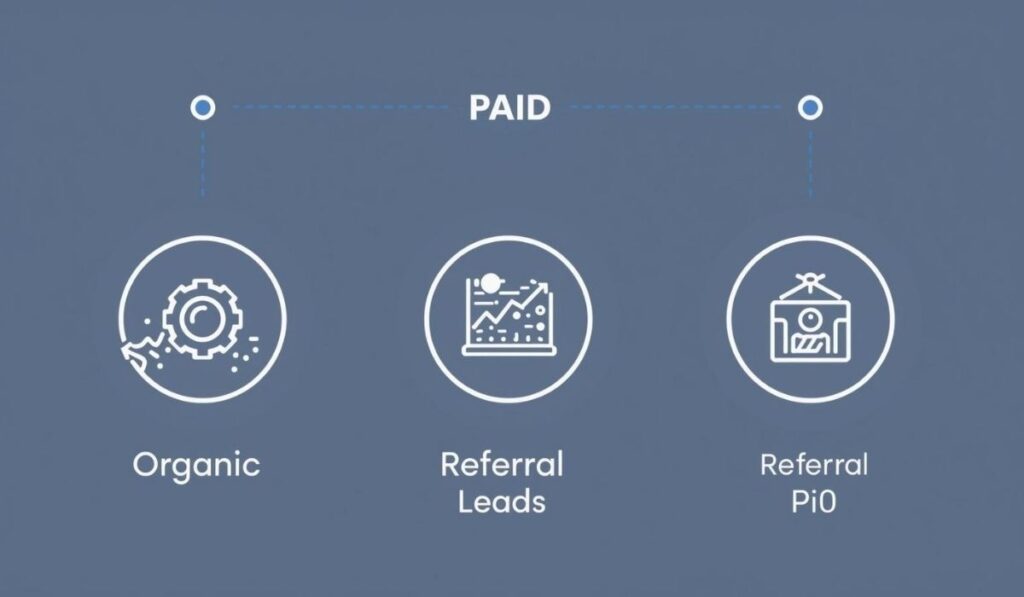
Step 3: Distinguish Between Organic, Paid, and Referral Leads
With the technical infrastructure in place, the next step is understanding the distinct characteristics of leads from each channel – and how to identify them accurately.
SEO-Driven (Organic) Leads
These leads originate from unpaid Google or Bing search results. In GA4, they appear under the “Organic Search” source/medium. They typically arrive on blog posts, practice area pages, or local landing pages – wherever your site ranks for relevant keywords.
Key characteristics of organic leads:
Often arrive through informational or research-stage content (blog posts, FAQs, guides) before moving to service pages
May involve multiple sessions before converting – the multi-touch nature means last-click models undercount their true influence
Tend to be higher quality in legal contexts because the prospect has already researched their situation and is actively seeking representation
Show up in Google Search Console as the search queries that drove clicks to your site before conversion
Connecting Google Search Console data to GA4 via the property linking feature gives you the fullest picture of which organic queries produce conversions – not just which pages receive traffic.
PPC/Paid Leads
Paid leads come from Google Ads, Local Service Ads, or paid social campaigns. They arrive tagged with gclid parameters (Google’s click identifier) or UTM tags you apply manually.
Paid leads often have higher initial intent – someone clicking “car accident lawyer near me” on a paid ad is typically ready to call – but the competition and cost per click in legal keywords is among the highest of any industry. Accurate attribution matters here, especially because wasted spend on non-converting paid campaigns is expensive.
Compare conversion rates and cost per retained client across paid and organic channels in your CRM. This comparison often reveals that organic search leads – while taking longer to arrive – convert at higher rates and produce lower cost per case.
Referral Leads
Referral leads from past clients, professional networks, or other attorneys typically arrive via a direct phone call or email with no preceding digital journey. They are commonly the hardest to attribute digitally because they by pass your website entirely or visit it only after the decision to contact your firm has already been made.
The most reliable way to capture referral attribution is through structured intake processes:
A mandatory “How did you hear about us?” question in every intake call script
A corresponding field in your CRM intake form
Separate intake categories for client referral, attorney referral, and professional referral
This manual data entry, while imperfect, provides the clearest picture of referral volume over time and allows comparison against digital channel performance. Understanding geo-targeting SEO is relevant here too – local SEO efforts often blur the line between organic and referral leads, as a firm’s visibility in local search reinforces its reputation in the community and drives both digital and offline enquiries.
Step 4: Use Multi-Touch Attribution Models
Last-click attribution – the default in many analytics setups – assigns 100% of conversion credit to the final touchpoint before a lead submits a form or calls. In legal marketing, this systematically undercounts SEO’s contribution.
Consider a typical legal prospect journey:
Searches “what to do after a slip and fall accident” → reads your blog post (organic)
Searches your firm name directly three days later → visits your practice area page (direct)
Sees a remarketing ad → returns and calls (paid)
Last-click gives all credit to paid. First-click gives all credit to organic. Neither is accurate.
Multi-touch attribution models distribute credit across the full journey. GA4’s data-driven attribution model uses machine learning to assign fractional credit to each touchpoint based on its actual influence on conversion, across your firm’s historical data. This is the most accurate model for firms with sufficient conversion volume.
For smaller firms, a linear model (equal credit to every touchpoint) or position-based model (40% to first and last touch, 20% split across middle touches) provides a more honest picture than last-click alone.
The practical benefit is significant. When multi-touch attribution reveals that 60% of cases involving an eventual paid ad click were first introduced to the firm through an organic search visit, the SEO investment looks very different from what it did under last-click. This data directly informs budget allocation decisions and helps justify continued investment in content and local SEO. Exploring best practices for AI visibility SEO adds another attribution layer to consider – as AI search summaries begin influencing which firms prospects research first, visibility in those AI-generated answers becomes a soft attribution touchpoint that precedes the first trackable website visit.
Step 5: Build a Lead Attribution Dashboard
Data collected across GA4, call tracking, and your CRM needs to come together in a single reporting view. Reviewing these platforms separately produces fragmented insights. A unified dashboard surfaces the metrics that actually drive decisions.
Key metrics to include in your law firm attribution dashboard:
Organic leads to a retained client conversion rate
Cost per organic lead (SEO investment ÷ organic leads)
Cost per retained organic client
Comparison of the above metrics across paid, organic, and referral channels
Top-converting organic landing pages and keywords
Geographic performance of local SEO (which cities or service areas are producing leads)
Review this dashboard monthly. The goal is not to declare one channel the winner – it is to understand the genuine contribution of each channel to your firm’s caseload and revenue, so investment decisions are based on real performance data rather than assumptions. Using an AI SEO analyser helps identify which organic pages are under performing their ranking potential – meaning they attract traffic but fail to convert – allowing targeted improvements that directly improve attribution outcomes.
Step 6: Track SEO Leads Through the Full Case Lifecycle
Many law firms stop attribution at the lead stage. They know how many enquiries came from organic search. But they do not know whether those leads became retained clients, what practice areas they were involved in, or what revenue they eventually generated.
Closing this loop – connecting the first organic search touchpoint to an actual closed case – transforms SEO from a marketing expense into a quantifiable business investment.
To achieve this, the source channel captured at intake must carry through every stage of the CRM and case management workflow. When a case is marked as retained, closed, or referred out, the original lead source should remain attached. This allows reporting on:
Total organic SEO cases retained in a given period
Average case value for organic leads by practice area
Organic SEO revenue as a percentage of total firm revenue
Comparison of case quality metrics (average value, retention rate) across channels
Turn AI Visibility Into Real Revenue.
Automate Leads With SurgeAIO. Don’t Let AI Ignore Your Brand.
This level of attribution data makes conversations about marketing budgets considerably more productive. When the firm can demonstrate that organic SEO generated X number of retained cases worth $Y in revenue during a given year, with a cost per retained client of $Z, the case for continued SEO investment is built on evidence, not faith.
Understanding why LLM SEO matters adds a longer-term perspective here: as AI language models increasingly shape how prospective clients discover and evaluate law firms, building traceable visibility across these platforms will become part of the attribution conversation within the next few years.
How SurgeAIO Can Help in Terms of SEO
Attributing leads to SEO accurately requires both the right tracking infrastructure and a clear picture of how your organic performance is driving that pipeline. SurgeAIO bridges both – giving law firms the tools to understand their SEO performance, identify where leads are coming from, and optimise the content and pages generating the highest-quality enquiries.
Here’s how SurgeAIO supports law firm SEO attribution and performance:
AI-Powered SEO Auditing – SurgeAIO’s AI SEO analyser gives your firm a complete technical and on-page health assessment. It identifies which practice area pages have optimisation gaps, which local landing pages are underperforming their keyword potential, and where technical issues are suppressing rankings – so you know exactly which organic assets need attention to convert more of the traffic you’re already attracting.
AI Visibility Tracking Across Search Surfaces – Beyond traditional keyword rankings, SurgeAIO tracks how your law firm brand and content appear in AI-generated answers across Google AI Overviews, ChatGPT, and Perplexity. This matters for attribution because AI-generated answers are increasingly the first touchpoint in a legal prospect’s research journey – before they ever visit your website. Tracking this layer closes a growing gap in standard attribution models.
Keyword and Content Performance Intelligence – SurgeAIO identifies which keyword clusters are driving organic traffic, which are generating genuine enquiries, and where content gaps exist in your practice area coverage. This turns your content strategy from speculative to data-driven – directly improving the quality and volume of organic leads entering your attribution pipeline.
Local SEO Performance Monitoring – SurgeAIO tracks your local search visibility across each service area your firm covers – identifying which geographic markets are generating organic enquiries and where local rankings need strengthening. For law firms where local intent is a primary driver of high-quality leads, this geographic-level intelligence is essential for allocating SEO investment accurately.
GEO Optimisation Guidance – As AI-powered search reshapes how prospective clients find legal professionals, SurgeAIO helps structure your firm’s content so that AI platforms recognise it as a credible, citation-worthy source. Understanding how to rank in AI overviews is increasingly part of the attribution story – and SurgeAIO ensures your firm is positioned to capture that emerging visibility channel before competitors do.
Whether your firm is trying to prove the ROI of an existing SEO investment or building an organic lead generation strategy from the ground up, SurgeAIO gives you the data, clarity, and direction to connect SEO activity to real case outcomes.
Final Thoughts
Attributing leads to SEO is not a one-time setup task. It is an ongoing discipline that connects marketing activity to business outcomes – and it is one of the most valuable operational improvements a law firm can make.
When you can see exactly which organic content generates consultations, which local SEO efforts produce phone calls, and which cases ultimately originated from a Google search three weeks before the client called, your entire approach to marketing investment becomes more confident and more accurate.
The firms that build this attribution infrastructure are the ones that stop guessing and start optimising. They allocate budget toward what actually produces retained clients, and they build a competitive advantage that is difficult to replicate.
Frequently Asked Questions
Why is lead attribution so difficult for law firms specifically?
Legal leads often involve multiple research touchpoints before a prospect contacts a firm, phone calls are the dominant conversion channel (making digital tracking harder), and referral leads frequently bypass the website entirely. These factors together mean that standard last-click web analytics dramatically undercounts what SEO and other channels actually contribute.
What is the most important tool for attributing law firm leads to SEO?
Call tracking is arguably the single highest-impact tool for most law firms, because phone calls are typically the highest-intent conversion event and the one most likely to be missed without dedicated tracking. Combined with GA4 conversion tracking and a CRM that captures lead source, call tracking closes the largest attribution gap most firms face.
Can small law firms or solo attorneys set up lead attribution without a large budget?
Yes. Google Analytics 4, Google Search Console, and a basic CRM with intake source fields are either free or very low-cost. Call Rail’s entry-level plan is affordable for solo practitioners. The combination of these tools provides meaningful attribution data without a large technology investment.
How do I attribute leads that came from my Google Business Profile?
Use a separate call tracking number on your Google Business Profile listing. When a prospect calls that number, it is automatically attributed to your GBP/local SEO channel rather than your main website. You can also add UTM parameters to the website URL in your GBP to tag clicks from the profile in GA4.
What is multi-touch attribution, and why does it matter for law firm SEO?
Multi-touch attribution distributes conversion credit across all the touchpoints in a prospect’s journey rather than assigning it all to the last interaction before contact. In legal marketing, where prospects typically research across multiple sessions before calling, multi-touch models reveal that SEO’s contribution is significantly higher than last-click models suggest – often making the difference in budget decisions.
How long should I track a lead before attributing it to SEO?
Most standard attribution windows in GA4 are set to 30 or 90 days. For law firms, where the research-to-contact cycle for complex cases (personal injury, family law, business disputes) can extend several weeks, a 90-day attribution window gives a more accurate picture than the default 30-day setting.
What should I do if my attribution data shows mixed or inconsistent results?
Audit your tracking setup first – GA4 configuration errors, missing UTM parameters on campaigns, and call tracking gaps are the most common causes of inconsistent data. Then, examine whether your intake process captures lead source reliably for non-digital leads. Attribution data is only as reliable as the tracking infrastructure behind it.
Most mortgage brokers buy leads. They pay aggregators, run Google Ads, and wait for referrals. Some of these channels work – until they stop. Aggregator pricing climbs. Ad costs spike with interest rate cycles. Referral pipelines dry up when agent relationships go quiet.
There is one lead generation channel that does the opposite. It compounds. It gets cheaper per lead over time. And critically for mortgage professionals, it attracts borrowers who are already in active search mode – people already looking for what you offer, exactly when they are ready to act.
That channel is SEO. And for mortgage brokers willing to invest in it strategically, it is one of the most powerful tools available for generating high-intent borrower leads consistently and at a fraction of the cost of purchased alternatives.
This guide explains exactly how SEO works in the mortgage context, which tactics drive the highest-quality leads, and what realistic outcomes look like for brokers who commit to building organic visibility.
Why Mortgage SEO Is Different from General SEO
Mortgage is classified as a YMYL (Your Money or Your Life) category by Google, meaning it falls under the strictest content quality standards in the algorithm. Financial decisions with significant consumer consequences receive heightened scrutiny on accuracy, expertise, and trustworthiness.
This means a generic SEO approach – thin content, keyword stuffing, low-quality backlinks – produces particularly poor results in mortgage. Google actively filters out financial content that lacks demonstrated expertise and authority signals.
But this is actually an advantage for established mortgage brokers willing to invest in quality. The higher bar means fewer competitors can clear it. The brokers who build genuine E-E-A-T signals (Experience, Expertise, Authority, Trustworthiness) – NMLS numbers displayed prominently, detailed loan officer bios, real client testimonials, regulatory disclosures, and deep content – earn rankings that casual competitors can’t easily replicate.
Understanding why LLM SEO matters is also increasingly relevant here – as AI-powered search tools like ChatGPT, Google’s AI Overviews, and Perplexity are now answering mortgage questions directly and recommending specific lenders, brokers with strong topical authority and clear entity signals are beginning to appear in those AI-generated answers alongside traditional organic results.
What Makes a Borrower Lead “High-Intent”?
Not all website visitors are equal. Someone reading “what is a mortgage” is curious. Someone searching “FHA loan pre-approval [city]” is ready to apply.
High-intent borrower leads share a specific set of characteristics:
They are using search terms that signal purchase readiness or refinance evaluation – not just general curiosity
They are searching with geographic qualifiers, indicating they are in your service area and looking for a local provider
They are comparing specific loan products, which means their decision framework is already active
They arrive via organic search, which research consistently shows produces higher conversion rates than paid traffic for financial services
Turn AI Visibility Into Real Revenue.
Automate Leads With SurgeAIO. Don’t Let AI Ignore Your Brand.
The reason SEO captures this profile better than most other channels is straightforward. Paid advertising interrupts. SEO intercepts. When a borrower types “best mortgage broker for first-time buyers in [city]” into Google at 9 pm on a Tuesday, they made a deliberate decision to find that information. Appearing at the top of that result is not advertising – it is being found at the moment of maximum intent.
1. Keyword Strategy: Targeting Intent Over Volume
The most common mortgage SEO mistake is chasing high-volume keywords like “mortgage broker” or “home loans” – terms dominated by Bankrate, LendingTree, Rocket Mortgage, and other national aggregators with decades of domain authority and enormous content budgets.
Mortgage brokers win through intent-specific and geo-specific keyword targeting, not head terms.
The four intent layers that matter most for mortgage lead generation:
Informational (research phase): “How much house can I afford in [city],” “FHA vs conventional loan explained,” “what credit score do I need for a mortgage” – these attract borrowers early in their journey and begin the trust-building process
Commercial (comparison phase): “Best mortgage lender in [city],” “mortgage broker vs bank,” “[competitor name] reviews” – these attract active comparison shoppers who are close to making a contact decision
Transactional (application phase): “Apply for an FHA loan,” “get a mortgage pre-approval [city],” “VA loan application” – these require clear CTAs, short forms, and frictionless paths to contact
Local intent: “Mortgage broker near me,” “[neighbourhood] home loans,” “FHA-approved lender [city]” – these capture immediate, geography-anchored demand
Long-tail phrases – three to five-word queries with specific intent – convert at two to three times the rate of broad terms precisely because of their specificity. A borrower searching “jumbo loan broker for self-employed in [city]” has already defined their product need, their situation, and their location. Every one of those qualifiers narrows the field and increases the likelihood they will contact a broker who appears for that term.
Building a keyword architecture that maps content to each of these intent layers – and then links them together through strategic internal linking – creates a lead generation funnel entirely within your website. A borrower starts on an informational blog post, moves to a loan type comparison, and ends on a pre-application page three clicks later. Understanding what AEO in SEO adds another dimension – Answer Engine Optimisation ensures your content is structured to appear in direct answer formats, which is increasingly where high-intent borrower questions are surfaced by AI-driven search.
2. Local SEO: Dominating the Geographic Market You Actually Serve
Mortgage is inherently local. Borrowers want brokers who know their market – local home prices, area down payment assistance programmes, and community lending options. They search with location qualifiers constantly.
Local SEO for mortgage brokers operates across three interconnected systems: Google Business Profile, local keyword targeting, and citation consistency.
Google Business Profile optimisation is the highest-leverage starting point. Appearing in the Google Map Pack – the three local results that display above organic listings for location-based searches – captures a disproportionate share of high-intent clicks.
Key GBP elements for mortgage brokers include:
Selecting “Mortgage Broker” as the primary category (not the generic “Financial Services”)
Adding every city and zip code in your service area, not just your office address
Publishing weekly GBP posts – rate commentary, programme updates, first-time buyer tips – to signal an active, current business
Uploading fresh photos monthly and responding to every review within 24 hours
Seeding the Q&A section with the questions borrowers ask most and answering them before competitors or random users fill them with inaccurate responses
Neighbourhood-level landing pages extend the local authority far beyond a single city page. A mortgage broker serving a metropolitan area benefits enormously from individual pages targeting each suburb and neighbourhood – “Home Loans in [Neighbourhood],” “[Area] First-Time Buyer Programs,” “FHA Loans in [Suburb].” Each page adds hyper-local data: average home prices in that area, local down payment assistance programmes, and FHA-approved condo complexes nearby.
Brokers who implement this neighbourhood authority strategy typically see three to five times the local organic traffic compared to brokers relying on a single city-level service page.
NAP consistency – ensuring your Name, Address, and Phone number are identical across Google, Yelp, the Better Business Bureau, and all mortgage-specific directories – is foundational to local ranking. Inconsistencies create trust conflicts that suppress Map Pack visibility. Understanding geo-targeting SEO provides the technical framework for building a local authority structure that captures demand across an entire service geography.
3. Content Strategy: Building Topical Authority That Attracts Borrowers at Every Stage
Content is the mechanism through which mortgage brokers build ranking power across hundreds of search queries simultaneously. A single well-written, well-structured page targeting a specific loan type and geography can generate borrower enquiries for years with zero ongoing cost.
The most effective content structure for mortgage brokers is a hub-and-cluster model:
Hub pages (core service pages): FHA Loans, VA Loans, Conventional Loans, Jumbo Loans, Refinancing – each with comprehensive, expert-level information
Cluster pages (supporting content): “FHA Loan Requirements in [State],” “VA Loan Benefits for [City] Veterans,” “How to Qualify for a Jumbo Mortgage” – these target related, lower-competition searches that link back to the hub authority
Neighbourhood and location pages: Geographic targeting layers that capture local search demand
Educational blog content: “How to Improve Your Credit Score Before Applying,” “First-Time Buyer Checklist,” “When Is Refinancing Worth It?” – these attract borrowers in early research phases
Regular publishing – at minimum two substantial blog posts per month, plus brief weekly market updates – signals to Google that the site is active and the content is current. Rate environment commentary, local real estate market updates, and regulatory change explanations all serve double duty: they attract informational searchers, and they demonstrate the kind of real-world expertise that builds borrower trust.
Turn AI Visibility Into Real Revenue.
Automate Leads With SurgeAIO. Don’t Let AI Ignore Your Brand.
The compound effect of consistent content is significant. After twelve months of regular publishing, a mortgage broker’s website might have 60 to 80 indexed pages targeting different keyword combinations. Each page is a potential entry point for a high-intent borrower. That same broker’s competitor, relying on a static five-page website, has five entry points. The gap in organic lead volume over time is enormous.
Using an AI SEO analyser helps mortgage brokers audit which existing pages have optimisation gaps, which keywords their site is already ranking for but underperforming on, and where the highest-opportunity content investments lie – making content planning data-driven rather than speculative.
4. E-E-A-T Signals: Why Google Trusts Some Mortgage Sites and Not Others
Because mortgage falls under Google’s YMYL framework, ranking in this category requires explicit trust signals that content categories like entertainment or lifestyle don’t need.
The E-E-A-T framework – Experience, Expertise, Authority, Trustworthiness – translates into specific implementation requirements for mortgage broker websites:
Experience signals:
Loan officer bios that include years in business, number of loans closed, and specific client scenarios they have navigated
Anonymised case studies showing real borrower situations and outcomes
Video walkthroughs of loan types explained by actual loan officers (not outsourced content)
Expertise proof:
NMLS licence number prominently displayed on every page (and marked up with Person schema so Google can read it)
Specific certifications and designations listed
Regular, original market analysis – not republished news, but the broker’s own interpretation of rate movements and market conditions
Authority building:
Getting quoted in local news or real estate publications about mortgage topics
Speaking at first-time buyer events and documenting them on the website
Publishing a regular [city] mortgage market report that becomes a cited local resource
Trustworthiness:
Real, specific Google reviews that mention loan types, timelines, and outcomes
Video testimonials from actual clients
Required regulatory disclosures and equal housing opportunity statements on every page
BBB accreditation and industry association memberships with live links
These signals collectively shift a mortgage broker’s website from anonymous financial content to verified expert resource – a distinction that significantly influences both rankings and borrower conversion rates.
5. Technical SEO: The Foundation Borrowers Never See, But Google Always Evaluates
Technical health is where many mortgage websites quietly lose rankings they should be earning from their content. Google’s algorithm cannot reward a well-written loan comparison guide if the page loads in six seconds on mobile or has broken internal links.
Core technical requirements for mortgage broker websites:
Core Web Vitals: Largest Contentful Paint (LCP) under 2.5 seconds, Interaction to Next Paint (INP) under 200 milliseconds, Cumulative Layout Shift (CLS) below 0.1 – these are official ranking factors and reflect the actual user experience of the site
Mobile-first performance: Over 60% of mortgage searches occur on mobile devices. The mobile experience is the primary experience Google evaluates. Forms with more than five fields, unclickable phone numbers, and text that requires zooming actively reduce both rankings and conversions
Schema markup: LocalBusiness + FinancialService schema, FAQ schema on Q&A pages, Person schema on loan officer bios with NMLS numbers embedded, AggregateRating schema displaying real review scores – each of these gives Google additional structured information that improves how the site appears in search results
Site architecture: Clean, logical URL structures (yourdomain.com/fha-loans/ rather than yourdomain.com/p=2714), proper internal linking between related pages, and a current XML sitemap submitted to Google Search Console
HTTPS security: Required for any financial services site that handles form submissions – a basic trust and security signal that also factors into rankings
Running best practices for AI visibility SEO alongside traditional technical audits ensures the site is structured not only for traditional search but for the growing number of AI-driven searches that are increasingly answering mortgage questions directly.
6. Backlink Authority: Earning the External Trust Signals That Elevate Rankings
No amount of on-site optimisation fully compensates for a weak backlink profile. Links from reputable external websites are among the strongest ranking signals in Google’s algorithm – and in competitive local mortgage markets, backlink authority often determines who claims the top three positions.
Local business and community organisations – Chamber of Commerce listings, community development financial institution (CDFI) partner pages, local non-profit housing organisations
Real estate agent co-marketing – writing content for real estate agent blogs or websites in exchange for attribution links
Local news and media – becoming the go-to expert source for mortgage-related questions when journalists cover local real estate markets
Manufacturer and industry association directories – NMLS licensee directories, state mortgage association member pages, housing finance agency contractor listings
Educational partnerships – contributing to first-time buyer resources at local credit unions, libraries, or community organisations
Each backlink from a relevant, reputable source functions as a credibility vote that strengthens the entire domain – not just the specific page being linked to.
What the SEO Timeline Realistically Looks Like for Mortgage Brokers
Setting honest expectations before investing in mortgage SEO prevents the premature abandonment that causes most brokers to conclude it doesn’t work, when in reality, they simply stopped before compound growth began.
A realistic mortgage SEO timeline looks like this:
Months 1–3: Foundation work – technical audit, keyword research, content architecture, on-page optimisation. Minimal ranking movement, but essential groundwork is being established
Months 4–6: Long-tail keywords and neighbourhood-level pages begin appearing on page one. First organic leads start arriving – small volumes but genuine purchase-intent borrowers
Months 7–12: Significant ranking improvements across the core keyword portfolio. Organic leads become a consistent, measurable channel. Cost per organic lead begins to substantially undercut paid alternatives
Year 2 and beyond: Compounding authority. Each new piece of content strengthens existing pages. Each new backlink elevates the entire domain. Brokers at this stage are generating high-intent borrower leads at near-zero marginal cost per enquiry
Turn AI Visibility Into Real Revenue.
Automate Leads With SurgeAIO. Don’t Let AI Ignore Your Brand.
The brokers who pay $150 to $250 per aggregator lead indefinitely are funding competitors’ SEO investments with their margins. The ones who build organic visibility are, by Year 2, receiving the same borrower attention for a fraction of that per-lead cost.
How SurgeAIO Can Help in Terms of SEO
Building mortgage SEO that generates consistent, high-intent borrower leads requires precision, persistence, and the right tools. SurgeAIO is designed for exactly this – helping mortgage brokers build organic visibility across both traditional search and the AI-driven search landscape that is reshaping how borrowers find financial professionals.
Here’s how SurgeAIO supports mortgage broker SEO:
AI-Powered Site Auditing – SurgeAIO’s AI SEO analyser audits your entire mortgage website – surfacing technical issues suppressing your rankings, identifying Core Web Vitals problems, flagging missing schema markup, and pinpointing on-page optimisation gaps. You get a clear, prioritised action list rather than a guesswork-driven approach.
Keyword and Content Gap Analysis – SurgeAIO identifies which intent-specific and geo-specific keyword clusters your site is already ranking for – and which high-opportunity terms you’re missing. This turns content planning from speculation into a data-driven process, ensuring every new page targets a real borrower search rather than assumed demand.
AI Visibility Tracking – Beyond traditional keyword rankings, SurgeAIO tracks how your mortgage brand and content appear in AI-generated answers across Google AI Overviews, ChatGPT, and Perplexity. Understanding AI visibility metrics helps you benchmark your AI search presence and identify which content needs to be strengthened to appear in the answers where high-intent borrowers are increasingly looking first.
Local SEO Intelligence – SurgeAIO identifies which local keyword clusters are generating enquiries, which neighbourhood landing pages are underperforming, and where your citation consistency has gaps suppressing Map Pack visibility. This gives mortgage brokers a precise view of their local search footprint – and exactly where to invest next.
GEO Optimisation Support – SurgeAIO helps you structure your mortgage content so that AI platforms recognise your business as a credible, citation-worthy source. As how AI Overviews will change SEO becomes a strategic priority for forward-thinking brokers, SurgeAIO ensures your content is built to appear in both traditional organic results and AI-generated answers – compounding your visibility across every surface where borrowers are searching.
Whether you’re a solo mortgage broker trying to compete in a crowded local market or a multi-branch operation looking to reduce paid lead dependence, SurgeAIO gives you the data, direction, and tools to build organic lead generation that compounds over time.
Final Thoughts
The mortgage borrower has changed. They research online before they call. They compare lenders on their phone at midnight. They read reviews, check credentials, and form opinions about brokers before a single conversation takes place. SEO positions mortgage brokers at the exact point in that research process where intent is highest and the decision to make contact is forming.
Purchased leads interrupt. SEO intercepts. The difference in lead quality – and in long-term cost per closed loan – is the compounding return that separates brokers who grow year over year from those who remain volume-dependent on channels they don’t own.
Building mortgage SEO takes patience and disciplined execution. But the brokers investing in it now are building an asset that pays dividends for years – while competitors continue paying for the same leads that everyone else is competing for.
Want to understand how the broader shift toward AI-powered search is reshaping how borrowers find financial professionals? Read our guide onhow AI Overviews will change SEO to see what mortgage brokers need to build today to remain visible in tomorrow’s search landscape.
Frequently Asked Questions
How long does it take for mortgage SEO to start generating leads?
Most mortgage websites see initial ranking movement for long-tail and geo-specific keywords within four to six months. Consistent organic leads typically begin flowing between months six and twelve. Significant volume and market authority are built over 12 to 24 months of sustained effort. The compound nature of SEO means results accelerate over time – the growth curve from months 12 to 24 is typically steeper than months one to twelve.
What types of borrowers does SEO attract?
Organic search consistently attracts high-intent borrowers who are in active research or decision mode. Unlike cold outbound or purchased shared leads, SEO leads have self-selected by searching for exactly what the broker offers – specific loan types, local service areas, or comparison information – making them warmer at first contact and more likely to convert to applications.
Is SEO more cost-effective than buying mortgage leads from aggregators?
Over a twelve to twenty-four month horizon, yes – significantly. Aggregator leads typically cost $50 to $250 per lead for shared contacts that may be simultaneously distributed to five or more competing brokers. A well-built SEO programme generates exclusive, first-party leads where the borrower has specifically chosen to contact one broker. The per-lead cost from organic search drops substantially as rankings compound, while paid lead costs remain fixed or increase with market competition.
What makes mortgage SEO harder than SEO in other industries?
Google’s YMYL (Your Money or Your Life) classification for financial content applies stricter quality standards than most other categories. Thin content, generic blog posts, and low-authority backlinks produce even worse results in mortgage than in entertainment or lifestyle verticals. Mortgage SEO requires genuine expertise signals – NMLS licensing visibility, original market analysis, real client testimonials, and regulatory compliance – that take more investment to build but also create more durable competitive advantages.
How does local SEO specifically help mortgage brokers?
Local SEO captures borrowers in specific geographic markets who are actively searching for a local lending professional. Appearing in the Google Map Pack for “[city] mortgage broker” or “[area] FHA loans” reaches borrowers at the moment of highest local intent – precisely when they are ready to compare providers and make contact. Local rankings also build community reputation and trust signals that influence conversion rates beyond just the initial click.
Should mortgage brokers do SEO themselves or hire a specialist?
For foundational tasks – Google Business Profile optimisation, basic keyword research, NAP consistency – independent mortgage brokers can make meaningful progress themselves. Technical SEO, comprehensive content strategy, link building, and schema implementation typically require specialist expertise to execute correctly. The cost of technical errors – incorrect redirects, broken schema, and content that violates compliance requirements – can significantly damage rankings and is difficult to reverse without expert intervention.
How does AI search affect mortgage broker SEO in 2026?
AI-generated answers are now appearing at the top of many mortgage-related searches, synthesising information from multiple sources to answer borrower questions directly. Brokers with deep topical authority and clear E-E-A-T signals are increasingly being cited in these AI-generated answers – creating a new visibility channel that compounds the value of quality SEO. Brokers without this authority are increasingly invisible even when they technically rank on page one. Understanding AI visibility metrics helps mortgage brokers track and improve their presence across both traditional and AI search surfaces.
A website migration is one of the most high-stakes decisions a business makes in its digital life. Done right, it creates a stronger foundation for long-term growth. Done wrong – or done without a proper SEO plan – it can erase years of search rankings in a matter of days and take more than a year to recover from.
The question businesses ask most often is also the one that gets the least honest answer: how long is this going to take?
This guide covers the full timeline honestly – from the preparation phase through to post-migration recovery – along with the variables that control how fast your traffic comes back, and the steps that separate a smooth migration from a costly one.
What Is an SEO Site Migration?
A site migration refers to any significant structural change to a website that affects how search engines crawl, index, and rank it. Not every redesign qualifies. But these scenarios almost always do:
Domain changes – moving from an old domain to a new one (e.g. a rebrand or business acquisition)
HTTP to HTTPS – transitioning to a secure protocol
CMS platform changes – moving from one content management system to another (e.g. WordPress to Shopify or vice versa)
URL structure changes – reorganising how page addresses are constructed across the site
Website consolidation – merging two or more domains into a single site
Subdomain to root domain migration – moving a blog from blog.site.com to site.com/blog
Each of these scenarios disrupts the existing relationship between your pages and how Google has indexed them. The SEO work involved is not optional – it is the mechanism through which your existing rankings, authority, and traffic are preserved through the transition. Understanding what SEO and GEO provide helpful context on why the foundation you’ve built is so worth protecting.
Turn AI Visibility Into Real Revenue.
Automate Leads With SurgeAIO. Don’t Let AI Ignore Your Brand.
The preparation and implementation phase of an SEO site migration typically takes anywhere from a few weeks to three to four months, depending on the size and complexity of the website. This covers the research, auditing, redirect mapping, technical implementation, and testing phases.
But the migration itself finishing is not the same as recovery completing.
After the new site goes live, it takes additional time for Google to recrawl the new domain or URL structure, process your redirects, transfer authority signals, and stabilise rankings. A study by Search Engine Journal, updated in 2024, tracked 892 domain migrations and found the following:
It took 523 days on average for the new domain to show the same level of organic traffic as the original domain
The fastest recoveries in the dataset occurred at 19, 22, 23, and 33 days – but these were outliers
17% of migrations never returned to pre-migration organic traffic levels even after 1,000 days
That last figure deserves to sit with you for a moment. For nearly one in five site migrations in that dataset, organic traffic never fully recovered. This is almost always a preventable outcome – but only when SEO is treated as a core part of the migration process rather than an afterthought.
The Four Phases of an SEO Site Migration Timeline
Understanding the timeline requires understanding what actually happens across each phase of the migration process.
Phase 1: Discovery and Audit (2–4 Weeks)
Before a single redirect is written or a URL is changed, you need a complete picture of what you currently have and what’s at stake. This phase involves:
Full content inventory – cataloguing every URL on the existing site, including pages that rank, pages with backlinks, and pages with high conversion performance
Technical baseline audit – documenting current site speed, crawl health, Core Web Vitals, indexation status, and any existing technical issues
Pre-migration benchmark data – recording current keyword rankings, organic traffic volumes, backlink profiles, and conversion rates for each significant page cluster
Backlink audit – identifying which external sites link to your domain and which URLs carry the most link equity
This data becomes your recovery reference point. Without it, you have no way to measure whether the migration succeeded or where traffic was lost. Knowing what elements are foundational for SEO with AI helps inform which technical signals matter most to preserve.
Phase 2: Planning and Strategy (2–12 Weeks)
The planning phase has the widest timeline range because it scales directly with site complexity. A 50-page brochure site takes far less planning than a 50,000-page e-commerce catalogue. Key outputs of this phase include:
Redirect mapping – building a comprehensive URL-to-URL map pairing every old URL with its new equivalent
Content migration plan – determining which pages move as-is, which are consolidated, and which are retired
Technical specifications – defining the new URL structure, internal linking architecture, sitemap strategy, and structured data requirements
Staging environment setup – building the new site in a test environment for QA before anything goes live
Tracking migration – ensuring analytics tags, call tracking, and conversion pixels carry over correctly so data isn’t lost
Redirect mapping is where many migrations fail. Missing redirects mean Google can’t pass authority from your old URLs to your new ones. Every unmapped URL is a broken signal – and enough of them will drag rankings down significantly.
Phase 3: Implementation (2–4 Weeks)
The implementation phase is where the migration actually executes. Best practice involves a staged rollout rather than a single simultaneous switch. Key steps include:
Launching the new domain or URL structure 24–48 hours before implementing redirects – this gives Google a head start on discovering the new paths before authority transfer begins
Implementing all redirects simultaneously once the new site is live
Using Google Search Console’s Change of Address tool for domain migrations – this is an often-missed signal that accelerates Google’s processing of the domain change
Submitting updated XML sitemaps immediately after launch
Verifying redirect chains are clean – chains of three or more redirects slow Google’s crawling and dilute link equity
Turn AI Visibility Into Real Revenue.
Automate Leads With SurgeAIO. Don’t Let AI Ignore Your Brand.
Phase 4: Post-Migration Monitoring and Recovery (12+ Weeks)
The work doesn’t end at launch. Post-migration monitoring is where problems get caught early – before they compound into larger ranking drops. Key monitoring activities include:
Daily crawl checks for the first two to four weeks – catching 404 errors, redirect chains, and crawl blocks immediately
Keyword ranking tracking – monitoring position changes across your top-performing keyword clusters and flagging unexpected drops
Organic traffic comparison – benchmarking weekly traffic against pre-migration levels
Google Search Console alerts – watching index coverage errors, manual actions, and crawl anomalies
Backlink monitoring – checking whether referring domains are following your redirects successfully or encountering errors
Recovery is not linear. Many sites experience an initial dip of two to four weeks post-migration, followed by gradual recovery over the next three to six months. Sites with clean technical execution often see faster stabilisation. Sites that skipped planning or had incomplete redirect maps frequently plateau below pre-migration levels.
Key Variables That Control How Fast SEO Recovers
Not all migrations take equally long to recover. These variables influence the speed and completeness of organic traffic recovery.
Backlink profile size and depth – The larger and more established a site’s backlink profile, the longer recovery takes. This is because Google must recrawl every external link pointing to the old domain and process the redirect before the authority transfers. A site with 10,000 referring domains takes longer than one with 200 – simply because there’s more for Google to process. The correlation is strong, though not perfect, as execution quality also plays a major role.
Site size and URL volume – Larger sites take longer to recrawl. A site with one million URLs can take weeks for Google to fully process after migration. Smaller sites often see faster indexation and recovery because the crawl budget required is lower.
Redirect completeness and chain depth – Every redirect that’s missing is a lost signal. Every redirect chain (old URL → interim URL → new URL) slows transfer speed. A migration with 100% single-hop redirects will recover faster than one with gaps and chains.
Domain age and authority of the new domain – If you’re migrating to a brand-new domain with no existing authority, Google starts rebuilding trust signals from scratch, even with redirects in place. Migrating to an established domain with its own history tends to recover faster.
CMS and technical quality of the new site– If the new site has significantly better Core Web Vitals, cleaner architecture, and stronger technical health than the old one, recovery can actually result in higher performance than the pre-migration baseline. Migrations that also improve the technical foundation tend to outperform those that are purely like-for-like moves.
Keyword optimisation continuity – Pages on the new site must remain optimised for the keywords their predecessor pages ranked for. If content is substantially changed during migration – headlines altered, keyword themes shifted, body copy thinned – rankings drop for reasons that aren’t related to the migration itself and are harder to diagnose. Using an AI SEO analyser can help validate whether pages on the new site maintain their optimisation strength before launch.
Critical Steps to Protect SEO Performance During Migration
These steps directly reduce the risk of long-term traffic loss and accelerate recovery:
Back up your old site completely before any changes – this protects you if a rollback becomes necessary
Record all pre-migration benchmarks, organic traffic, keyword rankings, top-performing pages, and conversion data
Migrate tracking tags correctly, analytics and conversion tracking must be verified on the new site before launch, so you don’t lose measurement continuity
Ensure every important page stays keyword-optimised for its top-ranking search terms
Generate and submit a new XML sitemap the day the new site goes live
Implement proper 301 redirects from every old URL to its exact new equivalent – not just the homepage
Use a staging environment to test the full migration before going live and catch errors before they affect rankings
Notify Google via Search Console using the Change of Address tool for domain migrations
Monitor daily for the first 30 days and respond immediately to crawl errors, 404s, or unexpected traffic drops
The best practices for AI visibility SEO are also worth reviewing before migration – ensuring your new site structure is optimised not just for traditional search but for how AI-powered search engines are now interpreting and citing content.
Common Migration Mistakes That Extend Recovery Time
Knowing what causes extended recovery periods is as valuable as knowing best practice. These are the most common causes of prolonged or permanent traffic loss after migration:
Incomplete redirect mapping – leaving high-traffic or high-authority pages without redirects is the single most preventable cause of permanent ranking loss
Redirect chains – cascading through multiple URLs before reaching the destination dilute link equity and slow Google’s processing
Changing too much at once – migrating domain, URL structure, content, and CMS simultaneously multiplies the risk of compounding errors that are difficult to diagnose
No pre-migration benchmarks – without baseline data, you can’t tell which pages recovered, which didn’t, and what caused specific drops
Blocking the new site from crawl during staging – many CMS platforms use robots.txt to block crawlers on staging environments; forgetting to remove this block post-launch can keep your entire new site out of Google’s index
Thin or changed content on new pages – SEO value follows content quality; substantially changing page content during migration removes ranking signals that took months or years to build
What Realistic Recovery Looks Like
Setting accurate expectations before migration is important for internal stakeholders who may interpret any post-migration dip as a sign that something went wrong.
A well-executed migration typically follows this pattern:
Weeks 1–2: Possible minor traffic fluctuation as Google begins recrawling the new site
Weeks 3–6: Rankings stabilise and, in some cases, begin recovering above pre-migration levels if the new site has better technical health
Months 2–4: Steady recovery back to or beyond pre-migration baselines for most keyword clusters
Months 4–12: Full authority transfer completion, especially for sites with large backlink profiles
Migrations with poor planning or execution follow a different trajectory – an immediate sharp drop, a slow partial recovery over six to twelve months, and in approximately 17% of cases, never returning to pre-migration levels at all.
Understandingthe future of SEO is also relevant here – as AI-powered search continues to evolve, site migrations carry additional stakes around how structured data, entity signals, and content authority are transferred between domains.
Should You Migrate Your Site at All?
Not every migration is worth the risk. Before committing to a major structural change, ask honestly:
What business outcome does this migration achieve?
Can the outcome be achieved without a domain or URL structure change?
Do we have the internal or external SEO resource to execute this properly?
Is the timeline realistic, given our current organic traffic dependence?
The business case for migration needs to outweigh the organic risk and the investment required. For rebrands, platform consolidations, or HTTPS transitions, the case is usually clear. For cosmetic or speculative changes, the calculus is different.
Turn AI Visibility Into Real Revenue.
Automate Leads With SurgeAIO. Don’t Let AI Ignore Your Brand.
A site migration is not the moment to rely on guesswork. Every decision – from redirect mapping to content continuity to post-launch monitoring – carries consequences that compound over months. SurgeAIO gives businesses the tools and intelligence to navigate migration with confidence and protect the organic performance they’ve built.
Here’s how SurgeAIO supports your migration SEO strategy:
Pre-Migration Site Auditing – SurgeAIO’s AI SEO analyser gives you a complete picture of your existing site’s technical health before a single URL changes. It surfaces crawl issues, identifies your highest-value pages, flags Core Web Vitals problems, and benchmarks your current keyword positions – so you know exactly what you’re protecting before the migration begins.
Keyword Optimisation Validation – One of the most common post-migration ranking losses comes from pages that lose their keyword optimisation during content changes. SurgeAIO helps you verify that every important page on your new site maintains the optimisation strength of its predecessor – before you go live.
AI Visibility Tracking – Traditional SEO recovery monitoring tracks keyword rankings and organic traffic. SurgeAIO goes further – tracking how your brand and content appear in AI-generated answers across Google AI Overviews, ChatGPT, and Perplexity. This matters because a migration that damages your entity signals can reduce AI visibility even when traditional rankings recover. Understanding LLM SEO gives you the framework for why this layer of monitoring is increasingly essential.
Post-Migration Performance Monitoring – SurgeAIO’s dashboards track organic traffic trends, keyword position movements, and AI visibility scores in one place – giving you a clear, continuous view of how your migration is performing and where recovery needs attention.
GEO Optimisation for New Site Structure – As how AI Overviews will change SEO becomes a critical consideration for every forward-thinking business, SurgeAIO helps you structure your new site’s content so that AI-powered search engines can interpret, summarise, and cite it effectively – protecting and extending your visibility beyond traditional organic results.
Whether you’re planning a domain rebrand, a CMS switch, or a full-scale site consolidation, SurgeAIO ensures you go into the migration with complete data, maintain optimisation through the transition, and recover faster on the other side.
Final Thoughts
SEO for a site migration is not a checkbox exercise completed the week before launch. It is a structured, multi-month process that begins with careful auditing, proceeds through meticulous planning and implementation, and continues with sustained post-launch monitoring.
The data is unambiguous: migrations without proper SEO planning risk permanent, not just temporary, traffic loss. The businesses that protect their organic performance through a migration are the ones that treated SEO as a strategic priority from day one – not a last-minute consideration.
If you’re planning a site migration, start the SEO process before any development work begins. The ranking equity you’ve built is worth protecting – and the window to protect it is the planning phase, not after launch.
Want to understand how modern SEO tools help you audit and protect your site’s performance before, during, and after a migration? Explore LLM SEO and why LLM SEO matters to understand why the new generation of AI search adds dimension to migration planning that forward-thinking businesses are already incorporating.
Frequently Asked Questions
How long does an SEO site migration take from start to finish?
The full process – from initial audit through post-migration monitoring – typically takes four to six months for a small to mid-size site. Larger enterprise sites with complex URL structures, international configurations, or extensive content libraries can take six to twelve months total. The preparation phase alone ranges from a few weeks to three months, depending on site complexity.
How long before organic traffic returns to pre-migration levels?
Based on data from 892 domain migrations, it took an average of 523 days for organic traffic to return to the original domain’s levels. The fastest recoveries happened in under 30 days, but these were exceptional cases involving small sites with limited backlink profiles. Most businesses should plan for three to twelve months of gradual recovery.
What percentage of site migrations never recover?
Approximately 17% of migrations in a recent large-scale study never returned to pre-migration organic traffic levels after 1,000 days. This is a significant reduction from an earlier study where 42% of migrations failed to recover – indicating the industry has improved execution standards over time. However, nearly one in five migrations still carries the risk of permanent traffic loss when not properly executed.
Can a site migration improve SEO rather than just maintain it?
Yes. Migrations that simultaneously improve technical health – better Core Web Vitals, cleaner URL architecture, improved mobile performance, stronger structured data – often result in higher post-migration rankings than pre-migration baselines. The migration itself creates the conditions for improved performance when executed well. A migration that simply moves content from one place to another without addressing underlying technical issues typically recovers to the same level rather than exceeding it.
What is the most important step in an SEO site migration?
Redirect mapping is the single most critical task. Every high-value URL on the old site must have a corresponding 301 redirect pointing to its exact equivalent on the new site. A gap in redirect mapping means that a page’s authority, backlinks, and ranking signals are lost – and for pages with significant link equity, that loss can be permanent. No other single step has as large an impact on whether a migration succeeds or fails.
Do I need an SEO expert for a site migration?
For any site with meaningful organic traffic, involving an experienced SEO professional is strongly advisable. Migrations involve highly technical decisions – redirect mapping, crawl budget management, structured data transfer, backlink preservation – that have long-lasting consequences when handled incorrectly. The cost of getting it wrong almost always exceeds the cost of getting professional help to get it right.
Does the type of migration affect recovery time?
Yes. HTTP to HTTPS migrations are typically the quickest to recover from – often within days to weeks when executed correctly. Domain-only changes take longer because Google needs to re-evaluate domain trust signals. Combined migrations – changing domain, URL structure, CMS, and content simultaneously – carry the highest risk and longest recovery timelines. When possible, staging changes sequentially rather than simultaneously reduces both risk and recovery time.
When a homeowner’s pipe bursts at midnight, they don’t flip through a directory. They grab their phone and search. If your home service business doesn’t appear in those results, a competitor books the job.
That moment-urgent, local, high-intent is exactly what SEO is designed to capture. And for home service businesses, it’s one of the most reliable and cost-effective lead generation systems available.
This guide breaks down exactly how SEO works for home service companies, which tactics generate the most leads, and what the modern search landscape demands from businesses competing for local customers in 2026.
Why SEO Is the Foundation of Home Service Lead Generation
Paid advertising generates leads while the budget runs. SEO compounds over time. The organic leads you earn in month six continue arriving in month twelve and beyond, without additional spend on each click.
The economics make a compelling case. The average cost-per-lead from SEO runs more than 60% lower than paid advertising for home service businesses. For a plumber or HVAC contractor spending on Google Ads, the math gets stark quickly, especially in competitive metro markets where cost-per-click keeps climbing.
Beyond cost, search visibility carries a trust signal that paid results don’t. Homeowners searching for emergency or high-ticket services are making a trust decision as much as a transactional one. Organic rankings, positive reviews, and a well-optimised Google Business Profile communicate legitimacy in ways a paid ad cannot fully replicate.
Turn AI Visibility Into Real Revenue.
Automate Leads With SurgeAIO. Don’t Let AI Ignore Your Brand.
With over 45% of all Google searches carrying local intent, and approximately 75% of people who find a local service searching visiting or contacting that business within 24 hours, the opportunity for home service companies that invest in SEO is substantial. The businesses capturing that demand aren’t necessarily the largest. They’re the most visible. Understanding what elements are foundational for SEO with AI helps frame exactly why a strong organic foundation is more valuable than ever as search continues to evolve.
The Two Types of Home Service Searchers-and Why Both Matter
Not every searcher behaves the same way. Home service businesses attract two distinct customer profiles, and effective SEO addresses both.
The Emergency Searcher has an immediate problem: a burst pipe, a tripped breaker, and a broken AC in July. Their search behaviour is urgent and mobile-first. They type “emergency plumber near me” or “24/7 HVAC repair [city]” and call the first business that appears credible. Their decision cycle is measured in minutes, not days. Speed, trust signals, click-to-call visibility, and Google Map Pack presence determine whether they call you or a competitor.
The Planned Service Searcher is researching an HVAC tune-up, a roof inspection, or a bathroom remodel. They compare providers, read reviews, check pricing transparency, and visit multiple websites before making contact. Their decision cycle spans days or weeks. Content depth, service page quality, and review volume all influence whether they shortlist your business.
Most home service companies focus entirely on capturing the emergency searcher. The businesses that build dominant local SEO typically serve both with targeted keyword strategies, distinct content types, and optimised conversion paths for each customer profile.
1. Google Business Profile Optimisation: The Highest-Leverage Starting Point
For home service businesses, the Google Business Profile (GBP) is often the single highest-leverage SEO asset. It directly determines whether your business appears in the Google Map Pack-the three local results that appear at the top of location-based searches and that attract a disproportionate share of clicks and calls.
A fully completed, actively managed GBP signals relevance and credibility to Google’s local algorithm. The key elements that drive Map Pack visibility include:
Complete business information-business name, service areas, hours (including holiday hours), phone number, and website link
Service category selection-selecting the most relevant primary and secondary categories ensures your business surfaces for the right searches
High-quality photos – images of your team, vehicles, completed jobs, and equipment build trust and increase profile engagement
Regular GBP posts, posting – seasonal offers, tips, and updates signal an active, legitimate business to Google
Q&A section-proactively answering common customer questions improves conversion and adds keyword-rich content to your profile
Booking integration – enabling direct booking links, reduces friction for high-intent searchers
The review component of your GBP deserves special attention. Businesses with 4-star ratings or higher convert approximately 270% better than those with three stars or fewer. Review volume, recency, and response rate all factor into both GBP rankings and consumer trust. Sending automated follow-up requests via SMS or email after service completion, displaying QR codes on invoices, and responding promptly to every review-positive or negative-builds a review profile that compounds lead generation over time.
2. Local SEO and NAP Consistency: Building the Citation Foundation
Local SEO for home service businesses operates differently from general organic SEO. The primary goal is hyper-local visibility, ensuring that people within your specific service area find your business when they search for what you provide.
NAP consistency (Name, Address, Phone number) is foundational to this. Google cross-references your business information across dozens of directories and platforms. Inconsistencies-different phone numbers, abbreviated versus spelt-out street names, outdated addresses-create confusion that suppresses local rankings.
Every home service business should audit and standardise its information across Google Business Profile, Yelp, the Better Business Bureau, Bing Places, Apple Maps, Angi, Thumbtack, Nextdoor, Houzz, Yellow Pages, and local Chamber of Commerce directories. Industry-specific directories also matter-plumbing contractors benefit from PHCC member directories and manufacturer “Find a Pro” listings; HVAC businesses gain from ACCA membership pages and Carrier or Trane locator tools.
Turn AI Visibility Into Real Revenue.
Automate Leads With SurgeAIO. Don’t Let AI Ignore Your Brand.
Beyond basic consistency, location-specific landing pages extend your local footprint significantly. A plumbing company serving five suburbs benefits from individual pages targeting each service area-“Plumbing Services in [Neighbour-hood A],” “Emergency Plumber in [City B]”-each with distinct local content, customer testimonials from that area, and a clear call to action. These pages accumulate rankings for geo-specific queries that a single homepage can never capture.
Understanding geo-targeting SEO provides a practical framework for structuring these location pages in a way that generates genuine local rankings rather than duplicate content that Google ignores.
3. On-Page SEO: Optimising the Website That Converts
Getting searchers to your website is only half the job. The page they land on determines whether they call, book, or bounce.
Effective on-page SEO for home service businesses addresses both ranking signals and conversion performance simultaneously.
Title tags and meta descriptions should include the primary service and location: “Plumber San Diego | 24/7 Emergency & Same-Day Service.” Titles should stay within 55–60 characters; descriptions within 150–160 characters. Both should communicate urgency, availability, and geographic specificity.
URL structure should be clean and descriptive: yourcompany.com/plumbing/drain-cleaning outperforms yourcompany.com/services?id=27 in both rankings and user trust.
Header structure guides both Google and visitors through your content. Your H1 should state the service and location clearly. H2 and H3 headings should address the value proposition and specific sub-services. Maintaining a keyword density of 1–2% prevents stuffing while keeping content relevant to target searches.
Core Web Vitals are official Google ranking factors that measure the actual user experience of your pages. Home service websites should target:
Largest Contentful Paint (LCP) under 2.5 seconds
Interaction to Next Paint (INP) under 200 milliseconds
Cumulative Layout Shift (CLS) below 0.1
Achieving these benchmarks requires compressing images, deferring non-critical JavaScript, using a content delivery network, and implementing lazy loading for below-fold content. A slow website loses both rankings and conversions, especially from mobile emergency searchers who will simply call the next result.
Trust signals on every service page-displayed licence numbers, insurance certifications, industry credentials, financing partnership badges, and prominent review snippets-convert browsers into callers. For high-ticket or emergency services, these elements address hesitation at the exact moment it occurs.
4. Keyword Strategy: Targeting Intent, Not Just Volume
Home service keyword strategy works differently from broad-market SEO. The most valuable searches aren’t necessarily the highest volume ones-they’re the ones with the strongest intent to hire.
A structured keyword approach covers four intent layers:
Transactional / emergency: “Emergency plumber near me,” “same-day HVAC repair,” “24/7 electrician [city]”-these convert immediately and deserve above-fold CTAs and click-to-call buttons
Commercial / comparison: “Best roofing company [city],” “affordable pest control [neighbourhood]”-these need social proof, case studies, and transparent pricing
Informational/educational: “Signs you need furnace repair,” “how long do water heaters last”-these build topical authority and capture future customers before they’re ready to hire
Navigational: “[Company name] reviews,” “[company name] [city]”-these need a professional GBP and website that validates the research
Long-tail keyword phrases convert two to three times higher than head terms because of their specific intent and lower competition. “Emergency electrician downtown Chicago” will generate a higher-quality lead than “electrician”-and it’s far easier to rank for. Building a keyword architecture that covers all intent types across all service areas creates a lead generation system that captures demand at every stage of the decision cycle.
5. Content Strategy: Building Authority That Generates Leads Over Time
Content is the mechanism through which home service businesses build topical authority-the depth of relevant expertise that Google recognises and rewards with sustained rankings.
For home service companies, the most effective content structure is a hub-and-cluster model:
Hub pages-primary service categories (Plumbing Services, HVAC Services, Electrical Services)
Cluster pages-specific service types (Emergency Plumbing, Drain Cleaning, Water Heater Repair)
Neighbourhood pages-location-specific landing pages for each service area
This architecture distributes authority from hub pages to cluster pages through internal linking, builds topical depth that AI and Google both recognise, and captures searchers at every stage of their decision.
Seasonal alignment makes content more relevant and timely. Spring AC tune-up guides, summer emergency cooling content, fall furnace preparation checklists, and winter burst pipe prevention articles all capture seasonal spikes in search demand. Publishing consistently-at minimum of two blog posts and one service page update per month, builds the content momentum that compounds rankings over 12 to 24 months.
TheAI visibility optimisation techniques that are reshaping search in 2026 also favour depth and topical authority, making content investment doubly valuable for home service businesses, as AI Overviews increasingly appear above traditional organic results.
Turn AI Visibility Into Real Revenue.
Automate Leads With SurgeAIO. Don’t Let AI Ignore Your Brand.
6. Backlink Building: Earning the Authority Signals That Elevate Rankings
Backlinks from reputable external websites remain one of the strongest ranking signals in Google’s algorithm. For home service businesses, local authority links carry outsized value. A link from a local Chamber of Commerce, a neighbourhood association website, a local news outlet, or a manufacturer’s “Find a Contractor” page tells Google your business is genuinely embedded in the community it claims to serve.
Home service businesses can build backlinks through:
Local sponsorships-sponsoring a community event or sports team generates a link from a local organisation’s site
Supplier and manufacturer pages-many HVAC, plumbing, and electrical manufacturers list certified contractors on their websites
Press releases-announcing a major hire, a new service area, or a community initiative often earn local news mentions
Guest posts – contributing helpful content to local home improvement or neighbourhood publications
Testimonials for suppliers – offering a testimonial to a software vendor or tool supplier typically earns a backlink from their site
Real estate agent partnerships-agents frequently recommend home service contractors to buyers; a resource page link is a natural outcome
Pages with a stronger backlink profile rank significantly higher in local search results-and the gap between a well-linked business and a poorly-linked competitor is often the difference between Map Pack inclusion and page-two obscurity.
7. Mobile Optimisation: Capturing Searchers Where They Actually Are
For home service businesses, mobile is not a secondary consideration-it is the primary channel. Emergency searches happen on phones. “Near me” queries happen on phones. The first-call decision happens on phones.
A mobile-optimised home service website delivers:
Page load times under three seconds, above this threshold, a significant portion of mobile visitors leave before the page finishes loading
Responsive design-content reflows appropriately on any screen size without horizontal scrolling or font rendering issues
Prominent click-to-call buttons-the conversion action for most home service leads is a phone call; this button should appear above the fold on every service page
Visible trust signals-licence numbers, review scores, and service guarantees should be visible without scrolling on mobile
Accessible contact forms-forms should auto-complete where possible and require minimal input to reduce abandonment
Over 60% of mobile users are more likely to contact a local business if they encounter a mobile-friendly website. For emergency searchers deciding between three Map Pack results, a fast, well-designed mobile site is a direct conversion advantage.
8. Tracking and Measuring SEO’s Impact on Lead Generation
SEO investment only compounds with direction. Home service businesses need to measure the right metrics-not just rankings, but lead outcomes-to allocate effort effectively.
Core metrics to track:
Organic traffic growth by page and keyword cluster
Phone calls from organic search (requires call tracking software)
Form submissions from organic pages
Map Pack visibility and GBP actions (calls, directions, website clicks)
Conversion rate by landing page
Cost per lead from organic versus paid channels
Review generation rate and average rating trajectory
Call tracking is particularly important for home service businesses because the phone call, not a form submission, is the primary conversion action. Setting up unique tracking numbers per channel allows you to attribute exactly how many inbound calls SEO generates versus paid search, social, or referral.
Monthly reviews of this data reveal which service pages generate calls, which location pages underperform, which content topics drive traffic without conversion, and where technical issues suppress rankings. Using an AI SEO analyser gives home service businesses a structured audit framework for identifying exactly where their SEO gaps are, resulting in lead generation losses.
9. AI Search and What It Means for Home Service Lead Generation in 2026
Google’s AI Overviews now appear above organic results for many home service queries. ChatGPT, Perplexity, and other AI platforms are increasingly answering service questions and recommending local businesses directly. This shift doesn’t make traditional SEO irrelevant-it raises the bar for what earns visibility.
The businesses appearing in AI-generated answers have typically built strong topical authority through consistent content, earned high-quality backlinks, maintained accurate and complete entity information across all platforms, and structured their content clearly enough for language models to summarise and cite.
Turn AI Visibility Into Real Revenue.
Automate Leads With SurgeAIO. Don’t Let AI Ignore Your Brand.
Home service businesses that invest in SEO with both traditional search and AI search in mind, building genuine depth, earning real authority, and maintaining consistent local presence, will increasingly appear in both result types simultaneously. Understanding how AI Overviews will change SEO is essential for home service business owners planning their lead generation strategy beyond the next six months. Similarly, knowing how to show up in AI overviews gives home service companies a practical checklist for adapting their content and technical structure to capture this emerging visibility channel.
How SurgeAIO Can Help in Terms of SEO
Building and sustaining an SEO system for a home service business takes consistent effort, the right tools, and a clear strategy. SurgeAIO is purpose-built to support exactly that – helping home service companies generate more leads through both traditional search and AI-driven visibility.
Here’s how SurgeAIO makes a difference:
AI-Powered SEO Audits – SurgeAIO’s AI SEO analyser scans your entire website and surfaces the technical issues suppressing your rankings – slow pages, indexation errors, missing schema, and more. You get a clear action list rather than a guessing game.
AI Visibility Tracking – SurgeAIO tracks how your home service business appears in AI-generated answers across Google AI Overviews, ChatGPT, and Perplexity. This is the visibility layer most local businesses are completely blind to – and where early movers are already gaining ground on competitors.
Local SEO Intelligence – SurgeAIO identifies which local keyword clusters are driving calls, which location pages are underperforming, and where your local citation presence has gaps. This turns your SEO effort into a precision instrument rather than a broad-stroke approach.
GEO Optimisation Support – SurgeAIO helps you structure your content and entity information so that AI platforms recognise your business as a credible, citation-worthy source. This is increasingly important as AI-generated local recommendations become a primary discovery channel for homeowners.
Best Practices for AI Visibility SEO – SurgeAIO incorporates the latest best practices for AI search directly into its recommendations. You don’t have to piece together guidance from scattered sources – the platform surfaces what matters most for your specific market and service area.
Whether you’re a solo plumber trying to compete in a crowded local market or a multi-location home service brand looking to scale organic lead generation, SurgeAIO gives you the data, direction, and tools to build a search presence that compounds over time.
Final Thoughts
SEO for home service businesses is not a set-it-and-forget-it marketing tactic. It’s a system-one built from a properly optimised Google Business Profile, consistent local citations, well-structured service and location pages, ongoing content development, legitimate backlink building, and continuous performance measurement.
The businesses that build this system compound their lead generation month over month. The ones that delay hand more of their local market to competitors who are already investing.
The path forward is clear: optimise your Google Business Profile, build a technically sound and mobile-first website, create content that addresses both emergency and planned service searches, earn local backlinks through genuine community presence, and measure everything against actual lead outcomes rather than vanity metrics.
Start with yourbest practices for AI visibility SEO to ensure your home service SEO strategy is built for the way search actually works in 2026, not the way it worked three years ago.
Frequently Asked Questions
How long does it take for SEO to generate leads for a home service business?
Most home service businesses begin seeing initial ranking improvements within two to three months and meaningful lead volume between four and six months. Highly competitive markets or websites with significant technical issues may take longer. Lead volume compounds consistently over 12 to 24 months of sustained investment-the businesses that commit early build advantages that become increasingly difficult for late entrants to close.
Is local SEO different from regular SEO for home service businesses?
Yes, significantly. Local SEO targets hyper-specific geographic areas and emphasises Google Business Profile performance, NAP consistency across directories, location-specific landing pages, and reviews. Regular SEO focuses more on broad keyword rankings and domain authority. Home service businesses need both local SEO to capture nearby ready-to-hire searchers and traditional on-page and content SEO to build the authority that supports those local rankings.
What is the Google Map Pack, and why does it matter for home service leads?
The Google Map Pack is the three-business listings that appear at the top of local search results, accompanied by a map. It is the first result most mobile searchers see for queries like “plumber near me” or “HVAC repair [city].” Appearing in the Map Pack can generate 300–500% more traffic compared to ranking on page two of organic results. Optimising your Google Business Profile, building local citations, and earning reviews are the primary levers for Map Pack inclusion.
Should a home service business invest in SEO or Google Ads first?
It depends on the timeline. Paid ads deliver immediate visibility but stop generating leads the moment the budget stops. SEO requires a longer investment period but produces compounding returns and lower cost-per-lead over time. The most effective approach for most home service businesses is running targeted paid ads for emergency and high-intent keywords while simultaneously building the organic SEO foundation that reduces paid dependence over 12 to 24 months.
How important are online reviews for home service SEO?
Reviews are critical-both for rankings and conversions. Google uses review volume, recency, rating score, and response rate as local ranking signals. Consumers rely on reviews to make trust decisions, particularly for high-ticket or access-to-home services. Businesses with 4-star ratings or higher convert dramatically better than lower-rated competitors. A systematic review generation process-post-job follow-up, automated requests, prompt responses-is one of the highest-return activities a home service business can implement.
What content should a home service website have to generate leads?
At minimum: a service page for every distinct service you offer, a location page for every geographic area you serve, an FAQ page addressing common homeowner questions, seasonal blog content aligned to your service calendar, and an emergency guide for your primary emergency services. Each page should have a clear call to action, visible contact information, trust signals, and local schema markup. Depth and specificity outperform volume-one excellent service page generates more leads than ten thin ones.
How does mobile optimisation affect lead generation for home service businesses?
Dramatically. The majority of home service searches, particularly emergency searches, happen on mobile devices. A slow or poorly designed mobile experience loses leads at the moment of highest intent. A site loading in under three seconds, with a prominent click-to-call button above the fold and clear trust signals visible without scrolling, converts a meaningfully higher percentage of mobile visitors into actual calls.
What role does schema markup play in home service SEO?
Schema markup is structured data that helps search engines understand and display your business information more effectively. For home service businesses, Local Business schema on your homepage, Service schema on individual service pages, and Aggregate Rating markup for reviews all help Google display your business with enhanced information-star ratings, service areas, and hours directly in search results. This increases click-through rates and builds credibility before a user even visits your site.
Choosing an SEO agency is one of the most consequential marketing decisions a business will make. The right partner compounds your growth over time. The wrong one wastes your budget, stalls your rankings, and sometimes creates problems that take months to undo.
The market is crowded. There are thousands of agencies calling themselves SEO experts. However, the gap between genuinely great SEO companies and mediocre ones is enormous – and it’s not always obvious from the outside which is which.
This guide cuts through the noise. It covers what actually separates the best agencies from the rest, what evaluation criteria matter most, what great companies deliver in practice, and why the SEO landscape in 2026 demands more from your partner than it ever has before.
Why Choosing the Right SEO Company Matters More Than Ever
Search is no longer just a list of blue links. Google’s AI Overviews now appear at the top of many search results, synthesising answers in real time from multiple sources. ChatGPT, Perplexity, and Gemini are answering commercial queries and recommending businesses directly. The rules have changed significantly – and the agencies that haven’t adapted are still selling 2019 strategies.
Great SEO companies in 2026 operate across two parallel tracks simultaneously: traditional organic search optimisation and AI search visibility. Businesses that partner with agencies stuck exclusively on one track are already falling behind.
Turn AI Visibility Into Real Revenue.
Automate Leads With SurgeAIO. Don’t Let AI Ignore Your Brand.
Moreover, SEO is a long-term investment. Results typically take three to six months to materialise meaningfully. That means a poor agency selection doesn’t just cost you money – it costs you irreplaceable time. Understanding the future of SEO before evaluating agencies gives you a much clearer lens for assessing whether a company’s approach is genuinely forward-thinking or simply dressed-up conventional thinking.
What Actually Separates Great SEO Companies from Average Ones
Most agencies make similar promises. The differentiators only become visible when you examine their methodology, their track record, and how they approach reporting.
1. They Prioritise ROI Over Vanity Metrics
Average SEO agencies report on keyword rankings and traffic volume. Great SEO companies tie everything back to revenue impact – leads generated, conversions driven, cost per acquisition compared to other channels. If an agency can’t tell you how their work affected your bottom line, they’re measuring the wrong things.
When evaluating agencies, ask specifically how they track SEO’s contribution to enquiries, sales, or revenue. Agencies with proprietary reporting tools or integrated dashboards that connect organic traffic data to conversion outcomes are demonstrating the right priority.
2. Their Content Generates Genuine Authority
A consistent finding across evaluations of top-performing agencies is that the best ones treat content as the primary lever for long-term ranking power. They don’t produce generic blog posts stuffed with keywords. They build thought leadership, answer real buyer questions in depth, and create resources that other websites link to naturally.
This matters because Google’s algorithm – and AI search platforms – increasingly weight topical authority and content quality over simple keyword density. An agency that still leads with keyword volume as the primary content metric is operating on outdated assumptions.
3. They Have Industry-Specific Experience or a Proven Methodology for Entering New Verticals
The best SEO companies either specialise in specific industries – legal, healthcare, B2B SaaS, eCommerce, home services – or they have a documented methodology for rapidly building expertise in a new vertical. Industry-specific knowledge matters because keyword intent, content format, search behaviour, and competitive dynamics all vary significantly across sectors.
Ask any prospective agency for case studies within your industry. If they can’t demonstrate results in your vertical, ask how they would approach building the domain expertise required to compete effectively for your audience.
4. They Build Backlinks Through Legitimate, Scalable Means
Link building remains one of the highest-impact and hardest-to-replicate elements of SEO. Great agencies build backlinks through guest posting, digital PR, supplier partnerships, industry association memberships, and earning links organically through high-value content.
Turn AI Visibility Into Real Revenue.
Automate Leads With SurgeAIO. Don’t Let AI Ignore Your Brand.
Avoid any agency that relies on link networks, purchased backlinks, or schemes that look unnatural. These tactics produce short-term spikes and long-term penalties that can take a year or more to recover from. Understanding why LLM SEO matters helps here too – AI systems are building credibility assessments partly based on the quality of external references pointing to your content, making ethical link building more important than ever.
5. They Stay Ahead of Algorithm and AI Changes
Google updates its algorithm constantly. AI search platforms are evolving rapidly. Great SEO companies don’t just react to changes – they anticipate them and adapt their strategies proactively. This requires dedicated ongoing investment in research, testing, and team training.
Ask prospective agencies how they handled a recent significant algorithm update. What changed in their strategy? Which clients were impacted, and how did they respond? These questions reveal operational maturity that surface-level pitches never will.
Key Evaluation Criteria When Comparing Great SEO Companies
Evaluating SEO agencies rigorously before committing protects your budget and accelerates your results. Use these criteria as your framework.
Years of operation and longevity – Surviving the constant evolution of Google’s algorithm – including major updates that have redefined ranking signals over the past decade – proves genuine adaptability. Agencies with ten or more years of operation have demonstrated the ability to evolve through multiple paradigm shifts in search. However, longevity alone isn’t sufficient – it needs to be combined with evidence of current results.
Client success scores and case studies – Verified case studies with real metrics are the most reliable evidence of an agency’s capabilities. Look for percentage improvements in organic traffic, keyword ranking movements, and most importantly, lead or revenue attribution. Agencies that lead with vague claims of “improved visibility” without numerical proof are hiding a weak track record.
Team size and specialist depth – The best SEO results come from teams with deep specialists – dedicated technical SEO engineers, content strategists, link builders, and analytics experts. Generalist agencies where one person handles everything rarely outperform specialist teams, particularly in competitive markets. Slightly larger agencies (50+ employees in the SEO context) tend to have more resources per client and longer-tenured staff, both positive signals.
Transparency in reporting – Top agencies provide clear monthly data covering keyword rankings, organic traffic, conversion metrics, and next-priority actions. They explain what they’re doing and why. They acknowledge when results are slower than expected and adjust proactively. Opacity in reporting is almost always a red flag.
Ethical practices – white hat only – Any agency that mentions tactics like keyword stuffing, paid link networks, cloaking, or guaranteed rankings within a specific timeframe is a firm no. These practices create short-term gains and long-term destruction. Great SEO companies build sustainable visibility through practices that align with Google’s quality guidelines.
AI search readiness – This is increasingly a differentiating criterion in 2026. Ask directly: how does this agency approach optimisation for Google’s AI Overviews? How do they think about content structure for a large language model citation? An agency that can’t answer these questions is behind the curve on a shift that’s fundamentally restructuring search results.
What Great SEO Companies Deliver in Practice
Understanding what top agencies actually deliver helps you set appropriate expectations and evaluate proposals more accurately.
Comprehensive technical audits – Every great engagement starts with a thorough audit of your website’s technical health – crawlability, page speed, mobile responsiveness, Core Web Vitals, structured data, redirect chains, duplicate content, and indexation errors. These issues often suppress rankings regardless of content quality, and fixing them can produce rapid improvements.
Keyword strategy mapped to buyer intent -The best agencies don’t just find high-volume keywords. They map keywords to specific stages of the buyer journey – awareness, consideration, and decision – and build a content architecture that serves searchers at each stage. This produces traffic that actually converts, not just traffic that inflates session counts.
On-page optimisation across the full site – Great agencies optimise every important page – title tags, meta descriptions, heading structure, internal linking, image alt text, and URL structure. They ensure each page targets a distinct keyword without cannibalisation and that the site’s architecture distributes authority efficiently across all commercial pages.
Content development at scale – Publishing consistent, expert content is the most reliable path to topical authority and long-term ranking dominance. Top agencies either have in-house content teams capable of producing genuinely expert material or well-managed networks of subject matter experts. Volume matters, but quality matters more – one authoritative, comprehensive piece outperforms ten thin posts every time.
Local SEO for geographically relevant businesses- For businesses serving specific geographic markets, local SEO is a critical component. This includes Google Business Profile optimisation, NAP citation consistency, localised content, and review generation strategies. Understanding AI local SEO is increasingly important, as AI search platforms now surface local business recommendations that go well beyond traditional map pack results.
Turn AI Visibility Into Real Revenue.
Automate Leads With SurgeAIO. Don’t Let AI Ignore Your Brand.
Off-page authority building – Backlink development through legitimate, relationship-driven means, remains essential. Great agencies run structured outreach programmes, earn coverage in industry publications, manage digital PR campaigns, and recover unlinked brand mentions – all building the external authority signals that elevate rankings.
AI visibility optimisation – The most forward-thinking SEO companies now incorporate optimisation for AI-generated answers as a core deliverable. This means structuring content to be clearly answerable, maintaining consistent entity information across all platforms, and building the kind of deep topical authority that large language models treat as citation-worthy. Understanding AI visibility optimisation techniques gives businesses a practical framework for evaluating how seriously an agency takes this emerging dimension of search.
Red Flags That Eliminate an Agency From Consideration
Not every agency that markets itself well deserves serious consideration. These warning signs should immediately eliminate any company from your shortlist.
Guaranteed rankings within a specific timeframe – no legitimate agency promises specific rankings. Google controls rankings, not agencies
Extremely low pricing – quality SEO requires skilled labour and professional tools. Agencies charging $200–$300 per month cannot deliver meaningful work at that price point
No clear reporting structure – if you can’t get a straight answer about how they’ll measure and communicate results, that absence is deliberate
No client references or verifiable case studies – agencies without demonstrable proof of results are relying on sales skills rather than track record
Vague or evasive answers about their link-building approach – this is where many agencies cut corners. Push for specifics
No mention of AI search or Generative Engine Optimisation – agencies that haven’t integrated these dimensions into their strategy are already a full cycle behind
The Best SEO Companies by Speciality in 2026
Different agencies excel in different contexts. Matching your needs to an agency’s genuine speciality produces far better results than hiring a generalist hoping for expertise.
Agencies that consistently rank among the strongest performers include those specialising in B2B SEO and thought leadership content, local SEO for service businesses, eCommerce SEO for product-heavy sites, international SEO with multi-market expertise, technical SEO for complex enterprise websites, and white-label SEO for growing marketing agencies.
In terms of what the market’s most respected evaluations identify as top performers, agencies like First Page Sage, Titan Growth, Victorious, Sure Oak, and Thrive Internet Marketing Agency consistently appear at the top across multiple independent rankings – each strong in distinct specialities. Thrive’s documented results in AI search visibility, for example, including a 5,556% increase in traffic from AI platforms in 2025, demonstrate what forward-thinking execution actually looks like at scale.
However, the right agency for your business isn’t necessarily the most famous one. It’s the one whose speciality, pricing, communication style, and industry experience most closely match your specific situation.
Using an AI SEO analyser before engaging any agency gives you a clear baseline understanding of your current technical health and keyword positioning – making every agency conversation more productive and helping you evaluate whether their proposed strategy addresses your actual gaps rather than generic recommendations.
Turn AI Visibility Into Real Revenue.
Automate Leads With SurgeAIO. Don’t Let AI Ignore Your Brand.
A structured evaluation process protects your budget and dramatically improves the quality of your final decision.
Step 1 – Define your goals precisely. More traffic is not a goal. “Generate 50 qualified leads per month from organic search within 12 months” is a goal. Specific, measurable objectives allow you to evaluate proposals against actual business needs rather than marketing language.
Step 2 – Shortlist based on speciality and track record. Identify three to five agencies with verifiable results in your industry and price range. Review their case studies critically, not their homepage claims.
Step 3 – Ask the hard questions. How do they approach AI search visibility? What’s their link-building methodology? How do they handle a significant algorithm update? What does their reporting look like monthly?
Step 4 – Request a technical audit before committing. Many great agencies offer a preliminary audit as part of the proposal process. This demonstrates their analytical depth and gives you a preview of how they think about your site.
Step 5 – Assess communication fit. The agency you choose will be a working partner for at least 12 months. Their communication style, responsiveness, and transparency matter as much as their technical capability.
How SurgeAIO Can Help in Terms of SEO
Finding the right SEO partner is hard. Executing a strategy that covers both traditional SEO and AI visibility is even harder. SurgeAIO is built to bridge that gap – giving businesses the tools and intelligence to compete across both dimensions of modern search.
Here’s how SurgeAIO supports your SEO success:
AI-Powered SEO Analysis – SurgeAIO’s AI SEO analyser audits your entire website, surfaces technical issues, and identifies keyword opportunities faster than any manual process. You get a clear picture of where you stand before any agency conversation.
AI Visibility Tracking – Beyond traditional rankings, SurgeAIO tracks how your brand and content appear in AI-generated answers across ChatGPT, Perplexity, and Google’s AI Overviews. This is the dimension most agencies are still ignoring. Understanding AI visibility metrics helps you benchmark your performance and hold agencies accountable for results in this new search layer.
GEO Optimisation – SurgeAIO helps you optimise for Generative Engine Optimisation – structuring content so AI tools cite your business in their responses. This is one of the fastest-growing channels for organic lead generation in 2026.
Best Practices Guidance – SurgeAIO incorporates best practices for AI visibility SEO directly into its recommendations. You don’t have to piece together advice from scattered sources – the platform surfaces what matters most for your specific situation.
Competitive Intelligence – See how your brand appears across AI platforms compared to competitors. SurgeAIO’s tools help you identify gaps, opportunities, and areas where your content needs to be strengthened to outperform in both traditional and AI search.
Whether you’re evaluating agencies, managing SEO in-house, or looking to layer AI visibility onto your existing strategy – SurgeAIO gives you the clarity, data, and direction to move forward with confidence.
Final Thoughts
The best SEO companies in 2026 share a set of common traits: they measure what matters, they build authority through genuine expertise rather than shortcuts, they communicate transparently, and they’ve already adapted their strategy to account for the AI-driven transformation reshaping search results.
Choosing a great SEO company is not about finding the most affordable option or the one with the flashiest pitch. It’s about finding the partner whose speciality, methodology, and track record align most closely with your specific goals and competitive context.
Take the time to evaluate properly. Ask the hard questions. Demand verifiable evidence rather than vague promises. And above all, prioritise agencies that approach SEO as a long-term growth system – not a quick fix or a set of isolated tactics.
The compound returns of a great SEO partnership are significant. The cost of a poor one is even higher. The due diligence you invest now pays dividends for years.
Want to understand exactly how AI is changing what great SEO companies need to deliver? Read our guide on how AI Overviews will change SEO to see what the next phase of search optimisation demands from your agency partner.
Frequently Asked Questions
What makes an SEO company “great” versus just good?
Great SEO companies produce measurable revenue impact, build sustainable rankings through ethical practices, adapt proactively to algorithm changes, and now incorporate AI search visibility into their core strategy. Good companies do the basics competently. Great ones compound their results over time and treat their business goals as their operating mandate.
How much do great SEO companies charge?
Quality SEO retainers typically range from $1,500 to $5,000 per month for small and mid-size businesses. Enterprise and highly competitive markets can run $5,000 to $15,000 or more per month. Be extremely cautious of agencies charging significantly less – quality SEO requires skilled specialists and professional tools, neither of which comes cheaply.
How long does it take to see results from a great SEO company?
Most businesses see initial ranking improvements within two to three months, with meaningful traffic and lead growth typically occurring between four and six months. Highly competitive markets or websites with significant technical issues may take longer. Consistent, compound growth builds over 12 to 24 months of sustained investment.
Should I work with a specialist agency or a full-service agency?
Specialist agencies tend to outperform generalists in their area of focus. If SEO is your primary digital marketing priority, a specialist agency with deep SEO expertise typically produces better results than a full-service agency where SEO is one of many offerings. However, some full-service agencies, particularly larger ones, have genuine specialist teams within their structure.
How do I know if my current SEO agency is underperforming?
Key indicators include: no meaningful ranking improvements after six months; reports focused on vanity metrics rather than leads or revenue; no proactive strategy adjustments after major algorithm updates; an inability to clearly explain their link-building or content strategy; and no mention of AI search visibility in their approach.
Can a small business benefit from great SEO companies?
Absolutely. SEO is one of the most cost-effective growth channels for small businesses precisely because it produces compounding organic returns without ongoing ad spend. Many of the best agencies specialise in SMBs and offer pricing structures that reflect smaller budgets.
What is Generative Engine Optimisation and why does it matter?
Generative Engine Optimisation (GEO) refers to structuring content and technical elements to appear in AI-generated search summaries produced by tools like Google’s AI Overviews, ChatGPT, and Perplexity. It matters because AI-generated answers are increasingly becoming the first thing users see – and businesses that don’t appear in them are losing visibility to competitors who do. Understanding what is AEO in SEO provides a deeper context for how Answer Engine Optimisation fits into a forward-looking search strategy.