Everyone wants a straight answer. Business owners, marketers, and startup founders all ask the same question before investing in organic search: how long does it take to see results from SEO?
The honest answer? Most websites begin seeing measurable SEO results within 3 to 6 months. Stronger, compounding gains typically appear between 6 and 12 months. And for highly competitive industries, meaningful traction can take 12 to 24 months.
However, this timeline is not universal. Multiple factors shape how fast – or slow – your SEO moves. Understanding those factors is the first step to setting realistic expectations and building a strategy that actually delivers.
Why SEO Takes Time in the First Place
SEO is not like paid advertising. When you run a Google Ad, you get traffic the same day. The moment you stop paying, that traffic disappears. SEO, on the other hand, builds equity over time.
Search engines evaluate dozens of signals before ranking a page. They assess your content quality, your backlink profile, your technical health, your domain authority, and your user engagement signals. None of that happens overnight.
Moreover, Google deliberately slows down ranking transitions. A well-known Google patent describes a process called “rank transition,” where ranking changes are phased gradually rather than applied immediately. This protects the algorithm from manipulation and explains why you might see your rankings fluctuate before they stabilize.
Turn AI Visibility Into Real Revenue.
Automate Leads With SurgeAIO. Don’t Let AI Ignore Your Brand.
Think of SEO like compounding interest. The longer and more consistently you invest, the faster the growth compounds. Paid ads are a treadmill – you only move while you are on it. SEO builds an asset that keeps paying dividends long after the initial work is done.
That said, understanding what SEO lead generation actually looks like helps you set the right business expectations from day one.
The SEO Timeline: What to Expect Month by Month
Here is a realistic breakdown of what typically happens at each stage of an SEO campaign.
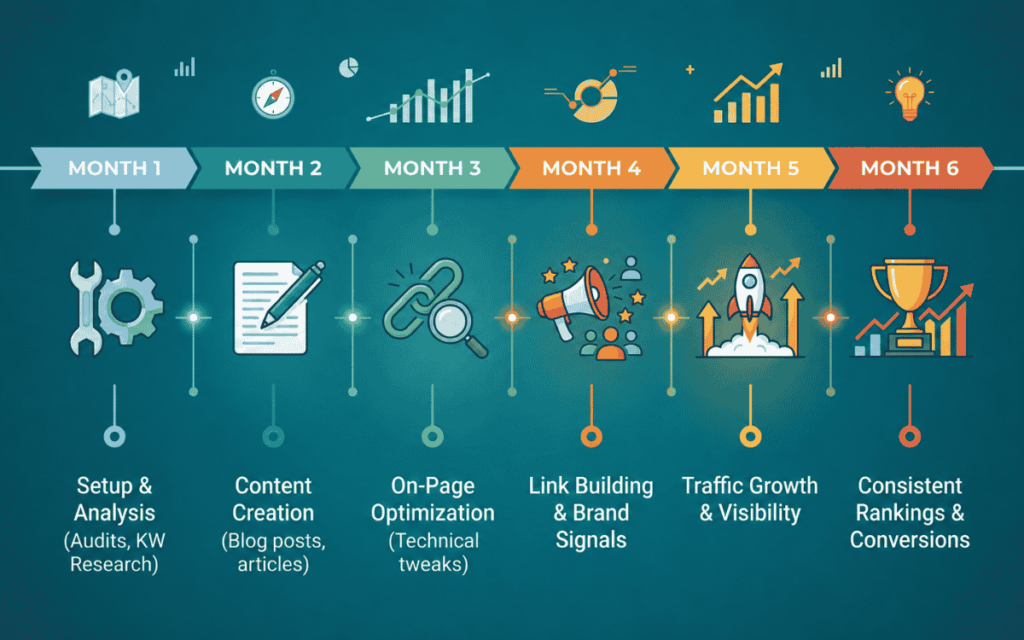
Months 0-1: Audit, Setup, and Foundation
The first month is rarely about rankings. Instead, your SEO team focuses on understanding exactly where your site stands. This phase includes:
- Technical SEO audits
- Fixing crawl errors and broken links
- Improving page speed and mobile performance
- Keyword research tied to search intent
- Competitor analysis and content gap identification
You will not see rankings move yet. However, this foundational work is critical. Without it, every other effort is built on sand.
Months 2-3: Early Signals Appear
By months two and three, implemented changes begin to take effect. Google starts re-crawling updated pages. Long-tail keyword rankings begin to appear. Impressions in Google Search Console rise before clicks do.
This is also when content performance data becomes your best friend. Rising impressions are an early positive signal – they confirm that Google is surfacing your content for more queries, even if traffic has not spiked yet.
Months 4-6: Traction Phase
This is the window where most business owners first see momentum. Organic traffic begins to increase. Some pages climb into the top 10 for lower-competition keywords. Featured snippets and local results start to strengthen.
Additionally, if you are in a local market, AI local SEO signals become visible here – especially in map packs and Google Business Profile rankings. Local businesses often see faster early wins than national brands.
Months 6-12: Authority and Momentum Build
By the six-month mark, SEO starts doing what it does best. Competitive keywords begin to move. High-quality content earns backlinks naturally. Brand mentions increase. Organic traffic compounds month over month.
At this stage, SEO transitions from an experiment into a reliable growth channel. Rankings become more predictable and consistent.
12 Months and Beyond: Compounding Returns
A year into a well-executed strategy, the compounding effect is real. Earlier content continues to gain authority. New pages rank faster because of the domain trust already built. The overall cost per organic lead decreases significantly.
In fact, research from Ahrefs found that 95% of newly published pages do not reach the top 10 within a year. However, pages from established domains with strong authority can rank new content much faster – which is exactly why building domain authority from day one matters so much.
Key Factors That Affect How Long SEO Takes
No two websites share the same starting point. Here are the most important variables that determine your specific timeline.
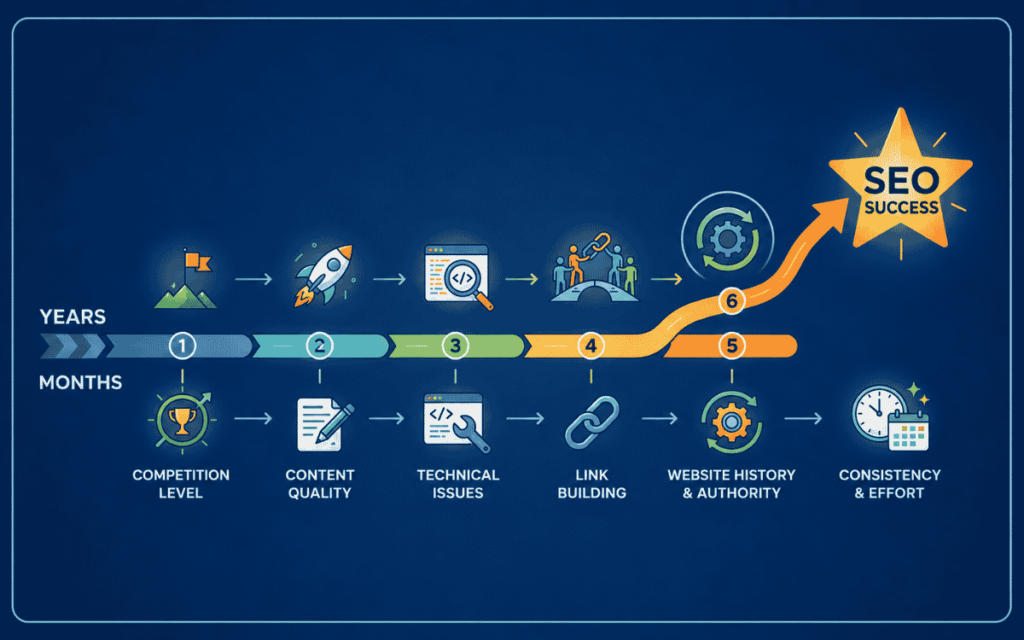
1. Website Age and Domain Authority
Brand-new domains move more slowly. Search engines have no historical data to evaluate – no backlinks, no engagement signals, no branded search demand. Established domains with existing authority can rank new content significantly faster.
2. Competition in Your Niche
Highly competitive keywords – those targeted by well-funded, authoritative websites – require more time and resources to rank for. Low-competition, long-tail keywords can show results in as little as two to three months. Understanding your competitive keyword analysis upfront helps you prioritize the fastest wins first.
3. Technical SEO Health
If Google cannot efficiently crawl and index your site, no amount of content or links will save you. Common issues that extend the SEO timeline include:
- Slow page speed
- Broken internal links
- Duplicate content
- Incorrect canonical tags
- JavaScript rendering problems
One famous case: Groupon added dynamic content to its homepage that browsers could display, but Google could not render. Once the fix was applied, their SEO-driven revenue increased by 120% in a single quarter.
Turn AI Visibility Into Real Revenue.
Automate Leads With SurgeAIO. Don’t Let AI Ignore Your Brand.
4. Content Quality and Search Intent Alignment
Churning out low-quality content for the sake of volume actively hurts your rankings. Google’s systems identify and penalize thin, unhelpful content. The “great SEO heist” case study showed a site that scaled AI-generated content rapidly, peaked briefly, then collapsed.
Quality, intent-aligned content always wins in the long run. Moreover, understanding whether your content is earned or owned media helps you build a more strategic content plan.
5. Backlink Profile
Backlinks remain one of Google’s top ranking signals. However, quality matters far more than quantity. A single link from a relevant, authoritative source outperforms hundreds of spammy links.
Building a natural, diverse backlink profile takes consistent effort over months. If you are wondering exactly how many you need, this guide on how many backlinks you need breaks it down by site type and competition level.
6. Budget and Resources
SEO timelines are directly tied to how much you invest. A team with developers, writers, designers, and data analysts moves significantly faster than a solo founder doing everything manually. More resources mean faster implementation and faster results.
How SEO Timelines Are Changing in 2026
The SEO landscape has shifted considerably. Today, results do not always appear as a traditional click in analytics. They appear as:
- Brand citations in AI-generated answers
- Zero-click featured snippets
- Map pack appearances
- Voice search responses
- AI Overview summaries
Up to 55% of Google searches now display an AI Overview. Up to 58% of searches result in zero clicks. This means your brand can influence buying decisions before a user ever visits your site.
Therefore, measuring SEO success in 2026 requires tracking AI visibility metrics alongside traditional rankings and traffic. Brands that appear in AI answers and featured snippets win far more mindshare than their click data suggests.
Understanding the future of SEO – including how AI Overviews, GEO, and AEO are reshaping search – is essential for anyone building a long-term organic strategy right now.
Common SEO Timeline Myths – Debunked
Myth: “You’ll see results in 30 days.” Rarely true, unless you operate in an extremely low-competition niche with an already-established domain. For most businesses, 30 days is barely enough to complete a proper audit.
Myth: “More content means faster results.” False. Publishing thin, low-value content at scale triggers algorithmic penalties, not rewards. Strategic, helpful content always beats volume.
Myth: “Once you rank, you stay there.” Rankings shift constantly. A Semrush study found that while 41% of domains reached the top 10 within six months, only 27% stayed there through the 13-month study period. Maintenance and continuous optimization are non-negotiable.
Myth: “SEO takes years to work.” For some highly competitive YMYL (Your Money or Your Life) industries – such as law, finance, and healthcare – yes, timelines are longer. However, a well-optimized site in a moderate niche can see meaningful results within six months.
How to Measure SEO Progress Correctly
Do not just watch for ranking jumps. Instead, track these leading indicators that signal positive momentum:
- Impressions rising in Google Search Console (before clicks)
- Crawl errors are reducing after technical fixes
- New pages are getting indexed within days of publication
- Long-tail keywords are beginning to appear in position tracking
- Organic session growth in GA4 month over month
- AI visibility signals – whether your brand appears in AI answers
Turn AI Visibility Into Real Revenue.
Automate Leads With SurgeAIO. Don’t Let AI Ignore Your Brand.
Tracking content performance data consistently allows you to identify which pages are gaining traction and double down on what is already working.
How SurgeAIO Can Help in Terms of SEO
SurgeAIO gives you a significant advantage over doing SEO blindly. The platform tracks your keyword rankings, identifies technical issues, monitors your AI visibility, and delivers clear, actionable recommendations – all in one place.
For businesses asking how long it takes to see results from SEO, SurgeAIO answers that question with real data. It shows you where you stand today, which opportunities are available right now, and how your competitors are positioned, so you know exactly where to focus first.
Moreover, SurgeAIO tracks your presence across both traditional search results and AI-powered answers like Google AI Overviews and ChatGPT. As zero-click searches grow, knowing where your brand shows up in AI results becomes just as important as tracking keyword rankings.
The platform also supports faster technical diagnostics. Instead of waiting weeks to discover a crawlability issue, SurgeAIO surfaces problems early – so you can fix them before they extend your timeline unnecessarily.
Whether you are three months into your SEO journey or just starting, SurgeAIO provides the visibility and clarity you need to make smarter decisions, move faster, and see results sooner.
Final Thoughts
The question – how long does it take to see results from SEO – does not have a single answer. It depends on your domain age, your niche, your competition, your content quality, your technical foundation, and how much you consistently invest.
However, the pattern is clear: businesses that approach SEO as a long-term compound investment win. Those who expect overnight results waste their budget and quit too soon.
Start with a solid technical audit. Build quality content aligned to search intent. Earn authoritative backlinks. Track the right metrics from day one. And use a platform like SurgeAIO to stay ahead of both algorithmic shifts and AI search changes.
The best time to start your SEO strategy was six months ago. The second-best time is today.
Frequently Asked Questions
Q: How long does it take to see results from SEO for a brand-new website?
New websites typically need 4-6 months before seeing consistent results. Search engines need time to evaluate your domain’s trustworthiness, build a backlink profile, and index your content.
Q: Can local businesses see SEO results faster?
Yes. Local SEO – especially Google Business Profile optimization – often delivers visible results within weeks, particularly in less competitive local markets. Map pack visibility can appear much sooner than national keyword rankings.
Q: Why do impressions increase before traffic does?
Search engines test content relevance before rewarding clicks. Rising impressions signal that Google is surfacing your pages for queries – it is an early positive indicator that your strategy is working.
Q: Does publishing more content speed up SEO?
Not necessarily. Consistent, high-quality content accelerates results. Low-quality content published at scale can actually slow down your SEO by diluting your site’s authority and wasting crawl budget.
Q: Is SEO still worth it with AI search changing everything?
Absolutely. AI systems surface trusted, authoritative sources. SEO is what determines whether you are one of those trusted sources. In 2026, strong SEO makes you more visible in both traditional search and AI-generated answers – not less.
Q: What is the fastest way to see early SEO wins?
Focus on long-tail, low-competition keywords, fix technical issues immediately, and optimize your Google Business Profile. These three actions consistently produce the fastest early wins.
