If you’ve spent any time researching search engine optimization, you’ve likely come across the term “white hat SEO.” But what is white hat SEO, and why does it matter so much for the long-term health of your website?
White hat SEO refers to ethical optimization techniques that follow search engine guidelines rather than exploiting loopholes for quick wins. It focuses on creating genuine value for users while playing by the rules Google and other search engines set. Unlike black hat tactics that risk penalties, white hat strategies build sustainable, long-term visibility.
In this guide, we’ll break down exactly what white hat SEO involves, why it matters, and how you can apply it to your own website.
What Is White Hat SEO?
White hat SEO is the practice of improving your website’s search rankings using methods search engines explicitly approve of. It centers on three principles: creating helpful content, earning credible backlinks, and delivering a strong user experience.
The term itself borrows from old Western films, where heroes wore white hats, and villains wore black ones. In SEO, that same distinction applies. White hat practitioners follow Google’s Search Essentials guidelines, while black hat SEOs manipulate algorithms through deceptive tricks.
Practically speaking, white hat SEO means writing content for real people first, not just for search engine crawlers. It means earning links naturally instead of buying them. And it means building a site that genuinely satisfies what users are searching for. This philosophy connects closely to understanding which keywords are important for SEO, since ethical optimization always starts with matching real search intent.
White Hat vs. Black Hat SEO: Key Differences
To fully understand white hat SEO, it helps to compare it against its opposite. Both approaches aim to improve rankings, but they take very different paths to get there.
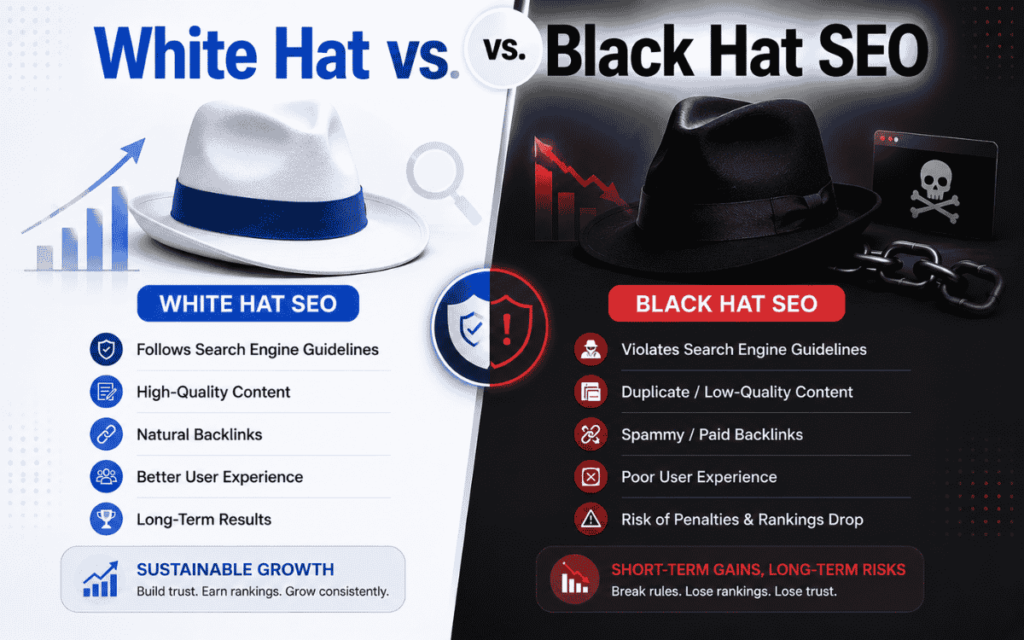
Here’s how the two compare:
- Content quality – White hat SEO produces original, valuable content matched to search intent. Black hat SEO often relies on thin, duplicated, or heavily templated pages built only to game algorithms.
- Keyword usage – White hat strategies use keywords naturally within content. Black hat tactics stuff keywords excessively into headers, meta tags, and anchor text.
- Link building – White hat SEO earns backlinks through guest posts, partnerships, and genuinely useful resources. Black hat SEO frequently buys links or uses link farms.
- Technical practices – White hat sites use proper alt text and legitimate on-page optimization. Black hat sites may use cloaking or hidden text to trick crawlers.
Importantly, black hat tactics can trigger serious consequences. Google penalties can suppress a site’s rankings or remove it from search results entirely, undoing months or years of work in a single algorithm update.
Why Does White Hat SEO Matter?
Without ethical guidelines, search results would quickly become unreliable. Search engines depend on trustworthy signals to rank content, and white hat SEO keeps that ecosystem functioning properly for everyone involved.
Consider the benefits from three perspectives:
- For search engines – Algorithms can confidently rank content that satisfies genuine search intent, which keeps users coming back to the platform.
- For website owners – You build rankings that last, rather than risking a sudden penalty that wipes out your traffic overnight.
- For users – People find accurate, relevant answers instead of sifting through manipulated or low-quality results.
This mutual benefit is exactly why white hat SEO remains the foundation of any strategy meant to generate consistent, compounding results. If you’re evaluating whether to build this expertise internally or bring in outside help, it’s worth reviewing whether you need to hire an SEO company to execute these strategies correctly.
Core White Hat SEO Techniques
Now that you understand the “why,” let’s look at the practical techniques that define white hat SEO in action.
1. Create Genuinely Valuable Content
Google’s algorithms are built to prioritize helpful, people-first content over material created purely to manipulate rankings. That means your content strategy should always start with the reader, not the algorithm.
Focus on:
- Answering the specific questions your audience is asking
- Providing original insights, data, or firsthand experience
- Structuring content clearly with headers and short paragraphs
- Keeping information accurate and up to date
Content length also plays a role here, though there’s no universal magic number. If you’re unsure how long your posts should be, this guide on how many words a blog post should be for SEO offers helpful benchmarks based on search intent.
2. Satisfy Search Intent
Search intent is the underlying goal behind a user’s query. Someone searching “best running shoes for flat feet” wants product recommendations, while someone searching “what causes flat feet” wants informational content.
White hat SEO means aligning your content with the correct intent type:
- Informational – The user wants to learn something
- Navigational – The user is looking for a specific website or page
- Commercial – The user is comparing options before buying
- Transactional – The user is ready to make a purchase
Misjudging intent is one of the most common reasons content underperforms, even when it’s well-written. Reviewing your keyword strategy regularly helps you stay aligned, and understanding how many SEO keywords per page you should realistically target prevents diluting your content’s focus.
3. Build Backlinks the Right Way
Backlinks remain one of the strongest ranking signals, but how you earn them matters enormously. White hat link building relies on genuine relationships and valuable content that other sites want to reference naturally.
Ethical link-building tactics include:
- Guest posting on relevant, reputable industry sites
- Creating original research or data that others want to cite
- Reaching out to reclaim unlinked brand mentions
- Building relationships with journalists and industry publications
Buying links or participating in link schemes violates search engine guidelines and puts your site at risk. If you’re trying to figure out a realistic target, this resource on how many backlinks you need breaks down what actually influences that number.
4. Optimize Technical SEO Properly
Technical SEO isn’t just about hitting checkboxes. It’s about making sure your site is genuinely easy for both users and search engines to navigate.
Key technical elements include:
- A clean, submitted XML sitemap
- Fast loading speeds across devices
- Mobile-friendly design and layout
- Properly implemented structured data
A well-organized sitemap plays a bigger role in white hat SEO than many site owners realize, since it directly affects how efficiently search engines crawl and index your pages. Learning how important a sitemap is for SEO can help you avoid indexing issues that quietly limit your visibility. Similarly, implementing structured data correctly, as outlined in this guide on schema markup, helps search engines understand your content more accurately.
5. Prioritize Mobile-Friendliness
Since most search traffic now comes from mobile devices, a site that doesn’t perform well on smaller screens will struggle regardless of how strong its content is. Google primarily uses mobile-first indexing, meaning the mobile version of your site is what gets evaluated first.
To stay compliant with white hat standards, make sure your site:
- Loads quickly on mobile networks
- Displays text and images without overlap or distortion
- Offers easy-to-tap navigation and buttons
- Scales properly across different screen sizes
Is Black Hat SEO Ever Worth the Risk?
Some industries operate in grey areas where aggressive tactics are common. In these cases, businesses sometimes blend white hat and black hat approaches, often referred to as “grey hat” SEO.

However, for most legitimate businesses, the risks far outweigh any short-term gains. Google’s algorithm updates continue to get better at detecting manipulation, and the penalties can be severe:
- Significant ranking drops across your entire site
- Manual actions that require lengthy reconsideration processes
- Complete removal from search results in extreme cases
- Lasting damage to brand trust and credibility
Building sustainable, white hat strategies takes longer to show results, but it protects your investment. It’s also worth remembering that SEO doesn’t work overnight regardless of which approach you take, so there’s little practical advantage to cutting corners.
How White Hat SEO Supports Long-Term Growth
Businesses that commit to white hat SEO consistently see more stable, compounding results over time. Instead of chasing short-lived spikes, they build authority that search engines trust more with each passing month.
This approach becomes especially important for businesses relying on organic traffic as a primary growth channel. Whether you’re running a SaaS company or a local service business, sustainable strategies protect your visibility from sudden algorithm shifts. For SaaS companies specifically, pairing white hat fundamentals with organic traffic strategies creates a much more resilient growth engine than relying on paid channels alone.
How SurgeAIO can help in terms of SEO
Implementing white hat SEO correctly requires more than good intentions – it demands consistent execution across content, technical optimization, and link building, all while staying compliant with ever-changing search engine guidelines. That’s a lot to manage alongside running a business.
SurgeAIO helps you build a sustainable SEO strategy grounded entirely in ethical, guideline-compliant practices. From content that genuinely satisfies search intent to technical audits that catch issues before they become penalties, SurgeAIO focuses on long-term visibility rather than risky shortcuts. If you want rankings that hold up over time instead of disappearing after the next algorithm update, SurgeAIO builds the foundation to make that happen.
Final Thoughts
White hat SEO isn’t the fastest path to ranking, but it’s the most reliable one. By focusing on genuine content quality, ethical link building, and solid technical foundations, you protect your website from penalties while building authority that compounds over time.
In an environment where search algorithms constantly evolve, playing by the rules isn’t just safer – it’s smarter business. Sustainable growth always outlasts shortcuts.
FAQ
What is white hat SEO in simple terms?
It’s the practice of improving search rankings using ethical methods approved by search engines, like quality content and genuine backlinks.
What’s the difference between white hat and black hat SEO?
White hat SEO follows search engine guidelines and focuses on long-term value. Black hat SEO exploits algorithm loopholes and risks penalties.
Is white hat SEO slower than black hat SEO?
Generally, yes. White hat strategies take longer to show results, but they produce more stable, lasting rankings.
Can black hat SEO get my website penalized?
Yes. Google actively detects manipulative tactics and can suppress or remove penalized sites from search results entirely.
What is grey hat SEO?
Grey hat SEO blends white hat and black hat tactics. It carries more risk than pure white hat strategies but isn’t as aggressive as black hat SEO.
Do I need backlinks for white hat SEO to work?
Yes, but they must be earned naturally through guest posts, partnerships, and valuable content rather than purchased or manipulated.
